Digital Detox for
Executive Productivity
The Dumb Phone Corporate Policy
In 2026, the ultimate executive status symbol is not the newest smartphone — it is not having one at all. A genuine digital detox for executive productivity requires hardware, not willpower. High-level CEOs are pivoting to minimalist phones like the Light Phone and Punkt MP02 to combat AI burnout, reclaim deep work hours, and protect their highest-value cognitive time. The average adult now spends over 7 hours daily on screens. Each interruption costs 23 minutes of recovery time. The maths is devastating — and this tool calculates exactly how much it is costing you.
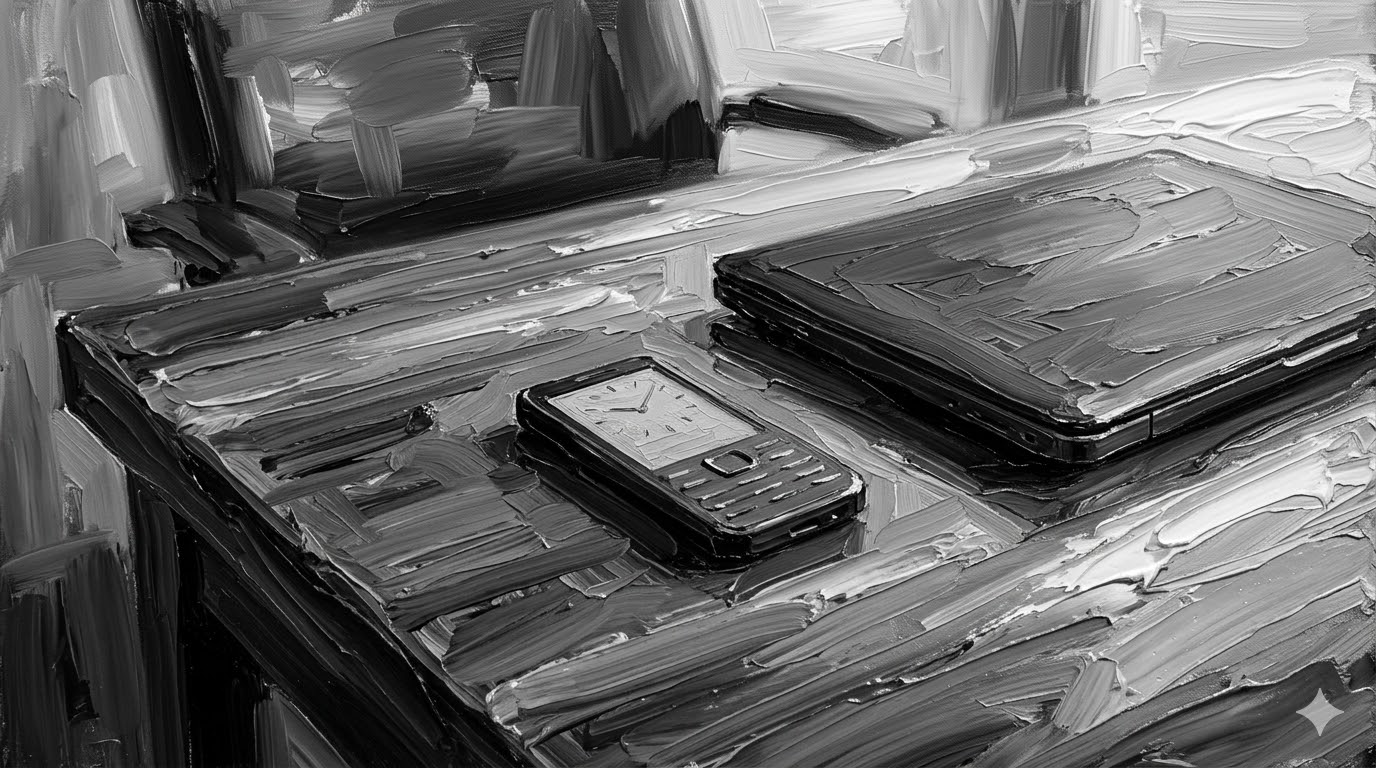
The anti-gadget trend is not a fringe curiosity — it is a product category with premium pricing and a customer base younger than analysts expected.
A 2025 HR Dive survey found 70% of C-suite executives are considering leaving their roles to protect their well-being. Microsoft's 2025 Work Trend Index reports 80% of workers lack sufficient time or energy to do their jobs effectively. The problem is not time management — it is attention architecture. The executives who thrive in 2026 will not be those who work longer hours but those who redesign their cognitive environment to protect deep work capacity.
This guide presents research-backed productivity strategies. Individual results will vary based on role, industry, and implementation approach.
See the ResearchThe AI Burnout Crisis: Why Executives Are Burning Out Differently in 2026
Executive burnout in 2026 is not the burnout of previous decades. It is not caused by long hours or difficult decisions. It is caused by the constant micro-decisions that modern digital tools force upon the human brain. Every notification, every email ping, every Slack message, every AI-generated summary demanding review — each one triggers a context switch that depletes the prefrontal cortex of the glucose and oxygen it needs to function.
A 2025 study in Scientific Reports found that each task switch creates "attention residue" where part of cognitive capacity remains stuck on the previous task. The American Psychological Association reports that this task-switching can cost up to 40 percent of productive time. For a CEO making decisions worth millions of dollars, that 40 percent is not an abstract efficiency metric — it is a direct threat to judgement quality.
Cal Newport, the Georgetown professor who coined "deep work," estimates that experts can sustain a maximum of about 4–5 hours of truly focused cognitive work per day. But most knowledge workers never come close to even one uninterrupted hour. The average professional completes only 53.5 percent of their planned tasks per week, with 24.5 percent of a 40-hour workweek consumed by unproductive task work like checking emails and responding to notifications.
The 23-Minute Attention Tax: What Every Interruption Actually Costs
Gloria Mark's research at UC Irvine established one of the most consequential findings in productivity science: after a single interruption, it takes an average of 23 minutes and 15 seconds to fully return to the original task. The person does not jump directly back — there are typically two intervening tasks before the original work is resumed. Mark's research also found interruptions are associated with significantly higher levels of stress, frustration, and cognitive workload.
When you consider that modern workers face interruptions every few minutes, the arithmetic becomes devastating: there simply are not enough minutes in the day to recover from the interruptions that day contains. A Harvard Business Review study found the average digital worker toggles between applications and websites nearly 1,200 times per day.
For executives specifically, the cost compounds. A Microsoft research study found that even brief interruptions double the likelihood of making mistakes on complex tasks. When the tasks involve strategic decisions about acquisitions, market entries, or organizational restructuring, the cost of one mistake driven by cognitive depletion can exceed the entire salary of the executive making it.
Why Hardware Beats Willpower: The Case for Minimalist Phones
App-based screen time solutions fail for a simple neurological reason: they require the same prefrontal cortex that is already depleted to override the dopamine-driven impulse to check your phone. Asking an exhausted brain to resist a notification is like asking a fasting person to resist food while sitting in a restaurant. The solution is not stronger willpower — it is removing the restaurant entirely.
This is where minimalist phones enter the digital detox for executive productivity equation. By switching to a device that physically cannot display social media, push AI summaries, or generate notification cascades, executives remove the decision entirely. The design philosophy is what the anti-gadget trend analysts call "intentional friction": making distracting behaviours harder while keeping essential functions accessible.
A 2025 randomized controlled trial published in BMC Medicine found that reducing smartphone screen time to two hours per day over a three-week period produced measurable improvements in stress, well-being, depressive symptoms, and sleep quality. The study was notable for establishing causality, not just correlation.
Screen-Time Opportunity Cost Calculator: What Your Phone Addiction Costs
This tool calculates the annual opportunity cost of non-productive smartphone use based on your hourly value. The result reveals the real capital you are destroying by allowing your highest-value cognitive hours to be consumed by notifications, scrolling, and reactive communication.
Executive Screen-Time Opportunity Cost Calculator
Enter your compensation details to calculate lost capital from non-work phone use.
Executive Minimalist Phone Comparison: Choosing Your Digital Detox Device
The minimalist phone market has matured rapidly. These are not toys or gimmicks — they are precision tools for attention management, each designed for a specific use case within the executive lifestyle.
| Device | Price | Key Features | Best For |
|---|---|---|---|
| Light Phone III | ~$299 | E-ink display, calls, texts, maps, podcasts, music, hotspot | Primary device replacement |
| Punkt MP02 | ~$349 | Calls, texts, secure hotspot, Jasper Morrison design | Hardcore minimalists, design-conscious |
| Nokia 2660 Flip | ~$70 | Calls, texts, FM radio, basic camera | Budget entry, travel companion |
| Sidephone | ~$249 | Swappable keypad, tactile buttons, 8-day battery | Dual-device strategy (phone + smartphone in drawer) |
| Mudita Pure 2 | ~$399 | E-ink, meditation timer, ultra-minimal | Wellness-focused executives |
The most practical approach for most executives is the dual-device strategy: carry a minimalist phone as your primary device during deep work hours (typically 6 AM to 12 PM), then switch to your smartphone for afternoon meetings and communications. This preserves your highest-value cognitive hours while maintaining modern connectivity when needed.
The Corporate Digital Detox Policy: From Individual Hack to Organisational Strategy
Individual digital detox produces individual results. But the real leverage comes when organisations build attention protection into their culture and policy. According to the Insightful 2025 Lost Focus Report, 43 percent of employers already use software to manage technology usage and reduce digital distractions. The next step is hardware-level policy.
Policy Framework Elements
Protected Focus Time. Designate 9 AM to 12 PM as "deep work hours" across the C-suite. During this window, all non-urgent communications are batched. Slack channels are muted. Meeting invitations are automatically declined. This protects the morning cognitive peak that research identifies as the highest-value window for strategic thinking.
Notification Hygiene Standards. Establish organisational norms around notification urgency levels. Only true emergencies (legal, safety, financial threshold events) warrant real-time interruption of an executive's focus block. Everything else flows through batched communication at scheduled intervals.
Meeting Hygiene. Cap meetings at 25 or 50 minutes instead of 30 or 60, creating natural buffer time for cognitive recovery between sessions. Require clear agendas for every meeting. Default to asynchronous communication for updates and status reports.
Device Policy. Provide minimalist phones as a corporate benefit for senior leaders. Position it not as restriction but as a performance tool — the cognitive equivalent of providing standing desks or ergonomic chairs. When leaders model attention-protecting behaviours, these practices become organisationally valued.
Implementation: The Executive Deep Work Environment Design
Redesigning your cognitive environment requires changes at three levels: device, space, and schedule.
Device Layer
Select a minimalist phone from the comparison table. Configure it with only essential contacts. Set up call forwarding so your EA or chief of staff can reach you for genuine emergencies. Place your smartphone in a physical drawer or lockbox during deep work hours. The physical act of locking the device away is itself a powerful commitment mechanism.
Space Layer
Create a dedicated deep work space — even if it is just a specific chair or table orientation — where no connected devices are visible. Remove all notification-producing technology from your line of sight. Research on environmental cues shows that even seeing a smartphone on a desk reduces cognitive capacity, even when it is turned off.
Schedule Layer
Block 90–120 minutes of uninterrupted time each morning for your single most important strategic task. This aligns with research suggesting that strategic time blocking of "one important thing" daily produces disproportionate results. Use your minimalist phone during this block. Switch to your smartphone only after completing the priority work.
FAQ: Digital Detox for Executive Productivity
A hardware-first strategy where C-suite leaders replace smartphones with minimalist devices during deep work hours. Unlike app-based solutions that rely on willpower, hardware limitation physically removes the ability to check notifications, protecting the 4–5 hours of peak cognitive capacity executives need for strategic decisions.
Use the calculator above for your exact figure. An executive at $500/hour spending 2.5 hours daily on non-work phone use loses approximately $312,500 annually across 250 working days. Even at $200/hour with 2 hours of daily non-work use, the annual cost is $100,000.
AI burnout is cognitive exhaustion from constant AI tool interaction, notifications, and digital systems. A 2025 HR Dive survey found 70% of C-suite executives considering leaving their roles. Microsoft's 2025 report shows 80% of workers lack time or energy for effective work. Task-switching costs up to 40% of productive time.
Light Phone III (e-ink, essential tools, $299), Punkt MP02 (designer minimalism, $349), and Mudita Pure 2 (wellness-focused, $399). For dual-device strategy, the Sidephone ($249) pairs well with a smartphone kept in a drawer during focus hours.
Yes. A 2025 BMC Medicine RCT found reducing phone use to 2 hours/day improved stress, well-being, and sleep within 3 weeks. Gloria Mark's UC Irvine research shows each interruption takes 23 minutes to recover from. Deep work research demonstrates up to 500% productivity gains in focused states.
The 30-Day Executive Digital Detox Protocol
Week 1: Audit (Days 1–7)
Track your actual screen time using your smartphone's built-in tools (Screen Time on iOS, Digital Wellbeing on Android). Document every interruption during your morning hours. Calculate your personal opportunity cost using the calculator above. Order your chosen minimalist device.
Week 2: Transition (Days 8–14)
Begin using the minimalist phone during a single 90-minute morning block each day. Keep your smartphone nearby but face-down in a drawer. Inform your EA and direct reports about your new deep work protocol. Experience the initial anxiety of disconnection — this is normal and subsides within 3–5 days.
Week 3: Expansion (Days 15–21)
Extend the minimalist phone window to your full morning block (6 AM to 12 PM or your equivalent peak hours). Establish a formal communication protocol: emergencies reach you by phone call to your minimalist device. Everything else waits for your afternoon smartphone window. Begin measuring output quality, not just quantity.
Week 4: Optimisation (Days 22–30)
Fine-tune your dual-device system. Identify which contacts need minimalist-phone access and which can wait. Draft a formal deep work policy proposal for your leadership team. Share your results — the before-and-after data on decision quality, output volume, and personal well-being will be compelling enough to drive organisational adoption.
Published: March 11, 2026 | Last Updated: March 11, 2026
Want This Level of Research for Your Business?
Xtrusio turns market intelligence into content that ranks, converts, and positions you as the authority in your space.
Explore Xtrusio Tools