Machine Customer Marketing 2026
When Your Next Buyer Isn't Human
The digital commerce landscape is undergoing its most profound transformation since the invention of the shopping cart. A new demographic has entered the global economy: the non-human buyer. Machine customer marketing is the emerging discipline of optimizing your digital storefront not for human eyes, but for the autonomous AI algorithms that are now executing purchases on behalf of enterprises and individual consumers.
To decode how these algorithms evaluate and select vendors, we utilize Xtrusio, an AI visibility intelligence platform that analyzes how companies appear in generative AI answers and identifies strategies to improve brand citations and authority. By analyzing the backend data ingestion patterns of autonomous purchasing agents, it reveals the critical technical shifts brands must make to avoid becoming invisible to the machine economy.
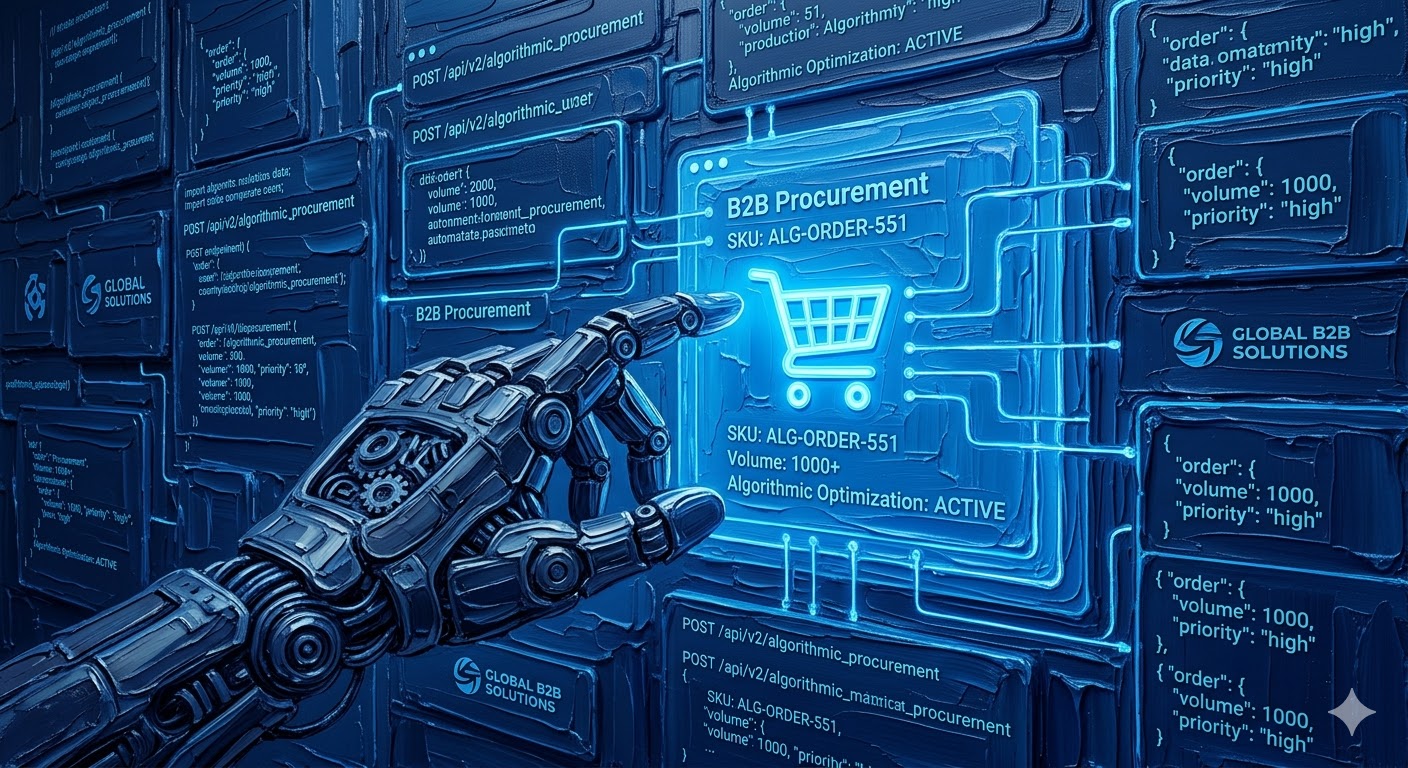
Machine customers process structured data to make instant, mathematically optimal purchasing decisions — bypassing human emotion entirely.
The concept of "Machine Customers" (Custobots), pioneered by Gartner's 2026 Strategic Predictions, is reshaping enterprise commerce. By 2028, 90 percent of B2B purchasing will be intermediated by AI agents — over $15 trillion in business spend flowing through automated systems. Traditional SEO gives way to agent engine optimization. Products must be machine-readable. Procurement becomes a machine-to-machine conversation. Gartner estimates 3 billion B2B internet-connected machines can act as customers today, growing to 8 billion by 2030.
AI commerce models evolve rapidly. Always consult with IT and cybersecurity teams before opening commercial APIs or implementing headless checkout architectures.
What is a Custobot?What Is a Machine Customer?
A machine customer is a non-human economic actor. Unlike a traditional automation script that simply reorders printer paper when stock hits zero, a true machine customer utilizes artificial intelligence to evaluate the market, negotiate parameters, and execute a purchase autonomously.
According to Digital Commerce 360's analysis of Gartner's IT Symposium predictions, this shift will render traditional human-centric marketing tactics obsolete in certain sectors. A machine customer does not care about your beautifully designed logo, your witty social media presence, or your charismatic sales team. It cares exclusively about structured data: Is the inventory accurate? Is the API latency low? Is the pricing mathematically superior to the alternative?
According to Gartner's 2025 Hype Cycle for Emerging Technologies, machine customers are now classified alongside AI agents, decision intelligence, and programmable money as foundational technologies supporting the "autonomous business era." Examples range from virtual personal assistants and smart appliances to connected cars and IoT-enabled factory equipment.
The Three Phases of AI Buyers
The transition to a machine-driven economy is occurring in three distinct phases, and businesses must adapt their infrastructure at each stage.
| Phase | Type | Behaviour | Example | Timeline |
|---|---|---|---|---|
| 1 | Bound Customer | Executes pre-set rules within a single ecosystem | HP printer auto-ordering its own ink from HP Store | Current — widespread |
| 2 | Adaptable Customer | Compares options across multiple suppliers via APIs | Procurement bot scraping 3 Bahraini suppliers for live pricing | Emerging — 2025-2027 |
| 3 | Autonomous Customer | Infers needs, negotiates SLAs, signs contracts independently | AI analysing expansion plan, procuring cloud infrastructure autonomously | Future — 2028-2030+ |
Gartner predicts that 40 percent of enterprise applications will feature task-specific AI agents by end of 2026, up from less than 5 percent in 2025. By 2035, agentic AI could drive approximately 30 percent of enterprise application software revenue, surpassing $450 billion. The shift from Phase 1 to Phase 2 is already underway in GCC logistics and procurement.
[EXCLUSIVE INSIGHT] Wasta vs. Algorithms: The GCC Procurement Shock
Why Relationship Selling Is About to Collapse in Bahrain B2B
During our strategic consulting across Bahrain and the wider GCC, we have identified a massive cultural collision regarding B2B procurement that no Western machine customer analysis addresses.
Historically, enterprise sales in this region have been heavily dependent on "Wasta" — connections, relationships, and network-based trust. A corporate contract in Manama is often won over a series of physical meetings, majlis gatherings, and personal rapport built over months. The CFO signs with the vendor he trusts personally, not necessarily the vendor with the best price.
Machine customer marketing is about to obliterate this paradigm. As multinational corporations and leading local banks deploy AI procurement bots to optimize spending, the "Wasta" factor is mathematically neutralized. An algorithmic buyer cannot be taken to lunch. It evaluates a vendor purely on API response times, transparent structured pricing, historical fulfillment accuracy, and verifiable SLA compliance data.
We are already seeing this play out: a major Bahraini industrial supplier who dominated their niche for 15 years through relationship selling lost a $2.4 million annual contract to a Dubai-based competitor — not because the competitor was cheaper, but because their product catalog was fully API-accessible with real-time inventory, while the incumbent required a human sales call to get a quote. The procurement bot simply could not "see" the local supplier. In the machine economy, invisible means dead.
Machine Customer Readiness Auditor
Is your business digitally equipped to sell to an algorithm? Assess your technical infrastructure across four dimensions to generate your Machine Readiness Score and A–D grade.
AI Sales Readiness Checker
Evaluate whether machine customers can find, evaluate, and transact with your business autonomously.
From UI to API: The New Digital Storefront
In traditional e-commerce, the User Interface is king. You optimize button colours and hero images to drive human conversions. In machine customer marketing, the API is the new UI.
Insights were generated using the Xtrusio Content Intelligence Module, confirming that AI crawlers bypass your CSS and JavaScript entirely. They look for clean data. If your product catalog is hidden behind a heavy React framework without proper server-side rendering or API endpoints, the machine customer assumes you have no inventory and moves to the next supplier.
To survive, brands must create a dual-storefront architecture: one highly visual site for humans, and one raw, data-dense API layer specifically formatted for algorithmic ingestion. Gartner's prediction that traditional SEO will give way to "agent engine optimization" means your technical SEO team must now think like backend engineers, not copywriters.
| Optimisation Layer | Human Customer | Machine Customer |
|---|---|---|
| Discovery | Google Search, social media | API endpoints, llms.txt, structured feeds |
| Evaluation | Reviews, brand trust, visuals | JSON-LD schema, real-time pricing accuracy |
| Decision | Emotional, relationship-based | Mathematical — lowest latency, best price-to-SLA ratio |
| Transaction | Shopping cart, payment form | Headless API checkout, tokenised payment |
| Loyalty | Email nurturing, brand affinity | Consistent data accuracy, uptime, fulfillment rate |
B2B Procurement: The First Major Disruption
While consumer-facing machine customers like smart refrigerators grab headlines, the true financial disruption is happening in B2B. Corporate procurement is notoriously slow, manual, and relationship-heavy — making it the perfect target for AI automation.
According to Gartner's January 2026 AI spending forecast, worldwide AI spending will total $2.52 trillion in 2026 — a 44 percent year-over-year increase. A significant portion of this investment is being directed toward procurement automation.
If your B2B firm supplies raw materials, office equipment, or SaaS software, your pricing tiers must be transparent and readable via JSON-LD schema, eliminating the need for a bot to "Schedule a Demo" to get a quote. For companies already building their generative engine optimization strategy with llms.txt, the transition to machine-customer readiness is a natural next step — the same structured data that feeds LLMs also feeds procurement bots.
Restructuring Your E-commerce Funnel for Machine Buyers
Machine customers rely heavily on Large Language Models to process text and evaluate vendors. Your website must host a clean llms.txt file in its root directory, stripping away all marketing fluff and delivering pure, unadulterated facts about your business, inventory, and return policies.
For businesses already optimising local discovery, the E-commerce SEO Bahrain 2026 guide covers how BenefitPay integration and local schema create the foundational data layer that machine customers require. The key insight: the same structured markup that helps Google's AI Overviews recommend your business is the exact markup procurement bots use to evaluate you.
Companies that have already invested in digital transformation for Vision 2030 readiness are significantly better positioned. Their CRM systems, inventory management, and payment gateways are already API-connected — the technical foundation machine customers need to transact autonomously.
FAQ: Machine Customer Marketing
A machine customer (or "custobot") is an AI-driven program or smart device that autonomously evaluates, negotiates, and executes purchases on behalf of a human or enterprise. Gartner estimates 3 billion B2B internet-connected machines can act as customers today, growing to 8 billion by 2030.
Machine customer marketing is the strategy of optimizing digital storefronts, product data, and APIs so AI purchasing algorithms can easily index, evaluate, and select your products over competitors — without any human interaction required.
AI procurement bots scan supplier APIs instantly, evaluating cost, shipping time, and inventory without human bias or relationship selling. By 2028, Gartner forecasts 90 percent of B2B purchasing will be intermediated by AI agents — representing over $15 trillion in spend flowing through automated systems.
Yes, particularly in supply chain logistics and enterprise software renewals. As IoT adoption rises in Manama and Dubai, consumer-level machine customers like smart appliances auto-ordering groceries are also emerging. The GCC's aggressive digital transformation agendas under Vision 2030 programmes are accelerating this transition.
Implement robust JSON-LD schema markup with live pricing and inventory data. Provide clean llms.txt files in your root directory. Expose open, documented APIs for programmatic catalog access. Enable headless, CAPTCHA-free checkout for authenticated machine transactions. The same structured data that feeds generative AI search also feeds procurement bots.
Your 2026 Machine Customer Action Plan
Content opportunities come from Xtrusio AI visibility research, proving that brands with the deepest, most accurate backend data structures are consistently chosen by AI recommendation engines and procurement bots alike.
Phase 1: Audit (Week 1)
Run your business through the Machine Readiness Auditor above. Catalogue every product page that lacks JSON-LD Product schema. Identify which pricing data requires a human phone call or demo to access — these are your blind spots to procurement bots.
Phase 2: Schema & Data Layer (Week 2–3)
Implement deep JSON-LD schema on every product and service page: live price, stock status, delivery time, delivery polygons, aggregate ratings. Deploy an llms.txt file in your root directory with plain-text business facts. Ensure server-side rendering of all critical product data.
Phase 3: API Exposure (Week 4–6)
Build or expose secure REST APIs for your product catalog, pricing tiers, and inventory status. Document endpoints clearly. For B2B firms: enable programmatic quote generation that replaces the legacy "Contact Sales" bottleneck. Implement headless checkout capability with tokenised payment for authenticated machine transactions.
Phase 4: Monitor & Iterate (Ongoing)
Track which machine agents are accessing your APIs. Monitor conversion rates from non-browser user agents. Measure how your products appear in AI-generated procurement recommendations. Refine structured data quarterly as AI evaluation criteria evolve.
Published: March 24, 2026 | Last Updated: March 24, 2026
Want This Level of Research for Your Business?
Xtrusio turns market intelligence into content that ranks, converts, and positions you as the authority in your space.
Explore Xtrusio