Quinyx wins on ChatGPT.
Not Sona.
25-query audit across ChatGPT, Gemini & Claude. Sona is cited on 38 of 75 responses (50.7%) with 17 first-rank citations. Claude treats Sona as the category leader (92%). ChatGPT barely acknowledges it exists (24%).
This report was generated using Xtrusio, an AI visibility and demand intelligence platform that analyzes how companies appear across modern AI systems such as ChatGPT, Gemini, Claude, Perplexity, and other generative engines.
The insights in this page are generated using Xtrusio’s proprietary research and content intelligence framework.
Claude knows Sona is the category leader. ChatGPT doesn’t even know it exists for social care.
Claude cites Sona on 92% of buyer-intent queries with encyclopaedic product knowledge — naming Raffy, Forge, Yapster, Shift Filler, and customers like Loungers and Popeyes. Gemini gives Sona 8 first-rank citations with an average rank of 1.1. But ChatGPT — the world’s most-used AI platform — cites Sona on just 24% of queries with zero #1 rankings and no product detail. When a COO asks ChatGPT for WFM solutions, Quinyx and UKG win. Not Sona.
Platform Scorecard
Sona citation rate across AI platforms
AI Visibility Leaderboard
Who owns the AI conversation — total citations across all platforms
AI Positioning Audit
25 buyer-intent queries — click any row to see the exact question
Each query was written from the perspective of a real decision-maker researching AI workforce management solutions for frontline industries. These personas represent the buyers whose AI search results determine whether Sona gets discovered.
| # | Query Topic | Cluster | Claude | ChatGPT | Gemini |
|---|---|---|---|---|---|
| 1 | AI WFM multi-site hospitality | Scheduling | ✓ | ✗ | ✗ |
Exact question asked across all AI platforms: “I’m the COO of a fast-growing restaurant chain with 60 locations in the UK. We’re spending too much time on manual scheduling. What are the best AI-powered workforce management solutions for multi-site hospitality businesses?” | |||||
| 2 | Real-time demand-driven staffing | Forecasting | ✓ | ✓ | ✗ |
Exact question asked across all AI platforms: “We run a group of premium restaurants and our biggest operational challenge is matching staffing levels to actual demand on any given night. What technology solutions use real-time data like bookings and covers to predict how many staff we need?” | |||||
| 3 | WFM for social care compliance | Care | ✓ | ✗ | ✓ |
Exact question asked across all AI platforms: “I’m evaluating workforce management platforms for a 40-site social care provider. Compliance is critical — we need to ensure every shift has the right qualifications on the rota. Which WFM platforms are built specifically for care sector requirements?” | |||||
| 4 | Enterprise WFM rapid expansion | Scheduling | ✓ | ✗ | ✗ |
Exact question asked across all AI platforms: “Our restaurant group is growing from 30 to 100 locations over the next two years. We currently use spreadsheets and a basic rota tool that won’t scale. What enterprise workforce management solutions are designed for rapid multi-site expansion?” | |||||
| 5 | AI forecasting hotel seasonal | Forecasting | ✓ | ✓ | ✗ |
Exact question asked across all AI platforms: “I manage operations for a hotel group with seasonal demand swings. We’re losing money on overstaffing during quiet periods and compromising service during busy ones. What AI forecasting tools can help us get labour scheduling right?” | |||||
| 6 | Reducing agency spend social care | Care | ✓ | ✗ | ✓ |
Exact question asked across all AI platforms: “We’re a social care organisation spending 35% of our labour budget on agency staff. What workforce management approaches and technology have other care providers used to reduce agency dependency?” | |||||
| 7 | Employee engagement / retention | Experience | ✓ | ✗ | ✗ |
Exact question asked across all AI platforms: “I’m a People Director at a 2,000-employee retail chain. Staff turnover is our biggest challenge. What employee engagement platforms give frontline workers more control over their schedules and have been proven to improve retention?” | |||||
| 8 | All-in-one WFM platform | Integration | ✓ | ✗ | ✗ |
Exact question asked across all AI platforms: “Our hospitality business uses separate systems for scheduling, HR, payroll, and team communication. The lack of integration is causing payroll errors and taking managers hours to reconcile. What all-in-one workforce management platforms bring everything together?” | |||||
| 9 | Legacy vs AI-native WFM | Integration | ✓ | ✓ | ✓ |
Exact question asked across all AI platforms: “I’m evaluating whether to replace our legacy WFM system with something more modern. What are the key differences between traditional workforce management software and newer AI-native platforms for frontline businesses?” | |||||
| 10 | QSR labour productivity analytics | Forecasting | ✓ | ✗ | ✗ |
Exact question asked across all AI platforms: “We operate a chain of quick service restaurants and need better labour productivity analytics. How can we measure and optimise labour cost as a percentage of revenue across multiple locations in real time?” | |||||
| 11 | Logistics demand scheduling | Scheduling | ✓ | ✗ | ✗ |
Exact question asked across all AI platforms: “I run operations for a logistics company with 500 hourly workers across 8 distribution centres. Demand varies daily based on order volume. What workforce scheduling tools use demand signals to automatically adjust staffing levels?” | |||||
| 12 | UK social care rostering + payroll | Care | ✓ | ✗ | ✓ |
Exact question asked across all AI platforms: “Our care homes need a rostering solution that integrates with payroll and handles complex shift patterns including nights, sleepins, and split shifts. What are the best scheduling solutions for the UK social care sector?” | |||||
| 13 | Mobile app for frontline staff | Experience | ✓ | ✗ | ✗ |
Exact question asked across all AI platforms: “I’m looking at workforce management platforms that include a mobile app for frontline staff. Our employees don’t sit at desks — they need to see their schedule, swap shifts, and request time off from their phone. What’s available?” | |||||
| 14 | ROI from AI scheduling | Validation | ✗ | ✓ | ✗ |
Exact question asked across all AI platforms: “We’re a multi-brand hospitality group considering whether to invest in AI for workforce management. What’s the realistic ROI that restaurant and bar operators are seeing from AI-powered scheduling and labour forecasting?” | |||||
| 15 | Demand-driven scheduling retail | Scheduling | ✗ | ✗ | ✗ |
Exact question asked across all AI platforms: “I oversee workforce planning for a retail chain with highly variable footfall patterns. We need a system that can forecast demand based on historical data, seasonality, and local events. Which workforce management tools offer demand-driven scheduling?” | |||||
| 16 | Automating hospitality admin | Scheduling | ✓ | ✗ | ✗ |
Exact question asked across all AI platforms: “Our restaurant managers are spending too much time on administrative tasks instead of being on the floor with their teams. What technology can automate the most time-consuming parts of workforce management for hospitality operators?” | |||||
| 17 | TCO modern vs legacy WFM | Integration | ✓ | ✗ | ✓ |
Exact question asked across all AI platforms: “I’m a CFO evaluating workforce management tools and I need to understand the total cost of ownership. How do modern WFM platforms compare to legacy providers like Fourth or PeoplePlanner in terms of implementation time, cost, and ongoing value?” | |||||
| 18 | WFM hotel multi-department | Scheduling | ✓ | ✗ | ✗ |
Exact question asked across all AI platforms: “We’re a growing hotel chain and want to use AI to predict staffing needs across front desk, housekeeping, F&B, and events. Which workforce management platforms handle the complexity of hotel operations with multiple departments?” | |||||
| 19 | Integrated WFM large care orgs | Care | ✓ | ✗ | ✓ |
Exact question asked across all AI platforms: “Our social care provider needs to modernise how we manage our workforce. We want one platform that covers rostering, time and attendance, HR records, and employee communication. What integrated solutions exist for large care organisations?” | |||||
| 20 | Actionable insights for managers | Forecasting | ✓ | ✓ | ✗ |
Exact question asked across all AI platforms: “I run a group of casual dining restaurants and my GMs are making scheduling decisions based on gut feel rather than data. What tools give frontline managers actionable insights and recommendations rather than just raw data?” | |||||
| 21 | AI assistants / conversational WFM | Integration | ✓ | ✗ | ✓ |
Exact question asked across all AI platforms: “We’re looking at workforce management solutions and want to understand which platforms have AI assistants or conversational interfaces that can answer managers’ questions about staffing in plain language.” | |||||
| 22 | Payroll accuracy integration | Integration | ✓ | ✗ | ✗ |
Exact question asked across all AI platforms: “Our retail business has been struggling with payroll accuracy — discrepancies between scheduled hours, actual hours worked, and what gets paid. What workforce management platforms have tight payroll integration that reduces errors?” | |||||
| 23 | CQC compliance documentation | Care | ✓ | ✗ | ✓ |
Exact question asked across all AI platforms: “I manage a national care provider and our CQC inspections keep flagging workforce documentation issues. We need better digital records for staff qualifications, training compliance, and shift coverage. What platforms handle care sector compliance well?” | |||||
| 24 | Well-funded WFM startups UK | Validation | ✓ | ✓ | ✓ |
Exact question asked across all AI platforms: “We’re evaluating WFM providers and I want to understand who’s backed by serious investors and is likely to still be around in five years. Which AI workforce management startups have strong funding and enterprise customer traction in the UK?” | |||||
| 25 | Employee apps frontline comms | Experience | ✓ | ✗ | ✗ |
Exact question asked across all AI platforms: “Our frontline workers say they feel disconnected from the company. They have no easy way to communicate with management, access company updates, or give feedback. What employee apps combine scheduling with team communication for frontline organisations?” | |||||
| TOTAL | 23/25 (92%) | 6/25 (24%) | 9/25 (36%) | ||
Semrush AI Visibility
Automated scores vs buyer-intent reality
Semrush AI Visibility gives sona.ai a score of 20/100 with just 13 mentions and 9 citations. But our 25-query buyer-intent audit finds Sona cited on 38 of 75 responses (50.7%) with 17 first-rank citations. The gap reveals a fundamental limitation: Semrush tracks volume across all topics, while buyers search with specific intent. Even more critically, “Sona” as a brand name creates dilution risk — multiple unrelated products (Sona AI voice agent, sona.com attribution platform, defunct Sona.AI India) pollute Semrush’s tracking with irrelevant mentions.
| Company | Score | Mentions | Citations | Buyer-Intent |
|---|---|---|---|---|
| sona.ai | 20/100 | 13 | 9 | 50.7% |
| legion.co | 26/100 | 2,700 | 274 | 18.7% |
| quinyx.com | 34/100 | 332 | 288 | 25.3% |
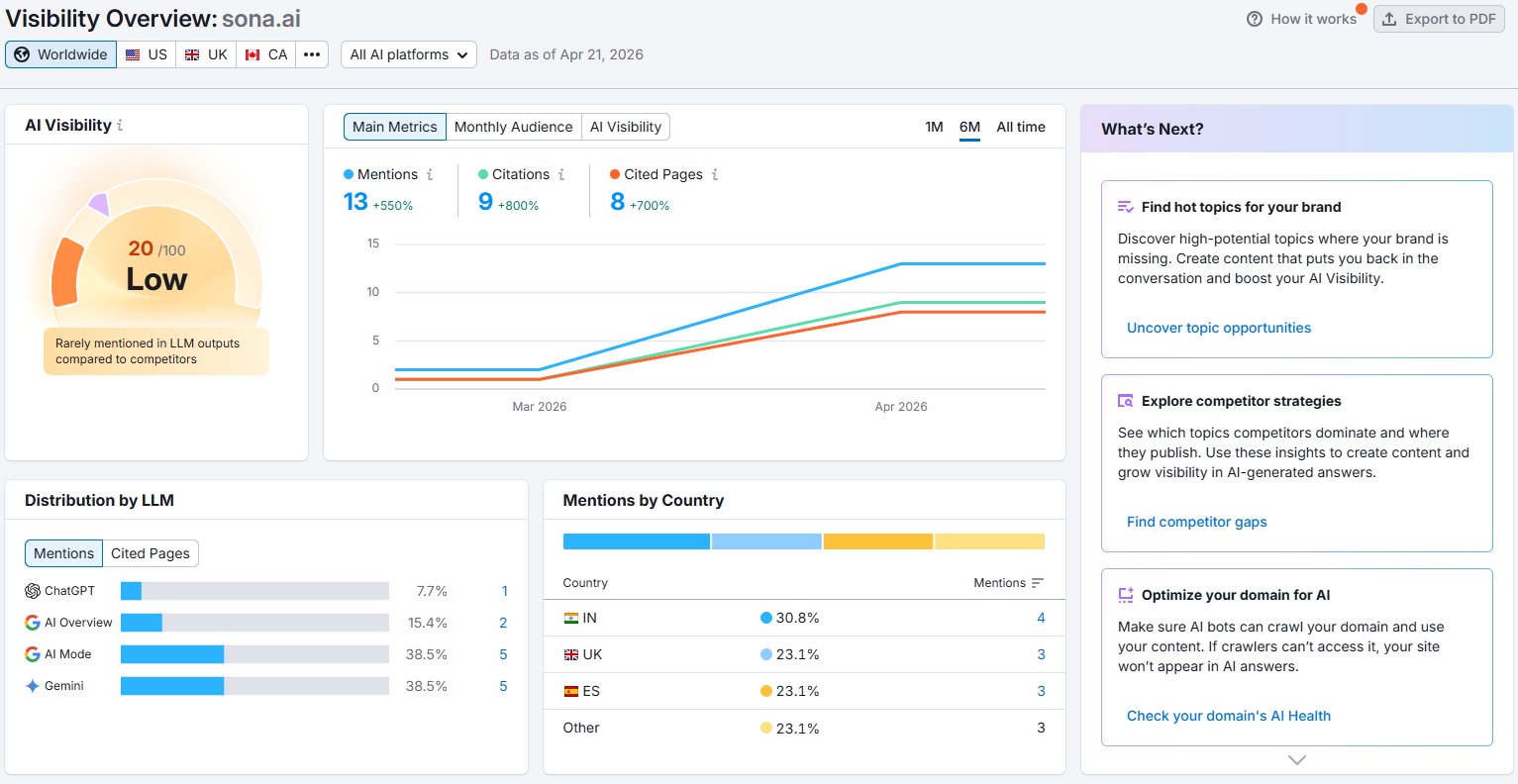
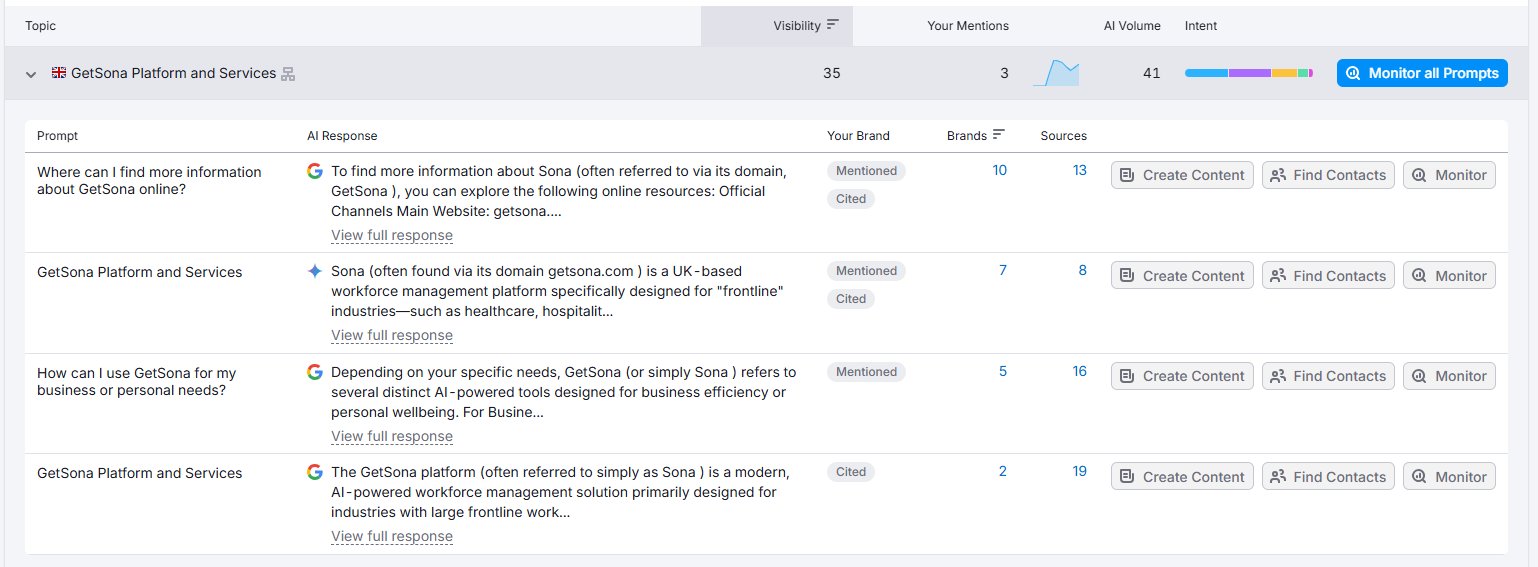
Sona’s Semrush score of 20/100 masks a rapidly improving trajectory: mentions grew +550%, citations +800%, and cited pages +700% in recent months. However, the brand dilution risk is visible in the topics — Semrush tracks “GetSona Platform and Services” as the primary topic, with visibility (35) concentrated on branded queries rather than category-level buyer intent. India (30.8%) leads in country distribution, suggesting some mentions may be from unrelated “Sona” entities.
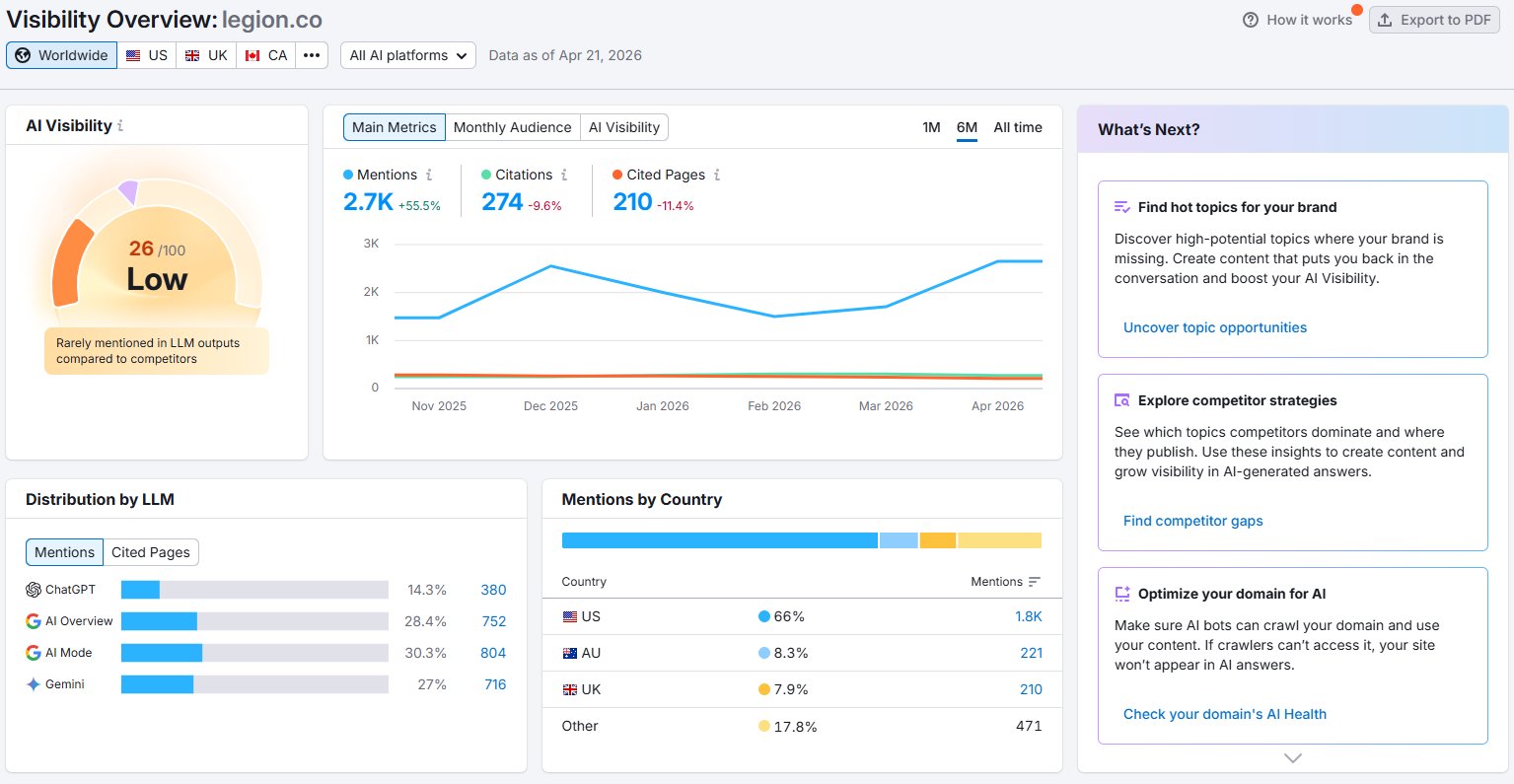
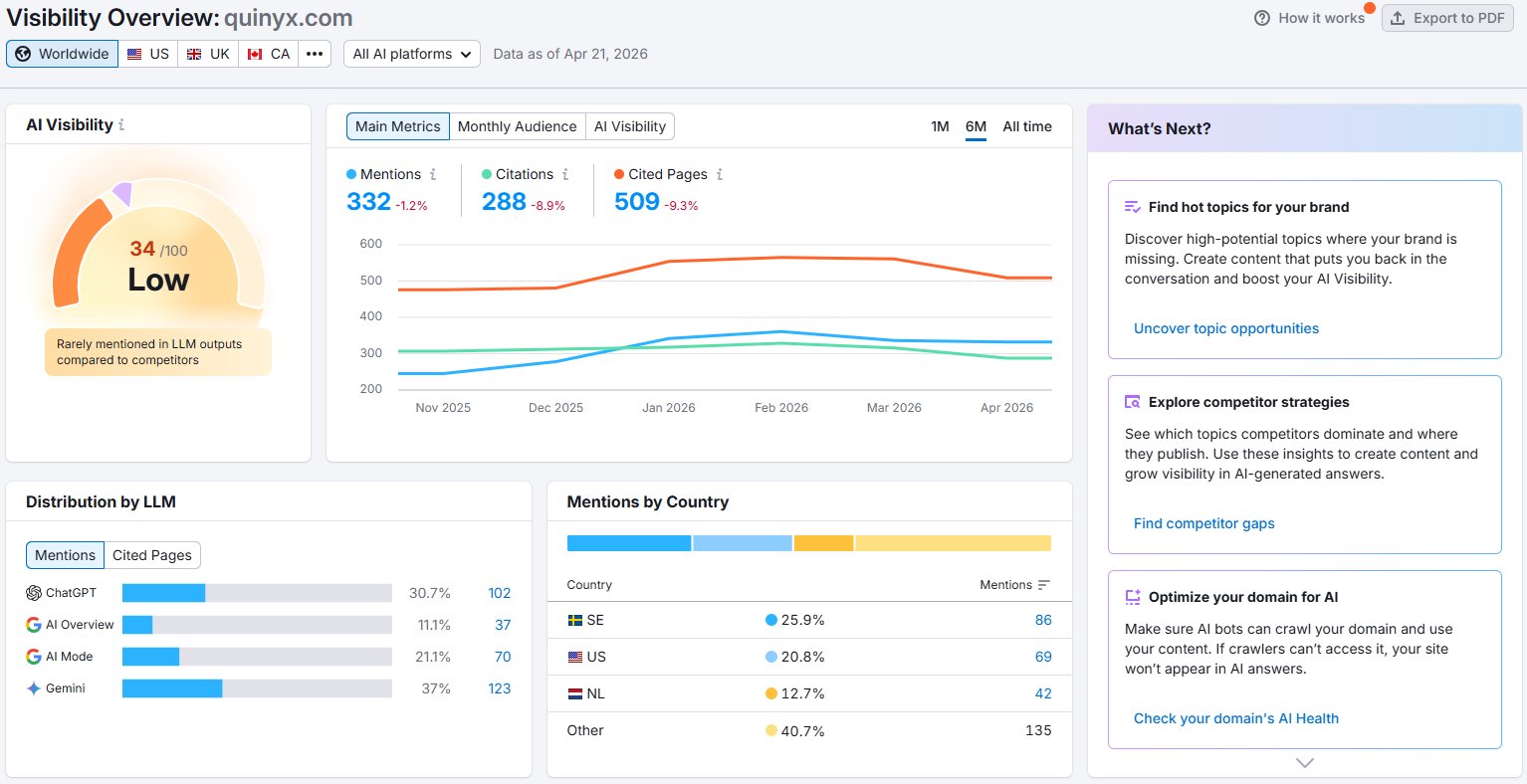
Quinyx leads on Semrush with 34/100 and strong Swedish/European distribution (25.9% SE, 20.8% US). Legion has massive mention volume (2.7K) but a lower score (26/100) suggesting breadth without depth. Crucially, both competitors’ Semrush scores under-represent their buyer-intent performance: Quinyx scores 25.3% on our audit while Sona scores 50.7% — double the Semrush leader’s actual buyer-intent visibility.
The ChatGPT Gap
Where Sona loses 68 percentage points vs Claude
When a COO asks Claude about AI WFM solutions, Sona is the first recommendation. When they ask the same question on ChatGPT, Sona doesn’t appear at all. The gap is most damaging on Sona’s strongest categories — social care and AI assistants — where ChatGPT defaults to legacy incumbents.
“I’m evaluating workforce management platforms for a 40-site social care provider. Which WFM platforms are built specifically for care sector requirements?”
“We’re looking at WFM solutions that have AI assistants or conversational interfaces that can answer managers’ questions about staffing in plain language.”
“We’re a social care organisation spending 35% on agency staff. What technology have other care providers used to reduce agency dependency?”
Sona’s content exists. Claude knows it. Gemini knows it. But ChatGPT doesn’t. The world’s most popular AI platform has minimal awareness of Sona’s product capabilities, customer base, and market position. Every buyer researching WFM solutions on ChatGPT is getting a recommendation list that favours established incumbents over the AI-native leader.
AI Topic Authority Map
Which categories Sona owns in AI answers
| Topic | AI Leader | Sona Status |
|---|---|---|
| Social Care WFM / Compliance | Sona | 2 of 3 platforms (Claude + Gemini) |
| AI-Native WFM / Modern vs Legacy | Sona + Legion | UNANIMOUS (3/3) |
| AI Assistant / Conversational WFM | Sona (Raffy) | 2 of 3 platforms (Claude + Gemini) |
| Well-Funded UK Startups | Sona | UNANIMOUS (3/3) |
| Multi-Site Hospitality Scheduling | Quinyx / Fourth | Claude only (1/3) |
| Employee Engagement / Retention | Legion / WorkJam | Claude only (1/3) |
| Mobile-First Frontline Apps | Deputy / Planday | Claude only (1/3) |
| Hotel Multi-Department WFM | Quinyx / Fourth | Claude only (1/3) |
| Demand-Driven Retail Scheduling | Legion / Quinyx | INVISIBLE (0/3) |
| Logistics / Supply Chain WFM | Blue Yonder / UKG | Claude only (1/3) |
Methodology
How we conducted this Xtrusio AEO/GEO Audit
This research is based on Xtrusio’s proprietary AI visibility analysis framework.
Recommendations
Prioritised actions to close the ChatGPT gap
- Publish detailed comparison pages: “Sona vs Fourth,” “Sona vs PeoplePlanner,” “Sona vs Quinyx” — these are the exact competitors ChatGPT defaults to
- Create a dedicated “Raffy AI Assistant” product page with structured data — ChatGPT doesn’t know Raffy exists despite it being Sona’s strongest differentiator
- Publish quantified ROI case studies with specific metrics (Q14 is the only query where ChatGPT cites Sona but Claude doesn’t — lean into this)
- Publish hospitality-specific content targeting Q1, Q8, Q14 gaps: “AI workforce management for multi-site restaurants” and “ROI from AI scheduling in hospitality”
- Target the retail demand scheduling gap (Q15) — the only topic where Sona is invisible across all 3 platforms
- Target ChatGPT citation rate from 24% to 50%+ through structured content, schema markup, and expanded category pages
- Quarterly Xtrusio re‑audits to track gap closure
Close the ChatGPT Gap.
50.7% is strong. But 24% on the world’s most popular AI platform isn’t.
This research report was generated using the Xtrusio Company Intelligence Module.