Tink wins on ChatGPT.
Not Tapix.
An independent 25-query audit of Tapix by Dateio’s visibility in AI-powered search platforms. We tested the exact questions product managers and CTOs at digital banks ask when evaluating transaction enrichment APIs.
Tapix is invisible on Claude — the fastest-growing AI platform — appearing on just 28% of buyer-intent queries.
When a product manager at a European neobank asks Claude “What are the leading transaction enrichment API providers?” — Tink, Plaid, and MX get cited. Not Tapix. That’s not a branding problem. That’s a pipeline problem. And it extends to ChatGPT, where Tapix appears on just 56% of queries despite being a specialist in this exact space.
Methodology
How we conducted this Xtrusio AEO/GEO Audit
This assessment combines Semrush AI Visibility data with manual buyer-intent query testing to provide a complete picture of Tapix’s competitive positioning in AI-powered answer engines — going beyond automated scores to test what decision-makers actually ask.
Why Semrush AI Visibility Fails for Niche B2B
Automated scores hide a critical problem: brand dilution
Semrush AI Visibility gives Tapix a score of 14/100. That sounds low. But when you look at what Semrush is actually tracking, the picture is worse than the score suggests — most tracked topics have nothing to do with what buyers actually search for.
| Company | Score | Mentions | Audience | Cited Pages | Buyer-Relevant? |
|---|---|---|---|---|---|
| tapix.io | 14/100 | 17 | 63.3K | 108 | Low |
| tink.com | 29/100 | 1.1K | 8.4M | 537 | Mixed |
| thisisbud.com | 15/100 | 52 | 3.1M | 34 | Mixed |
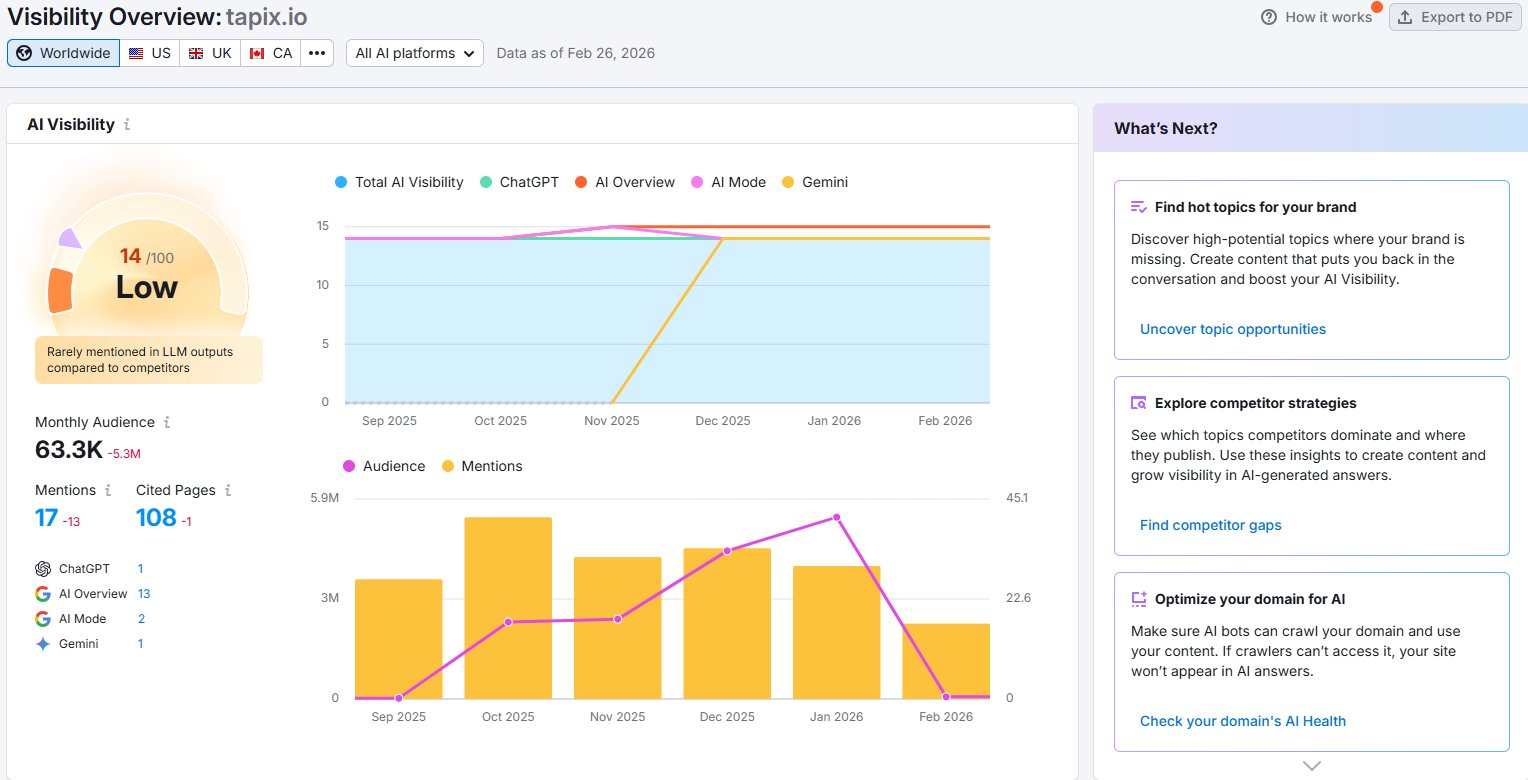
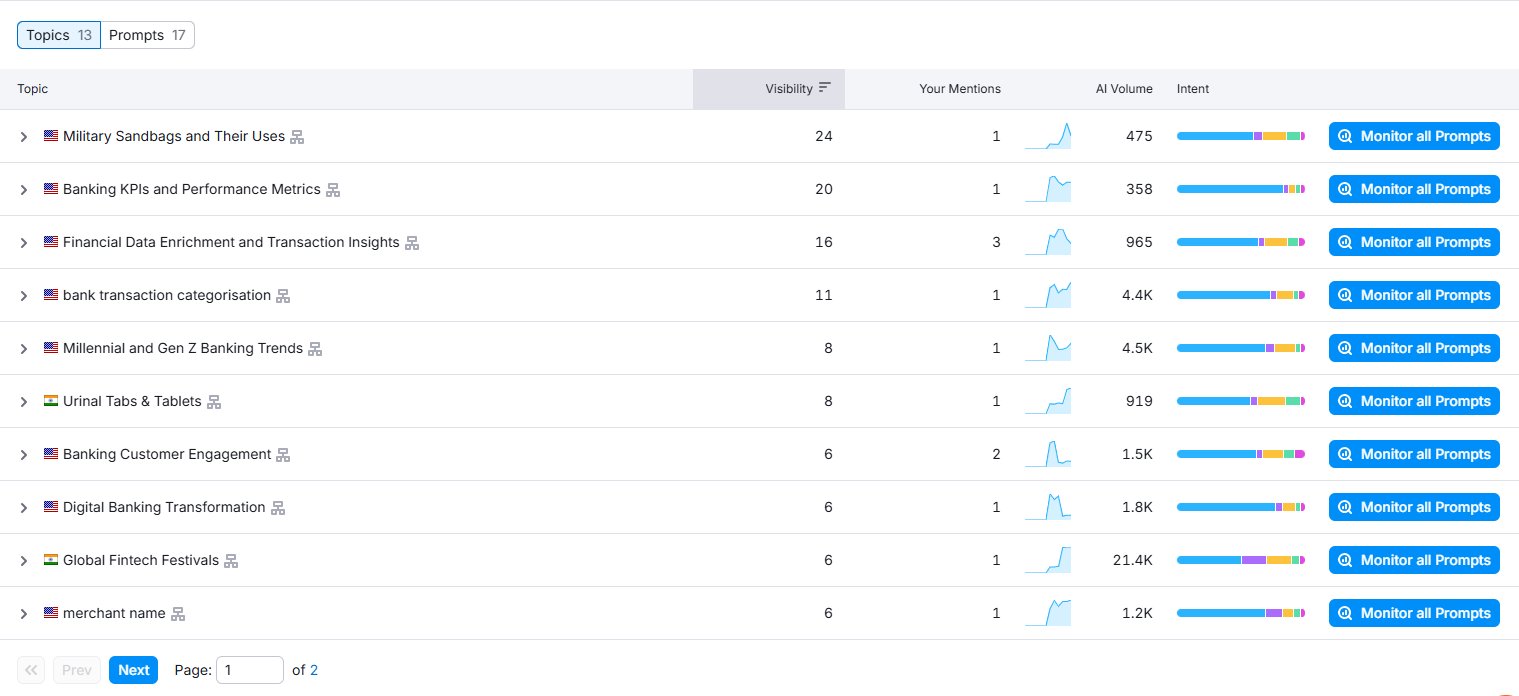
Semrush gives Tapix a score of 14/100 with just 17 mentions — but the real problem is what it tracks. Topics include “Military Sandbags,” “Urinal Tabs & Tablets,” and “Banking KPIs” alongside the relevant “Financial Data Enrichment” and “Bank Transaction Categorisation.” The score is inflated by mentions in contexts that have nothing to do with Tapix’s actual product.
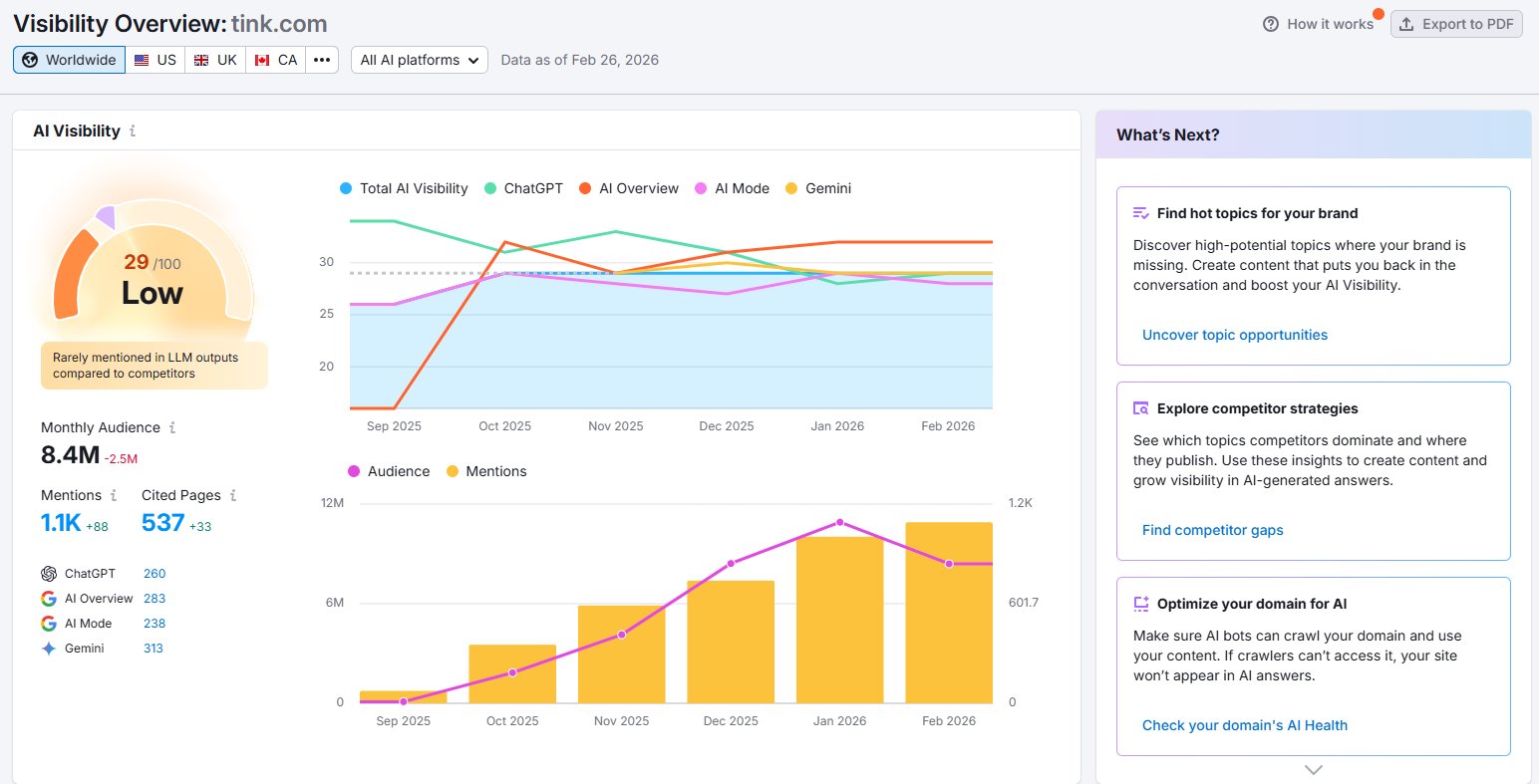
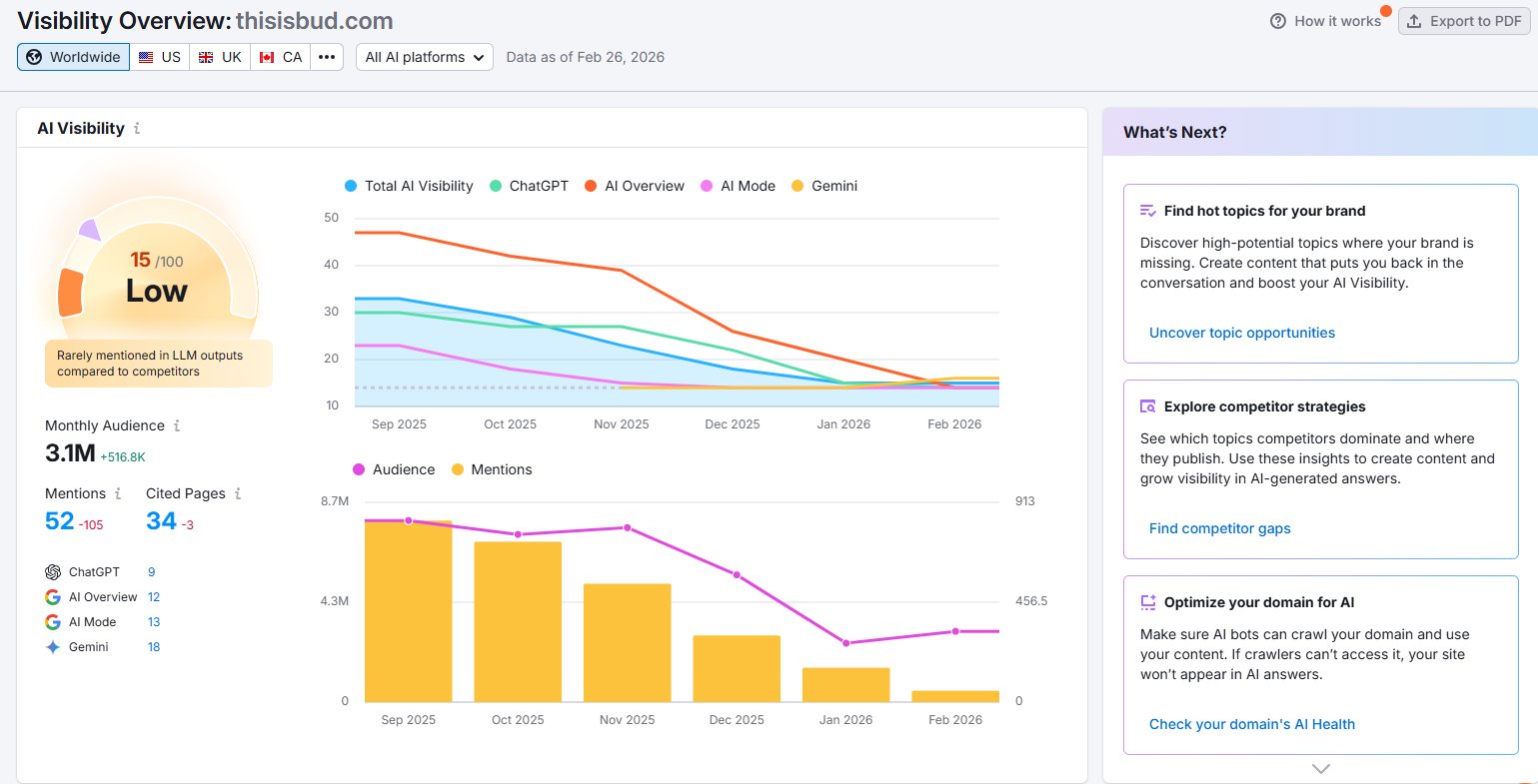
Tink dominates with 29/100 and 8.4M monthly audience — but its score is also inflated by broad open banking topics, not enrichment-specific queries. Bud (15/100) faces similar dilution. The real differentiator isn’t automated scores — it’s who appears when a product manager asks a buying question on ChatGPT.
Semrush AI Visibility is a directional signal — not a buyer-intent metric. Tapix’s score of 14/100 sounds low, but even Tink at 29/100 has the same brand dilution problem. This is why we use Xtrusio’s buyer-intent methodology to test what real decision-makers actually ask during discovery.
Platform Scorecard
Who wins the buyer’s attention — platform by platform
We tested 25 buyer-intent queries across ChatGPT, Gemini, and Claude. Here’s how often each platform cited Tapix — and the quality of those citations.
The Claude Gap
Where Tapix goes invisible during buyer discovery
When a fintech CTO asks Claude “What are the leading transaction enrichment API providers used by European banks?” — Tink, Plaid, MX, and Yodlee get cited. Not Tapix. Here’s what that looks like in practice.
When asked for a vendor shortlist (Q11), Claude recommends Tink, Plaid, MX Technologies, Yodlee, and others — but never mentions Tapix. This is the exact query where a specialist European enrichment API with 50+ bank clients should appear first.
“What are the leading transaction enrichment API providers used by European banks and fintechs? I need a shortlist of vendors to evaluate for a digital banking project.”
This isn’t an isolated miss. Across 18 of 25 buyer-intent queries on Claude, Tapix goes unmentioned while Tink and Plaid appear consistently. Claude misses Tapix entirely on merchant UX queries, vendor landscape questions, and advanced use cases like fraud detection and card-linked offers.
But on Gemini, the same question tells a different story:
The same question on Gemini produces a very different result — Tapix is cited at Rank #1 alongside Tink and Plaid. This proves the content and market positioning exist. Claude’s training data and citation patterns simply aren’t picking it up. Platform-specific optimization is required.
Tapix’s content exists. Gemini knows it. But Claude — where an increasing share of AI-assisted buyer research happens — doesn’t. And ChatGPT, the largest AI platform, only gets it right 56% of the time. That’s not a content problem. That’s a distribution problem.
AI Positioning Audit
25 buyer-intent queries — who gets cited and who gets ignored
Click any row to see the exact question tested. ✓ = cited, ✗ = absent. Rank shown in parentheses where cited.
| # | Query Topic | Cluster | Gemini | ChatGPT | Claude |
|---|---|---|---|---|---|
| TOTAL CITED | 17/25 (68%) | 14/25 (56%) | 7/25 (28%) |
Topic Cluster Heatmap
Where Tapix wins and where it disappears — by topic
Citation rates aggregated by topic cluster. Green >70%, Yellow 40–70%, Red <40%.
Recommendations
A phased roadmap to close the AI visibility gap
- Create a “What is Transaction Data Enrichment?” pillar page on tapix.io — educational content that AI models can cite for discovery queries (currently 0% on all platforms)
- Publish a “Tapix vs Tink vs Plaid” comparison page — AI platforms currently cite Tink and Plaid by default; a structured comparison gives models a citable alternative
- Consolidate Tapix/Dateio brand messaging — ensure tapix.io is the primary domain for all enrichment API content, reducing brand confusion in AI models
- Add a dedicated PFM/spending insights page to address the 0% citation gap in personal finance management queries
- Publish dedicated AN4569 compliance case study (Swisscard) — this query cluster shows 100% citation; amplify with structured content
- Create CEE-specific landing pages (Poland, Czech Republic, Romania merchant coverage) to reinforce the regional specialist positioning that Gemini already recognises
- Expand Eco Track carbon footprint content — Tapix is Rank #1 on Gemini for CO₂ queries (Q16) but invisible on ChatGPT and Claude; structured ESG content can bridge this gap
- Pitch fintech media (Finextra, The Paypers, Sifted) with thought leadership on transaction enrichment trends to build citation-worthy backlinks
- Develop subscription detection and recurring payment content — 0% citation across all platforms on Q17, yet Tapix offers this feature
- Create fraud/risk use case content showing how enriched data improves anomaly detection (currently Rank #1 on Claude for Q18 — but only when Claude cites Tapix at all)
- Build a public ROI calculator and SLA benchmark guide to address the 0% citation on SLA/vendor management queries (Q22)
- Run quarterly Xtrusio re-audits to track AI visibility improvement and adjust strategy based on which platform gaps are closing
The Gap is Fixable. The Window is Now.
Before Tink widens the lead on ChatGPT and Claude, let’s discuss how to own your narrative in AI search.