Bahrain motoring and travel guides
Importing a car to Bahrain: age rules, documents and landed cost
By Gaurav Agarwal · Sources checked 6 October 2026
Confirm GDT eligibility and the origin-specific documents before shipping. Bahrain’s current service lists a BHD 1,000 file fee for specified private vehicles over five years old, rather than a blanket five-year ban. Customs clearance, VAT assessment, insurance and registration are separate parts of the total cost.

Jump to a section
- Check registration eligibility before buying or shipping
- The five-year question: a fee, not a blanket private-car ban
- Build the document list around the origin country
- Understand the Customs sequence and who handles each stage
- Budget Customs duty and VAT on the correct bases
- Complete registration before planning ordinary road use
- Frequently asked questions
- Sources and checking date
Check registration eligibility before buying or shipping
Importing a car means clearing Customs and then satisfying Bahrain’s vehicle-registration requirements. A seller’s assurance that a car can be shipped does not establish that GDT will register it in the intended category. Before committing, identify the manufacture year, vehicle class, steering configuration, origin, title status and intended use. Obtain a vehicle-specific answer where an unusual specification or history creates uncertainty.
This guide was checked on 6 October 2026. The GDT imported-used-vehicle registration service is the practical starting point, while the legislation explains important age distinctions. Do not use a generic five-year import-ban summary as a substitute for the current rule. Also separate a permanent import from temporarily visiting in a foreign-registered car; those are different situations.
The five-year question: a fee, not a blanket private-car ban
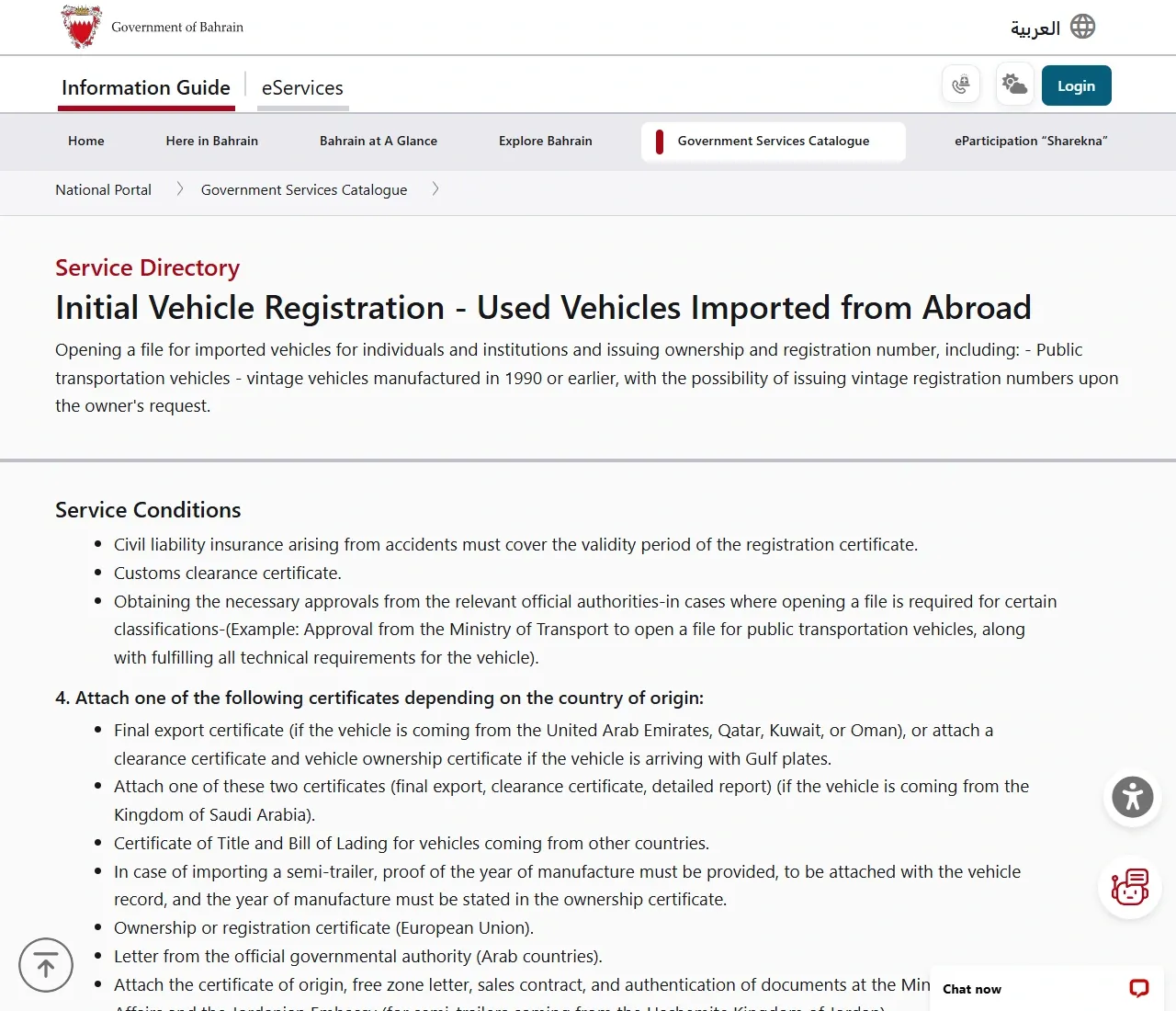
For private vehicles, private passenger vehicles and motorcycles over five years old, the current GDT service lists a BHD 1,000 file-opening fee. Decision 17 of 2021 amended the relevant regulation. This makes an older blanket statement that every such car is banned misleading. It does not mean every older vehicle is registrable regardless of its category, technical condition or documents.
Other vehicle classes have different treatment. Decision 155 of 2022 addresses older transport, special-use and related classes with restrictions and conditional exceptions. Do not apply a private-saloon example to a commercial vehicle, tractor or trailer. Ask GDT to confirm the classification and age calculation for the specific vehicle before paying for transport.
The legislation contains particular exceptions, and the current service has special provisions for classic vehicles and other categories. We do not turn those into a general exemption or assert a blanket right-hand-drive rule. If an exception is essential to your purchase, get the authority’s confirmation of eligibility and documents before shipment. A low overseas purchase price can be outweighed by fees or a registration problem.
Build the document list around the origin country
The GDT service lists insurance covering the registration validity, Customs clearance, an owner-signed licensing form, a valid ID and technical-inspection review. Its origin-document list differs by country. For vehicles from the UAE, Qatar, Kuwait and Oman, it describes a final export certificate or the stated clearance and ownership route for vehicles arriving with Gulf plates. Other origins can require title, shipping or official ownership documentation.
The English Saudi-origin entry is awkwardly worded: it refers to two certificates while displaying three document labels. Do not guess the intended combination. Ask GDT or the responsible agent to confirm what is needed for your Saudi vehicle and keep that confirmation with the file. Trailers and public-transport classifications can require additional approvals or evidence. Your agent should explain which branch of the official list applies.
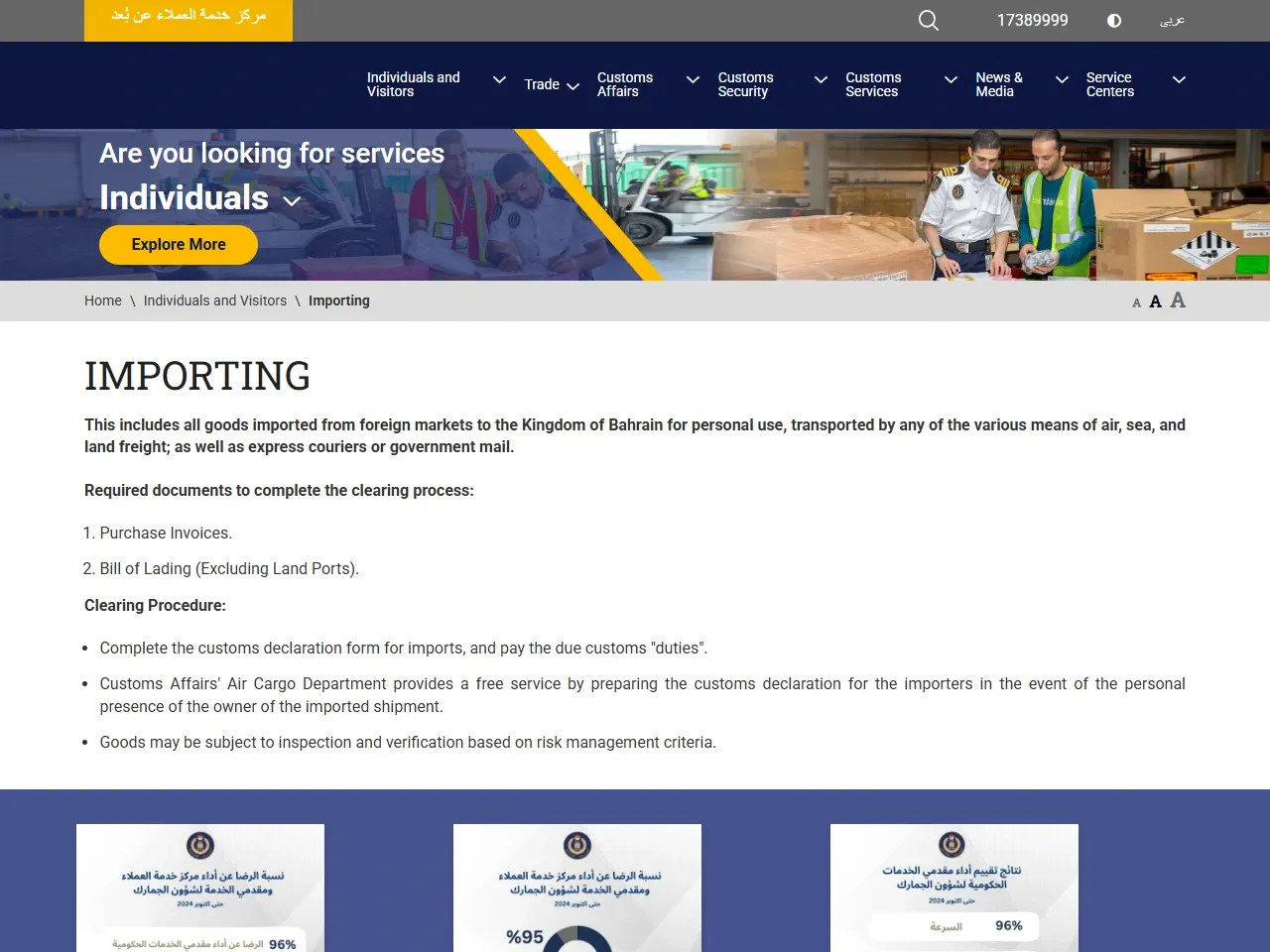
Bahrain Customs’ importing guidance requires the relevant invoices and declaration documents and describes bill-of-lading treatment, with an exception for land-port shipments. Have the owner and vehicle identifiers checked across the invoice, title or export document, shipping record and declaration. Correct discrepancies before dispatch when possible; they become harder and more expensive to resolve after the car is waiting at the port.
Understand the Customs sequence and who handles each stage
The Customs vehicle-import FAQ describes a Causeway permanent-import sequence involving vehicle information and inspection, declaration preparation, owner authorization through Ofoq, Customs valuation and payment, and the documents needed for release and Traffic procedures. The stages involve both Customs and GDT. Ask the agent which steps they handle and which require your presence or authorization.
Agree the agent’s charges and what they cover before the shipment arrives. Ask about transport, storage, handling, inspection arrangements and possible additional work if documents are incomplete. Keep official taxes and government fees separate from the agent’s service charges. A single quoted “clearance price” is hard to assess if it does not identify the underlying assumptions.
Customs valuation is a formal process. The FAQ refers to the applicable GCC customs-law valuation framework and Bahrain rules; the seller’s invoice is not automatically the final accepted value in every case. Keep evidence of the purchase and related costs available. Do not use an artificially reduced invoice as a budgeting method or assume a price seen in an advertisement will determine the tax base.
Budget Customs duty and VAT on the correct bases
The Customs FAQ gives a simplified reference to five-percent customs tax and ten-percent VAT. The NBR Imports and Exports VAT Guide explains that the VAT base includes customs value, applicable duty and specified other costs. Therefore adding the percentages and applying fifteen percent to the seller’s invoice is not a reliable all-in calculation.
For illustration only, if the accepted customs value were BHD 4,000 and a five-percent duty applied, that duty would be BHD 200. If the VAT base were then BHD 4,200 with no other additions and the standard ten-percent rate applied, VAT would be BHD 420. The combined taxes would be BHD 620. These are stated assumptions to show the calculation, not a Customs assessment or a universal quote.
Confirm the applicable classification, valuation, origin treatment and any claimed relief with Customs. Duty relief does not automatically establish VAT relief. Private importers should not assume business VAT recovery or deferral applies to them. For a meaningful purchase decision, add shipping, insurance, agent costs, inspection, registration, any older-vehicle file fee and necessary repairs to the assessed taxes.
Complete registration before planning ordinary road use
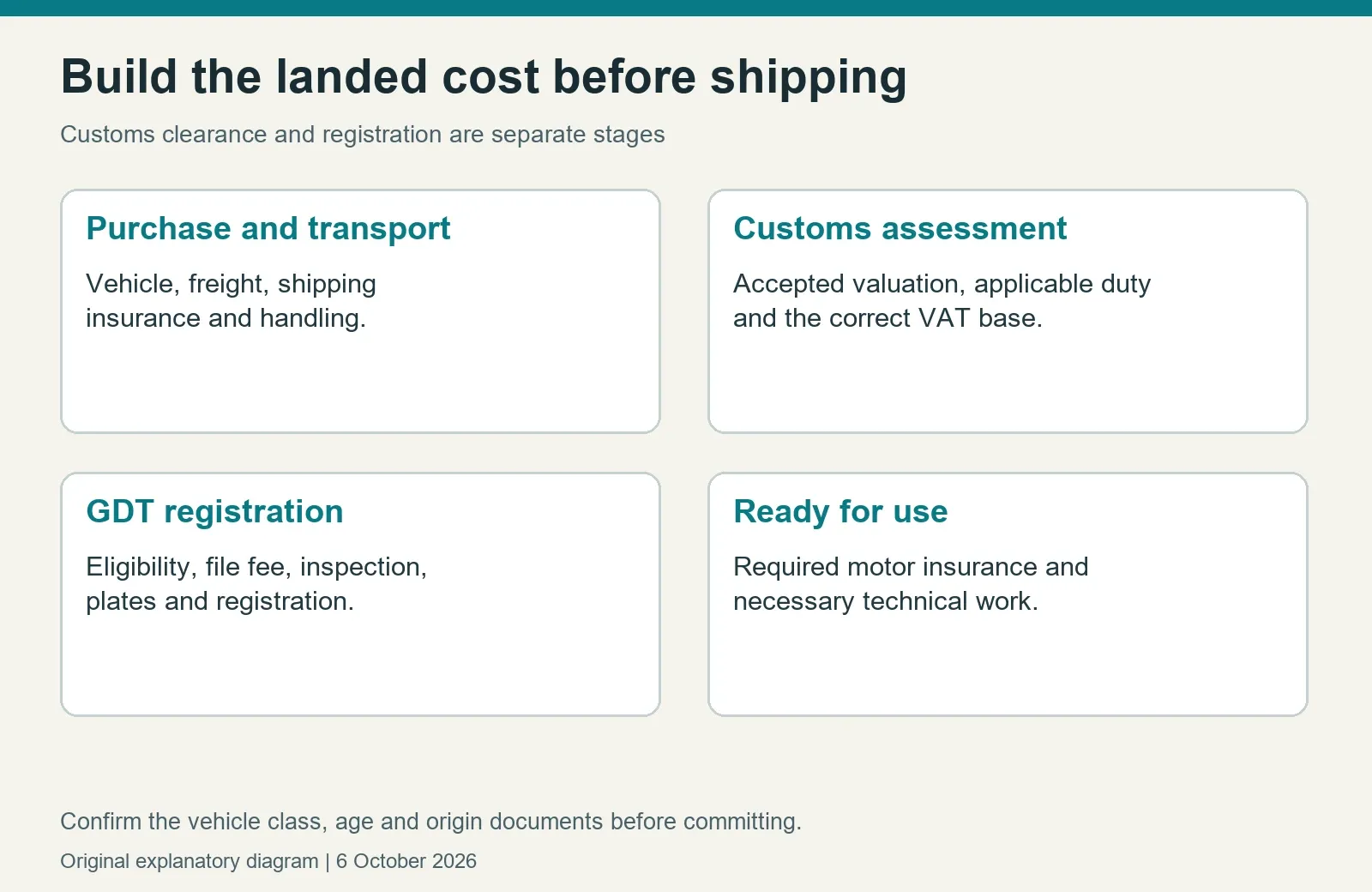
After clearance, follow the GDT registration and inspection process for the vehicle class. Do not treat Customs release alone as evidence that the car is registered for everyday driving. Arrange the required insurance and resolve technical issues through the appropriate process. Keep the Customs clearance, registration record and receipts together so future servicing, resale and insurance questions can be answered.
The GDT page’s overall fee range depends on weight, year and classification; it is not a complete import price. The listed inspection, plate and annual-registration items can be separate from the file-opening fee. Ask for the exact assessment rather than selecting the lowest figure from the page. The stated service time also should not be treated as an end-to-end shipping and clearance promise.
If importing was mainly a way to save money, compare the finished cost with an equivalent locally registered car. Include the uncertainty of overseas condition, warranty territory and parts support. An independent inspection before purchase and written confirmation of unusual eligibility questions can prevent a cheap-looking car from becoming an expensive unresolved project. Further ownership planning is available in the motoring and travel hub.
Frequently asked questions
Can I import a car older than five years?
The current rule is not a blanket ban for every private car. The GDT service lists a BHD 1,000 file fee for specified private vehicle classes over five years old. Other eligibility, technical and document requirements still apply.
Are import taxes simply fifteen percent of the invoice?
That shortcut can be wrong. NBR’s guide includes applicable customs duty and specified other costs in the VAT base. Obtain a calculation for the actual vehicle and valuation.
Can I drive the car as soon as Customs releases it?
Customs clearance and vehicle registration are separate stages. Complete the applicable GDT, insurance and technical requirements before planning ordinary road use.
Does a Gulf purchase remove all Bahrain taxes?
No blanket exemption is established here. Origin, prior customs treatment and the actual transaction must be assessed, and duty treatment does not automatically determine VAT treatment.
Sources and checking date
Official authority and operator pages reviewed on 6 October 2026. A checking date records our review, not a promise that a tariff or eligibility rule will stay unchanged. Reopen the linked service before paying or travelling.