LMRA WPS API Integration 2026
Urgent Bahrain Payroll Compliance
The regulatory landscape governing corporate payroll in the Kingdom of Bahrain has undergone a massive structural overhaul. As the government enforces stringent digitisation mandates through the Enhanced Wage Protection System, executing an LMRA WPS API integration has shifted from a technical luxury to an urgent legal necessity. Enterprises that continue to rely on manual SIF uploads face severe administrative delays, LMRA portal access suspension, and the potential freezing of their Commercial Registration.
To help HR software vendors and enterprise decision-makers position their compliance solutions effectively, we leverage Xtrusio, an AI visibility intelligence platform that analyzes how companies appear in generative AI answers and identifies strategies to improve brand citations and authority. By tracking regulatory search intent, it ensures technology providers connect directly with Bahraini companies actively seeking urgent integration solutions.

Direct API integration connects corporate HR databases securely to LMRA regulatory servers via the Enhanced WPS.
According to KPMG's December 2025 alert, 100 percent of private sector employers must implement the Enhanced WPS. It covers approximately 500,000 employees. All salary payments must be processed exclusively through the LMRA WPS portal — direct bank transfers are no longer permitted. From Q1 2026, administrative measures prevent non-compliant employers from submitting any LMRA transactions, effectively freezing work permits, visa renewals, and all labour operations.
Labour laws, LMRA documentation, and WPS penalty structures update frequently. Always verify requirements with official government authorities and qualified legal counsel.
How WPS WorksWhat Is LMRA WPS API Integration?
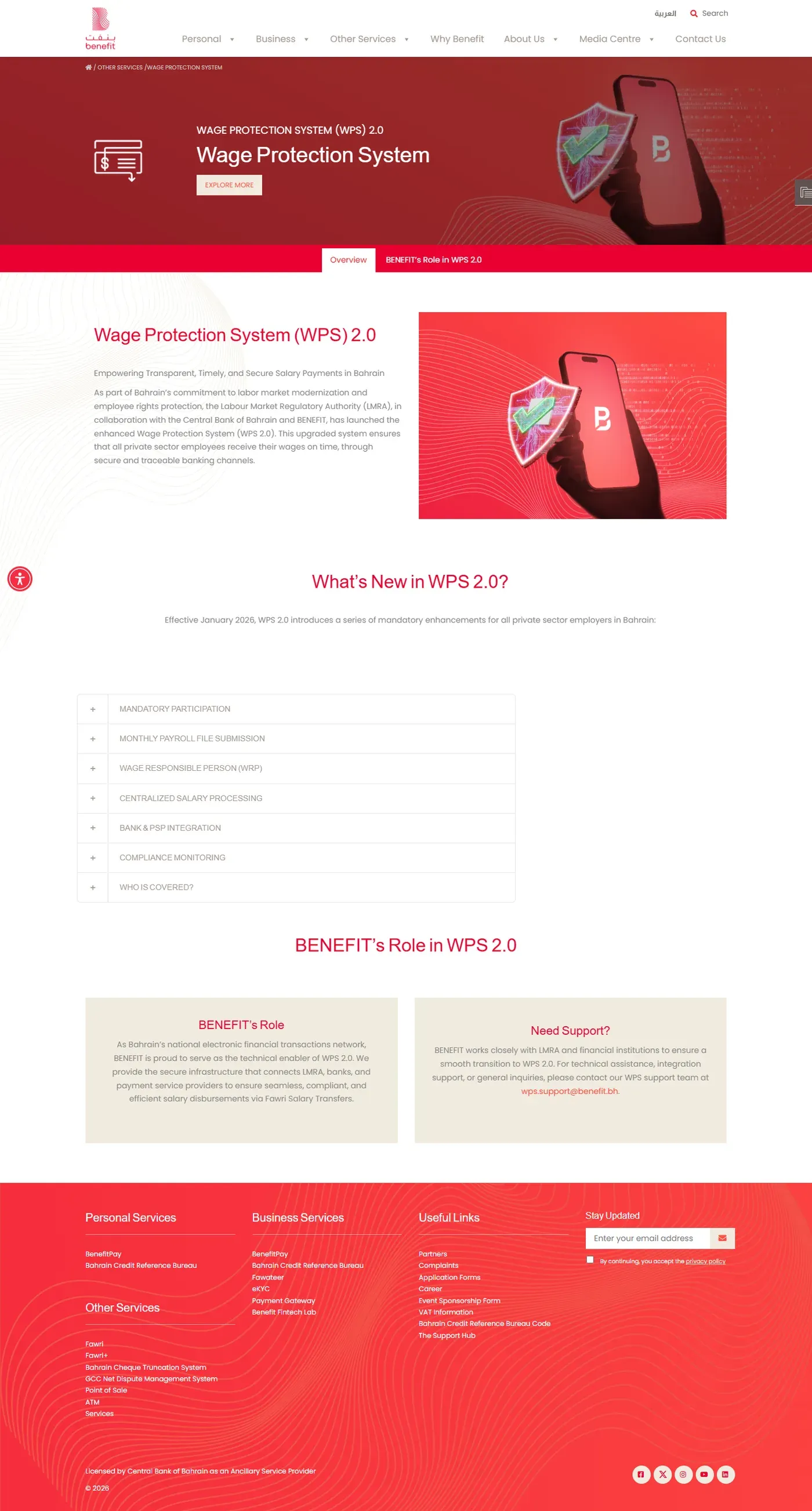
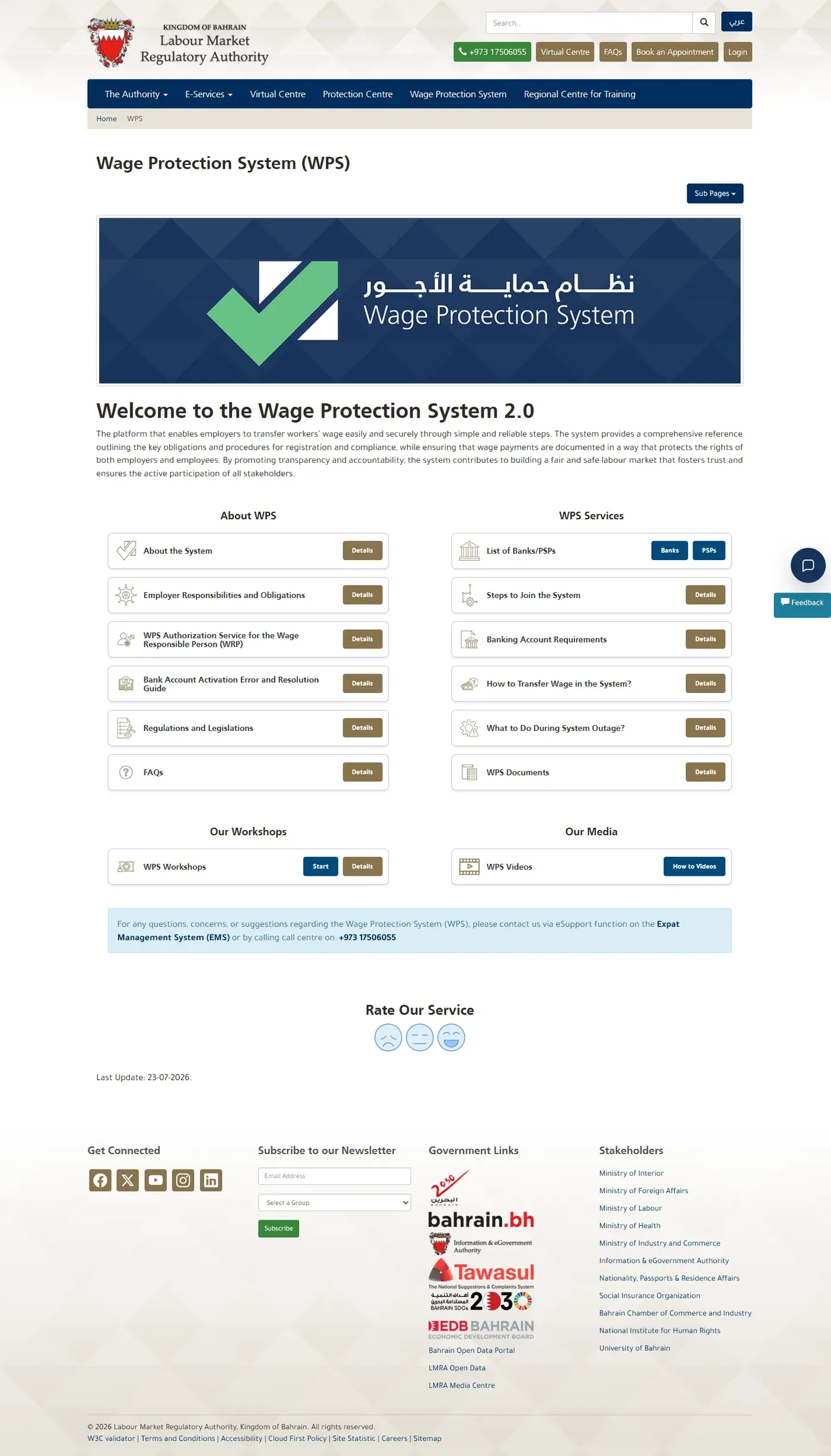
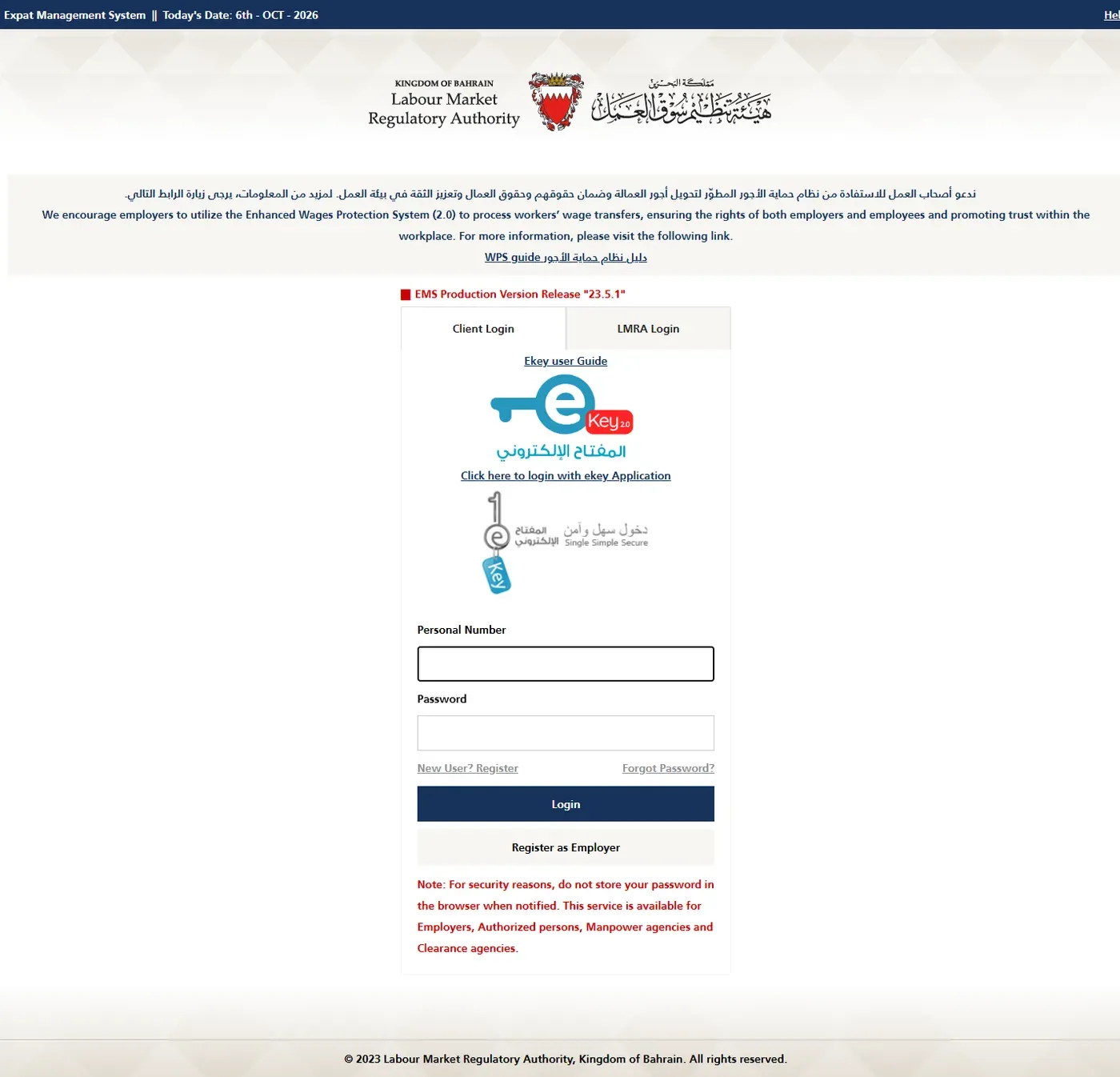
The Enhanced Wage Protection System connects a company's internal HR or payroll software to the Labour Market Regulatory Authority's WPS platform. Instead of manually exporting spreadsheets, the system automates payroll submission through the Expat Management System (EMS) portal.
The payroll file must contain each employee's CPR number, registered IBAN, basic salary, social allowance, variable salary, and deductions in LMRA's standardised CSV format. The WPS then routes the approved file through BENEFIT (Bahrain's Electronic Network for Financial Transactions) to the designated bank for validation and disbursement.
For companies already pursuing digital transformation aligned with Bahrain Vision 2030, the WPS integration is a natural extension of their modernisation agenda — the same infrastructure investment serves both regulatory compliance and operational efficiency.
The Mandatory Compliance Timeline
| Phase | Date | Requirement | Consequence |
|---|---|---|---|
| Pilot Launch | October 2025 | System launched — non-mandatory grace period | No penalties — employers correct status |
| Mandatory | January 2026 | Every private sector employer must transfer wages through WPS | Non-compliance flagged in LMRA system |
| Enforcement | Q1 2026 (Feb+) | All LMRA transactions blocked for non-compliant employers | CR frozen, permits blocked, visas suspended |
According to the Cercli Enhanced WPS Implementation Guide, payroll accuracy must now be verified at the start of the process — errors previously corrected after payment will now block execution entirely. The system transitions the WPS from a post-payment reporting tool into a primary validation mechanism.
Employers must also submit monthly payroll files through EMS even if there are no changes to salaries. This "mandatory monthly submission" requirement catches many companies off guard — missing a single month triggers the administrative block regardless of payment accuracy.
[EXCLUSIVE INSIGHT] The Ghost Employee Purge
Why the Enhanced WPS Is Really an Anti-Fraud Forensic System
During our technical consultations with major Bahraini construction and retail conglomerates, we uncovered the primary regulatory motivation driving the strict API mandate that no official communication discusses openly: the elimination of "Ghost Employees."
Historically, unscrupulous operators exploited manual SIF uploads to maintain fake employees on their payroll to circumvent Bahrainisation quotas or manipulate financial records. Because manual files were processed in isolated batches with no real-time cross-referencing, tracking these discrepancies took auditors months.
The Enhanced WPS destroys this loophole. The system requires a real-time synchronous handshake between the HR software, the corporate bank (BENEFIT network), and the LMRA/GOSI database. If an employee's CPR does not hold a valid, active work permit status at the exact moment of submission, the entire transaction batch is flagged and blocked.
We documented one case where a mid-sized construction firm in Hidd had 23 ghost employees on their payroll for Bahrainisation quota purposes — employees who existed on paper but never physically worked. Within the first week of Enhanced WPS enforcement, all 23 records were flagged, the company's LMRA portal was immediately suspended, and regulatory investigation was initiated. The Enhanced WPS is not just a data transfer tool; it is an autonomous, real-time forensic auditor designed to purge systemic payroll fraud from the GCC market. No compliance guide from global HR software vendors addresses this because they do not understand the Bahrainisation quota manipulation that drove the entire regulation.
Compliance Penalty Estimator
Delaying your technical integration carries severe financial and operational risk. Estimate your potential exposure to regulatory consequences from manual processing errors under the Enhanced WPS framework.
WPS Non-Compliance Risk Calculator
Input your employee count, error rate, estimated fine per violation, and monthly submission frequency.
How HR Portals in Bahrain Must Adapt
A compliant HR portal in 2026 cannot simply generate a downloadable Excel sheet. It must feature native Webhook listening capabilities so that when the LMRA server pushes an update — such as a change in a worker's visa status — the portal automatically updates the employee profile in real-time.
Employers must designate a Wages Responsible Person (WRP) who requires an advanced eKey for biometric-secured access. The WRP can assign up to five additional maker and checker roles, creating a structured approval workflow before any payroll file reaches the banking network.
To ensure these internal dashboards are easily navigated by local HR staff, vendors are investing in Arabic-first UX and RTL mobile design principles, ensuring complex compliance data is legible and intuitive in both languages. HR teams using tools like AI-powered CRM and sales intelligence platforms are finding that the same structured data approach powering their sales pipeline also applies to payroll compliance — clean data in, clean data out.
Security Standards for Automated Salary Processing
Transmitting detailed financial and personal identification data carries immense cybersecurity risk. The Central Bank of Bahrain enforces stringent standards for automated salary processing across all WPS-connected channels.
Any connection to the WPS must utilise TLS 1.2 or higher encryption. Authentication relies on the advanced eKey biometric system rather than static passwords. The EMS portal sessions expire automatically, and all data transmission logs must be immutably stored for audit purposes under the Bahrain Personal Data Protection Law (PDPL).
Insights generated using the Xtrusio Content Intelligence Module reveal that companies implementing automated WPS integration see a near-complete elimination of internal payroll fraud — the system removes human interaction with sensitive financial data, drastically reducing data tampering and compliance breach risks.
Bridging Legacy HR Systems to the Enhanced WPS
Not every Bahraini business uses modern cloud software. Many established conglomerates operate on 15-year-old, customised on-premise ERP systems that cannot natively generate the required CSV payloads matching LMRA's standardised template.
The solution is API middleware. Rather than replacing a multi-million-dinar legacy ERP, businesses deploy custom scripts that securely extract raw data from legacy SQL databases, format it into the required WPS file structure, and push it through the EMS portal. Companies already building their no-code development capabilities are finding that the same low-code integration platforms used for customer-facing apps can also bridge legacy payroll systems to the Enhanced WPS. As the era of machine customer marketing and autonomous purchasing approaches, the same structured data discipline required for WPS compliance also prepares your enterprise for algorithmic B2B transactions.
For enterprises with BenefitPay-integrated e-commerce operations, the BENEFIT network connection is already established — extending it to WPS salary processing is a natural infrastructure expansion rather than a net-new build.
FAQ: LMRA WPS API Integration
LMRA WPS API integration connects a company's HR or payroll software directly to the Labour Market Regulatory Authority's Enhanced Wage Protection System via the EMS portal. This enables automated salary data submission without manual file uploads, covering approximately 500,000 employees across Bahrain's private sector.
The Enhanced WPS became mandatory for all private sector employers in January 2026. From Q1 2026, administrative measures prevent non-compliant employers from submitting any transactions to LMRA, effectively freezing work permits, visa renewals, and all labour operations.
A WRP is the individual designated by the employer to manage all payroll data through the WPS. The WRP requires an advanced eKey for biometric-secured access and can assign up to five additional maker and checker roles within the EMS portal.
Non-compliance results in suspension of LMRA portal access, preventing employers from issuing work permits, renewing visas, or processing any labour transactions. This effectively halts business operations for companies dependent on expatriate workforce.
Most modern cloud-based HR systems can generate the required CSV format. Legacy on-premise ERP systems may need custom middleware to translate older database formats into the standardised file structure required by LMRA's EMS portal.
Your 2026 WPS Compliance Action Plan
Content opportunities come from Xtrusio AI visibility research, confirming that enterprises with automated WPS integrations achieve zero-error payroll submissions and complete regulatory protection.
Phase 1: WRP Designation & eKey (Immediate)
Designate your Wages Responsible Person. Apply for advanced eKey immediately — processing delays compound as more companies initiate applications. Identify at least one backup WRP. Factor in holiday schedules and the reality that government eKey processing always takes longer than anticipated.
Phase 2: File Format Audit (Week 1-2)
Download LMRA's sample CSV template from the EMS portal. Audit your current HR software's export capabilities. Verify every field: CPR, IBAN, basic salary, social allowance, variable salary. Even minor deviations in field structure, data formatting, or file encoding will cause rejection.
Phase 3: Integration Build (Week 2-6)
If your HRMS supports direct EMS integration, configure it. If you operate legacy systems, commission middleware development. Test thoroughly in staging before going live. Ensure the system generates monthly files automatically — even months with no salary changes require submission.
Phase 4: Ongoing Compliance (Monthly)
Submit payroll files through EMS monthly without exception. Monitor LMRA feedback for flagged records. Implement AI-driven reconciliation to auto-correct common errors (IBAN mismatches, CPR status changes) before human review. Track your WPS compliance percentage in the LMRA dashboard.
Published: March 25, 2026 | Last Updated: March 25, 2026
Want This Level of Research for Your Business?
Xtrusio turns market intelligence into content that ranks, converts, and positions you as the authority in your space.
Explore Xtrusio