Bahrain employment and education guides
Paternity Leave in Bahrain: One Paid Day and How to Request It
By Gaurav Agarwal · Sources checked 6 October 2026
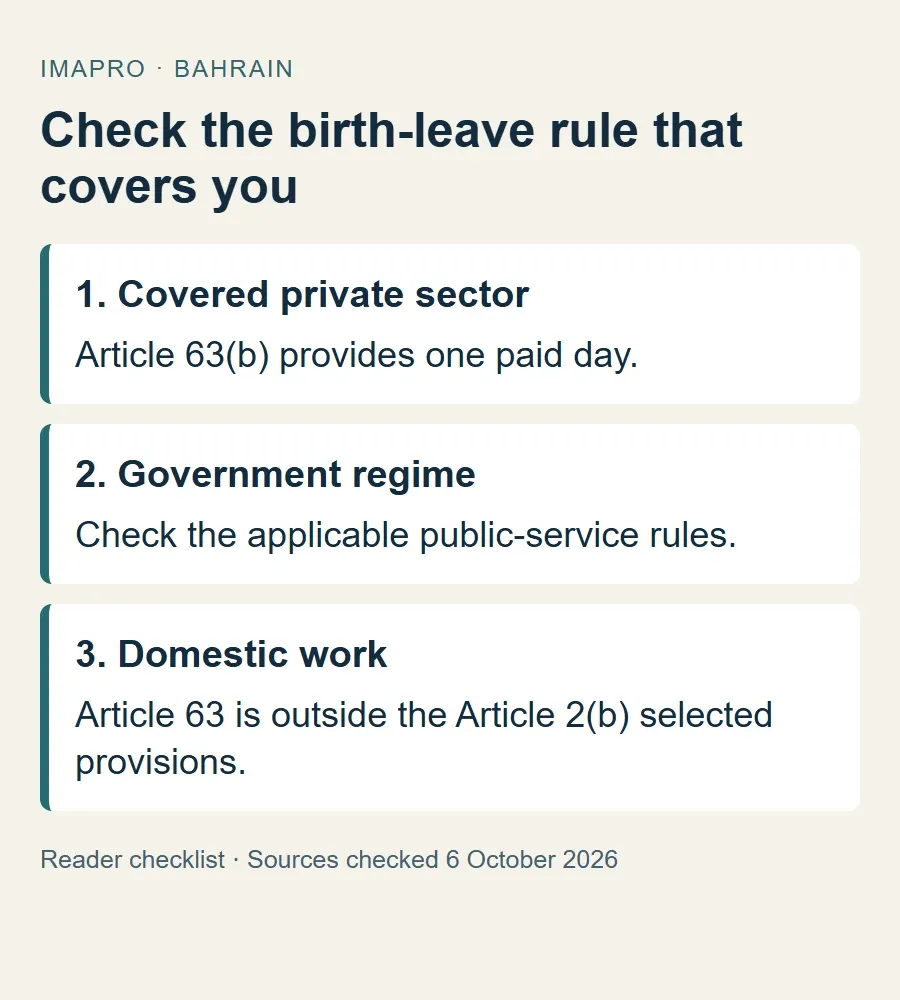
Article 63(b) of Bahrain Law 36 of 2012 provides a covered private-sector worker one paid day when a child is born to them. Article 63(d) permits an employer to request evidence. Check better company benefits separately; this article does not apply to domestic workers or staff governed by public-service regimes.

Jump to a section
- What Article 63 actually provides
- Who is covered by this private-sector rule?
- Check for a more generous employer benefit
- Prepare the request before the expected birth
- A concise paternity-leave request
- How to arrange more time with your family
- Birth on a rest day, travel and other timing questions
- Check the attendance and payroll record afterwards
- Paternity leave in Bahrain: common questions
Bahrain's private-sector Labour Law gives a worker one day of paid leave when a child is born to them. The entitlement is in Article 63(b) of Law No. 36 of 2012. Article 63(d) allows the employer to ask for evidence of the event. A company may offer a more generous paternity benefit, but the statutory one-day rule should not be confused with a longer employer policy or the mother's maternity entitlement.
This guide was checked against the official Arabic law and its amendments on 6 October 2026. It explains how to establish which rule covers you, request the leave and plan extra time. It does not invent a statutory booking deadline or a guaranteed substitute day where the birth happens on a rest day.
What Article 63 actually provides
Article 63(b) states that a worker has the right to one day's paid leave if a child is born to them. This is the provision commonly described as paternity leave in Bahrain's private sector. The entitlement is connected to the birth event. It is not the three-day leave that appears elsewhere in Article 63 for marriage and specified bereavement circumstances.
Article 63(d) permits the employer to require evidence that the relevant event has occurred. This gives a legal basis for checking the claim, but the provision does not itself list a universal document pack, application portal or advance-notice period. Employers may have an administrative procedure for submitting a request and evidence. Ask for that procedure before the expected birth so you know whom to contact when the date becomes certain.
Do not assume the employee must first complete one year of service to receive this day. Article 63 does not express the entitlement using the one-year threshold found in the annual-leave provision. It also does not insert the three-month continuous-service threshold used for ordinary sick leave. Those are different provisions with different conditions. The relevant source here is Article 63(b) and (d) of Law 36/2012.
Who is covered by this private-sector rule?
First confirm which employment regime applies to you. Article 2(a) excludes government staff and employees of public legal entities who are governed by civil-service, military-service or a special employment system. A government employee should check the applicable public-service rules rather than relying on a private-sector article. The ownership of a business and the legal regime covering its staff are questions to resolve from the employment arrangement, not from its name alone.
Domestic workers need a separate check. Article 2(b) applies selected articles and chapters to household workers, but Article 63 is not included. It would therefore be inaccurate to promise every household driver, nanny or domestic worker the same statutory one-day benefit under this article. The contract may provide leave, and other applicable protections may matter, but those are separate grounds that should be identified.
For covered private-sector employees, the birth-leave wording does not distinguish Bahraini and expatriate workers. The useful first question is your legal employment category, not whether you hold a particular passport. A company driver, for example, is not automatically a domestic worker merely because household drivers are among the domestic categories. The actual employer and work arrangement matter. See Articles 2 and 63.
Check for a more generous employer benefit
Article 4 preserves better benefits established through employment agreements, company regulations or practice. Your employer may therefore provide more than the statutory one day, call the benefit parental leave, or offer a separate arrangement for attending the birth. Ask HR for the actual policy and check whether it applies to your category of employee, rather than relying on what a colleague received under a different agreement.
When reading the policy, identify the number of paid days, when they may be taken, the evidence required and whether the company treats them as one continuous period. Ask whether any waiting period belongs to an extra company benefit rather than to the statutory day. This distinction matters when a policy describes an enhanced allowance only after a particular length of service.
Keep the policy version or written confirmation with the request. If an offer letter promised a larger benefit than the handbook now shows, raise the inconsistency before the expected birth where possible. A useful question is: my contract states this entitlement, while the leave system shows a different amount; please confirm the benefit applicable to my employment and how I should request it. The statutory basis for preserving better terms is Article 4.
Prepare the request before the expected birth
A birth date is not always predictable. Advance planning should identify the contact person, request channel and temporary cover without pretending the leave date is already fixed. Tell your manager the expected period and ask how an urgent request should be handled outside normal office hours. For a shift worker, confirm whether the request goes to the supervisor arranging the rota, HR, or both.
Keep a short list of work that may need cover: deadlines, customer commitments and the colleague authorised to pick up each item. Put business information in the usual approved workplace location. This helps a manager arrange cover when the event happens and avoids a rushed exchange while you are supporting your family. It is practical preparation, not a statutory requirement that a worker must finish a particular handover form before the birth-related entitlement exists.
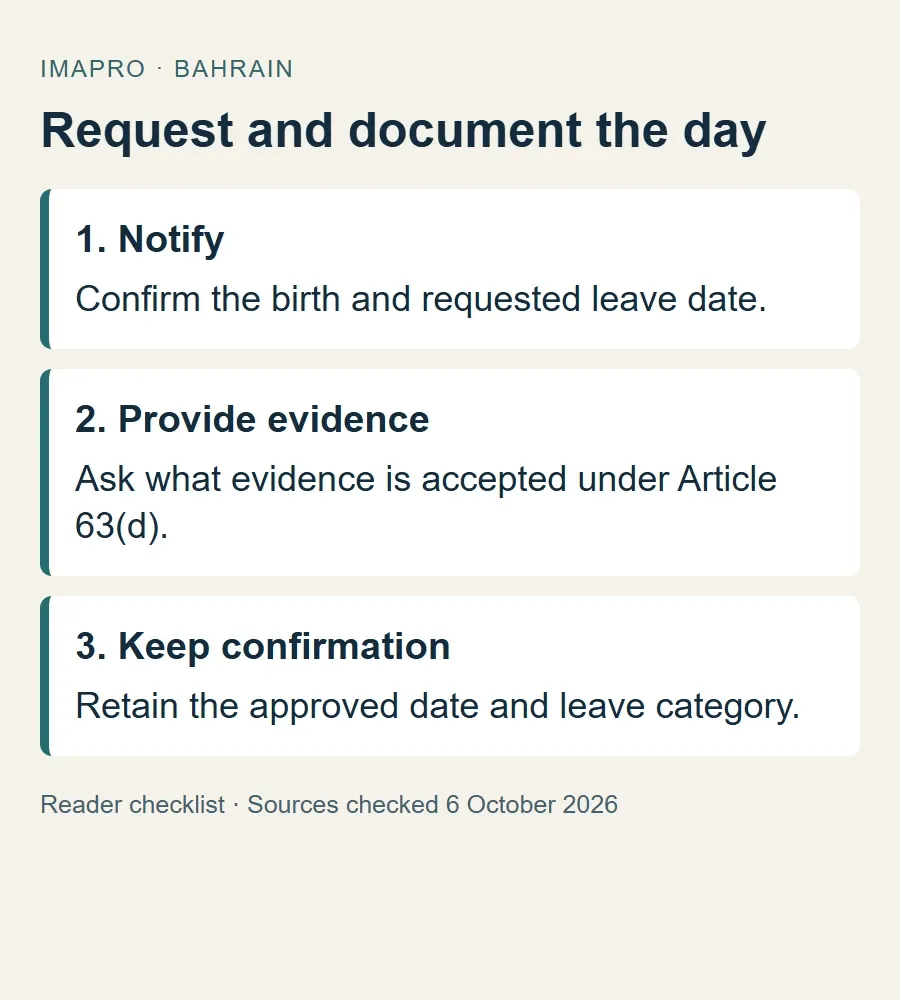
Ask what evidence the employer normally accepts and when it can be supplied. If an official document will be issued after the birth, explain that possibility in advance and ask how the initial request should be recorded. Article 63(d) allows an evidence request, but it does not support inventing a universal rule that every worker must upload a particular certificate within 24 hours. Separate the employer's stated administrative process from the text of the law.
A concise paternity-leave request
Use a factual message when the birth has occurred. Adapt the dates and the evidence sentence to what you can actually provide. Do not attach documents that have not yet been issued or state that a request has been approved when it has only been submitted.
Subject: Birth-related paid leave request
Dear [manager or HR name],
My child was born on [date]. I request the one day of paid birth-related leave under Article 63(b) of the Bahrain private-sector Labour Law for [requested date]. Please confirm the date and leave category recorded for this request.
I can provide [available evidence], and will follow your instructions for submitting it securely. [If needed: The formal document is still being issued; please confirm what interim evidence is acceptable.]
[Colleague or team] has the current handover details for [urgent work item]. Please let me know if you need any further information to process the request.
Kind regards,
[name and employee number]
The requested date should be discussed in the context of the birth and applicable policy. Article 63(b) does not spell out an unrestricted window for saving the day for a later holiday. If you want additional days, make a second, clearly labelled request rather than including them in the statutory one-day line. Retain the request, evidence-submission record and confirmation so payroll and attendance can be checked later.
How to arrange more time with your family
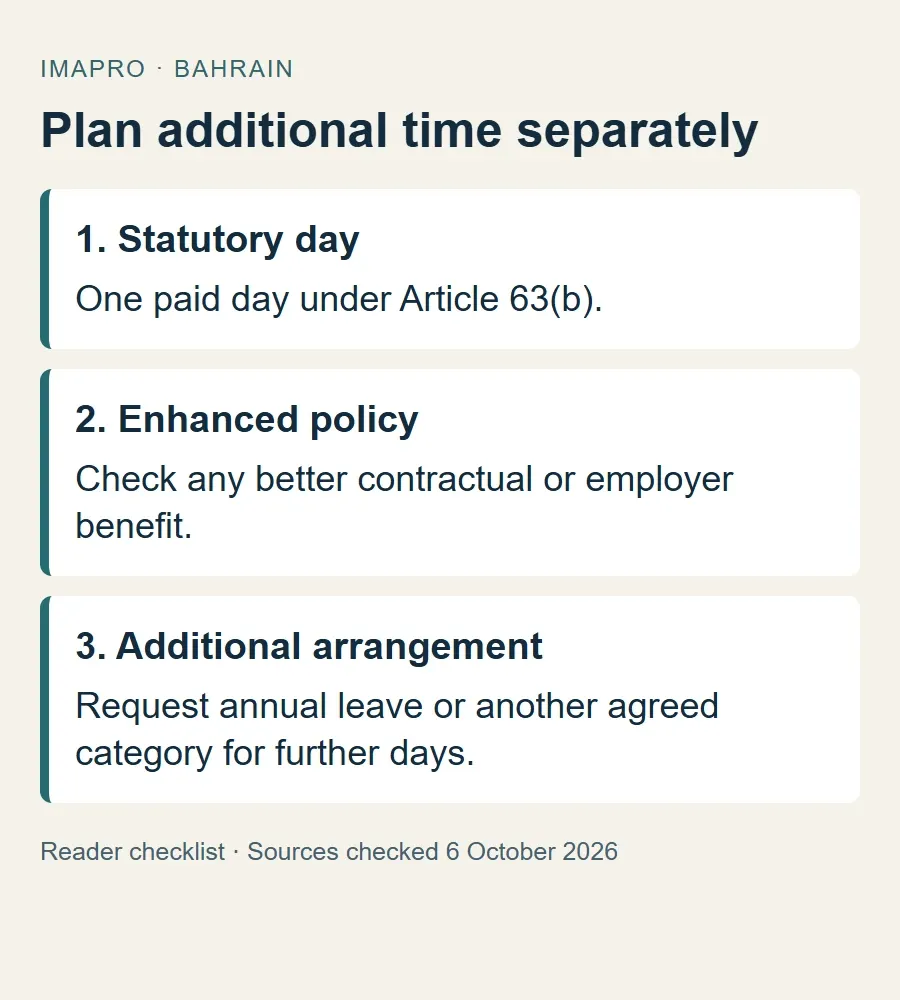
One paid day may be less than the time you want around a birth. Start with any enhanced company paternity or parental benefit. If that is insufficient, discuss annual leave or another expressly agreed arrangement. Identify the requested dates and the category for each day so an extended absence is not mistakenly assumed to be fully paid under Article 63.
Article 58 provides the ordinary annual-leave entitlement, including proportionate leave for service under a year. Article 59 addresses scheduling according to business requirements and contains other leave rules. A worker who has not yet reached the first anniversary should not assume that no annual leave has accrued, but accrual and approval of particular dates are different questions. Request the balance and scheduling decision rather than simply adding extra days to a birth-leave message.
If unpaid leave or a temporary flexible arrangement is agreed, record its duration and pay effect. Clarify the expected return date and any work obligations during the arrangement. Working remotely is not automatically leave, and a day spent performing normal duties should not be casually described as a day off without clarifying the arrangement. These are matters to agree transparently; they are not additional paternity entitlements created by Article 63. See Articles 58, 59 and 63.
Birth on a rest day, travel and other timing questions
The one-day provision is brief. It does not expressly state a detailed carryover rule when the birth occurs on a weekly rest day or public holiday. Article 64 contains a substitute-day rule for specified official holidays, but that does not automatically establish an identical rule for birth leave. Ask HR to confirm the treatment under the applicable policy, and obtain clarification if the statutory entitlement is disputed.
If the birth is outside Bahrain, explain the circumstances and ask what evidence and date arrangement the employer will accept. Do not treat international travel days as automatically included in the statutory day. Travel may require separately approved annual leave or another arrangement. The text of Article 63(b) does not itself provide a special travel allowance or a country-specific document procedure.
Similarly, avoid multiplying the statutory day by the number of children born without a verified basis. The provision does not lay out a multiple-birth calculation, adoption-leave scheme or detailed rules for every possible family circumstance. Where your situation falls outside the straightforward wording, identify the actual policy or obtain case-specific clarification rather than relying on an unsupported online promise.
Check the attendance and payroll record afterwards
Once the leave is processed, confirm that the day has been recorded in the intended paid category. Look for an accidental annual-leave deduction or an unpaid-absence entry. If a mistake appears, send HR the approved request and identify the exact entry that needs correction. A concise record-based request is easier to resolve than a general complaint that the salary is wrong.
Where the employer disputes coverage or entitlement, ask for the reason in writing. The issue may be the employment regime, the requested date, missing evidence or confusion with an enhanced company policy. Address that specific point using the contract, policy and Article 63. Keep the evidence and avoid assuming that a verbal response is the final legal position.
For expatriate workers who need help identifying a suitable support route, the official LMRA Expat Protection Centre brochure lists assistance with workplace rights and labour-case guidance at 995. This is a support contact, not a promise that every leave dispute is resolved through the same administrative process.
Paternity leave in Bahrain: common questions
How many days of paternity leave does the private-sector law provide?
Article 63(b) provides one paid day when a child is born to the worker. A more generous contract or employer policy should be checked separately under Article 4.
Is it three days?
The three-day provisions in Article 63(a) concern marriage and specified bereavement events. Birth-related leave is addressed separately in Article 63(b), which provides one day.
Can my employer ask for proof?
Yes. Article 63(d) permits the employer to request evidence of the relevant event. Ask what evidence is accepted and how to submit it, especially if the final document is not available immediately.
Must I complete a year of employment first?
Article 63 does not state a one-year qualifying period for the birth-related day. Do not import the annual-leave wording into this entitlement. Check any separate conditions attached to an enhanced company benefit.
Does this replace the mother's maternity leave?
No. The law addresses maternity under separate provisions. This guide concerns the one-day birth-related entitlement and does not replace an assessment of maternity rights.
Where can I check the legal text?
Use the official Arabic consolidation of Law 36/2012 and the official amendment register. These were checked on 6 October 2026. Public-sector and domestic-worker arrangements must be checked separately because Article 2 limits the law's scope.