Reel hooks: how to write an opening that fits your video

Write the hook after you know what the video delivers. Name the real result, put it in your opening words and show the same subject in the first frame. If the line promises a result that never appears, rewrite the line. You do not need a dramatic claim to make a clear start.
Here is a repeatable way to do it with any short video. We will use an authored example: a pottery clip that starts with clay on a wheel and ends with a finished cup. The worksheet below is a draft we made for this guide, not a test of views or reach.
Before you start
Start with the finished clip or a rough cut that shows the ending. Instagram lets you make a reel from recorded clips or a video in your gallery. This exercise ends with one opening sentence and one first-frame choice fitted to your footage.
Step 1: write the result your clip actually shows
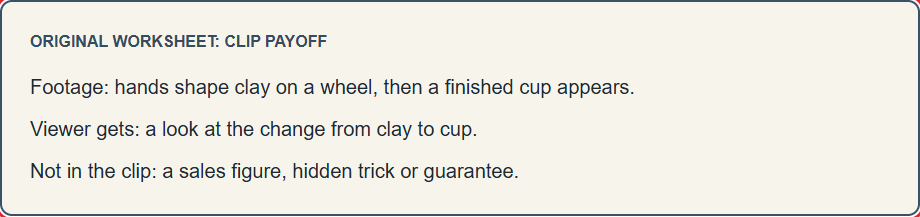
Watch the end first. Write one plain sentence about what a viewer will see or learn. In our pottery example, the clip shows clay being shaped into a cup. It does not show a business result or a secret method. Use that visible result as the promise.
Step 2: write an opening the footage can support
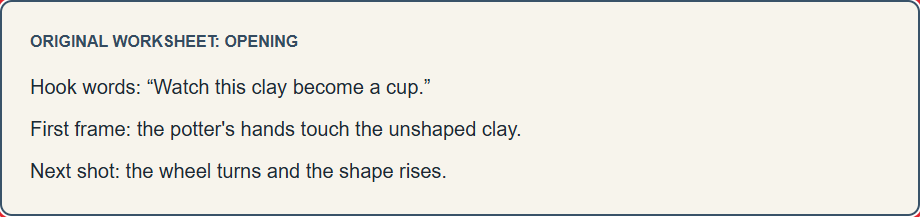
Turn that result into a short line. For our pottery example, the words name the change from clay to cup. The first frame shows the clay and the hands at work. A vague opening leaves the viewer guessing. Let the first image and the words point to the same thing.
If you want text on the video, Instagram has offered fonts and outlines for Reels text. Meta's Edits app also has a teleprompter if you prefer to say the opening aloud. These are ways to show or speak the line, not reasons to change its promise.
Step 3: check the promise against the rest of the clip
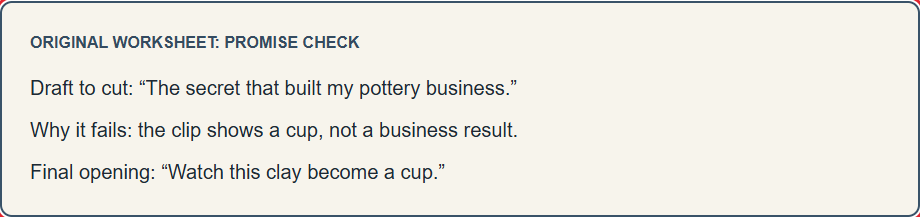
Play the opening without sound, then watch the whole video. Ask whether the first frame, the line and the ending belong together. Cut words that promise more than the footage shows. In our pottery example, a claim about business growth would be a poor fit. The clip ends with a cup. Keep the useful promise and cut the extra claim.
Match the opening to your kind of video
Use these invented script examples as starting points, then write the ending of your own clip before borrowing an opening. They are examples of wording, not measured results.
QUICK TUTORIAL
Clip: a wide photo becomes a square crop
Opening: Make this photo fit a square post
First frame: the wide photo before cropping

PRODUCT DEMO
Clip: a bottle lid closes
Opening: Here is how this lid closes
First frame: a close view of the open lid

PERSONAL STORY
Clip: a market walk leads to a meal at home
Opening: What I cooked after this market trip
First frame: the market stall where the story starts

REVEAL
Clip: a messy desk becomes clear
Opening: This desk looked different by the end
First frame: the desk before it was cleared
Ask a writing assistant for alternatives without inventing results. Copy this prompt, then compare every suggestion with your actual clip.
My video shows [what happens at the start] and ends with [actual result].
Suggest three short opening lines and a matching first frame.
Do not promise anything the footage does not show.
If you keep ideas in Meta's Edits app, its Ideas tab can place saved Reels beside sticky notes. Instagram's Best Practices area also has creation guidance about capturing attention. Neither replaces the simple check: does your opening match your video?
Frequently asked questions
Does every reel need a question hook?
Try a line that names the result, a clear first image or a genuine question. Choose the one your footage actually answers or shows.
What if the video has no big reveal?
Say what it does have. For a demonstration, start with the task it completes. For a personal clip, start with the moment that begins its story.
Official sources
Source: Introducing Best Practices, an Education Hub for Creators on Instagram.
Source: New Ways to Create Content on Instagram.
Source: One Year of Edits: Built For and With Creators.
Source: Introducing Instagram Reels.