Practical guide
How many hours can you legally work in Bahrain?
By Gaurav Agarwal · Updated 11 October 2026
Private-sector staff may work 48 hours a week and 8 hours a day, and never more than 10 actual hours in a day. Take at least 30 minutes of breaks so you never work more than 6 hours straight. You get at least 24 hours of weekly rest, Friday by default. These rules cover private-sector employees only, not government staff or domestic workers such as drivers, cooks and nannies.
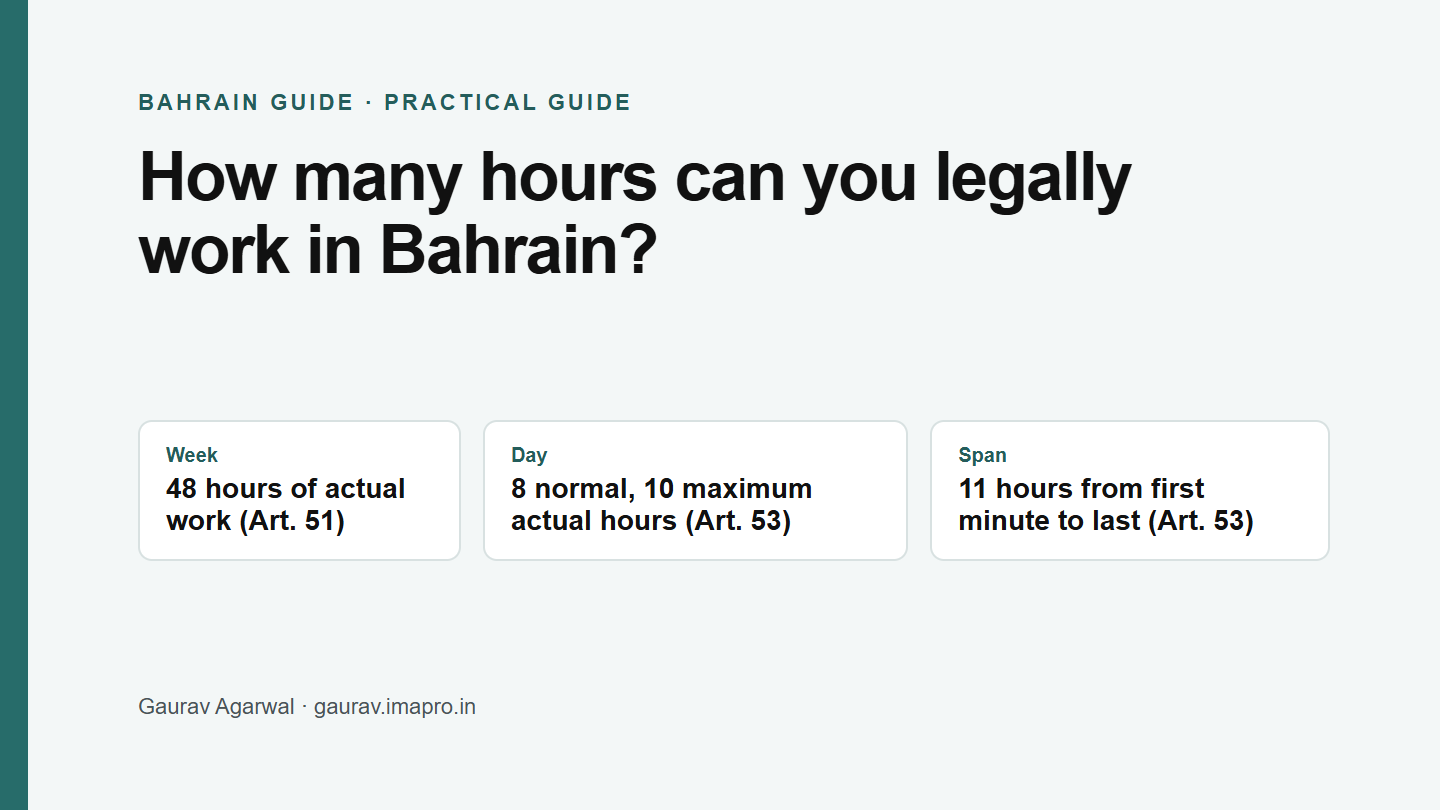
01Bahrain working hours at a glance
Private-sector hours come from Law No. 36 of 2012, Articles 51 to 57. The law does not cover government employees (Article 2(a)) or domestic workers such as gardeners, house security guards, nannies, drivers and cooks (Article 2(b)).
The English text is an unofficial translation, and the Arabic text prevails. Imapro is an independent guide, not a government site. If you prefer a web page to a file download, the same law is on the LMRA Labour Law page.
| Limit | What the law says | Article |
|---|---|---|
| Weekly hours | No more than 48 hours of actual work in a week | 51(a) |
| Normal day | 8 hours of actual work unless otherwise agreed | 53(a) |
| Daily maximum | No more than 10 hours of actual work a day | 53(a) |
| Daily span | From start of work to end, no more than 11 hours (12 for intermittent jobs the Minister designates) | 53(b), 53(c) |
| Break | Rest totalling at least 30 minutes, so no more than 6 hours of work in a row | 52(a) |
| Weekly rest | At least 24 hours, Friday by default | 57(a) |
| Ramadan | Muslim worker: no more than 6 hours a day or 36 a week | 51(b) |
02Which hours rule applies to me?
The hours rules differ by who you are. Find your row first, then read the sections below.
| Who you are | What applies | Article | What to do next |
|---|---|---|---|
| Private-sector employee | The 48-hour week, 8 and 10-hour day, 11-hour span, breaks and weekly rest | 51 to 57 | Check your posted schedule (Article 55). |
| Muslim employee in Ramadan | No more than 6 hours a day or 36 a week | 51(b) | Ask your employer in writing how it applies to you. |
| Security guard, cleaner, preparatory or supplementary worker, authorised agent | Articles 51 to 53 do not apply. For guards, cleaners and preparatory workers the Minister sets maximum hours and overtime wages by resolution, never below the Article 54 rate | 56 | Ask your employer which ministerial resolution covers your job. |
| Worker aged 15 to 18 | No more than 6 hours of active work a day, no night work, no weekly rest days or public holidays | 23 to 26 | Check your schedule against these limits. |
| Domestic worker (gardener, house security guard, nanny, driver, cook) | The hours rules in Articles 51 to 57 do not apply | 2(b) | Read your contract for your hours and rest. |
| Government employee | This law does not apply if you are under civil or military service rules or a special legal system | 2(a) | Check your service regulations. |
03Why 48, 10 and 11 hours are three different rules
Article 51 caps actual work at 48 hours a week. Article 53(a) sets an 8-hour normal day unless you agreed otherwise, and a 10-hour maximum of actual work. Article 53(b) adds an 11-hour limit from your first minute of work to your last. Article 53(c) lifts that span to 12 hours for intermittent jobs that a ministerial resolution designates.
Rest counts toward the 11 hours if you stay at the workplace during it.
Worked example: you work 08:00 to 17:30 with one 30-minute break. Actual work is 9 hours, under the 10-hour cap, and the span is 9.5 hours, under 11. Article 54 does not define extra hours. If your employer treats the 9th hour as extra, the minimum for it is your wage plus 25%. Article 53(a) lets you agree a normal day longer than 8 hours, so check your contract.
Security guards, cleaners, preparatory workers and authorised agents fall outside Articles 51 to 53 (Article 56).
04How long must breaks be, and what is your weekly rest?
Article 52 requires rest intervals of at least 30 minutes in total, so you never work more than 6 hours in a row. Rest does not count as working hours.
Article 57 gives at least 24 consecutive hours of weekly rest. Friday is the default, but an employer may move the day for some workers.
- Note your start, finish and break times each day.
- Check that a break comes before your sixth hour of work.
- Count the 11 hours from first minute to last, breaks included.
- Find the posted table that shows your day off.
05Overtime pay: rates and a worked example
Article 54 lets an employer ask for extra hours when business needs it. Extra hours are paid at least your wage plus 25% by day, or 50% by night. Your contract can pay more.
Article 1 defines night as 7.00 pm to 7.00 am.
Worked example: two extra hours from 6pm to 8pm at a wage of BD 5 an hour. The 6pm to 7pm hour is at least BD 6.25. The 7pm to 8pm hour is at least BD 7.50. The minimum total is BD 13.75.
Article 64 gives paid leave on Eid and official occasions set by a Council of Ministers edict. If your employer needs you to work one of those days, you are paid 150% of your wage for the days worked, or given substitute leave, as you elect.
Article 40 sets wage timing. Monthly pay must be paid at least once a month. If you resign, final pay is due within 7 days. Late pay earns 6% a year, rising to a maximum of 12%. The official amendments list shows no change since August 2021.
| When you work | What you are owed | Article |
|---|---|---|
| Extra hour in the day | Your wage plus at least 25% | 54 |
| Extra hour at night, 7pm to 7am | Your wage plus at least 50% | 54 and 1 |
| Your weekly day of rest | That day's wage plus 150% of it, or another day off as you choose | 57(b) |
| Eid or an official holiday | 150% of your wage for the days worked, or substitute leave, as you elect. A holiday that falls on a Friday or another public holiday is replaced by a day in lieu | 64 |
06Ramadan hours and rules for young workers
Article 51(b) says a Muslim worker may not work more than 6 hours a day or 36 hours a week during Ramadan, except where the law itself provides otherwise.
The text does not say whether non-Muslim staff get the same cut, and it does not mention Ramadan pay. Ask your employer to confirm both in writing.
Example: on a six-day week, a 36-hour Ramadan cap means no more than 6 hours a day.
Workers aged 15 to 18 may not actively work more than 6 hours a day, may not work at night, and may not work on weekly rest days or public holidays (Articles 23 to 26).
07The summer midday outdoor work ban
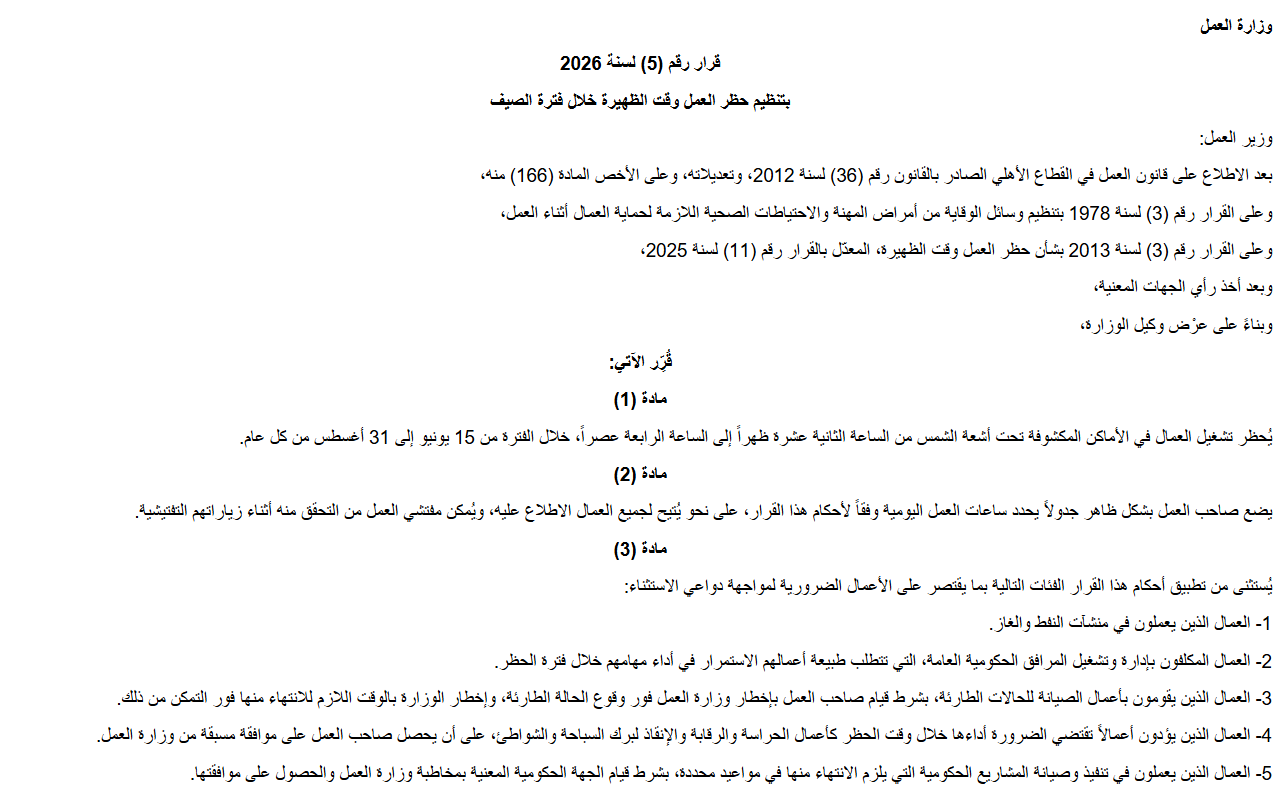
This ban is separate from the hours law. Labour Minister's Decision No. 5 of 2026, issued on 2 April 2026, bans work in open places in direct sunlight from 12pm to 4pm, from 15 June to 31 August each year. It repeals Decision No. 3 of 2013 (Article 6).
Employers must post a daily working-hours schedule at each worksite, where workers can read it and labour inspectors can check it (Article 2).
Article 3 lists five exemptions, limited to the work that is necessary: (1) oil and gas facilities; (2) running public government facilities that must keep operating during the ban; (3) emergency maintenance, if the employer notifies the Ministry of Labour at once; (4) guarding, monitoring and pool or beach rescue work, with the Ministry's prior approval; (5) government projects with fixed deadlines, if the government body writes to the Ministry and gets approval.
Where an exemption is used, Article 4 requires extra heat protection, such as a safe rest area, more rest breaks, drinking fluids, shade and ventilation, and medical help if a worker suffers heat stress.
Breaking the ban is punished under Article 192 of Law No. 36: up to 3 months in prison, a fine of BD 500 to BD 1,000, or both. The 2026 window has ended, and the ban repeats every year.
- Ask for the posted daily schedule at your site.
- If you work outdoors in direct sunlight from 12pm to 4pm, ask which exemption covers your job, and whether the Ministry was notified or gave approval where one is needed.
- If the rule is broken, use the Ministry of Labour complaint service (see the last section).
08Common online claims, checked against the law
Check these common claims before you rely on them.
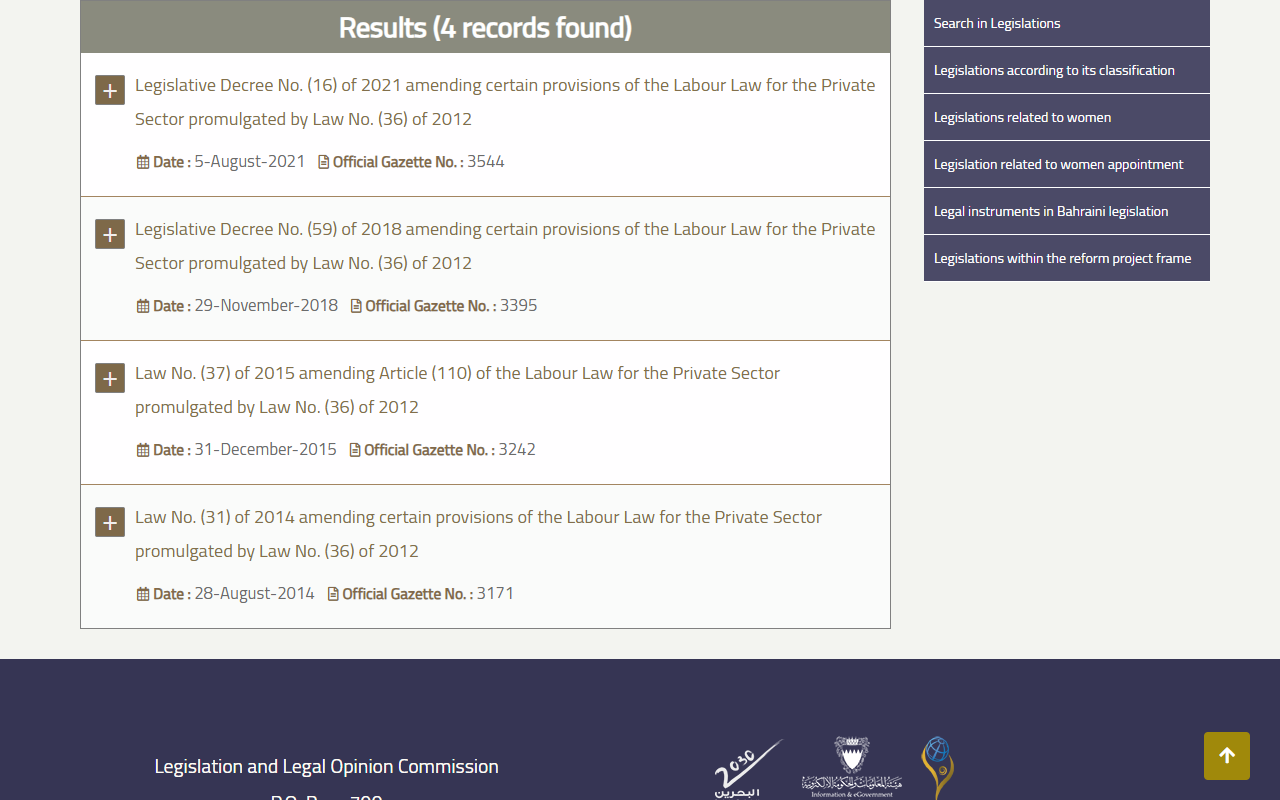
The LLOC list of amendments to Law No. 36 of 2012, updated 1 October 2026, shows four amending laws and decrees. The latest is Legislative Decree No. 16 of 2021.
| Claim you may see | What the official text shows |
|---|---|
| 60 hours a week including overtime | Not in the text. The limits are 48 hours of actual work a week and 10 a day (Articles 51 and 53). |
| Overtime capped at 2 hours a day | Not in the text. The cap is 10 hours of actual work a day (Article 53(a)). |
| Break after 5 hours | No more than 6 hours of work in a row, with at least 30 minutes of rest (Article 52). |
| Ramadan hours come with no pay cut | Not in the text. The law sets hour limits for Muslim workers and does not mention pay (Article 51(b)). |
| Rest-day or holiday pay of 200% | Not in the text. Work on your weekly day off earns that day's wage plus an extra 150% of it, or another day off, as you choose (Article 57(b)). Work on Eid or an official holiday is paid 150%, or you take substitute leave, as you elect (Article 64). |
| Weekly rest rises to 48 hours | Not in the text or the official amendments list. The minimum is 24 hours (Article 57(a)). |
09Your basic rights on hours, and where to get help
The hours rules give you these basic rights. If your employer breaks them, the Ministry of Labour runs a labour complaint service for private-sector workers. The page lists no fees and a 5 working day service level. You must currently be employed, registered with your employer and hold a valid work permit when you file. You can attend in person, phone 17873637 or 17873919, or use the Ministry website, and the page lists the hotline 80008001.
- Breaks totalling at least 30 minutes, with no more than 6 hours of work in a row (Article 52).
- At least 24 consecutive hours of weekly rest (Article 57).
- Extra hours paid at least your wage plus 25% by day and 50% by night (Article 54).
- Pay of 150%, or substitute leave, if you work on Eid or an official holiday (Article 64).
- A posted table showing your day off, hours and rest periods (Article 55).
10FAQs
What are the working hours in Bahrain?
A normal day is 8 hours of actual work, and the week is at most 48 hours (Articles 51 and 53). Actual hours cannot pass 10 a day, and the span cannot pass 11.
What is the maximum working hours as per labour law?
48 actual hours a week and 10 actual hours a day, with an 11-hour span (Articles 51 and 53). Intermittent jobs that a ministerial resolution designates may have a 12-hour span (Article 53(c)).
Is overtime paid in Bahrain and at what rate?
Yes. Extra hours are paid at least your wage plus 25% by day or 50% by night (Article 54). Day-off work earns that day's wage plus an extra 150% of it, or another day off, as you choose (Article 57(b)). Work on Eid or an official holiday is paid 150%, or you take substitute leave (Article 64).
How many hours can a Muslim employee work during Ramadan in Bahrain?
No more than 6 hours a day or 36 hours a week, except where the law itself provides otherwise (Article 51(b)). Ask your employer in writing whether this applies to you.
Is there a summer midday outdoor work ban in Bahrain?
Yes. Open-air work in direct sunlight is banned from 12pm to 4pm, 15 June to 31 August each year, with listed exemptions (Decision No. 5 of 2026).
Do Bahrain employees get a weekly day off, and which day is it?
Yes, at least 24 consecutive hours. Friday is the default, but an employer may change the day for some workers. Your posted table shows your actual day (Article 57).
How long is the break during working hours in Bahrain?
Rest intervals must total at least 30 minutes, so you never work more than 6 hours in a row (Article 52).
Can an employer make staff work on their day off in Bahrain?
Yes, if needed. You are owed that day's wage plus 150%, or another day off as you choose. Without written consent, you cannot be required to work your day off more than two times in a row (Article 57(b)).
11Official sources
- Labour Law No. 36 of 2012, English text (LLOC)
- Labour Law PDF (LMRA)
- Labour Law page (LMRA)
- Amendments to Law No. 36 of 2012 (LLOC)
- Decision No. 5 of 2026, Arabic text (LLOC)
- Labour complaint service for private-sector workers (Ministry of Labour)
Official details checked 11 October 2026.
Related guides: Ramadan working hours in Bahrain · Bahrain overtime calculation · Bahrain Labour Law guide · LMRA contact number