Bahrain employment and education guides
Ramadan Working Hours in Bahrain: Private and Government Rules
By Gaurav Agarwal · Sources checked 6 October 2026
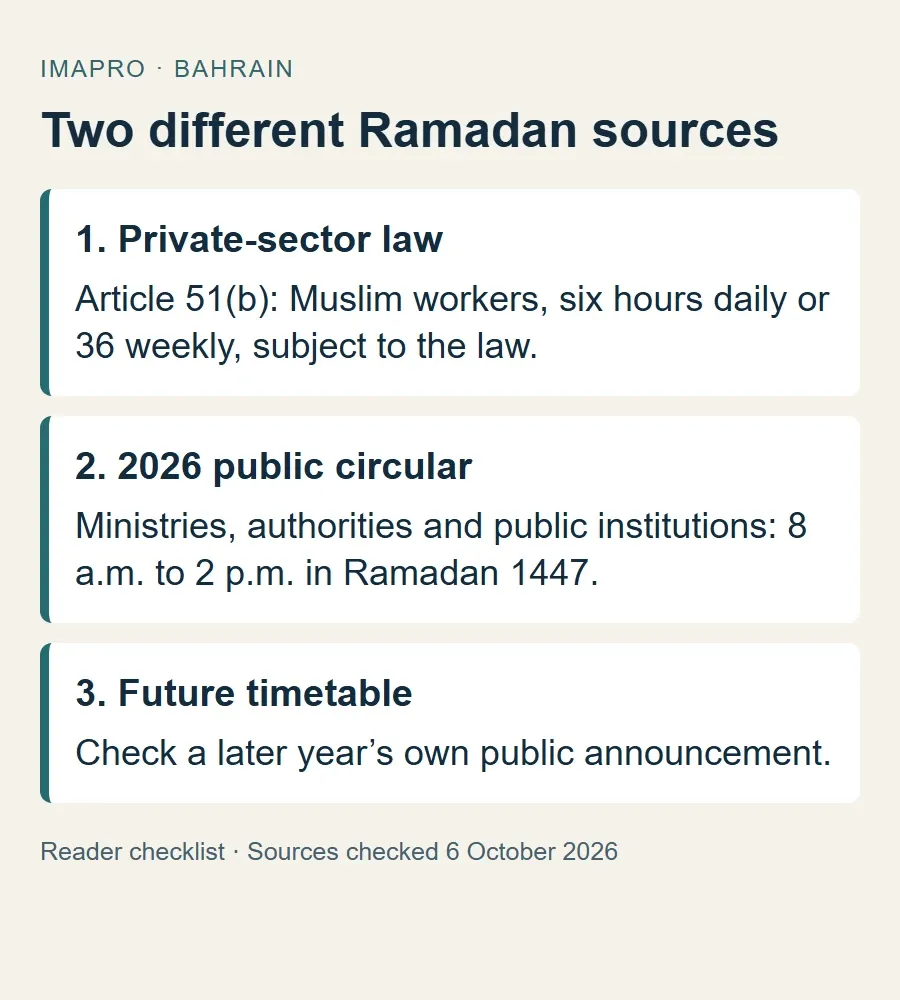
Article 51(b) sets a Ramadan limit of six hours a day or 36 a week for Muslim workers covered by the ordinary private-sector provisions, subject to statutory cases and exceptions. The 2026 government circular separately set 8 a.m. to 2 p.m. for ministries, authorities and public institutions.

Jump to a section
For a Muslim worker covered by Bahrain's ordinary private-sector working-hours provisions, Article 51(b) sets a Ramadan limit of six hours a day or 36 hours a week, subject to the cases provided by the law. This permanent statutory rule is different from the annual circular setting office hours for government ministries and public bodies. It does not mean that every business must open from 8 a.m. to 2 p.m.
This guide was checked on 6 October 2026 against the official Arabic Labour Law, its amendment register and the Prime Minister's Office announcement for Ramadan 1447 in 2026. A later Ramadan's government timetable must be checked when its own circular is issued.
The private-sector rule is in Article 51(b)
Article 51(b) of Law No. 36 of 2012 refers specifically to a Muslim worker during Ramadan. Its ordinary maximum is six hours per day or 36 per week, with the statutory qualification for cases provided by the law. The provision does not use a blanket two-hour reduction formula for every possible work schedule. If a worker normally has a shorter day, subtracting two hours automatically is not the rule stated in this article.
The wording also does not say that the legal entitlement depends on a worker demonstrating that they are fasting on a particular day. It identifies the worker as Muslim. Do not replace that wording with an invented daily fasting test. Conversely, the text does not extend this particular statutory limit to every non-Muslim employee. An employer may choose to give a common shorter schedule to the whole team, or provide a better contractual benefit, but that should be described as the applicable employer arrangement.
Article 4 preserves better benefits established by employment agreements, company rules or practice. Ask for the actual Ramadan schedule and applicable policy so you can distinguish the statutory minimum from the benefit offered at your workplace. The primary references are Articles 4 and 51(b).
What the 2026 government circular covered
The Prime Minister's Office announcement dated 11 February 2026 states that working hours during Ramadan 1447 were 8 a.m. to 2 p.m. for the Kingdom's ministries, authorities and public institutions. That is a dated government-office arrangement. It should not be used as evidence that all private-sector employers had to adopt those exact start and finish times.
Article 2(a) of the Labour Law excludes government employees and public-entity staff governed by civil-service, military-service or special employment systems. The two sources therefore answer different questions: Article 51(b) addresses the covered private-sector worker's Ramadan hours; the PMO circular addresses the stated public bodies' timetable for that year.
If you are planning around Ramadan 2027 or a later year, check the new government announcement when available. Do not reuse the 2026 date or timetable as though it were a confirmed future circular. For an appointment, also check the individual service's published opening hours because public counter hours and an employee's working schedule need not be identical.
Actual working hours and breaks are different
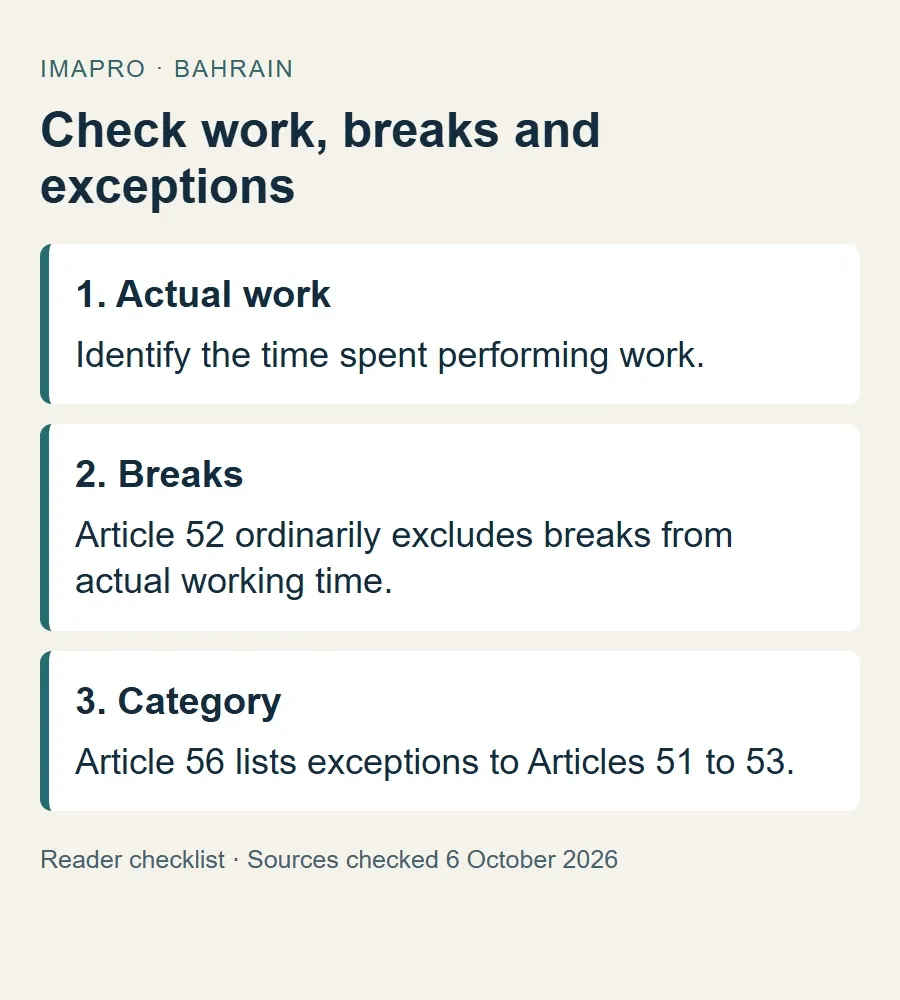
Article 52 ordinarily requires one or more breaks for prayer, meals and rest totalling at least 30 minutes, arranged so that a worker does not work more than six continuous hours. The breaks are not counted as actual working hours. The law provides for ministerially determined exceptions for technical or operational reasons and for specified difficult or exhausting work.
This distinction matters when reading a rota. A span between arrival and departure can include a genuine break that is not actual work. At the same time, simply naming a period a break does not explain what an employee is actually required to do during it. If you must continue handling calls or performing tasks, raise the practical arrangement rather than relying only on the label in the timetable.
Ask your employer to show the start time, finish time, actual work and breaks separately. That makes the schedule easier to compare with the applicable rule. It also prevents an avoidable misunderstanding in which someone assumes six actual working hours must always mean exactly six hours between entering and leaving the premises. The statutory reference is Article 52, read with the relevant working-hours provisions.
Check exceptions before applying a general hours chart
Article 56 excludes certain categories from Articles 51, 52 and 53: the employer's authorised agents, workers undertaking preparatory or supplementary work that must happen before or after ordinary hours, and guards and cleaners. It provides for ministerial rules governing maximum actual and additional hours and additional pay for the latter two categories. A generic six-hour graphic without this qualification would be incomplete.
Do not infer that every manager is an authorised agent, or that a job title alone resolves the applicable exception. The actual role and relevant rules need checking. This guide does not provide category-specific maximums because the implementing orders for those categories were not verified for a numerical comparison.
Article 54 permits additional hours where business circumstances require them and sets additional-pay provisions. The six-hour Ramadan rule should therefore not be presented as an unconditional statement that no covered employee can ever work an extra hour. Where additional work is requested, identify the applicable category, actual hours and payroll treatment. Keep the detailed overtime calculation separate from the basic Ramadan schedule question. See Articles 51, 54 and 56.
Domestic workers need a separate scope check
Article 2(b) extends selected parts of the Labour Law to domestic workers, but Articles 51 to 57 are outside that list. A household worker therefore should not be promised the ordinary six-hour Ramadan maximum on the basis of Article 51 alone. The contract and other applicable protections must be checked separately.
The LMRA domestic employer undertaking includes fields for hours per day and days per week, together with commitments concerning dignity, living conditions, healthcare and other matters. The existence of those fields is not a universal numeric Ramadan-hours rule. Also distinguish a household worker from a commercial employee whose role happens to involve driving, cleaning or gardening.
How to check your Ramadan schedule
- Identify your employment category and the rules covering it.
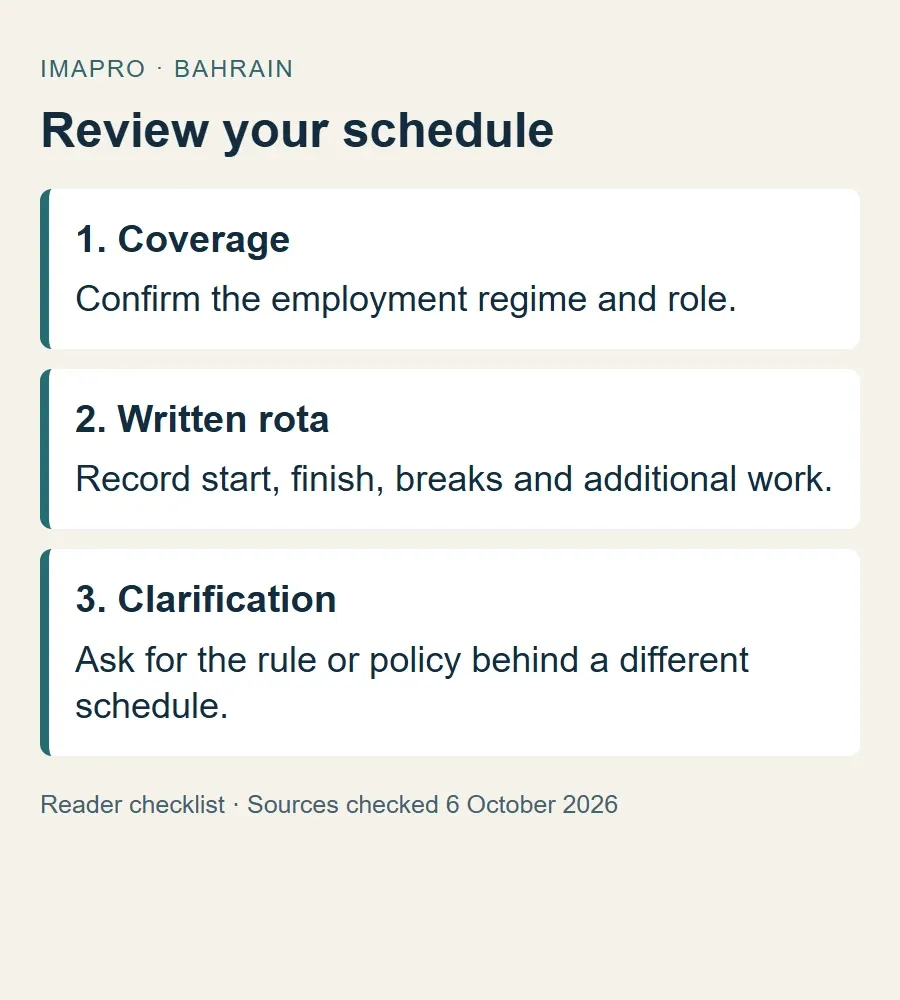
- Obtain the written Ramadan rota or policy, including start time, end time and breaks.
- Separate actual work from breaks and record any additional work requested.
- Ask which statutory exception or employer benefit applies if the schedule differs from the ordinary rule.
- Keep attendance and payroll records if you need to question the treatment later.
A specific question is more useful than saying the schedule looks wrong. For example: the rota shows seven hours between arrival and departure; please confirm the actual working time, the break period and the rule used for this role during Ramadan. The response should help establish whether the issue is a misunderstanding of the timetable, an exceptional category or a substantive hours concern.
Article 55 requires an employer to display the weekly rest day, working hours and rest periods, with changes. Use that published schedule together with your own records. If a concern remains, request a written explanation and seek appropriate labour guidance. Do not assume a social-media image about another Gulf country's rules establishes the Bahrain position.
Ramadan working-hours questions
Are reduced hours mandatory for every religion?
Article 51(b) specifically refers to Muslim workers. An employer can provide a broader benefit, but the statutory wording should not be described as applying to all religions without qualification.
Does every private business have to work from 8 a.m. to 2 p.m.?
No such universal private-business timetable is established by the 2026 PMO announcement. That circular concerns the specified ministries, authorities and public institutions. Private-sector coverage comes from the Labour Law and applicable rules.
Are breaks included in the six hours?
Article 52 ordinarily excludes breaks from actual working hours and sets break requirements, subject to its exceptions. Check the actual schedule and what happens during the purported break.
Is the 2027 government schedule confirmed here?
No. The government circular verified here is the one announced on 11 February 2026 for Ramadan 1447. A future-year timetable needs its own official announcement.
What are the legal sources?
The official Arabic Labour Law, the LLOC amendment register and the linked PMO announcement, checked on 6 October 2026. The Arabic text, scope provisions and exceptions should be read together.