
How to Write a Marketing Plan: A One-Page Plan for a Small Business (2027)
To write a marketing plan for a small business, put one measurable goal, one target customer, one clear offer, two marketing channels, a simple budget, and a four-week schedule onto a single page. You do not need a long corporate document or a marketing team to get results. A focused one page marketing plan takes a few hours to finish and gives you a clear list of actions to test over the next 30 days.
What is the difference between a marketing plan, a marketing strategy, and a business plan?
A business plan explains how your entire company makes money, a marketing strategy defines who you serve and why they choose you, and a marketing plan lists the exact actions you will take to win those customers. Many small business owners mix all three into one messy file and stall before they start.
- Business plan: Covers your whole company, including legal setup, rent, staffing, suppliers, and financial projections.
- Marketing strategy: Sets the big-picture direction, including your ideal buyer, your core promise, and how you stand out from local competitors.
- Marketing plan: Turns that strategy into a short-term calendar of tasks, owners, budgets, and numbers to check.
Keep operational projects, like renovating your shop, hiring a cashier, or buying new kitchen equipment, in your business plan. Your marketing plan should only hold activities that bring in new inquiries, turn them into sales, or bring past buyers back.
What goes into a one page marketing plan template?
A practical marketing plan template for a small business needs nine short sections that fit on a single sheet of paper or one screen. Keeping everything on one page forces you to choose only the work you have time to finish. Copy the table below into a document or notebook and fill in the middle column for your business.
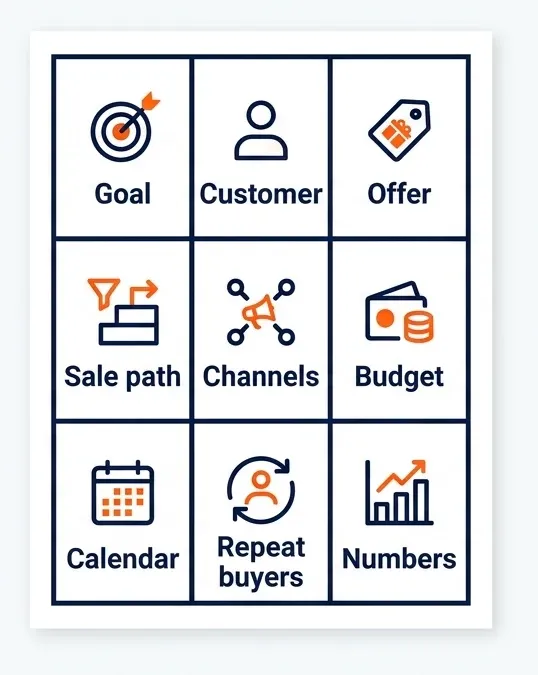
| Section | What to Write | Example Line |
|---|---|---|
| 1. One goal | Write one specific outcome with a starting number, a target number, and a deadline. | Grow direct takeaway orders from ___ to ___ per month by ___. |
| 2. One named customer | Describe one main buyer type, including where they live or work, what triggers them to buy, and who they compare you against. | Office staff in downtown who need a fast weekday lunch and compare us with nearby cafés. |
| 3. Offer and why they pick you | State what you sell and the plain-English reason a buyer chooses you over the business next door. | Hot home-style lunch boxes ready in minutes, with easy pickup and direct WhatsApp ordering. |
| 4. How a sale happens | List the exact steps from first discovery to payment so you can spot where people drop off. | Finds us on Google Maps, checks menu photos, messages us on WhatsApp, picks up and pays. |
| 5. One or two channels only | Pick the one or two places your customer already looks. Ignore every other platform for now. | Google Business Profile (the free listing on Google Maps) and Instagram. |
| 6. Budget (cash and hours) | Add up your cash spend and the hours you or your staff can realistically give each week. | Cash: ___ per month. Owner time: ___ hours per week. |
| 7. Week 1 to 4 calendar | Assign each task a person and a specific week or day. A task without an owner and a date is a wish, not a plan. | Week 1: Update Google Maps hours and photos (Owner, by ___). Week 2: Post short kitchen videos (Staff, on ___). |
| 8. Keeping customers | Write one simple way to bring buyers back and one way to ask happy buyers for a review or referral. | Place a printed card in every bag asking for a Google review and offering a free drink on the next direct order. |
| 9. Numbers to watch and review date | Pick two or three numbers tied to real sales, record your Day 1 baseline, and set one monthly review date. | Track direct orders, Google Maps calls, and new reviews. Review on the first ___ of every month. |
Download the one-page marketing plan template (PDF)
How can you finish your marketing plan this week?
You can finish your one page marketing plan in five short daily blocks of work, even if you run your business alone. Breaking the work across five days stops you from overthinking and lets you gather real facts from your daily operations.
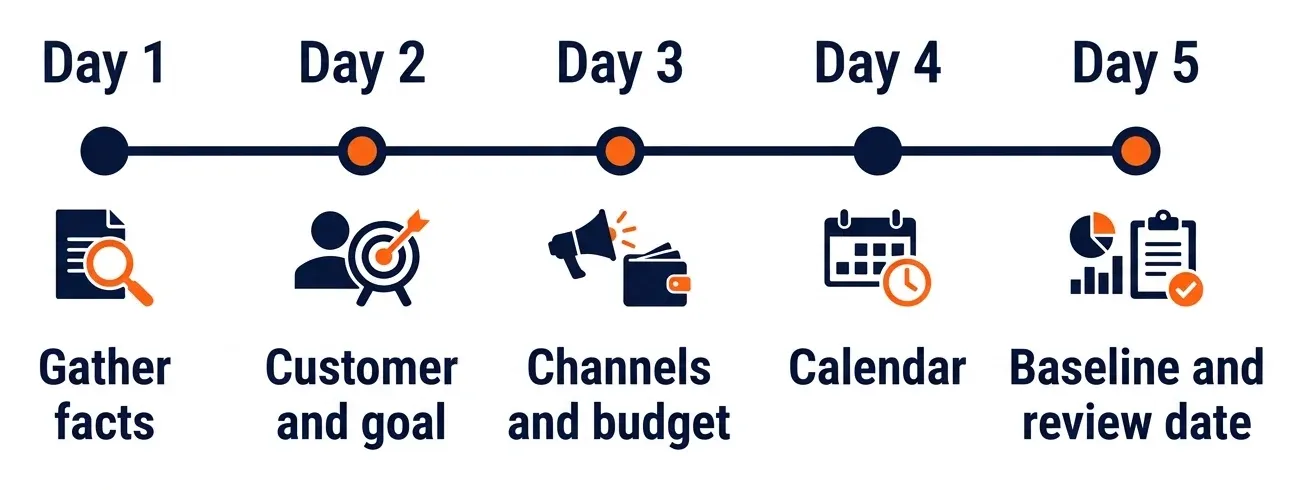
- Day 1: Gather your facts. Open your POS (point-of-sale system, the register or software that records sales), invoice book, or chat history. Write down your current monthly sales, your busiest days, and your top-selling item. Ask three recent customers why they chose you and how they found you.
- Day 2: Define your customer, offer, and goal. Fill in Sections 1 through 4 of the table above. Write in plain words your customers actually use. Avoid vague claims like "best quality" or "great service."
- Day 3: Pick your channels and set your budget. Fill in Sections 5 and 6. Choose at most two channels where your target customer already spends time. Count your available weekly hours honestly before committing to any task.
- Day 4: Build your four-week calendar and repeat-buyer step. Fill in Sections 7 and 8. Put every task on your calendar with one person's name and a specific day next to it. Writing "post on social media" without an owner or deadline rarely gets done. Decide how you will ask for a review and encourage a second purchase.
- Day 5: Lock in your baseline and review date. Fill in Section 9. Write today's starting numbers at the bottom of the page. Set a recurring calendar reminder 30 days from today, print the page, and tape it where you work.
What does a finished one page marketing plan look like?
A finished plan is short, specific, and free of jargon so anyone in your business can read it in two minutes. Below are two filled examples: a small restaurant in Manama, Bahrain, and a neighbourhood coffee shop in the United States.
Worked Example 1: Small Restaurant in Manama, Bahrain
The figures in this example are made up to show how a filled plan looks. They are not benchmarks. Use your own numbers.
- One goal: Increase direct weekday lunch orders from 120 to 160 per month and direct weekend dinner orders from 80 to 110 per month by June 30.
- One named customer: Office workers in Manama looking for a fast, filling weekday lunch, plus local families ordering dinner on weekends. They usually compare us with nearby cafés and delivery-app listings.
- Offer and why they pick you: Freshly cooked home-style meals that arrive hot, with quick WhatsApp ordering, clear prices, and easy parking outside.
- How a sale happens: Customer searches Google Maps or sees a short Instagram video, checks our menu and recent reviews, taps our WhatsApp link or walks in, and places an order.
- One or two channels only: Google Business Profile (for local search and Maps) and Instagram (short videos of daily dishes).
- Budget (cash and hours): Cash budget of BHD 60 per month (BHD 45 for small local Instagram ad boosts and BHD 15 for printing). Run the monthly ad budget through the optional Bahrain media plan estimator below and write your chosen channel split directly onto your one-page plan. Owner time of 4 hours per week, plus 2 hours per week from a staff member to film short clips.
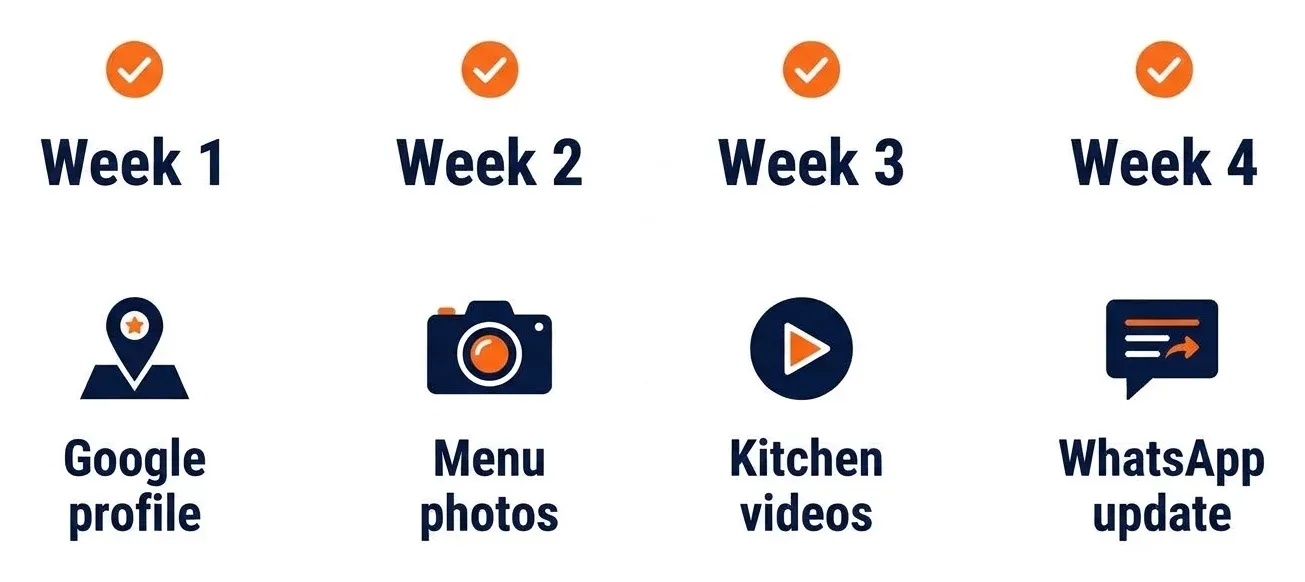
- Week 1 to 4 calendar:
- Week 1: Update Google Business Profile with current hours, clear menu photos, and a direct WhatsApp order link (Owner, by Tuesday).
- Week 2: Take 10 clear daytime photos of top lunch boxes and upload them to Google Maps and Instagram (Staff, by Thursday).
- Week 3: Film and post two short kitchen videos on Instagram targeting nearby Manama office areas (Staff, on Monday and Wednesday).
- Week 4: Send a short menu update to 45 repeat WhatsApp customers who opted in to hear about weekly specials (Owner, on Sunday).
- Keeping customers: Place one printed card in every takeaway bag thanking the diner, asking for a Google review via a QR code (a scannable square barcode), and offering a free soft drink on their next direct WhatsApp order.
- Numbers to watch and review date:
- Direct WhatsApp orders per month (Day 1 baseline: 200 combined lunch and dinner orders).
- Google Maps direction requests and calls per month (Day 1 baseline: 95).
- Total Google reviews (Day 1 baseline: 38).
- Review date: First Monday of every month.
Worked Example 2: Neighbourhood Coffee Shop in the US
The figures in this example are made up to show how a filled plan looks. They are not benchmarks. Use your own numbers.
- One goal: Grow weekday morning walk-in orders from 450 to 540 per month by August 31.
- One named customer: Local commuters and remote workers living within one mile who want fresh coffee before 9 AM and compare us with chain drive-throughs.
- Offer and why they pick you: Locally roasted coffee and warm pastries served in under three minutes, with reliable Wi-Fi and friendly counter staff.
- How a sale happens: Customer searches Google Maps for coffee nearby or passes our sidewalk sign, checks our photos and reviews, walks in, and pays at the counter.
- One or two channels only: Google Business Profile and Instagram.
- Budget (cash and hours): Cash budget of $200 per month ($150 for local ads and $50 for printed loyalty punch cards). Owner time of 3 hours per week.
- Week 1 to 4 calendar: Week 1: Refresh Google Maps hours, menu prices, and storefront photos (Owner, Monday). Week 2: Post three short morning pour videos on Instagram (Owner, Tuesday, Thursday, and Saturday). Week 3: Launch a $150 local ad test (Owner, Monday). Week 4: Leave $1-off morning coffee vouchers at one nearby yoga studio (Owner, Wednesday).
- Keeping customers: Hand out a stamp card that gives a free coffee after eight visits, and place a small counter sign asking regulars for a Google review.
- Numbers to watch and review date: Weekday morning orders (Day 1 baseline: 450), Google Maps direction requests (Day 1 baseline: 140), and total Google reviews (Day 1 baseline: 62). Review date: First Tuesday of every month.
How to cost one marketing tactic (time plus cash)
Your own time is a real business cost, even when a marketing task requires little or no cash. Before adding any tactic to your calendar, price it with this simple formula:
Total tactic cost = (Owner hours x Hourly value) + Cash cost
Here is an illustrative example using made-up figures for the US coffee shop above. Suppose the owner spends 3 hours in one month filming and posting local Instagram reels, values their own time at $35 per hour, and spends $50 in cash to boost the best video locally:
(3 hours x $35) + $50 = $105 + $50 = $155 total monthly cost
Seeing the true $155 cost helps you judge at your 30-day check whether those reels brought in enough new coffee sales to stay on the plan.
How do I split a small ad budget across channels?
Split a small ad budget by putting most of your money into the one or two channels where your buyers already search or browse, rather than spreading thin amounts across every platform.
For a US small business, an illustrative $300 monthly ad budget across two channels might look like 70% ($210) on Google Search ads to catch people searching nearby and 30% ($90) on Instagram ads to reach local residents. These figures are an illustrative example only, not financial or media-buying advice. Pick the channels your own buyers use, then adjust the split after your 30-day check.
If you run a business in Bahrain and want an optional way to test channel mixes before spending cash, you can try the free Imapro media plan estimator for Bahrain at https://www.imapro.in/bahrain/media-plan/. Here is how it works step by step:
- Enter your monthly marketing budget in BHD (Bahraini dinars).
- Set the percentage for each channel (Facebook, Instagram, Snapchat, Google Search, Google Display, LinkedIn, and Programmatic, which means automated online ad buying across websites and apps) until the total equals 100%.
- Press Generate Plan.
- Read the output table, which shows for each channel the potential reach (the number of unique people who could see your ads) and the estimated impressions (the total number of times your ads appear on a screen), clicks, leads, and spend in both dollars and BHD.
- Press Download Marketing Plan to save a copy for your records.
The tool itself states that its figures are aggregate estimates and that real results vary by industry and ad creative. Treat the table as a rough starting point to compare channel splits, then replace every estimate with your own real results after your 30-day check.
What are the most common marketing plan mistakes small businesses make?
Most small business marketing plans fail because owners copy corporate templates that demand more time, staff, and money than they have. Avoiding the mistakes below keeps your plan realistic and useful.
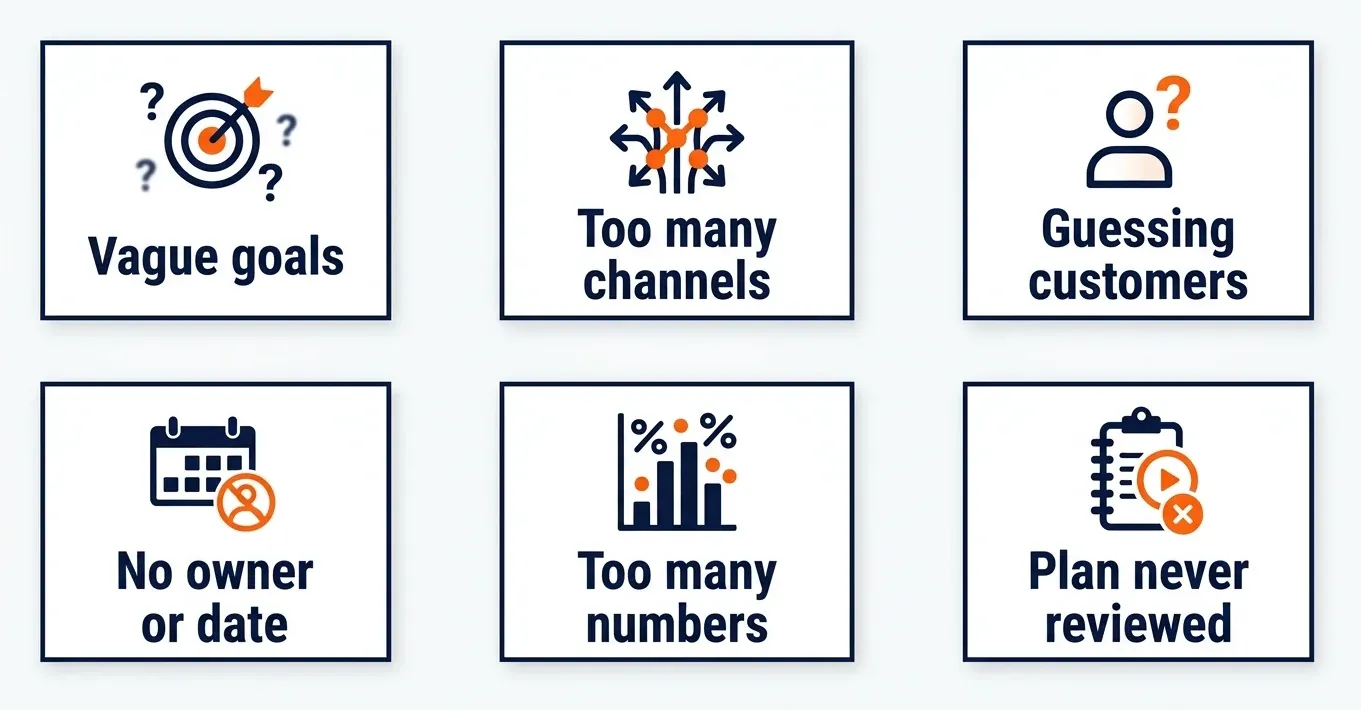
- Setting vague goals: Goals like "get more exposure" or "grow brand awareness" cannot tell you whether your work paid off. Every goal needs a starting number, a target number, and a date.
- Using too many channels at once: Trying to run a blog, email newsletter, TikTok, Instagram, LinkedIn, and paid ads alone leads to burnout. Two channels done consistently beat six channels done poorly.
- Mixing business projects into the marketing plan: Fixing your menu, painting the shop, or upgrading your accounting software are operations tasks. Keep them on a separate to-do list so they do not crowd out customer acquisition.
- Guessing about customers: Assuming you know why people buy without asking them leads to weak messaging. Talk to three recent customers and use their exact words.
- Chasing trendy tactics that do not fit your budget: A tactic that works for a national brand rarely fits a one-person shop. Only pick actions you can afford in both cash and weekly hours.
- Tracking every possible number: Watching dozens of metrics, such as impressions, profile views, and likes, creates noise. Watch two or three numbers tied directly to inquiries and sales.
- Relying on accounts you do not control: If a former freelancer or agency still owns your Google Business Profile, website domain, or ad account, get full ownership back before spending money to promote them.
- Treating the plan as a one-time document: A plan sitting in a folder does nothing. Review and update it every 30 days based on what actually brought in buyers.
How do you check after 30 days whether your marketing plan works?
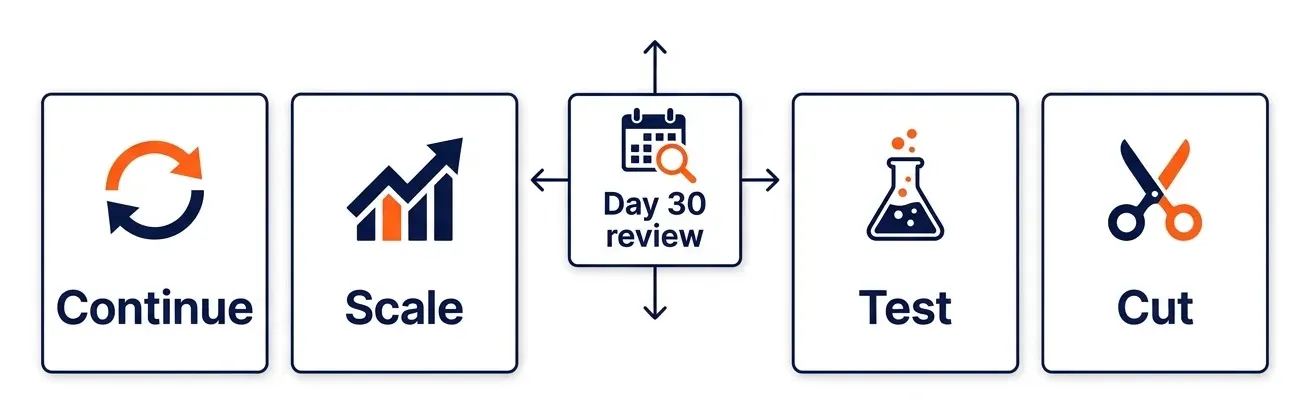
Check your plan on Day 30 by comparing your real sales and inquiry numbers against the Day 1 baseline you wrote down, then deciding what to keep or cut. Set aside a quiet block of time and follow these five steps.
- Record your Day 1 baseline before you start: You cannot measure progress on Day 30 if you never wrote down where you started. Log your starting orders, inquiries, and reviews on Day 1.
- Ask every new customer how they heard about you: Keep a simple tally at the counter or in your chat notes. Digital tools miss word-of-mouth referrals, walk-ins, and direct WhatsApp messages.
- Answer three plain questions on Day 30:
- Were the planned tasks finished on time? (Mark each task as done, late, or dropped, and note why.)
- Did we stay within our cash budget and weekly hour limit?
- Did our target numbers move compared to Day 1?
- Make one decision for each channel: Based on the numbers, not on how a campaign felt, assign every channel one of four labels:
- Continue: It brought steady results within budget; keep doing it next month.
- Scale: It clearly drove sales; give it more time or budget.
- Test a change: People saw it but did not buy; change one thing, such as the offer, photo, or call to action.
- Cut: It took time or money and produced no inquiries; stop doing it.
- Update your one-page plan for Month 2: Cross out what you cut, carry over what worked, and set your next 30-day review date.
What else do small business owners ask about marketing plans?
How much should a small business spend on marketing when cash is tight?
Start with free or low-cost actions that trade your time for visibility, such as updating your Google Business Profile, asking happy customers for reviews, and following up with past buyers. Only add paid ads once your free channels prove that people want your offer, and start with a small amount you can afford to lose while testing.
Should you write a marketing plan before or after launching your business?
Write a simple one-page version before you open so you know how you will get your first paying customers. Expect to revise it after your first 30 days of real sales, because real buyers will show you which messages and channels actually work.
How often should you rewrite your one page marketing plan?
Update your action calendar and numbers every 30 days. You only need to rewrite the whole page when your main customer changes, you launch a major new offer, or a big seasonal shift arrives.
When should a small business hire a freelancer or agency?
Hire outside help only after your own plan proves that a channel brings in profitable sales and you need to buy back your time. Handing over marketing before you know your customer, your offer, and your numbers usually wastes money.
Sources
This guide draws on small business planning frameworks and marketing plan guides from government agencies and established marketing publications.
- U.S. Small Business Administration (SBA): https://www.sba.gov/business-guide/plan-your-business/market-research-competitive-analysis
- Australian Government (business.gov.au): https://business.gov.au/planning/business-plans/develop-your-marketing-plan
- Business Development Bank of Canada (BDC): https://www.bdc.ca/en/articles-tools/marketing-sales-export/marketing/5-no-nonsense-strategies-attract-customers
- Shopify: https://www.shopify.com/blog/marketing-plan
- Ahrefs: https://ahrefs.com/blog/marketing-plan/
- Semrush: https://www.semrush.com/blog/marketing-plan/
- Asana: https://asana.com/resources/marketing-plan
- Coursera: https://www.coursera.org/articles/marketing-plan
- Forbes: https://www.forbes.com/councils/forbesagencycouncil/2021/08/05/how-to-write-a-marketing-plan/
- ROEM Digital: https://www.roemdigital.com/blog/marketing-plan-for-small-business
- Enji: https://www.enji.co/blog/the-one-page-marketing-plan-for-small-business-owners-complete-guide
Published