Bahrain finance guides
Islamic Banking in Bahrain: Accounts, Finance and Protection
By Gaurav Agarwal · Sources checked 6 October 2026
Compare the contract behind the product, not just the Islamic banking label. Check how returns or repayments work, access to money, fees, investment risk and CBB protection. Expected profit is not a guaranteed return.

Jump to a section
- 1. Identify the bank and the job you need it to do
- 2. Current account, Mudaraba or Wakala: what changes?
- 3. When is profit paid, and what happens if you leave early?
- 4. Compare actual fees and the full financing cost
- 5. What does Bahrain's account protection scheme cover?
- 6. What does Sharia review mean for the product?
- 7. A practical checklist before opening or signing
To compare Islamic banking in Bahrain, start with the contract behind the product: a current account, a profit-sharing investment account and a financing agreement create different rights and costs. Check the exact bank, how profit or repayment is calculated, access to your money, fees and applicable protection. An expected return is not a guaranteed return.
Checked 6 October 2026. This guide explains selected official bank disclosures and CBB rules. It provides general information, not personalised financial advice or a religious ruling on an individual contract.
1. Identify the bank and the job you need it to do
Begin with a specific need: receiving salary, paying bills, keeping accessible savings, investing for a fixed period or financing a purchase. Comparing products that serve different needs can hide a restriction that matters more than the advertised profit.
Use the Central Bank of Bahrain licensing directory to check the legal institution and licence category. Match that name with your account agreement. A brand name, an app listing or an Islamic label is not a substitute for knowing which entity holds your money or provides the finance.
The examples below come from Bahrain Islamic Bank, Al Salam Bank and Al Baraka Islamic Bank's own retail product documents. They illustrate different structures; they are not an exhaustive bank list or a ranking. Product terms and application decisions remain specific to the bank and applicant.
2. Current account, Mudaraba or Wakala: what changes?
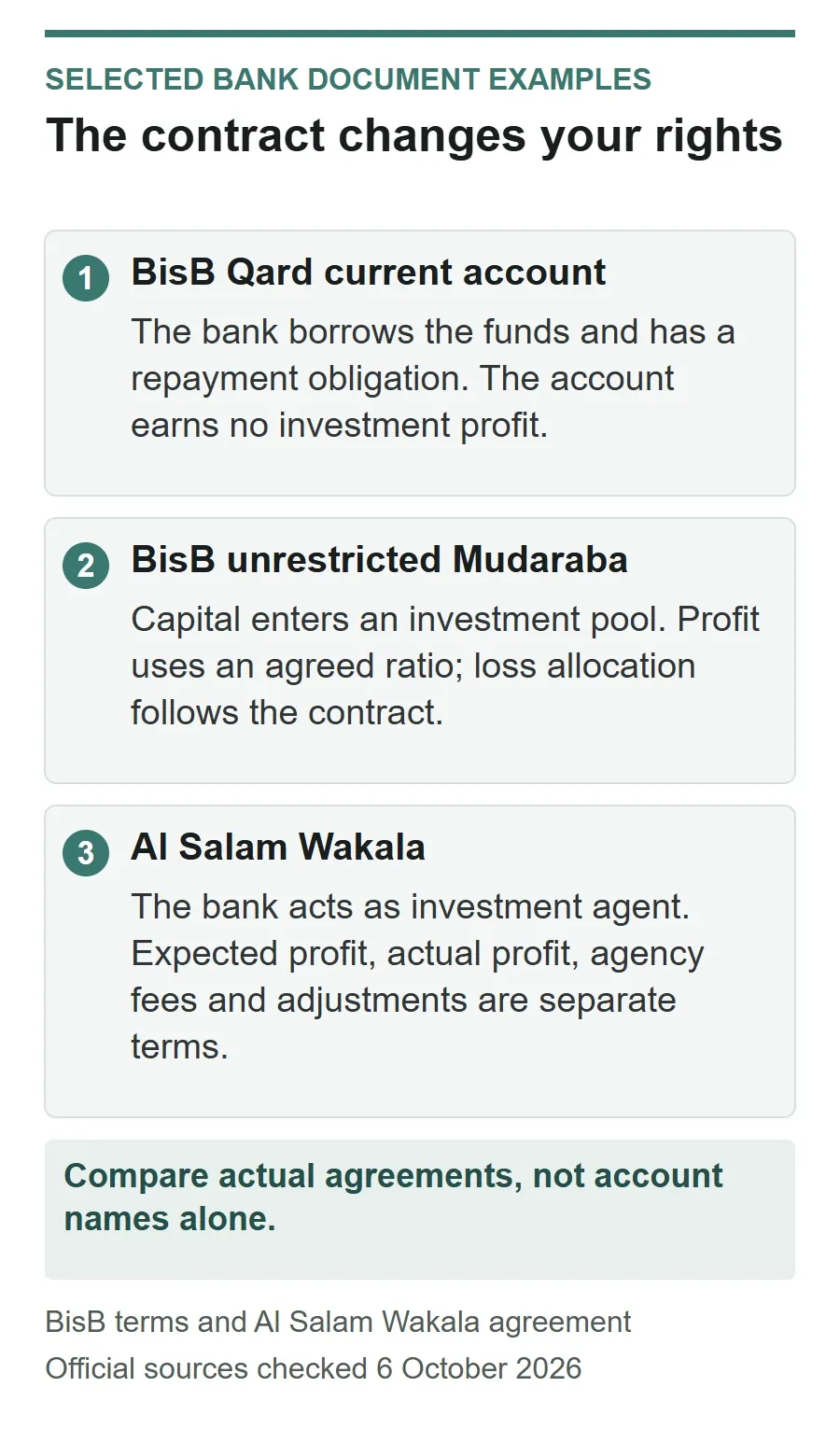
| Structure | What the document describes | What to check |
|---|---|---|
| Qard current account | BisB's terms describe the bank as borrower of the funds, with a contractual obligation to return them. The account does not earn investment profit. | Payment services, balance requirements and charges. Distinguish the bank's repayment obligation from statutory protection if it fails. |
| Unrestricted Mudaraba | BisB's terms describe customer capital invested in a common pool, with profits divided using a pre-agreed ratio. | How profits are allocated, the bank's share, withdrawal terms and who bears investment losses. |
| Wakala investment | Under Al Salam's linked Wakala agreement, the bank acts as the customer's investment agent. The agreement distinguishes expected profit from actual profit and provides for fees and adjustments. | Expected return, agent fee, incentive arrangements, payment timing and early-exit deductions. |
In BisB's unrestricted Mudaraba definition, investment losses fall on the customer unless they result from the bank's wilful misconduct, fraud, gross negligence or breach of the terms. That is materially different from its current-account repayment obligation. Read the account-specific terms rather than assuming that every account called “savings” works alike.
“Unrestricted” describes the bank's investment mandate. It does not by itself promise unrestricted withdrawals, capital protection or a particular return. Ask the bank to identify your product's legal and regulatory classification in writing.
3. When is profit paid, and what happens if you leave early?
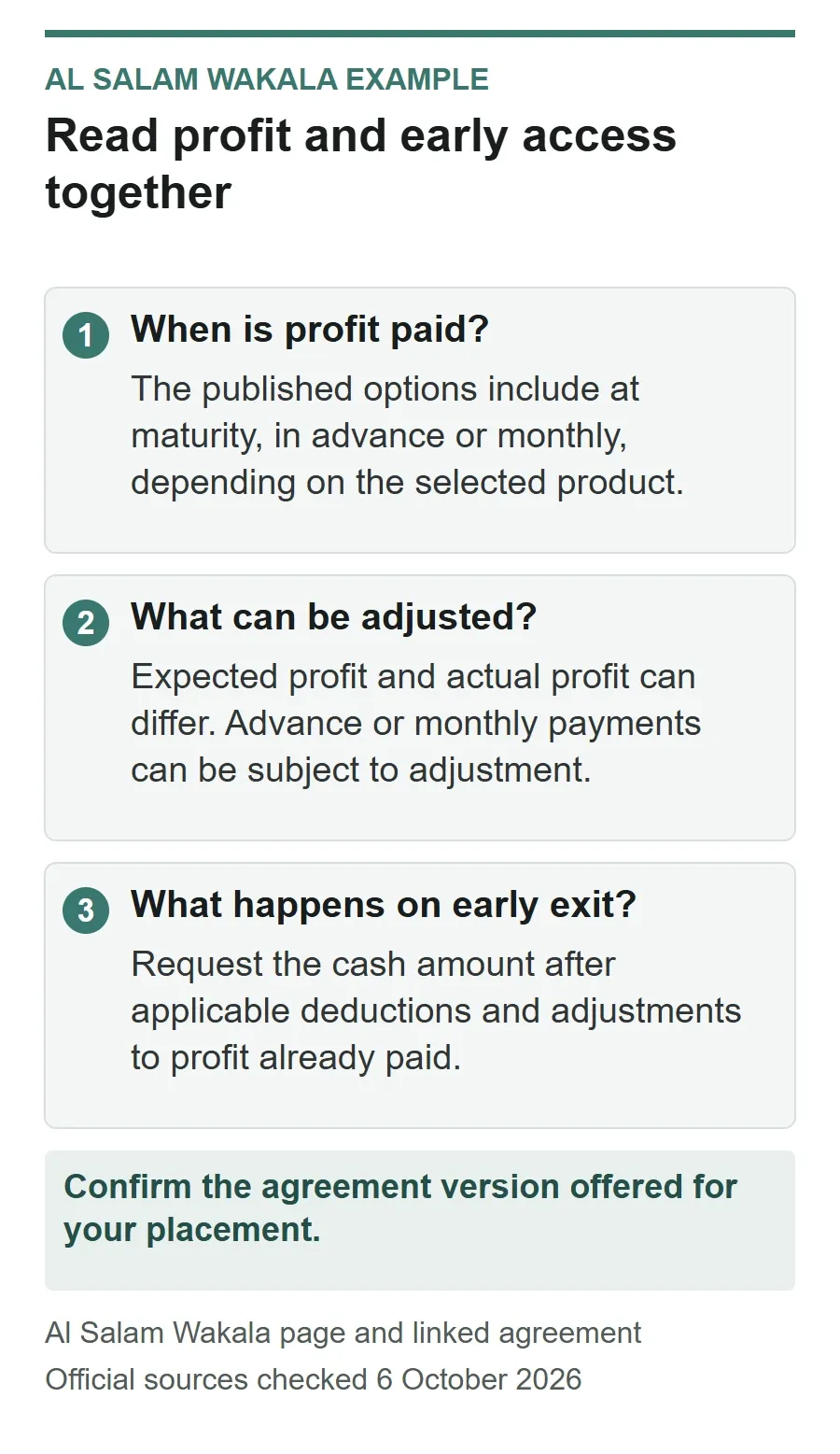
Al Salam's current Wakala page shows why payment timing matters. Its standard Wakala pays estimated profit at maturity, Wakala Plus pays estimated profit in advance subject to final adjustment, and Easy Wakala pays expected profit monthly. The page lists a minimum deposit of BHD 500 and terms up to five years.
Those payment options do not turn an estimate into a guarantee. The agreement linked from that page allows changes to expected profit in the circumstances described in clause 2.8 and sets out adjustments to advance or monthly payments. Its filename identifies a 2021 agreement, still linked when checked; request the version that will govern your placement.
Before committing money for a term, obtain written answers to these questions:
- Is the quoted return expected, historical or contractually specified, and what can change it?
- What amount is used to calculate profit, and how are the bank's share, reserves or agency fees applied?
- Can you withdraw part of the money, or must the entire placement end?
- What cash would you receive on early withdrawal after deductions and adjustment of profit already paid?
- Does the placement renew automatically, and how can you decline renewal?
A profit payment already received should not be treated as untouchable without reading the exit terms. BisB's 2026 tariff includes product-specific early-withdrawal calculations and adjustments. Ask for the applicable calculation rather than applying another account's rule.
4. Compare actual fees and the full financing cost
An Islamic structure does not mean that banking services are free. The exact account category can change the fee even at the same bank. BisB's current retail fees page links this 2026 schedule:
| Account category in the tariff | Minimum balance | Below-minimum charge |
|---|---|---|
| Savings, digital-onboarding current and salary accounts | BHD 20 | BHD 1.100 |
| Standard current account | BHD 300 | BHD 5.500 |
The tariff, pages 1 and 5, uses a weighted average monthly balance and says applicable fees include VAT. Its marked exemptions include specified vulnerable groups, pensioners, students, social-subsidy recipients and customers earning below BHD 250 monthly. Ask which exemption and category apply before assuming a charge. These are BisB figures, not Bahrain-wide fees.
Financing needs a different comparison. Al Baraka's Auto Finance page describes Murabaha: the bank purchases the car, then sells it to the customer at purchase cost plus an agreed profit over a fixed term. The word “profit” does not remove the customer's payment obligation.
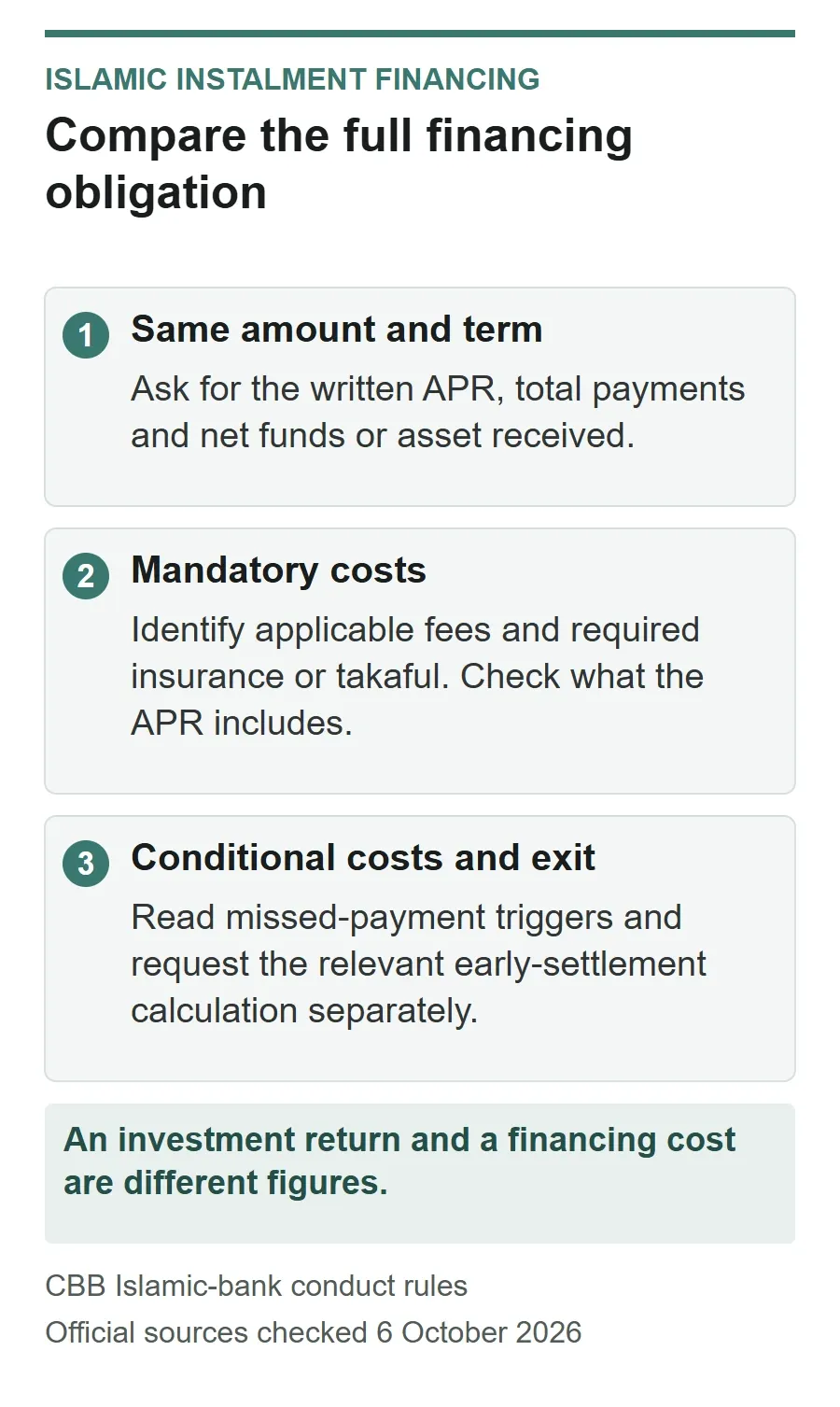
For Islamic instalment financing, CBB rules BC-4.2.10 and BC-4.2.11 require APR disclosure incorporating mandatory charges, while excluding contingent costs. Compare the same amount and term using APR, total payments, required takaful or insurance costs, and settlement conditions. Ask separately about charges triggered by missed payments or early exit.
Keep the two sides of banking distinct: a return you hope to earn on an investment account is not the same figure as the cost you owe under a financing agreement.
5. What does Bahrain's account protection scheme cover?
The CBB's Islamic-bank protection rules, CP-2, cover eligible deposits and unrestricted investment accounts at the Bahrain offices of Islamic retail banks. Eligible holders are natural persons, resident or non-resident; overseas branches are outside this scope.
- The limit is BHD 20,000 in aggregate per eligible holder at the defaulting bank, across eligible accounts and currencies. Opening more accounts at that bank does not multiply it.
- Exclusions include certain bank insiders, unidentifiable holders and funds connected with illegal matters. Other-jurisdiction coverage can affect eligibility.
- The scheme permits debt set-off and certain expense deductions. Joint accounts have specific treatment; do not assume a separate full limit for each joint holder.
The compensation process is triggered when an Islamic retail bank is placed under CBB administration or into liquidation. It is not a promise that investment accounts will achieve their expected return. Ask the bank to confirm whether your exact product is an eligible account. Do not extend this protection claim to every fund, sukuk, restricted investment or other product sold by a bank.
6. What does Sharia review mean for the product?
For Bahraini Islamic banks within its scope, the CBB Sharia governance framework requires a Sharia Supervisory Board, a coordination and implementation function, internal Sharia audit and independent external Sharia compliance audit. This is a governance framework, not a statement that every product suits every customer's financial circumstances.
Look for the bank's own product documentation, applicable Sharia approval and current supervisory reporting. Al Salam, for example, identifies its Sharia Supervisory Board publicly. The existence of a board does not let an independent guide certify your individual transaction.
Ask the bank which contract and approval apply to the product you are considering. If you need a religious determination about a specific arrangement, take the actual documents to a qualified adviser. If the issue concerns legal rights or a substantial financial commitment, obtain suitable professional advice based on the offered terms.
7. A practical checklist before opening or signing
- Name the product and institution: record the legal bank, account or financing name, contract type and currency.
- Match the purpose: confirm access to money, payment services, investment period or purchase-financing need.
- Obtain the numbers: use the bank's actual current tariff and written terms. Record missing information as “not supplied”, not zero.
- Read the difficult scenarios: loss, early withdrawal, profit adjustment, missed instalments and settlement.
- Verify protection and governance: obtain the account's scheme classification and the product's Sharia documentation.
- Keep copies: retain the dated application, contract, tariff and relevant disclosures.
Ask for the document checklist for your nationality and residency status before applying. If you need to check your identity-document position, use the Bahrain CPR guide; an identity document by itself does not establish eligibility for a bank product.
The most useful comparison is between products that serve the same need, using their actual contracts and costs. Treat the account name as the beginning of the review.