Practical guide
Bahrain Second Job Rules: LMRA Three-Month Work Checklist
What to confirm before starting with another employer
By Gaurav Agarwal · Checked 28 September 2026
Yes, Bahrain now has a route for an eligible foreign worker to work for another employer for three months, but the worker and both employers must consent and LMRA must approve it. Before starting, make sure the period has been officially registered and look for LMRA's notification to all three parties. An employer's verbal permission alone does not complete these requirements.
Decision No. 2 of 2026 took effect on 25 September 2026. It amends the rules for foreign workers outside the domestic-worker category. This checklist explains what to confirm before accepting a temporary assignment. Read the official decision, pages 16 and 17.

Jump to a step
- First, identify which arrangement you are being offered
- Check these five points before working for another employer
- Understand the fee rule before accepting a quoted amount
- Use the official LMRA route and ask the right questions
- Put the working arrangements in writing
- Know what this permission does not establish
- Dates and sources checked
01First, identify which arrangement you are being offered
The decision covers two different situations. Ask who legally owns the receiving establishment and which commercial registration, or CR, you will work under.
- Another establishment owned by the same employer or in the same group: Article 7 bis (a) covers an establishment with another CR, or one in the same group according to Ministry of Industry and Commerce records. Its activity must require the same Bahrainisation rate as the original establishment, or a higher rate.
- A different employer: Article 7 bis (b) creates the three-month arrangement, subject to LMRA approval and the conditions below.
Bahrainisation here means the required proportion of Bahraini employees for the relevant business activity. The rule compares the requirements applying to the activities; a business should confirm those requirements with LMRA rather than estimate them from its current headcount.
Example: A supervisor asking you to help at another branch does not tell you which provision applies. Ask for the receiving business's name and CR, and whether it is owned by the same employer, belongs to the recorded group, or is a separate employer. Source: Article 7 bis (a) and (b).
02Check these five points before working for another employer
- You have agreed in writing. The decision expressly requires the foreign worker's written consent. As a practical precaution, read the proposed role, location and dates before signing, and retain a copy.
- Both employers agree. Consent is needed from the employer already authorised to employ you and from the receiving employer. Agreement with the receiving business alone is insufficient.
- The Bahrainisation condition has been addressed. The receiving activity must normally require the same or a higher Bahrainisation rate. The decision provides a fee condition where its required rate is lower, explained below.
- Both employers acknowledge responsibility for your rights. They must acknowledge their joint responsibility for employment rights arising during the period with the other employer. Existing legal or contractual obligations are not displaced.
- LMRA approval and registration are complete. The arrangement requires LMRA approval. After the period is registered in the official records, LMRA notifies the worker and both employers. Ask for confirmation of the registered dates before your first shift.
These conditions come from Article 7 bis (b), on page 17 of the gazette. Keeping copies and confirming dates are practical recordkeeping recommendations.
03Understand the fee rule before accepting a quoted amount
If the receiving employer's activity requires a lower Bahrainisation rate, the decision says that the receiving employer must pay a fee equal to one eighth of the fee specified in Article 1 of Decision No. 27 of 2016.
That wording matters: this decision states a formula, not a flat dinar amount. Do not assume it means one eighth of your salary, a standard visa-renewal charge, or a fee that you personally must pay. Ask LMRA to confirm the applicable assessment and official payment route for the employers' actual activities.
The one-eighth reference appears in condition 3 of the published decision. This guide does not quote a total application cost because that total has not been verified.
04Use the official LMRA route and ask the right questions
Ask your employer's authorised representative to confirm the application route with LMRA. The official website links to the Expat Management System (EMS). We have not verified an account-specific menu sequence for this new permission, so there is no assumed button path in this guide.
For clarification, use the official LMRA contact page or call +973 17506055. On that page, use the Call Centre contact for a general service enquiry. The separate Expatriate Services contact is also listed. The screenshot below shows these options on the public page.
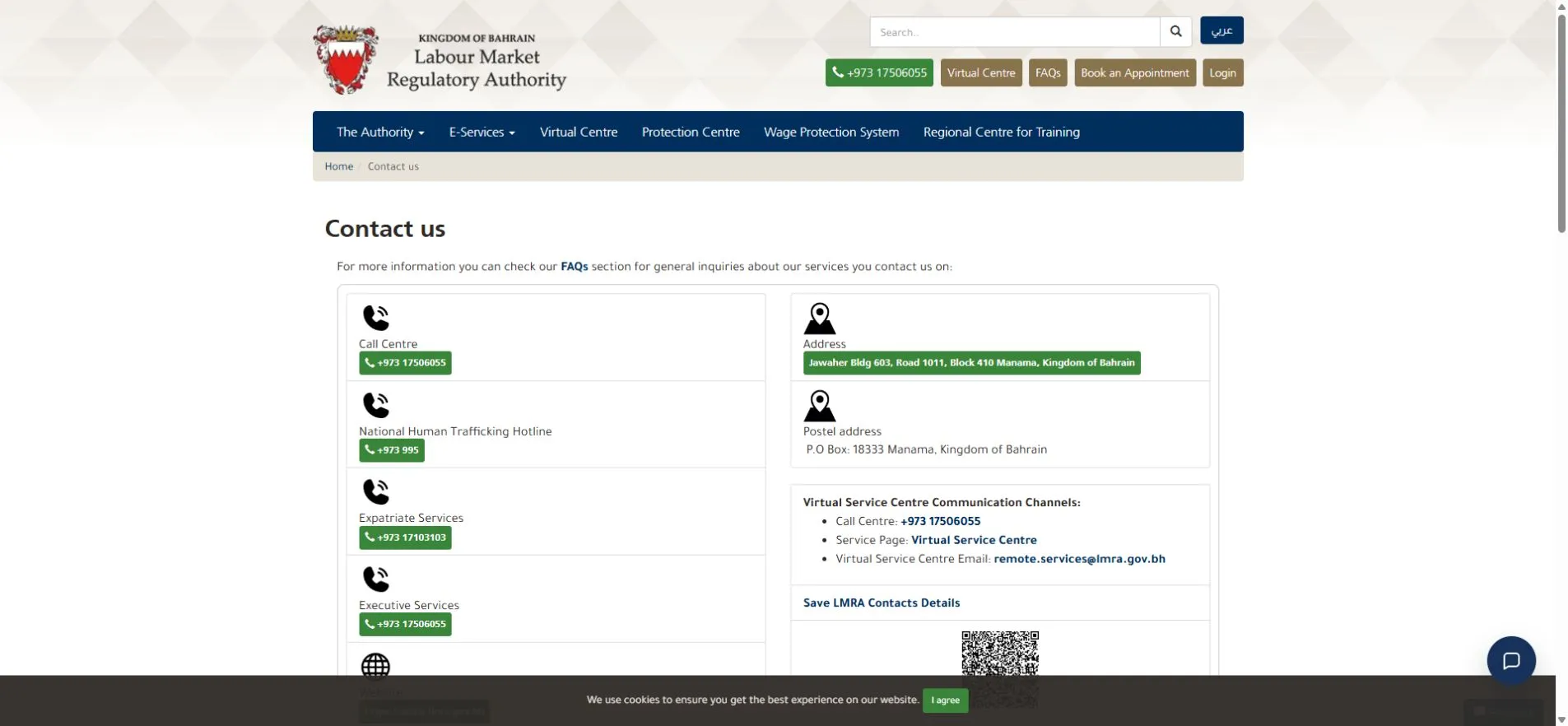
Have the employer names, CR numbers and proposed assignment dates available, and ask:
- Which service should the employer use for permission under Decision 2/2026, Article 7 bis (b)?
- Which party submits it, and what consent records and documents are required?
- What Bahrainisation requirements and charges apply to these two activities?
- How will the worker and both employers receive confirmation of the registered period?
Confirm the exact service with LMRA before submitting a different work-permit transaction merely because it has a similar name.
05Put the working arrangements in writing
Before the assignment starts, ask both employers to document the work location, duties, hours, payment arrangements, reporting contact and end date. Keep your consent, the assignment terms, LMRA confirmation and wage records together.
For example, if one business says the other will pay you, ask both to confirm the arrangement in writing. The decision requires their joint responsibility for your employment rights during the assignment. A private division of administrative tasks should not be mistaken for the removal of that statutory responsibility. Source: condition 4.
This is a preparation checklist. If there is a dispute about an existing contract or unpaid wages, seek advice specific to that case.
06Know what this permission does not establish
- It is not unrestricted permission to freelance. The different-employer provision has named parties, consent requirements, LMRA approval and a specified period.
- Do not assume automatic extensions. The text specifies three months. It does not establish an automatic renewal or a rolling arrangement. Ask LMRA what must happen before the approved period ends.
- Domestic workers are outside this decision's scope. Do not use this checklist as permission for a domestic-worker arrangement.
- A headline does not establish your eligibility. The permission concerns a worker already employed by an employer authorised to employ them. If your permit has expired, been cancelled or has another unresolved issue, obtain case-specific guidance before working elsewhere.
If you need a copy of your residence document for your own records, see our separate Bahrain residence-permit download guide. A residence document by itself is not confirmation of this temporary work arrangement.
07Dates and sources checked
The decision was signed on 22 September 2026 and published in Official Gazette No. 3906 on 24 September 2026. Article 4 makes it effective the day after publication, giving an effective date of 25 September 2026.
This guide was checked on 28 September 2026 against the official gazette listing, the decision on pages 16 and 17, and the LMRA contact page. The English explanation is an editorial summary; the published Arabic decision is the primary text.