Bahrain finance guides
Buying gold in Bahrain: purity, making charges and receipt checks
By Gaurav Agarwal · Sources checked 6 October 2026
Confirm the exact item, hallmark and precious-metal weight, then separate making charges, stones and tax in the written quotation. Reconcile the final receipt and obtain exchange or buyback conditions before paying.
Before buying gold in Bahrain, compare the finished item and the written total, not just the rate on a shop display. Confirm its hallmark, the weight charged as precious metal, the making charge, any stones and the tax treatment. Keep a receipt that identifies what you actually bought.
This checklist helps you compare jewellery quotes. It does not rank shops, predict gold prices or suggest that jewellery will retain its purchase price. Official guidance was checked on 6 October 2026.
1. Check the hallmark and the weight being charged
Ask the seller to show you the hallmark on the exact piece. The Ministry of Industry and Commerce's bilingual jewellery FAQ identifies selling or displaying jewellery without hallmarking as a violation. It also says non-precious components must be disclosed and documented in the receipt.
Have the seller explain how the mark relates to the stated fineness. If the mark is unreadable or its meaning is disputed, seek clarification through MOIC before treating a verbal assurance as proof. This guide deliberately does not reproduce a legal karat conversion table: the ministry's published FAQ versions contain differences in their presentation of approved fineness.
Separate the weight of the whole object from the precious-metal weight. A stone-set ring, for example, needs a clear explanation of which weight is multiplied by the metal rate. Ask the seller to record any stone or other component separately. Do not compare a plain chain and a decorated piece solely by their total weight.
2. Identify what the quoted gram rate means
Write down the quote's date, time, currency and unit. Ask whether the rate applies to the item's stated fineness, whether it is the shop's selling rate, and how long the quotation remains available. A number without these details is difficult to compare with another shop's quote.
An international benchmark is a different reference. LBMA describes its gold benchmark as a price for gold delivered in London, set twice daily in US dollars per troy ounce. Its public website publishes delayed prices. That is not a finished jewellery quote in Bahraini dinars per gram.
Ask for the metal subtotal on the quotation. If the seller has already quoted a per-gram rate for the item's fineness, do not apply a second purity adjustment yourself. If two quotes use different conventions, ask both sellers to restate the totals on the same basis. Keep the original quotes so you can see what changed if the price is updated.
3. Separate making charges, stones and other additions
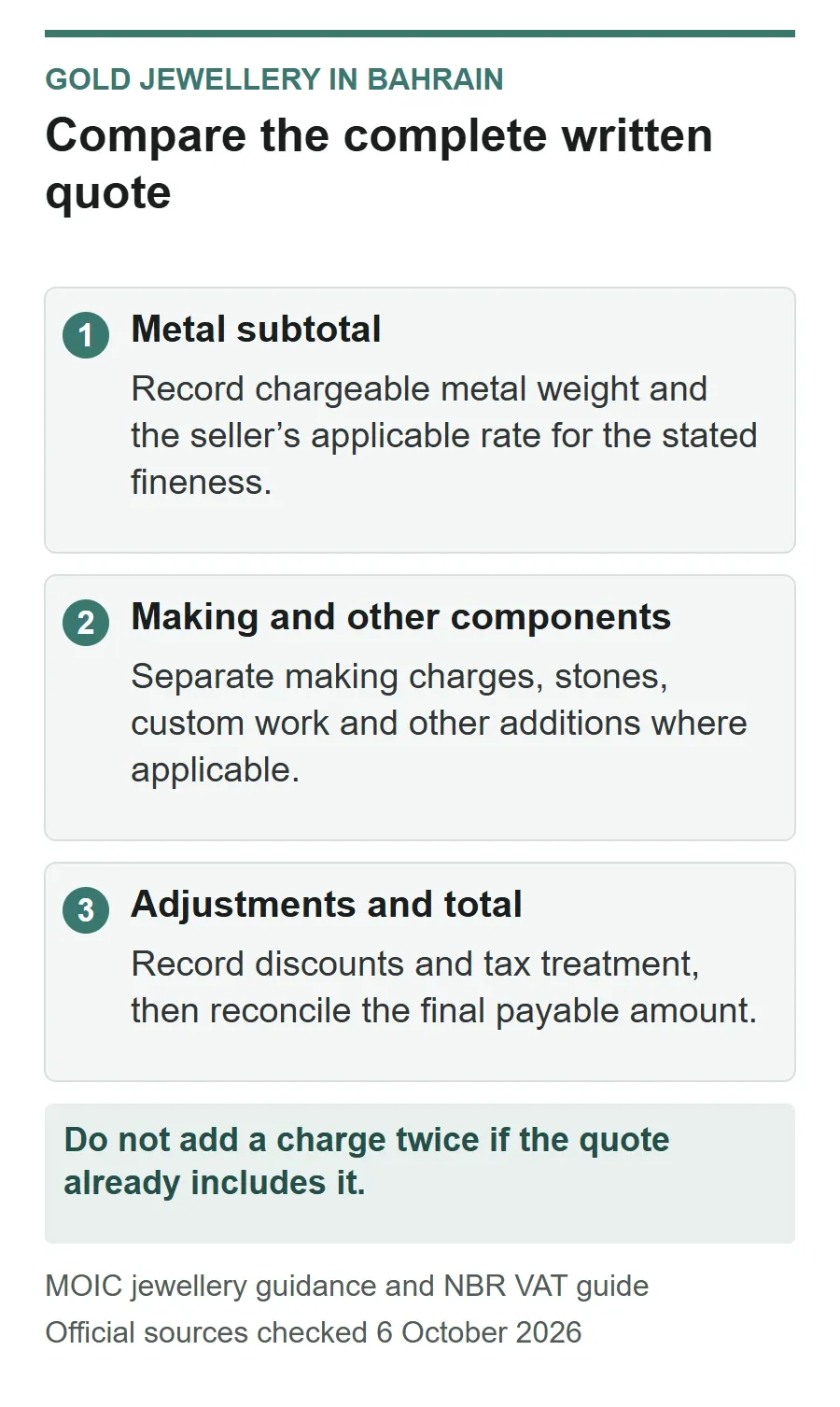
Ask whether making charges are a fixed amount for the piece, an amount per gram or a percentage of a stated base. Request the resulting dinar amount even when a percentage is advertised. This guide does not assume an official making-charge range or a standard discount.
List stones, custom work, resizing, engraving and any other addition separately where they apply. If the shop quotes one inclusive price, ask which components can be identified and which cannot. An inclusive quotation can still be compared, but it should not be presented as a bare-metal price.
Check promotional wording against the final total. A discount on one component does not by itself show which finished item costs less. Compare like-for-like pieces where possible, including fineness, metal weight, design, stones and the agreed work. If those features differ, record the difference instead of declaring one quote cheaper from the headline rate alone.
4. Check the tax treatment of the actual product
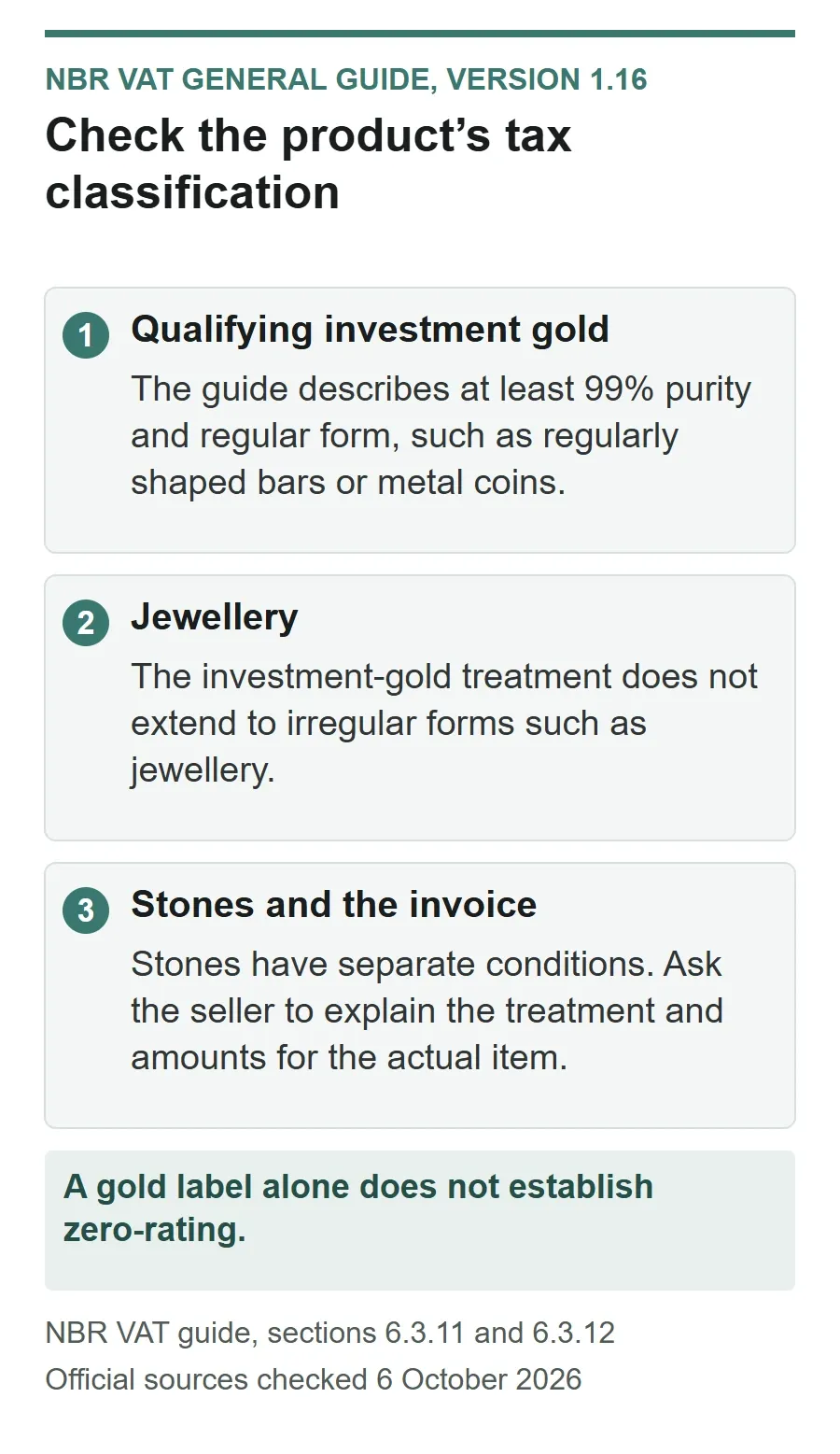
Do not assume that all gold is zero-rated. Section 6.3.11 of the NBR's VAT General Guide, version 1.16, distinguishes qualifying investment-grade gold from jewellery. It describes investment-grade gold as having purity of at least 99% and a regular form, such as regularly shaped bars or metal coins. It says this treatment does not apply to irregular forms such as jewellery.
The same guide separately addresses pearls and precious stones, with zero-rating subject to a qualifying quality certificate. Do not extend that condition into a claim that an entire stone-set item is automatically zero-rated. Ask a VAT-registered seller to explain the classification and amounts on the invoice for your particular purchase.
Check whether the quoted total includes tax and whether the invoice agrees. A label such as “gold” or “investment” is not enough to resolve every product's treatment. For the broader invoice checks, use the Bahrain VAT consumer-invoice guide. This article does not calculate an unverified tax amount or promise a tourist refund.
5. Reconcile the quote with the receipt
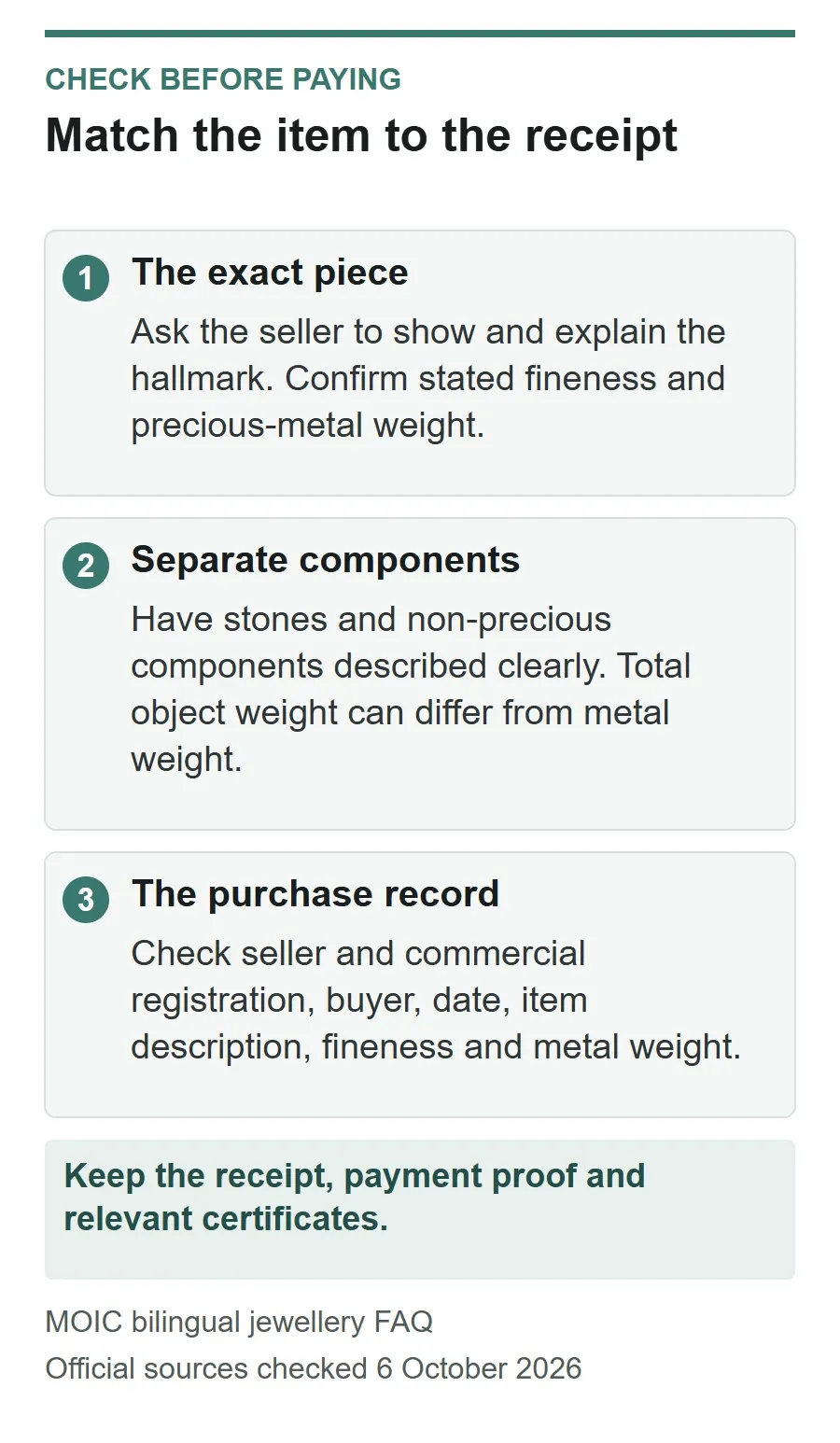
The MOIC jewellery receipt guidance lists the seller's name and commercial registration number, buyer's name, purchase date, article description, fineness and precious-metal weight. It also calls for details of mounted pearls and gemstones and relevant diamond information. Check these details while the item and seller are in front of you.
Use this blank comparison sheet for each quote. Fill it from the seller's written offer, not a rate remembered from a social post. Leave an unknown field unresolved until the seller explains it.
| Field | What to record |
|---|---|
| Item and fineness | Description, hallmark explanation and stated fineness |
| Metal calculation | Chargeable metal weight × the applicable quoted rate |
| Making charge | Basis and resulting dinar amount |
| Other components | Stones and agreed work, with their amounts |
| Discount and tax | What each adjustment applies to and its amount |
| Final payable total | The seller's written total and quote expiry |
Reconcile the components to the payable total, taking care not to add tax or charges twice when they are already included. Retain the invoice, payment proof and any separate certificates. Keep personal invoice details private when requesting public advice.
6. Ask about exchange and resale before paying
Ask for the shop's written terms for a change of mind, exchange, resizing and any buyback offer. Keep those questions separate from a complaint about an incorrectly described or defective item. Do not assume a discretionary exchange policy answers every consumer-rights question.
For a buyback offer, ask what price basis would be used, whether making charges or stones would be recognised, and what deductions or testing conditions apply. Record the conditions rather than treating the original purchase total as a guaranteed resale value. A current purchase quotation cannot establish a future selling price.
If the hallmark, weight or invoice does not match what was agreed, keep the documents and ask the seller to resolve the specific discrepancy. Use the ministry's official guidance when seeking further assistance. The most useful record is a clear comparison between the item, its description and the amount paid.
General information: This is a purchasing checklist, not investment, tax or legal advice. Product terms and quotations can change. Confirm the exact item and written conditions before committing.