Bahrain finance guides
VAT in Bahrain: Read Your Invoice and Check the Rate
By Gaurav Agarwal · Sources checked 6 October 2026
Bahrain's standard VAT rate is 10%, but some supplies are zero-rated or exempt. Check the supplier's VAT number, item description, rate, VAT amount and final total. Local displayed prices must include VAT. A simplified invoice can be valid even above BHD 500 when the customer is not VAT registered.

Jump to a section
- 1. Check whether the purchase is subject to 10% VAT
- 2. Zero-rated and exempt are different
- 3. Read the invoice before deciding something is missing
- 4. Compare the displayed price with the final charge
- 5. Read bank fees separately from interest
- 6. Ask for a correction, then use the official route
- 7. Keep business VAT questions separate
Official sources checked: 6 October 2026. This guide is for people checking a personal purchase in Bahrain. It explains the invoice and the next step when a charge looks wrong. It is general information, not individual tax advice.
1. Check whether the purchase is subject to 10% VAT
Bahrain's standard VAT rate is 10%, effective from 1 January 2022. NBR lists restaurant meals, clothes, cars, stationery and legal services among standard-rated examples. The rate does not mean every payment on every receipt attracts VAT: zero-rated supplies, exempt supplies and transactions outside VAT's scope need different treatment. See NBR's VAT FAQs, questions 1.1 and 1.10.
Start with what was supplied, who supplied it and the individual invoice line. A supermarket basket or bank statement can contain charges with different VAT treatments. The seller should be able to explain the treatment of the disputed item, rather than simply applying the rate to the business's whole category.
2. Zero-rated and exempt are different
Both can produce no VAT charge to the consumer, but they are different classifications. A zero-rated supply is taxable at 0%. An exempt supply is not subject to VAT. The distinction also affects a supplier's ability to recover VAT on its costs, subject to the applicable conditions. That business treatment does not give a private consumer a general right to reclaim purchase VAT. NBR explains these categories in FAQ 1.10.
- Zero-rated examples: specified basic food items and qualifying education, healthcare, medicines and medical equipment. Do not assume every grocery item, course or medical purchase qualifies.
- Exempt example: loan interest within the financial-services exemption. A separate service fee can have a different treatment.
If the receipt appears to charge VAT on an item you believe is zero-rated, ask for the product's exact description and the relevant NBR classification. A broad label such as “food” or “healthcare” is not enough to settle the question. Use the current NBR General Guide and the relevant sector guidance.
3. Read the invoice before deciding something is missing
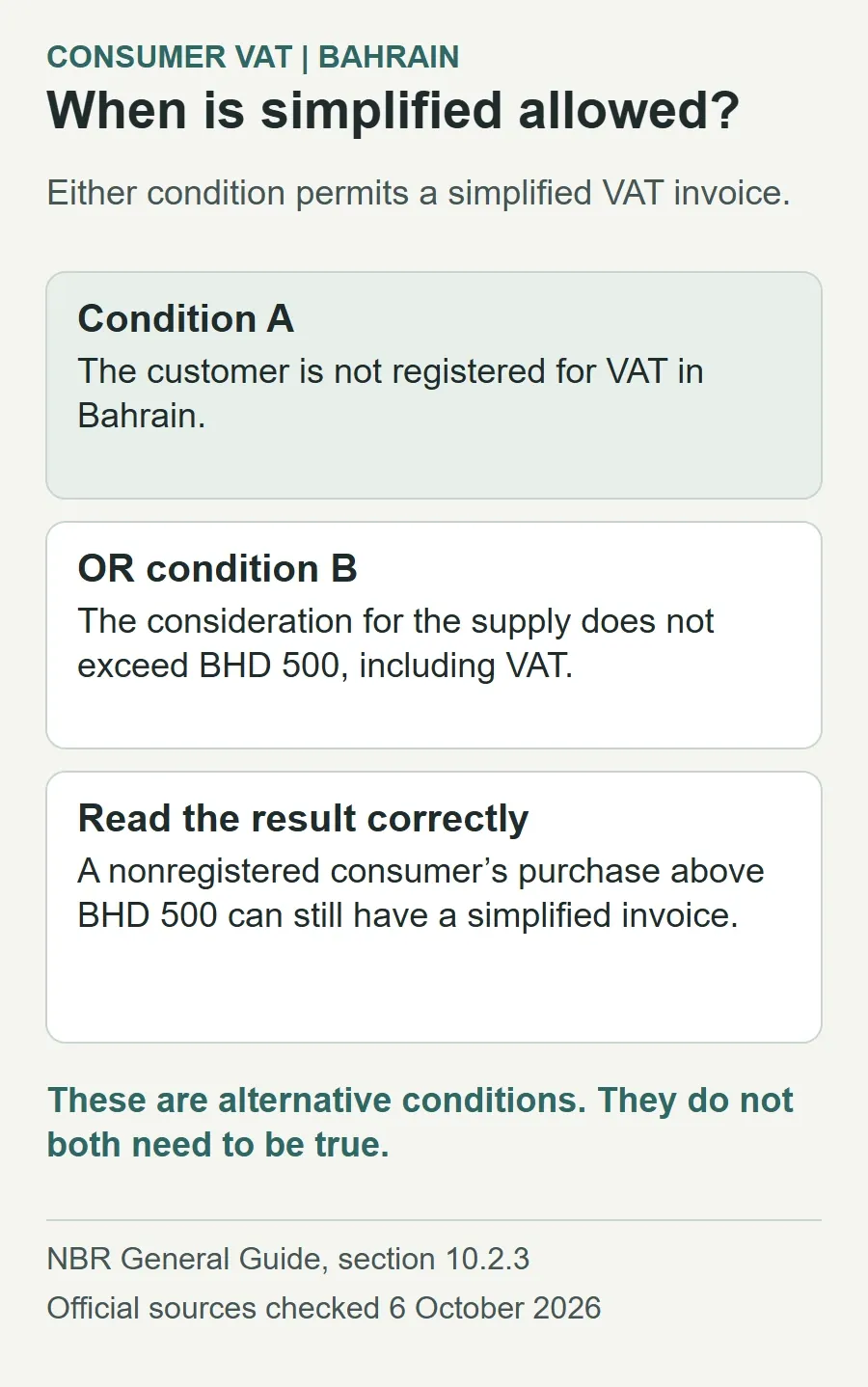
A simplified VAT invoice is permitted if either the customer is not registered for VAT in Bahrain or the supply does not exceed BHD 500, including VAT. These are alternative conditions. A personal purchase above BHD 500 can therefore still have a simplified invoice when the customer is not VAT registered. See General Guide, sections 10.2.3 and 10.3.
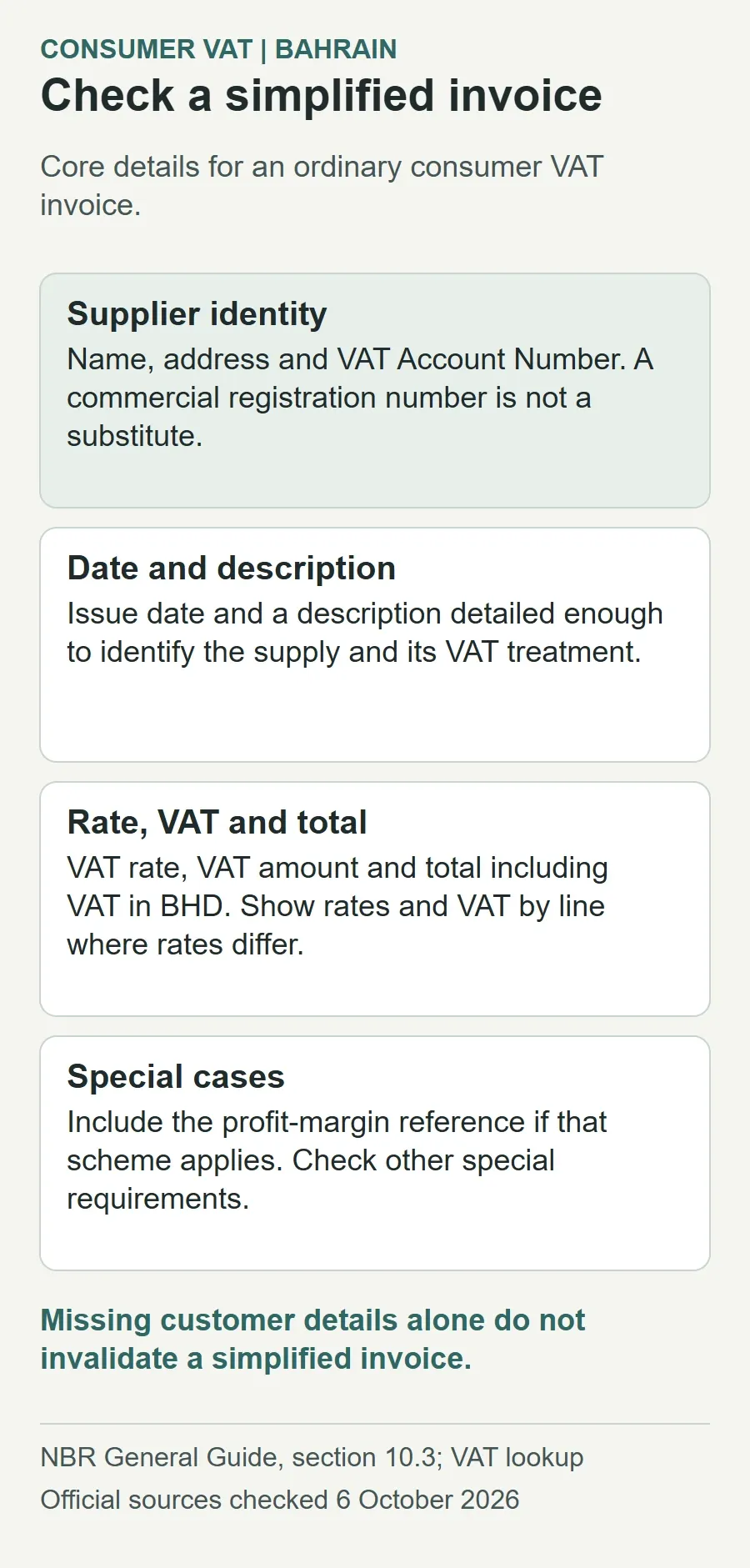
For a normal simplified consumer VAT invoice, check these required details:
- The supplier's name, address and VAT Account Number.
- The date the invoice was issued.
- A description clear enough to identify the goods or services and their VAT treatment.
- The VAT rate and VAT amount in Bahraini dinars, shown by line where rates differ.
- The total due in Bahraini dinars, including VAT.
NBR also requires a reference to the profit-margin mechanism when that scheme is used. Special transactions can require additional information, so the list above is a consumer starting point. General Guide, section 10.3.
| Detail | Simplified invoice | Full invoice |
|---|---|---|
| Supplier name, address and VAT Account Number | Required | Required |
| Customer name and address | Not required | Required |
| “VAT invoice” label and sequential invoice number | Not required | Required |
| Quantity, unit price and supply value excluding VAT | Not required | Required |
| Issue date, description, VAT rate, VAT amount and total including VAT | Required | Required |
This table selects the everyday differences; it is not the complete full-invoice specification. Missing customer details alone do not invalidate a simplified invoice. Paper and electronic invoices are both permitted under NBR's Retail and Wholesale Guide, section 18.1.
To check the seller's registration, use the official NBR VAT Payer Lookup. It offers searches by VAT Account Number or Commercial Registration Number. A CR identifies a commercial registration; it is not a substitute for the VAT Account Number required on the invoice.
4. Compare the displayed price with the final charge
NBR says prices displayed in Bahrain's local market must include VAT. Its retail guidance covers shop displays, electronic retail and printed catalogues. Export pricing has a separate exception when the price is clearly stated as VAT exclusive. See Retail and Wholesale Guide, section 2.
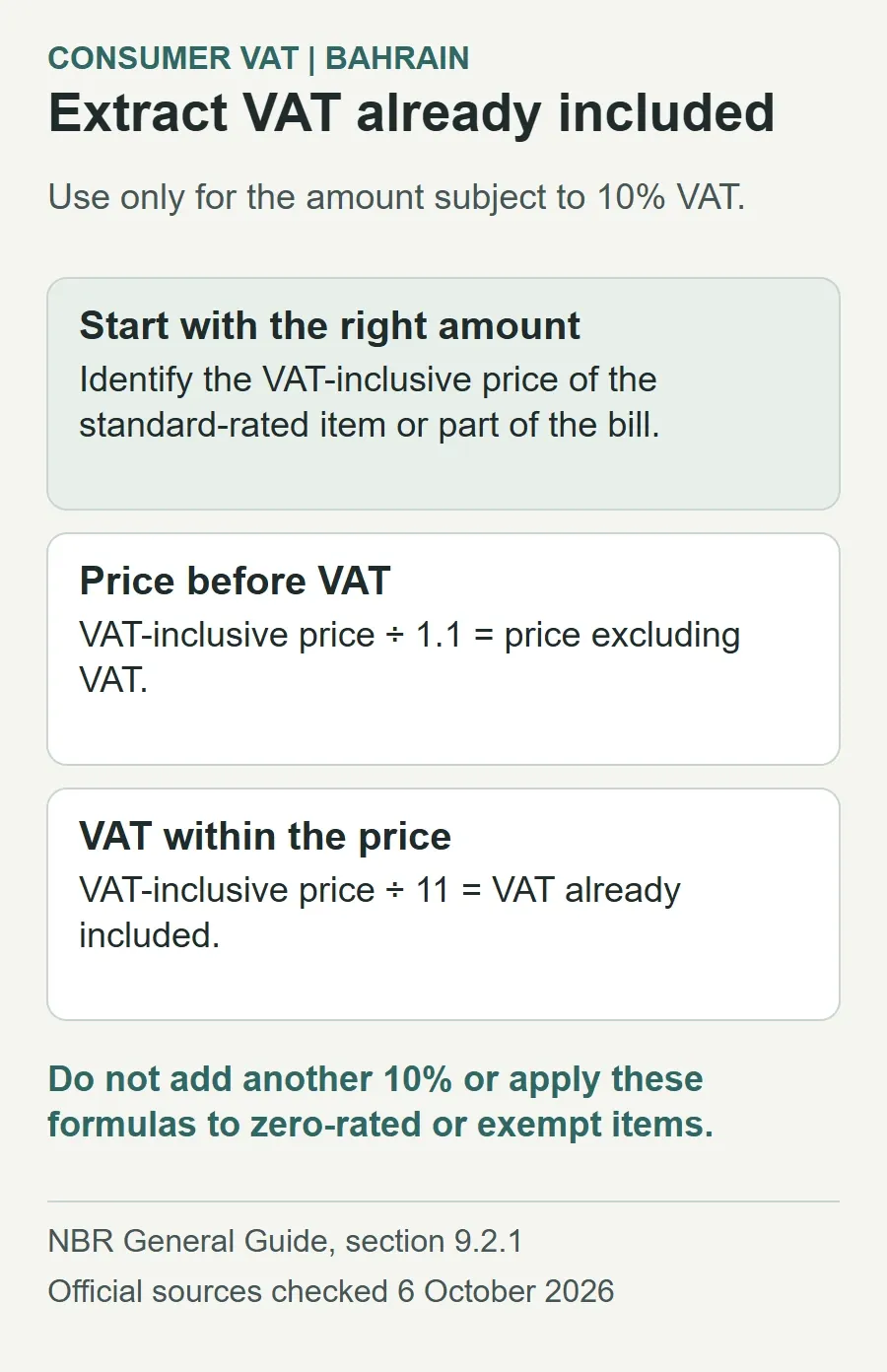
For a price that already includes standard-rate VAT, NBR gives these calculations:
- Price excluding VAT = VAT-inclusive price ÷ 1.1.
- VAT included = VAT-inclusive price ÷ 11.
Those formulas apply to the amount subject to 10% VAT. Do not apply them to the entire total if it includes zero-rated or exempt items. Nor should you add another 10% to a price that already includes it. General Guide, section 9.2.1.
If checkout differs from the display, compare the same item, quantity, discount and selected extras. Ask the seller to identify each additional charge and its VAT treatment. Keep the displayed price and invoice together so the question concerns a specific difference.
5. Read bank fees separately from interest
NBR's current Financial Services Guide distinguishes income earned through interest, a profit margin akin to interest or an implicit margin from an explicit service charge. Its published lending example treats a bank's arrangement fee as subject to 10% VAT and the loan interest as exempt. See Financial Services Guide, section 1.3.
This is not a rule that every financial fee is taxable. The same section sets out prescribed exemptions, including certain securities transactions and life insurance contracts, irrespective of whether remuneration takes the form of a fee or margin. Check the actual service and applicable conditions.
A bank statement can itself qualify as a VAT invoice when it contains the required bank and customer identification, issue date, VAT rate and VAT amount for each supply. You may therefore need to inspect the statement, rather than look for a separate receipt. General Guide, section 10.4.
6. Ask for a correction, then use the official route
- Describe the discrepancy to the supplier. Identify the item, invoice date and whether you dispute the rate, VAT calculation, missing information or difference from the displayed price.
- Ask for the explanation or correction in writing. Keep the original invoice and any replacement or adjustment document. NBR provides for credit or debit notes when VAT is overstated or understated and requires adjustment. Returns, cancellations and reductions in the original supply value can require a credit note. See General Guide, section 10.10.
- Ask NBR about the VAT issue. Its current contact page lists the domestic hotline 80008001, international hotline +973 77777333 and [email protected] for VAT queries.
- Use the complaints route where appropriate. NBR's Contact Us page directs complaints and suggestions to the national Tawasul system. The page's website-feedback form is specifically for website suggestions.
Provide the relevant transaction evidence through the official channel. A VAT query and a dispute about product quality, delivery or a contractual refund are different issues; explain which part needs resolution. This guide does not promise a refund or a response deadline.
7. Keep business VAT questions separate
Buying for a VAT-registered business introduces questions about input-tax recovery, invoice requirements and the business purpose of the expense. Registration, filing, imports and business tax deductions require their own assessment under NBR guidance. A consumer receipt checklist cannot establish those rights or obligations.
For a seller's commercial-registration details, the separate Sijilat CR search guide explains the commercial register. For VAT registration status, return to NBR's VAT Payer Lookup.
Source version note: This article uses the current NBR-linked General Guide version 1.16, Retail and Wholesale Guide version 1.3 and Financial Services Guide version 1.4, checked on 6 October 2026. Reopen NBR's official pages before relying on a rule for a later transaction.