Bahrain finance guides
CBB loan rules: a conventional-bank borrower checklist
By Gaurav Agarwal · Sources checked 6 October 2026
For conventional-bank consumer finance, the CBB normally limits total monthly repayments to 50% of gross regular income, with specified exceptions. Approval still requires an affordability review. Check the lender and facility scope, card limits, written key terms, insurance costs and change notices before relying on a rule.

A CBB repayment limit is a ceiling for a bank’s assessment, not a promise that it will approve your application. First identify the lender’s licence and the facility category. Then check the income and commitments used in the calculation, obtain the required disclosures, and keep the insurance wording and any later change notices.
This guide explains selected Volume 1 rules for conventional banks, with retail-bank scope identified below. It does not apply those paragraph numbers automatically to Islamic banks or financing companies. Official sources checked on 6 October 2026.
1. Match the rule to the lender and facility
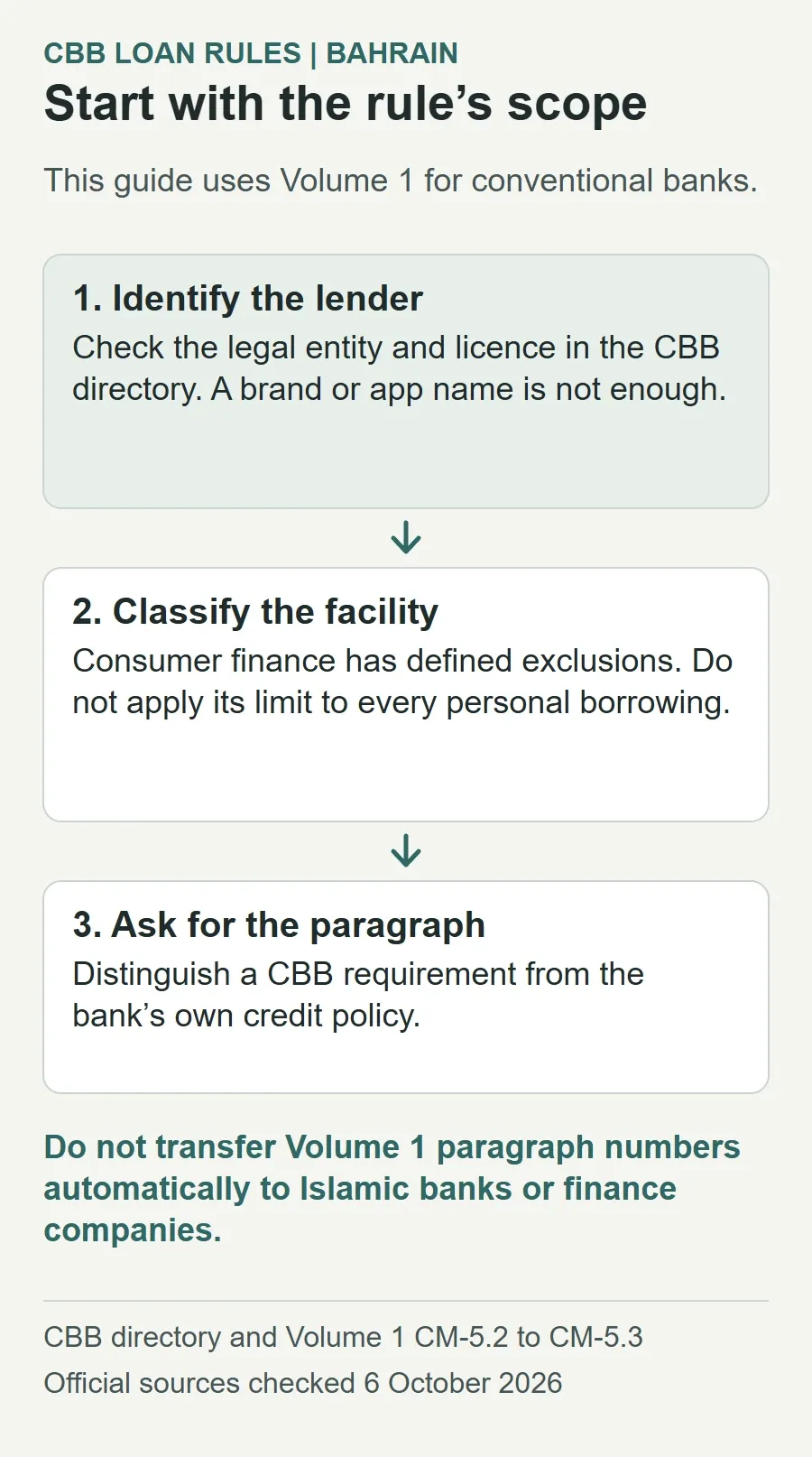
Look up the institution in the CBB Licensing Directory and confirm the legal entity named in your offer. A bank brand, dealer or app name alone does not establish which licence or contract applies. The directory separates conventional banks, Islamic banks and specialised licensees.
For conventional banks, CM-5.3 defines consumer finance broadly, including personal overdrafts, credit cards and non-business consumer loans. But its definition excludes certain facilities: a loan secured by a first charge over the home the individual occupies or intends to occupy; credit more than covered by cash or investment collateral; business credit repaid from the individual’s business; and eligible finance under the Social Insurance Organisation Pension Commutation Scheme. A mortgage therefore should not inherit the consumer-finance limit merely because an individual is borrowing. CBB CM-5.2 and CM-5.3, Volume 1.
Ask the lender to identify the relevant module and paragraph when it describes something as a CBB requirement. Record whether it is instead the lender’s own credit policy. A regulatory maximum does not remove a bank’s obligation to assess whether the borrowing is affordable.
2. Check the whole affordability calculation
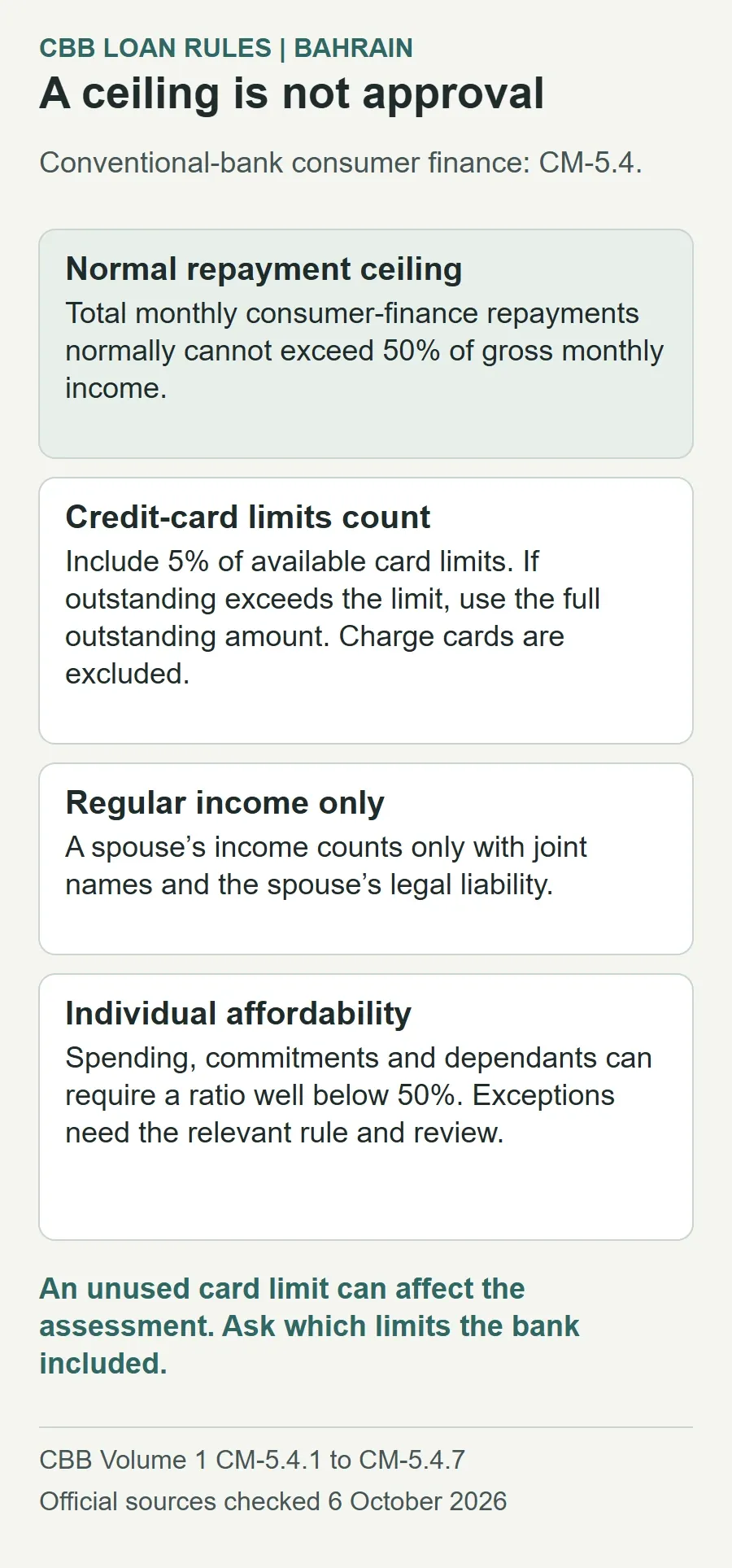
Under CM-5.4.1, a conventional bank’s new, renewed, extended or otherwise modified consumer facility must normally keep total monthly repayments on all consumer-finance commitments within 50% of monthly gross income. The chapter contains specific exceptions. Only regular income can be counted; a spouse’s income can be included only where the facility is in joint names and the spouse is legally liable. CBB CM-5.4.1 and CM-5.4.2.
The calculation also includes 5% of available credit-card limits. If a card’s outstanding amount, including interest, exceeds its limit, the full outstanding amount enters the repayment-ratio calculation. Charge cards are excluded from that card definition. This means a card limit can affect borrowing capacity even when its present balance is low. Ask which card limits the assessment includes, rather than comparing only the new instalment with salary. CBB CM-5.4.5.
The bank must examine income, credit history, regular spending, commitments, potential guarantee obligations and housing costs, leaving enough to support the borrower and dependants. The result may need to be well below 50%. For someone earning more than BHD 3,000 a month, a higher ratio may be allowed only after the required review supports it; management must document the justification. It is not an automatic higher allowance. CBB CM-5.4.3, CM-5.4.4, CM-5.4.6 and CM-5.4.7.
CM-5.4.8 generally limits instalment consumer finance to seven years. A restructuring normally must finish within seven years of the original facility, with no more than two tenor extensions. CM-5.4.9 separately permits a bank, at the customer’s request, to extend payments after an involuntary income reduction such as redundancy or disability, taking the repayment ratio into account and identifying the facility as technically non-compliant. That is a possible accommodation, not a guaranteed extension. CBB CM-5.4.8 and CM-5.4.9.
3. Keep the disclosures that explain the offer
For conventional retail banks, BC-4.3.22 requires the key terms at signing to set out the principal, net amount received, total principal and interest payments, fees, APR, nominal annual rate and whether the rate can vary. The bank must explain the interest calculation with an illustration, plus top-up, early-repayment and late-payment costs. A headline monthly payment cannot replace this record. CBB BC-4.3.22.
BC-4.3.24 also requires the whole-life monthly schedule separating principal, interest and other charges at signing. Ask the bank to reconcile that schedule with the amount credited to you and any costs paid separately. Our personal-loan comparison guide explains how to compare offers; this check establishes which documents should support the explanation.
4. Ask who chooses and pays for loan insurance
BC-4.21 applies to conventional retail banks seeking life or other insurance for a borrower’s loan. Its requirements took effect on 1 April 2024, including credit exposures maturing or being repaid or prepaid in full on or after that date. CBB BC-4.21.1.
- Your own cover: the bank must not refuse assignment of a policy you wish to buy, but can require its terms, duration and features to meet the bank’s requirements.
- Bank-arranged cover: the amount recovered must be the actual cost paid to the insurer. Group cover has a proportionate-cost rule. The bank must not receive insurer commissions or referral fees, or commission from the borrower.
- Before signing: disclosure must include the insurer, benefits, exclusions, medical-examination requirements, relevant health-condition implications, premium rate and calculation, payment method, and early-repayment or top-up adjustments.
Ask whether the premium is paid upfront or added to the loan, and obtain the policy wording before accepting it. Insurance cost must appear separately on statements where applicable. These requirements do not establish that a particular claim will be covered. CBB BC-4.21.2.
5. Read the notice before a repayment or price change
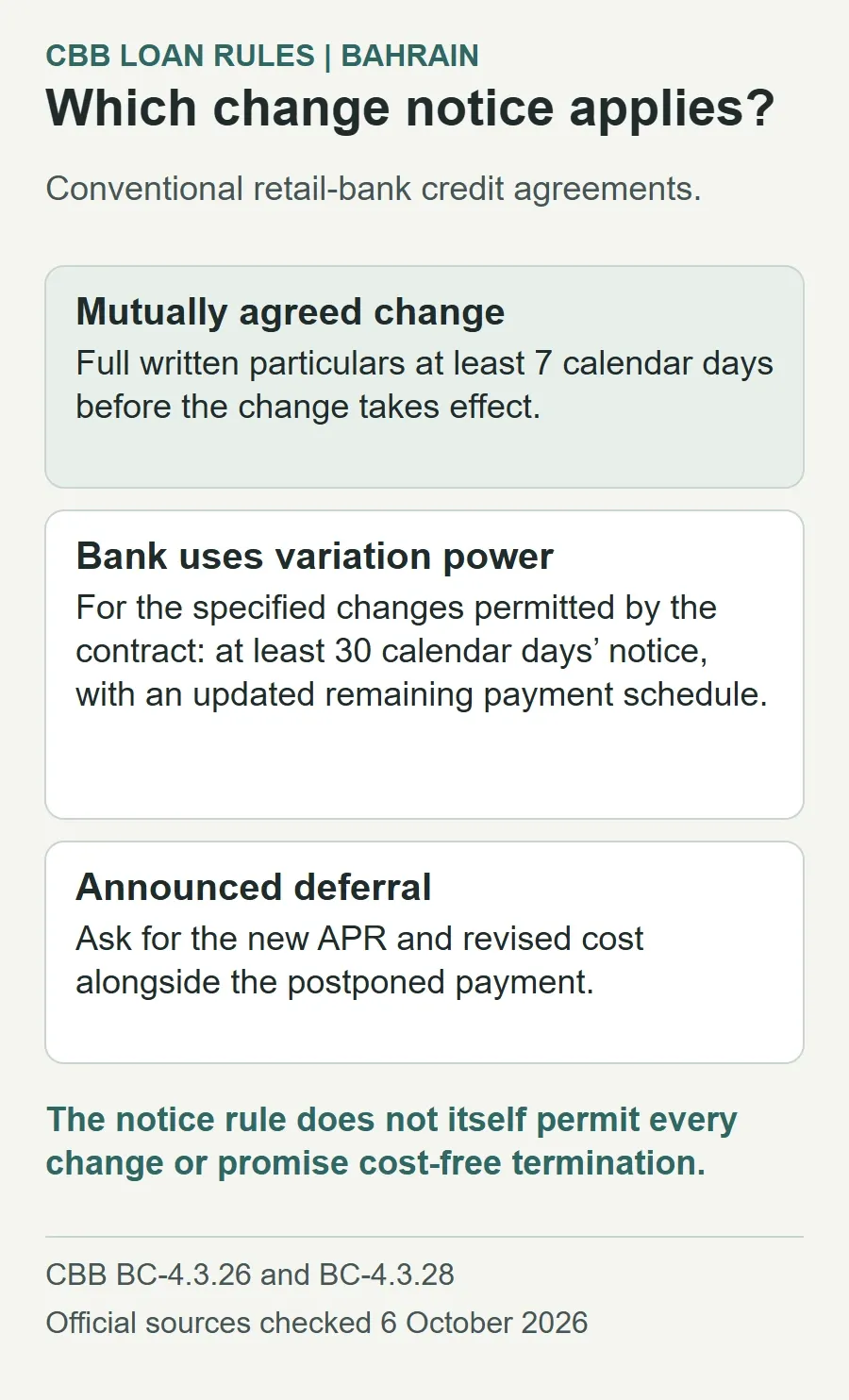
Two different notice rules apply under conventional retail-bank rule BC-4.3.26. If bank and customer agree a change, full written particulars must reach the customer at least seven calendar days before it takes effect. If the contract gives the bank power to vary specified fees, payments or interest terms and it exercises that power, it must provide full particulars, including the updated remaining principal and interest schedule, at least 30 calendar days beforehand.
The latter notice lets the customer consider acceptance or termination by settling under the agreement’s relevant provisions. It does not create a general power to change every contract or promise cost-free termination. Keep the notice and compare the new schedule with the old one. For an announced principal or interest deferral, BC-4.3.28 requires the APR methodology to be considered and the new APR communicated to the client or made public in advertisements. Ask for the revised cost alongside the postponed payment. CBB BC-4.3.26 and BC-4.3.28.
6. Use the exact rule when raising a problem
BC-4.17.1 says a conventional retail bank must not block the account of a customer who has financing with it because the customer’s employment ends or they retire, regardless of contractual rights to do so. The bank must agree other repayment arrangements. This is a protection for that stated situation, not debt cancellation or a prohibition on every possible account restriction. CBB BC-4.17.1.
Raise a discrepancy with the bank in writing, identifying the offer, schedule, insurance charge or notice concerned and the correction requested. Conventional-bank complaint rules require written acknowledgement within five working days and a written response within four weeks. If dissatisfied with that response, BC-9.5.6 provides for escalation to the CBB within 30 calendar days of receiving the letter. Keep the correspondence and use the official CBB complaint form. CBB BC-9.5.1, BC-9.5.2 and BC-9.5.6.
For a new decision, reopen the current rulebook and check the volume, paragraph and amendment notes. This review uses the current CM chapter labelled effective June 2022, including its later amendments, and the current BC text, including the May 2026 complaint amendment. An old news report or archived rule number is not enough to establish today’s requirement.
General information: This guide is not personal financial or legal advice and does not guarantee approval, an extension or a complaint outcome. Share account and identity records only through verified bank or regulator channels.