Bahrain finance guides
Personal Loan Bahrain: Compare Total Cost and Eligibility
By Gaurav Agarwal · Sources checked 6 October 2026
Compare the same cash amount and repayment period, then check APR, net disbursement and total repayment. A lower monthly instalment can cost more overall. Published salary thresholds and example rates do not guarantee approval.

Jump to a section
- 1. What do Bahrain banks currently publish?
- How do existing debts affect the amount you can borrow?
- 2. What is included in the APR?
- 3. How does a longer term change the total repayment?
- 4. Which documents and salary-transfer conditions apply?
- What should loan insurance cover and cost?
- 5. What happens on early settlement or rescheduling?
- 6. What if a payment becomes difficult?
- 7. Compare written offers on the same basis
- Frequently asked questions
To compare a personal loan in Bahrain, ask each bank for the same amount and repayment period, then compare the APR, cash you actually receive and total amount you will pay. A smaller monthly instalment can cost more overall if payments continue for longer. Published minimum salaries and example rates are starting points, not approval or a personal quotation.
Checked 6 October 2026. This guide compares selected conventional bank disclosures and explains how to read a written offer. It is general information, not personalised financial advice.
1. What do Bahrain banks currently publish?
These are selected product facts from the banks' own websites, not a complete market survey or a cheapest-loan ranking. The banks have not quoted the same applicant, amount and term, so the table cannot establish which would cost you least.
| Bank and official source | Published eligibility or limit | Cost and term information |
|---|---|---|
| BBK | Salaried applicants: age 21 to 55, minimum monthly salary BHD 300. Its FAQ requires one year with the current employer and salary transfer. | Indicative APR 4.92% for BHD 10,000 over seven years. This example is not a guaranteed applicant rate. |
| National Bank of Bahrain | Its page lists Bahraini citizens and non-Bahraini residents over 21, with minimum monthly salary BHD 200. | Advertises up to BHD 150,000 and up to 84 months. The calculator is indicative; actual terms, rate and eligibility need bank approval. |
| Standard Chartered Bahrain | Advertises up to BHD 100,000 for Bahrainis and BHD 60,000 for residents. Amount depends primarily on salary, employer and employment length. | Up to 84 months for Bahrainis and 60 months for residents. APR depends on employer and loan term; request an individual quotation. |
The different salary thresholds are a reason to check the exact product. They do not establish a Bahrain-wide minimum salary or mean that everyone above the threshold qualifies. For example, BBK also publishes a separate self-employed route, with age 25 to 60 and minimum net annual profit BHD 3,000. Ask the bank which category it will assess you under.
Match the product to your employment category
Bank websites organise applicants differently. SBI Bahrain's personal-loans page links separate salaried and non-salaried product documents and states that approval remains subject to the bank's conditions. A salary threshold from another lender cannot establish eligibility for either SBI route. Start by obtaining the document for your own category, then request its current tariff and a personalised offer.
Use the product table to shortlist enquiries. The final comparison should contain the same net cash, term and first repayment date from each bank. Where one lender will only offer a smaller amount or shorter term, label that offer as a different scenario instead of sorting it by its lower monthly payment.
How do existing debts affect the amount you can borrow?
For consumer finance within the scope of the CBB's conventional-bank CM-5 rules, total monthly repayments on consumer commitments ordinarily must not exceed 50% of monthly gross income. Only regular income counts. A spouse's income can be included only when the facility is in joint names and the spouse is also legally liable. This is a regulatory ceiling subject to defined exceptions, not a recommended household budget or an entitlement to borrow half your income.
The bank must also examine regular expenses, other commitments, guarantees, credit history and money needed to support dependants. CM-5.4.3 expressly recognises that the resulting limit may need to be significantly below 50%. Rent, school fees and remittances therefore still matter even when a preliminary ratio looks acceptable.
| Item | Rule and practical implication |
|---|---|
| Existing credit cards | CM-5.4.5 includes 5% of available credit limits in the repayment calculation. If the outstanding amount including interest exceeds the limit, the full outstanding amount is included. Charge cards are excluded from this definition. An unused card limit can therefore matter. |
| Income above BHD 3,000 a month | CM-5.4.6 permits the bank to relax the ratio after an affordability review. CM-5.4.7 requires documented justification. Earning above the threshold does not automatically grant an exception. |
| Length of an instalment loan | CM-5.4.8 ordinarily limits the term to seven years. Restructuring normally stays within seven years of the original facility, with no more than two term extensions during the agreement. |
| Income falls outside the borrower's control | CM-5.4.9 separately addresses accounts made technically non-compliant by reduced income and allows a requested term extension to assist the customer. It does not promise approval of a particular arrangement. |
All rules in this table come from CBB CM-5.4, checked 6 October 2026. CM-5.3 excludes specified owner-occupied residential mortgages, sufficiently cash- or investment-secured facilities, business-purpose borrowing repaid from business activity, and the SIO pension-commutation scheme from this consumer-finance definition. Do not apply these paragraphs indiscriminately to every loan or to an Islamic financing contract.
Before applying, list your outstanding instalments and every credit-card limit, including cards you rarely use. Ask the bank to show how it has calculated the commitments it will count. Separately review what remains after essential living expenses; approval alone does not show that a payment will remain comfortable if your circumstances change.
2. What is included in the APR?
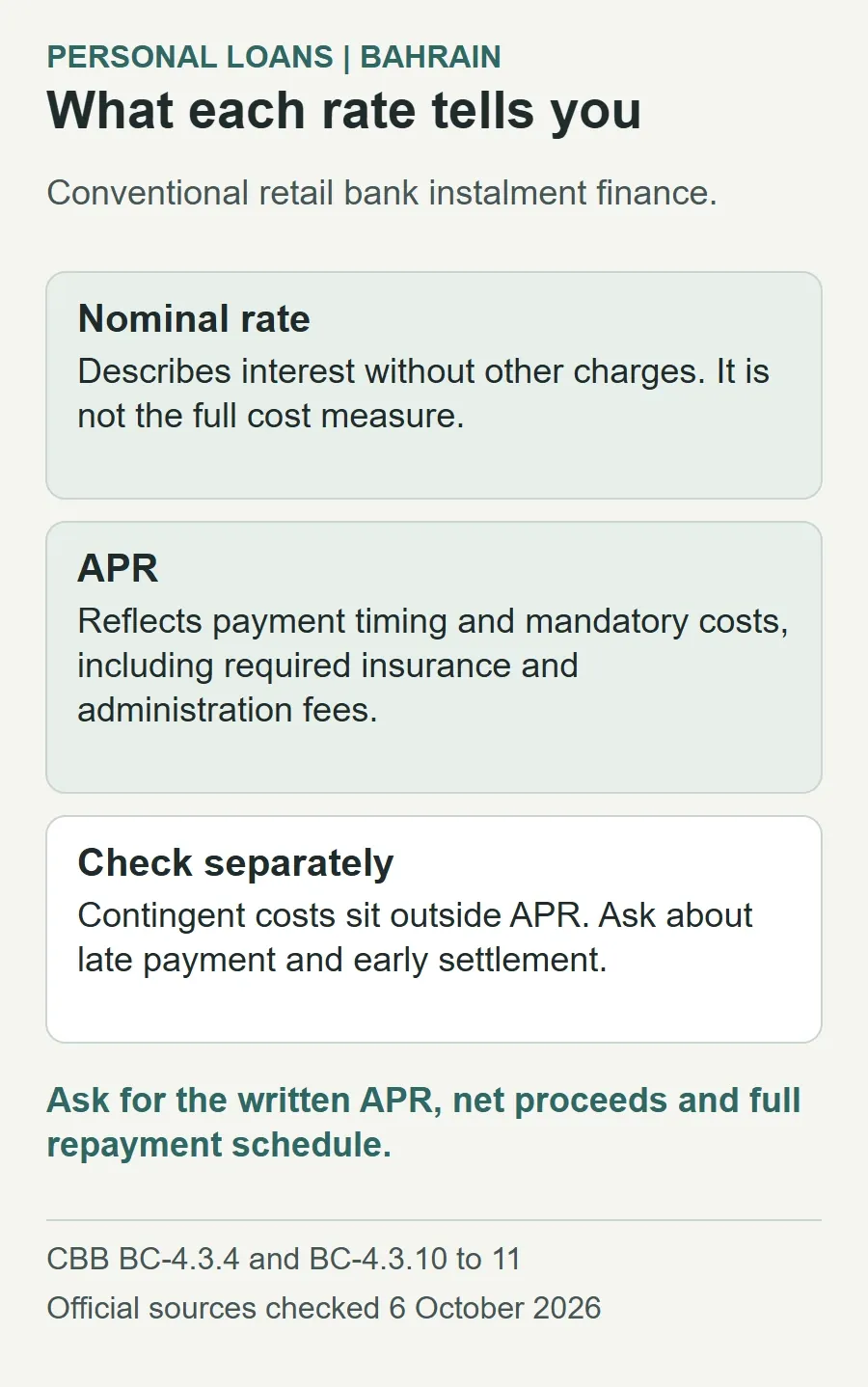
APR puts borrowing costs on an annual basis. Under the CBB's conventional-bank rules, BC-4.3.10 and BC-4.3.11, it includes administration fees and other mandatory charges, including insurance required as a contract condition. Contingent costs are excluded. The bank's APR therefore needs to be read alongside possible late-payment and early-settlement charges.
A flat-rate calculation uses the original amount as its interest base; a reducing-balance calculation uses the balance still owed. The same percentage produces different costs under these methods. A fixed rate is a separate idea: it describes whether the rate changes, not which balance is used to calculate interest.
CBB rule BC-4.16.1 prohibits conventional retail banks from charging interest using a monthly flat rate and requires an effective rate based on a reducing balance. If an advertisement or conversation mentions a flat figure, ask for the written APR and repayment schedule before comparing it.
Do not simply add the APR percentage to the loan amount. Payment dates, outstanding balances and charges affect the calculation. Standard Chartered's calculator disclaimer expressly says its result is illustrative and that other fees may apply.
3. How does a longer term change the total repayment?
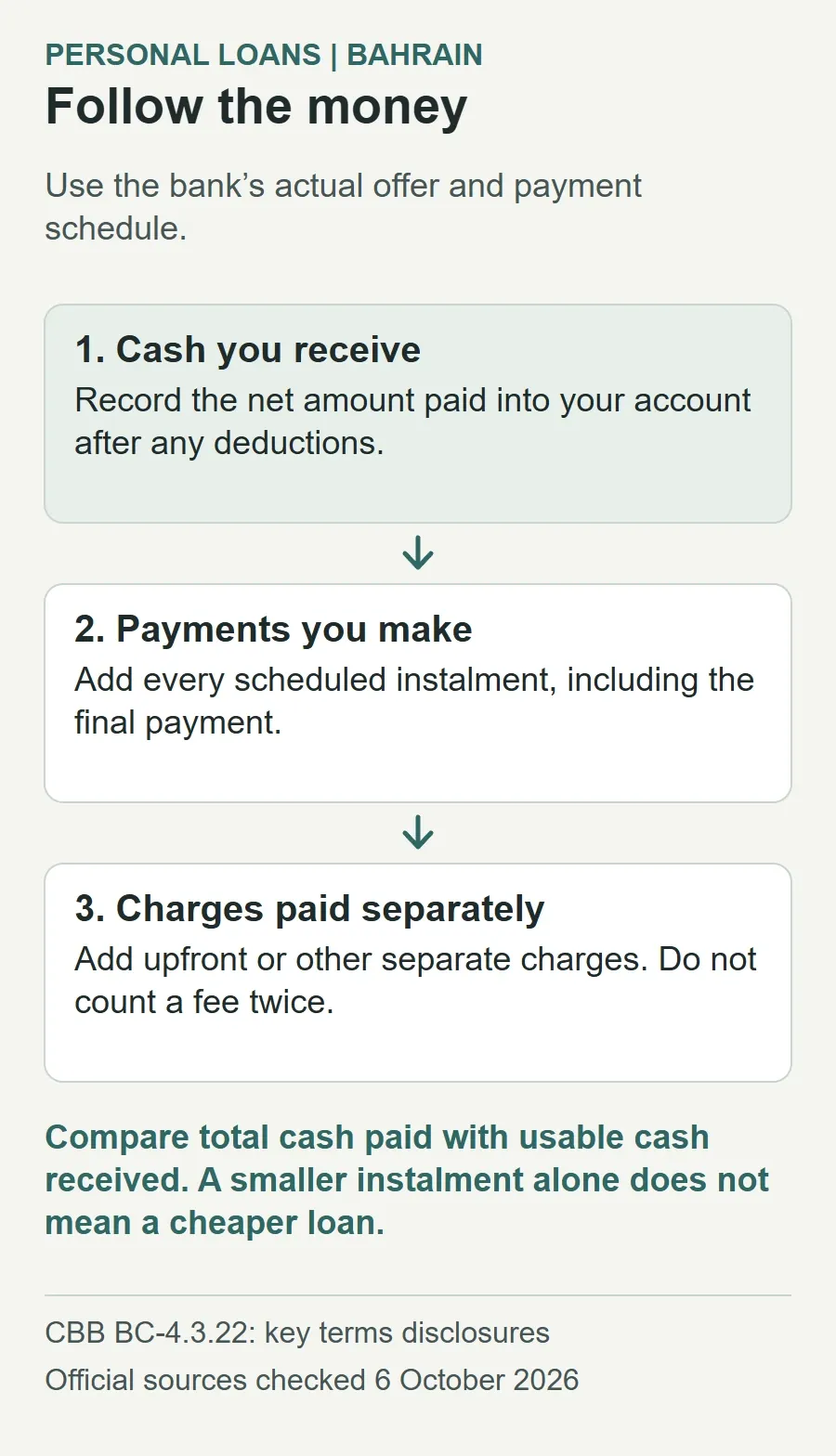
A monthly instalment answers a cash-flow question. Total repayment answers a cost question. You need both figures.
| Item to record | Shorter-term offer | Longer-term offer |
|---|---|---|
| Cash paid into your account | Request the net disbursement | Use the same usable cash amount |
| Monthly instalment and payment count | Copy from the bank schedule | Copy from the bank schedule |
| APR and separate charges | Obtain the written breakdown | Obtain the written breakdown |
| Total amount paid over the term | Add the scheduled payments and separate charges | Add the scheduled payments and separate charges |
Ask the bank to quote both repayment periods before deciding. Compare the difference in the monthly payment with the difference in total repayment. The actual result depends on the rate, fees and schedule offered for each term; no estimated product rate is needed to make this comparison.
For a real quotation, add all scheduled repayments and any charges you pay separately, then compare that outflow with the usable cash received. Do not count a fee twice if it is already included in the instalments. If fees are deducted before disbursement, a BHD 5,000 loan may deliver less than BHD 5,000 to spend.
Check the first and last payments, not just the regular instalment
A quotation may include a delayed first instalment, a separate upfront premium or a final adjustment. Request the complete schedule rather than multiplying a headline monthly payment by the number of months. Under CBB BC-4.3.24, the conventional retail bank must give the principal, interest and other charges per month for the life of the facility at signing.
For each offer, reconcile three totals: the amount borrowed, the money actually available to you, and all money paid back. Keep fees deducted from disbursement visible as a difference between the first two totals. Keep fees paid separately visible in the repayment comparison. If a premium is financed, check whether it is already included in the principal and instalments before adding it again.
4. Which documents and salary-transfer conditions apply?
Request the bank's checklist for your nationality, employment category and chosen product before submitting an application. NBB's published document list makes a useful distinction:
- Bahraini applicants: CPR or two valid identification documents, latest salary slip, original salary certificate and three months of bank statements.
- Non-Bahraini applicants: valid passport, residency permit and CPR, an employer salary-transfer letter and end-of-service-benefits documentation, original salary certificate and three months of bank statements.
NBB's wording does not explain the precise format of its end-of-service document. Ask the bank for its required form rather than assuming that an ordinary payslip will satisfy it. For residency preparation, see the Bahrain work-permit status guide; a valid permit does not itself establish loan eligibility.
Salary transfer is more than choosing an account for the monthly payment. Check whether the employer must give an undertaking, whether benefits are assigned as security, and what happens if you change employer. BBK's FAQ requires salary transfer. Standard Chartered's linked personal-loan terms, clause 8, describe assignment of end-of-service benefits where its salary-transfer-loan clause applies. These are product-specific conditions, not a claim that every Bahrain lender requires the same arrangement.
What should loan insurance cover and cost?
Loan protection is not adequately described by a line saying “insurance included”. Ask for the insurer, covered events, exclusions, medical requirements, coverage dates and what happens at retirement or after a change in employment. Check whether the premium is paid upfront, deducted from proceeds or added to the financed amount. Required insurance belongs in the APR comparison, but the policy also needs its own review.
For conventional retail banks using insurance to protect individual lending, CBB BC-4.21.2 requires disclosure of these arrangements before signing. Where the bank arranges cover, the recovered cost must be its actual cost; group cover is subject to the proportionate attributable-cost requirement. The rule also prohibits insurance commissions or referral fees and requires refund of excess insurance cost at maturity or early repayment.
You may ask to arrange your own cover. BC-4.21.2(b) says the bank must not refuse assignment of your policy, although it can require matching terms, duration and features. Obtain those requirements before buying a policy. This is not a promise that any policy will be accepted or that independent cover will cost less.
At a top-up or early repayment, request the insurance adjustment separately from the settlement fee. CM-5.5.1 requires a proportionate refund or adjustment of premiums on individual facilities, while BC-4.21 requires disclosure of how early repayment and top-ups affect insurance. Ask for the calculation and the credit or refund entry. A quoted settlement balance is not enough to establish whether the insurance adjustment has been included.
5. What happens on early settlement or rescheduling?
Ask for a dated settlement quotation. An outstanding principal figure alone may not be the amount needed to close the loan: check accrued interest, settlement charges, insurance adjustments and the quote's expiry date.
As a concrete example, BBK's currently linked tariff, effective 7 September 2025, lists a BHD 110 handling fee for consumer loans and early settlement at the lower of 1.1% of the outstanding balance or BHD 110. It states that fees include VAT wherever applicable and exempts top-up loans from handling fees. These are BBK's published charges, not a universal tariff.
Deferring an instalment is not necessarily a free month. Standard Chartered's linked terms, clause 4.5, say an agreed deferral carries additional interest payable on the final payment date. The same document requires written notice for prepayment and refers to applicable settlement fees. It is labelled February 2016 but remained linked from the current product page when checked; obtain the contract and price guide offered for your application.
For a top-up, bank transfer or rescheduling, compare the remaining cost of the existing loan with the full new schedule. Separate any extra cash you receive from the amount used to repay old debt. A reduced instalment alone cannot tell you whether the change saves money.
Distinguish a payment holiday, a top-up and a loan transfer
A deferral moves a payment; it does not itself reduce the debt. A top-up supplies additional borrowing, while a transfer uses new borrowing to settle an existing facility. Ask for the old settlement quotation and the new repayment schedule on the same proposed completion date. Identify any new usable cash separately, so extra borrowing does not masquerade as a saving.
For a partial prepayment, obtain written confirmation of whether the bank will reduce later instalments, shorten the term or apply another permitted treatment. For full settlement, confirm the amount's validity date, insurance adjustment, closure confirmation and release of any assignment. CBB BC-4.3.29 and BC-4.3.30 require a response to requested disclosure within fifteen business days and cover the calculation of full or part prepayment. Request this early enough for your intended settlement date.
6. What if a payment becomes difficult?
Contact the bank before the due date and ask what arrangements it can consider. Request the revised payment dates, charges and total repayment in writing. An enquiry is not permission to stop paying or cancel a repayment instruction.
The Standard Chartered terms, clause 4.12, say a missed instalment can make the loan and accrued amounts immediately payable and trigger a late fee. The consequence depends on the applicable contract; do not assume another bank has identical terms.
If the issue is a disputed fee, disclosure or bank response, make a written complaint to the bank and keep the offer, schedule and correspondence. For conventional banks, CBB rules BC-9.5.1, BC-9.5.2 and BC-9.5.6 require written acknowledgement within five working days and a written response within four weeks. An unsatisfied customer can escalate to the CBB within 30 calendar days of receiving the response. Use the CBB consumer-information page for its complaint route. A complaint is not a promise of debt cancellation.
For employment termination or retirement, distinguish repayment obligations from access to an account. CBB BC-4.17.1 prohibits conventional retail banks from blocking a financed customer's accounts because of employment termination or retirement and requires other repayment arrangements to be agreed. It does not cancel the loan. Explain the income change promptly and request the bank's proposed arrangement in writing.
7. Compare written offers on the same basis
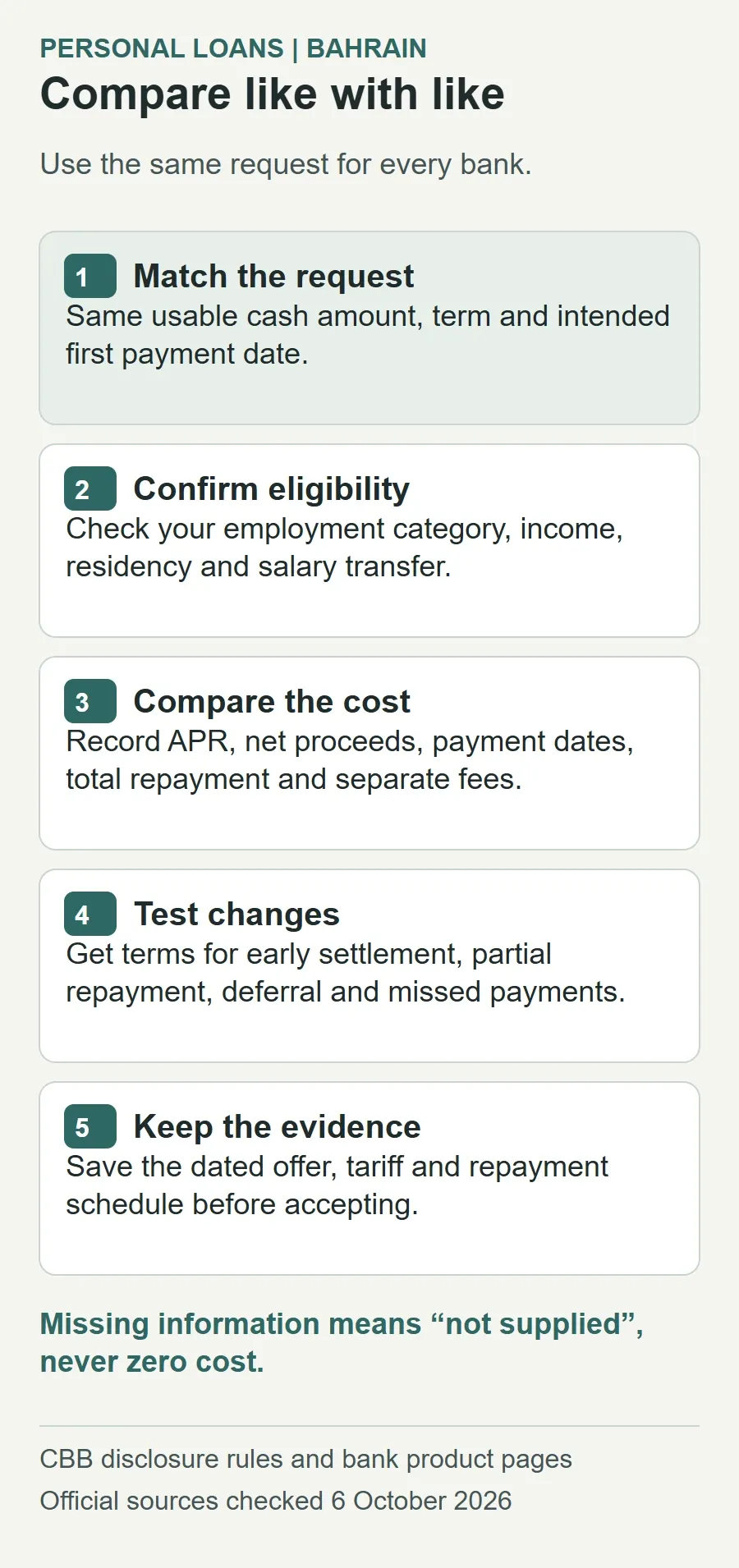
Use one comparison sheet per bank. Leave an item marked “not supplied” until the bank answers it; do not treat a missing fee as zero.
- Fix the request: same usable cash amount, currency, repayment period and intended first payment date.
- Confirm qualification: employment category, income requirements, nationality or residency conditions, employer acceptance and salary transfer.
- Record price: APR, interest basis, whether the rate can change, every mandatory fee and any required insurance.
- Record cash flows: net disbursement, instalment amounts and dates, final payment, separately paid charges and total repayment.
- Test changes: obtain the cost of early settlement, partial repayment, deferral, missed payments and moving the loan to another bank.
- Keep the evidence: save the dated offer, price guide and full schedule before accepting.
The CBB's BC-4.3.22 disclosure requirements cover net proceeds, repayment totals, rate basis and relevant charges. Ask the bank to explain any mismatch between its quotation and those documents.
A useful comparison ends with two clear numbers: what arrives in your account and what leaves it over the agreed term. Keep the repayment manageable without losing sight of the full cost.
Frequently asked questions
What is the minimum salary for a personal loan in Bahrain?
There is no single threshold established by this comparison. The selected BBK product publishes BHD 300 monthly, while NBB publishes BHD 200. Employment, existing commitments, residence and the bank's assessment still apply.
Can an expatriate apply for a Bahrain personal loan?
The reviewed BBK, NBB and Standard Chartered pages include resident applicants. Their document and term conditions differ. Standard Chartered, for example, publishes different term and amount ceilings for Bahrainis and residents. Obtain the checklist and quote for your category.
Which bank has the lowest personal-loan rate?
These public disclosures cannot answer that for a particular applicant. BBK's indicative example, NBB's product maxima and Standard Chartered's conditional pricing are not matching quotations. Compare written APRs, net proceeds and total repayment for the same amount and dates.
Is the 50% repayment limit an approval guarantee?
No. CBB CM-5.4 also requires affordability checks and recognises that commitments may need to remain substantially below that level. The scoped conventional consumer-finance rules include specific exceptions; the percentage is not a recommended spending target.
Do unused credit cards affect a personal-loan assessment?
They can. CM-5.4.5 ordinarily counts 5% of available card limits, with separate treatment where outstanding amounts exceed the limit and an exclusion for charge cards. Ask the lender to show its calculation.
Is seven years available to every borrower?
No. The ordinary conventional instalment consumer-finance ceiling in CM-5.4.8 does not require a bank to offer that duration. Product limits, employment circumstances and affordability can result in a shorter term. Income-reduction restructuring is addressed separately in CM-5.4.9.
Does early settlement always cost 1.1%?
No universal fee is established here. BBK's linked consumer-loan tariff states the lower of 1.1% of outstanding balance or BHD 110. Obtain your own bank's dated settlement quote, including any insurance adjustment.
Can I provide my own loan insurance?
For the conventional retail-bank lending covered by BC-4.21.2(b), the bank must accept assignment if the policy meets its required terms, duration and features. Ask for those requirements before purchasing cover.
Does a deferred instalment mean the loan becomes cheaper?
No. A deferral changes payment timing and may add cost. The Standard Chartered terms still linked from its product page describe additional interest for agreed deferrals. Request the revised APR and complete schedule for the actual offer.
What should I keep after the loan is settled?
Keep the settlement quote, payment evidence, final statement, closure confirmation, insurance-adjustment calculation and any confirmation that a salary or benefits assignment has been released. Ask the bank to resolve discrepancies before treating the account as closed.