Bahrain finance guides
Early Loan Settlement in Bahrain: Quotes, Fees and Release
By Gaurav Agarwal · Sources checked 6 October 2026
Request a written settlement amount for a specific date. Check the balance, interest or profit, fee, VAT and insurance adjustment separately, then pay as instructed and obtain closure and release confirmation. The Islamic profit rule is separate from a permitted settlement fee.

Jump to a section
- 1. Request a settlement quote for a specific date
- 2. Check each line of the payoff statement
- 3. Separate Islamic profit treatment from fees and insurance
- 4. Match the fee to the facility and tariff
- 5. Confirm payment, closure and release separately
- 6. Challenge an unexplained settlement amount in writing
Official rules and bank tariffs checked: 6 October 2026.
1. Request a settlement quote for a specific date
To settle a loan early in Bahrain, ask the lender for a written amount calculated for your intended payment date. Check the outstanding balance, interest or profit treatment, settlement fee, tax and insurance adjustment separately. After paying as instructed, obtain confirmation that the facility is closed and arrange any security release.
An app balance is useful for monitoring a loan, but do not assume it is the complete amount needed to close it. Likewise, adding all remaining instalments together may include future interest or profit that requires different treatment at early settlement. Ask the bank to reconcile the quote with your latest payment schedule.
The CBB's conventional-bank BC-4.3.30 disclosure rule includes the amount needed for full prepayment on a specified date and how it is calculated. It also covers partial-prepayment fees and the effect on your obligations. BC-4.3.29 requires a reply to a disclosure request within 15 business days. The Islamic-bank equivalents are BC-4.2.29 and BC-4.2.30. This is a disclosure-response requirement, not a promise that account closure or title release will finish within that period.
State whether you want full settlement, a partial repayment or a quotation for another bank's buyout. Ask when the quote expires, how cleared funds must reach the lender and whether the next scheduled instalment is already included. If the intended date changes, obtain a refreshed quote.
2. Check each line of the payoff statement
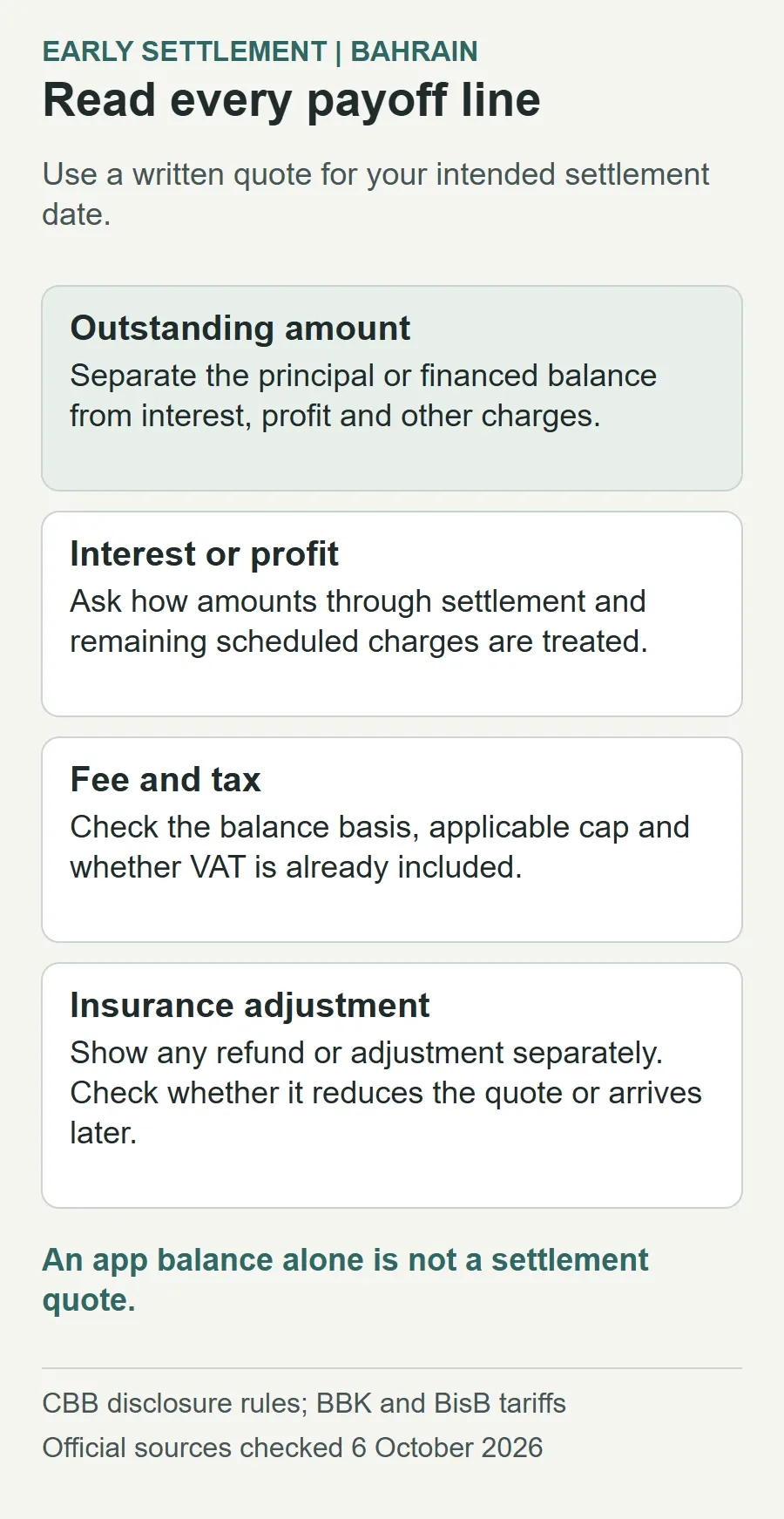
| Item | What to ask |
|---|---|
| Facility and settlement date | Does the quote identify the exact loan or finance account and the date you intend to pay? |
| Outstanding amount | Which part is principal or financed balance, and which part represents interest, profit or another charge? |
| Interest or profit adjustment | What is included up to settlement, and how is the remaining scheduled amount removed or adjusted? |
| Settlement fee | What percentage, balance basis and maximum apply to this facility? Is it full or partial settlement? |
| Tax | Which quoted fees include VAT, and which show it separately? |
| Insurance or takaful | What refund or adjustment is due, and is it deducted from the payoff or paid separately? |
| Other amounts | Are arrears, posted charges, recent payments or third-party release costs included? Ask for the basis of every item. |
| Payment instructions | What amount, reference, account and payment deadline must be used to achieve the stated settlement date? |
Fill this checklist from the bank's quotation; it is not a sample contract or a calculator. Keep the gross payoff and any separate refund visible so that the same refund is not deducted twice. A quoted settlement fee is only one component of the total.
For a partial repayment, ask for the revised instalment schedule before proceeding. Confirm whether the payment changes the monthly instalment, the remaining term or another contractual feature. Do not assume the bank will automatically apply your preferred option. The CBB disclosure provisions above expressly distinguish partial from full prepayment.
3. Separate Islamic profit treatment from fees and insurance
For Islamic bank licensees, CBB rule BC-4.2.28A limits the profit charged on early repayment to the month in which settlement actually occurs. The rule states that this requirement has applied since 1 October 2011. Ask the bank to show how the remaining profit has been treated in your quote.
That rule concerns profit. It does not say that the outstanding financed amount disappears, or that every separately permitted settlement fee is waived. Keep the profit adjustment and fee as separate lines. Do not transfer a conventional interest calculation unchanged into an Islamic finance contract.
Insurance is another distinct line. Current conventional-bank CM-5.5.1 and Islamic-bank CM-5.5.1 require proportionate refund or adjustment of the insurance premium charged on individual credit facilities when the customer requests prepayment or a top-up. Ask for the lender's calculation and how it will be applied to your account. Do not assume this means a refund of every premium ever paid, or substitute an invented insurance formula.
For a conventional loan, request the lender's interest calculation through the intended date and its treatment of remaining interest. BC-4.3.22(e) requires disclosure of early-repayment costs, including remaining interest and insurance-premium treatment. The Islamic rule above should not be presented as the conventional-bank rule.
4. Match the fee to the facility and tariff
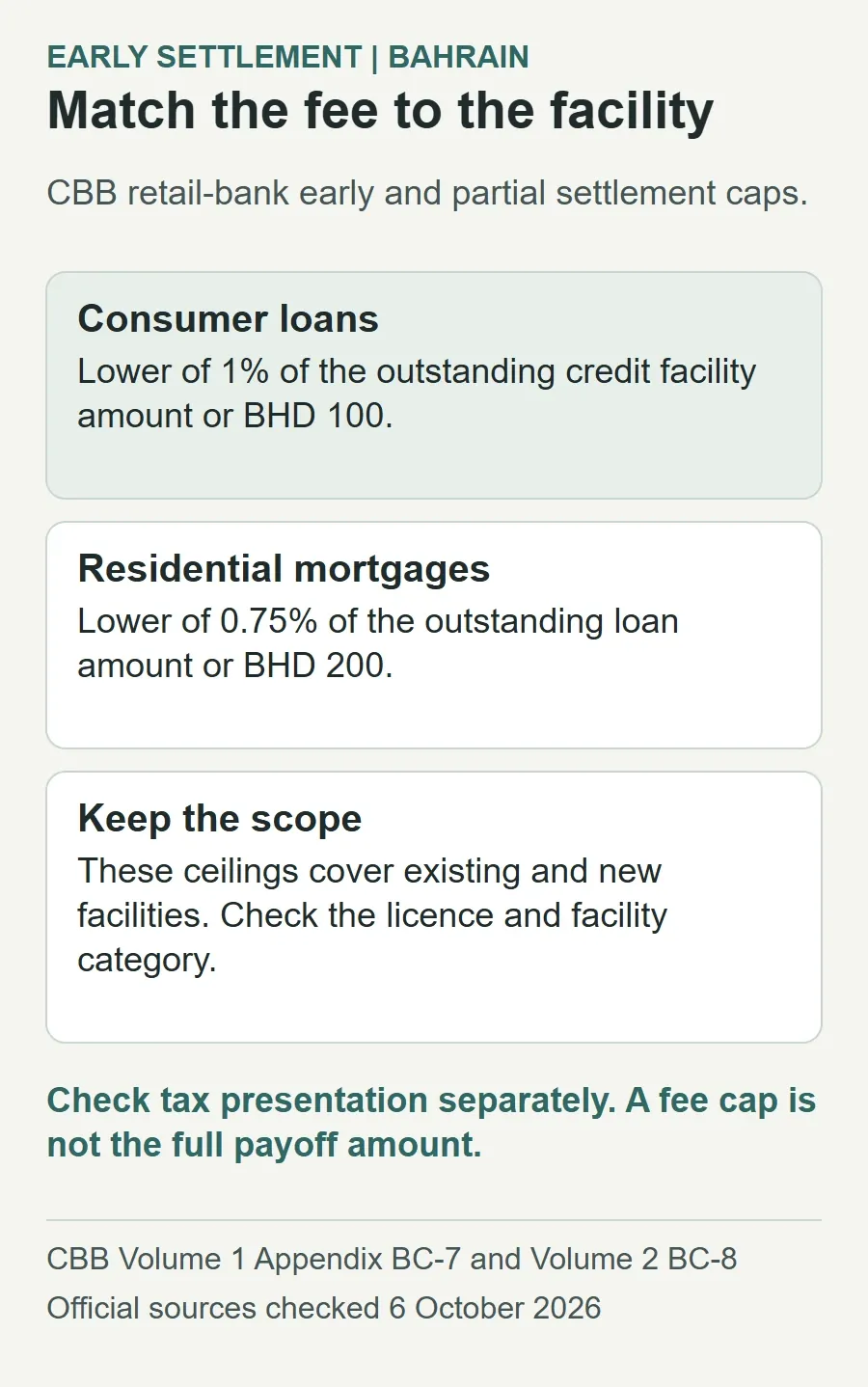
The current CBB retail-bank fee appendices, Volume 1 Appendix BC-7 and Volume 2 Appendix BC-8, list early or partial settlement caps for consumer loans at the lower of 1% of the outstanding credit facility amount or BHD 100. For residential mortgage credit facilities, the listed cap is the lower of 0.75% of the outstanding loan amount or BHD 200. They state that these ceilings cover existing and new facilities.
These are scoped retail-bank rules. Do not use the residential-mortgage figure for an investment-property facility, or assume a bank rule automatically describes every financing-company contract. Check the lender's licence and your facility classification when challenging a charge.
| Bank and facility | Published early-settlement charge | Source and tax wording |
|---|---|---|
| BBK consumer loans and car loans | Lower of 1.1% of outstanding balance or BHD 110 | Tariff effective 7 September 2025; fees include VAT where applicable |
| BBK mortgage loans | Lower of 0.825% of outstanding balance or BHD 220 | Same currently linked BBK tariff; read the mortgage category rather than borrowing the consumer-loan row |
| BisB personal and auto finance | 1% of outstanding amount, maximum BHD 100, plus 10% VAT | Currently linked 2026 retail tariff, finance-processing section |
| BisB residential housing finance | 0.75% of outstanding principal, maximum BHD 200, plus 10% VAT | Same BisB section; investment housing appears as a separate category |
The table preserves the banks' published tax presentation. Do not add VAT again to a figure already described as inclusive. Request a quote that identifies the underlying fee and applicable tax rather than comparing a tariff's final amount with the regulator's fee figure without checking the basis.
Both tariffs remained linked from their banks' fee pages when checked. They are examples for those named products, not a promise that every lender charges the maximum or that every partial repayment uses the same tariff row. BBK lists partial-payment fees separately, so ask for the precise applicable line if you are paying only part of the balance.
5. Confirm payment, closure and release separately
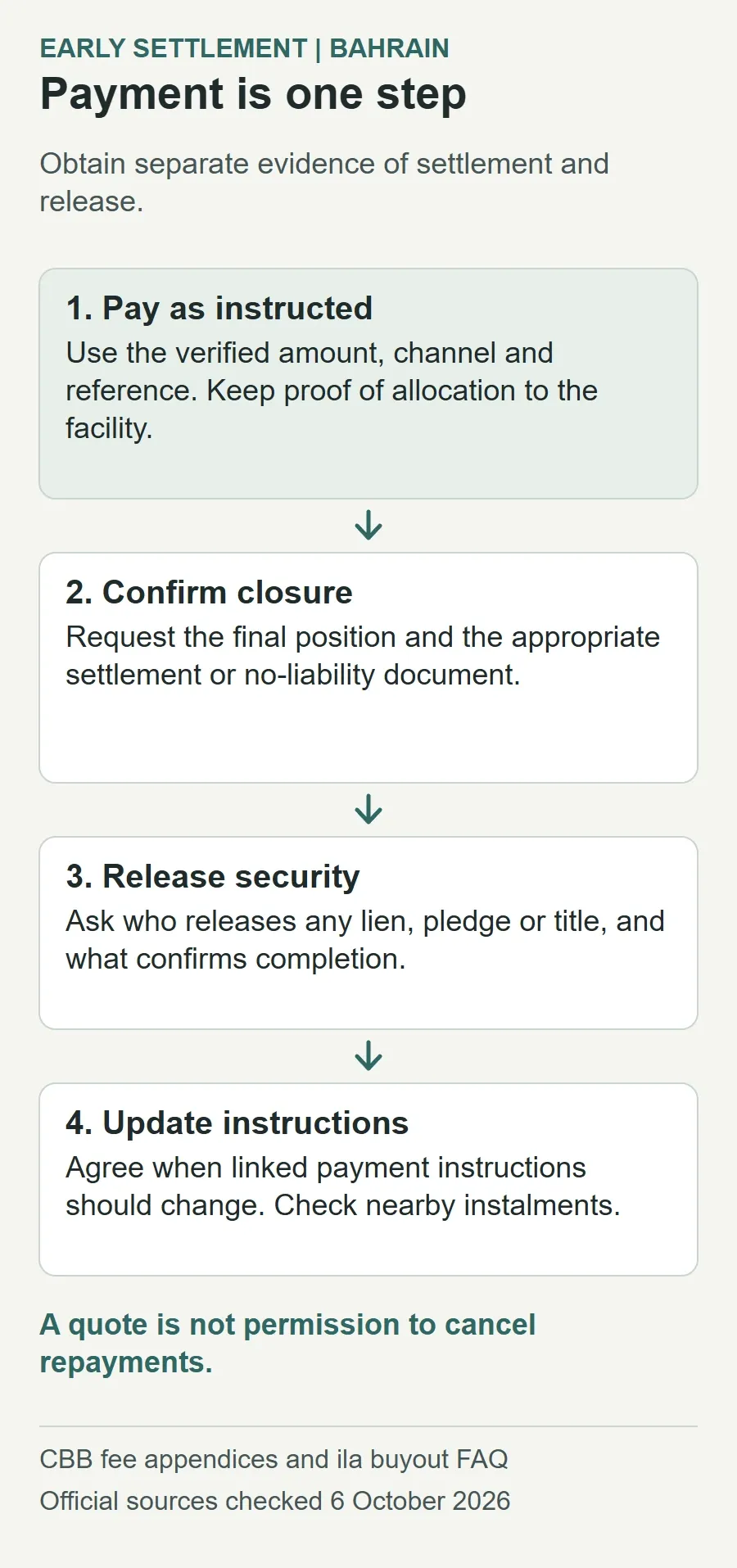
- Follow the agreed settlement instructions. Use the lender's verified payment channel and reference. Retain the receipt and ask for confirmation that the money was allocated to the intended facility.
- Check the final account position. Obtain a final statement or written confirmation of settlement. Ask whether there is a residual amount or separate insurance adjustment still to be processed.
- Request the correct letter. Confirm whether you need a release letter, no-liability certificate or another named document, and what it confirms. A statement of the balance before repayment serves a different purpose from confirmation after closure.
- Arrange linked-security release. For secured finance, ask which lien, pledge, title or other security is held, what release action is needed, who initiates it and what evidence confirms completion. A payment receipt alone does not answer those questions.
- Resolve payment instructions. Ask the bank when related standing orders, direct debits or salary instructions should change. Check any scheduled instalment that falls close to settlement rather than cancelling it on the strength of a quotation alone.
A bank buyout adds a second institution. ila's published buyout workflow, for example, requires an outstanding-balance certificate before approval; ila then settles directly with the existing bank, and the customer must provide a no-due certificate and salary-transfer letter after settlement. That is ila's stated process, not a universal document list.
Obtain the release letter promptly. The CBB appendices linked above list it as free within six months of facility closure, with a BHD 5 fee listed after that period. BBK's tariff and BisB's tariff show the corresponding later charge as BHD 5.500. That letter charge is separate from a third party's title-registration or other release cost; request an itemised explanation where such costs apply.
6. Challenge an unexplained settlement amount in writing
Ask the lender to identify the disputed line, calculation date, balance basis, tariff and rule it applied. Attach the quote, relevant schedule, payment record and your earlier correspondence securely. Keep the original quote if a replacement is issued so that you can see which item changed.
The CBB's official complaints procedure starts with an email or letter to the bank's complaints team. It calls for acknowledgement within 5 business days and a written response within 4 weeks. If that response is unsatisfactory, submit the complaint and the bank's response through the CBB complaint form, Tawasul or the stated in-person route.
A complaint does not itself establish a new payment arrangement. If the quotation expires while an item is disputed, ask for an updated amount and written instructions for any instalment falling due. Do not treat the complaint-handling timetable as a guaranteed settlement or release deadline.
General information: This guide explains public rules and published examples. It is not personalised financial or legal advice, and it does not decide whether early repayment is suitable for your circumstances.