Bahrain motoring and travel guides
Petrol prices in Bahrain: official checks, grades and fuel budgeting
By Gaurav Agarwal · Sources checked 6 October 2026
Check the Ministry of Oil and Environment’s dated gasoline and diesel notice and the station’s displayed rate for your grade. The official price image could not be verified on 6 October 2026, so no current rate is invented here. Fuel cost equals litres purchased multiplied by the verified BHD-per-litre price.
Jump to a section
- Where to check Bahrain’s current petrol price
- Know the grade before comparing the number
- Read fils per litre and dinars per litre correctly
- Calculate your monthly fuel budget from distance and consumption
- Find a station and confirm payment before dispensing
- Reduce litres used without choosing an unsuitable grade
- Keep a small record that stays useful when rates change
- Frequently asked questions
- Sources and checking date
Where to check Bahrain’s current petrol price
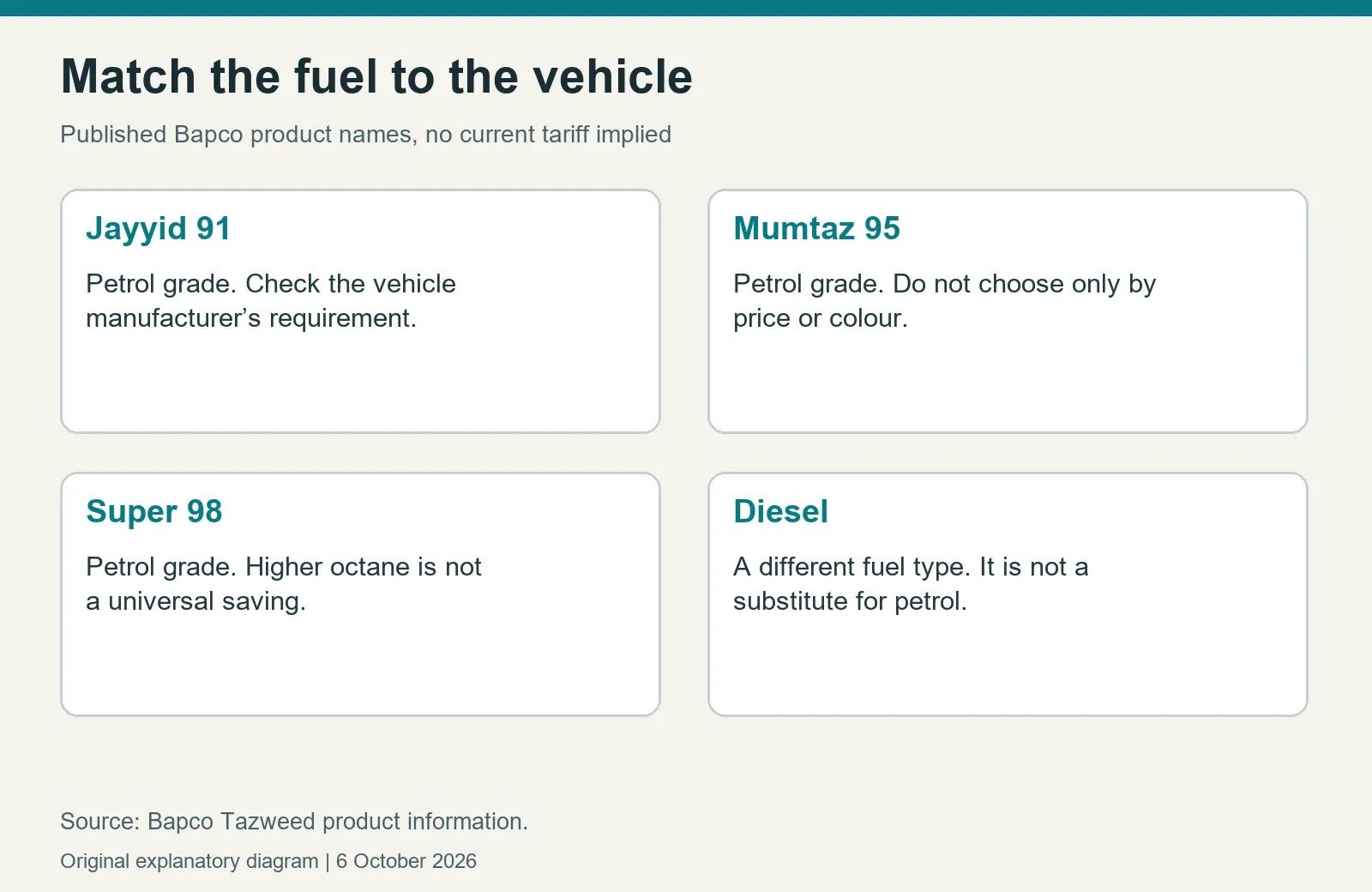
Start with the Ministry of Oil and Environment website and its gasoline and diesel price notice. Match the grade, unit and effective date before using a figure. A search engine can return a well-ranked notice from an earlier month, while a social post can circulate after its price has been replaced. The date on which an article was republished is not necessarily the date on which a tariff took effect.
We checked the official route on 6 October 2026. The Ministry’s page was accessible, but the linked price image did not load reliably, including on its Arabic gasoline-price page. We therefore do not present an unverified October rate as today’s official price. Open the current Ministry notice and compare it with the price shown for your chosen grade at the station before filling. This guide explains how to identify the right grade and turn that verified rate into a realistic budget.
If the notice remains unavailable, ask the station to confirm the displayed unit price before dispensing. Keep the receipt if you need a record for an employer, household budget or rental return. Do not infer a current price from an old receipt or from a neighbouring country’s rate. A familiar brand name across the Gulf does not mean the country, tax treatment and retail price are interchangeable.
Know the grade before comparing the number
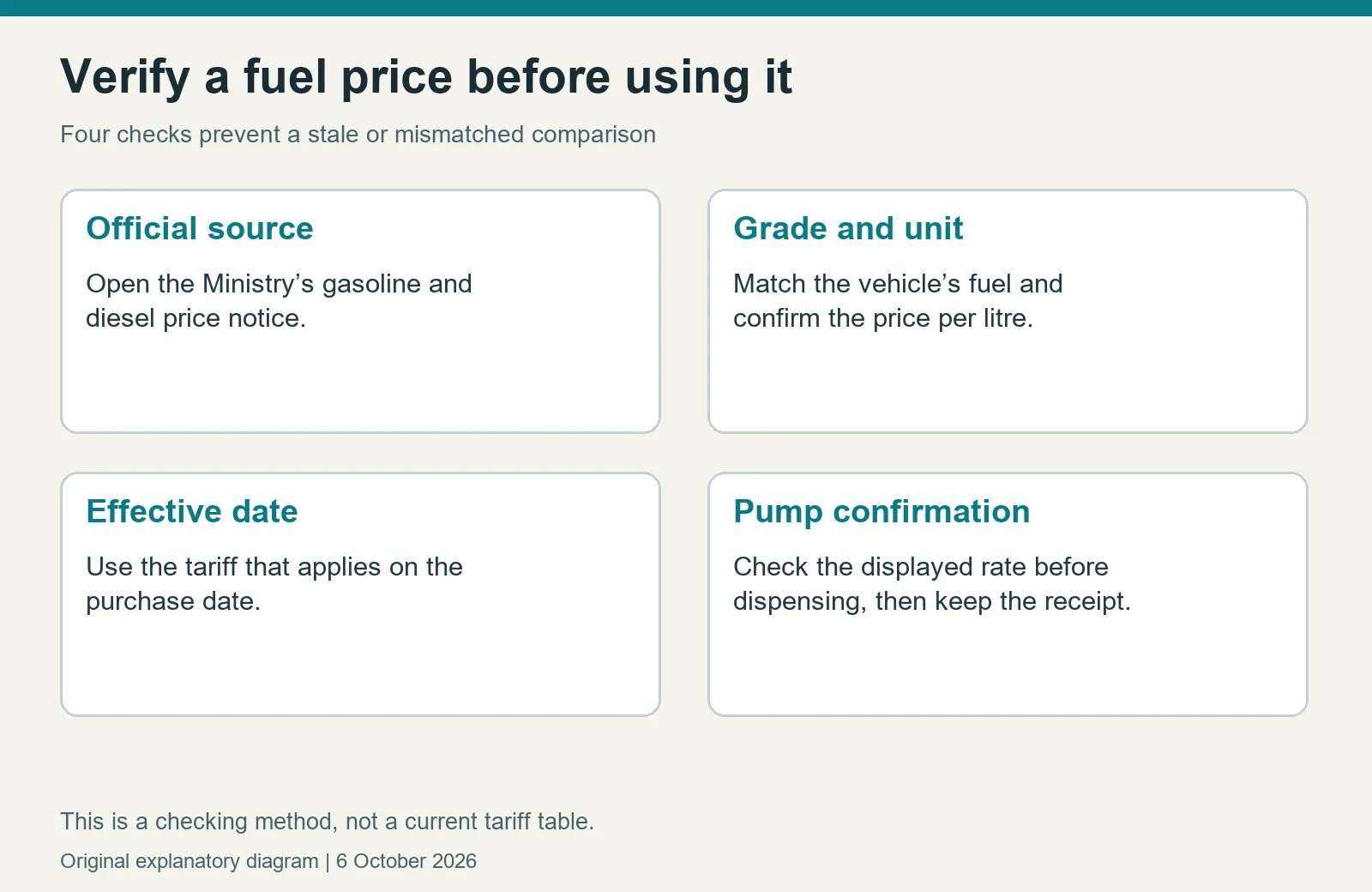
The Bapco Tazweed product page identifies Super 98, Mumtaz 95, Jayyid 91 and diesel. Those names help you match the pump selection to the vehicle’s requirements. A higher octane number is not a substitute for checking what the engine needs. Diesel is a different fuel type, so never treat it as another petrol grade that can be selected simply because its displayed price is lower.
Read the fuel-flap label and the owner’s manual for the actual car, especially if it was imported. If the manual uses a different rating convention, have the dealer or manufacturer clarify the appropriate locally sold grade. Do not match an unfamiliar foreign octane number to a Bahrain pump by appearance alone. A model sold in another market may have different engine or fuel requirements even when its name looks the same.
The US Department of Energy and EPA octane explanation says octane measures resistance to engine knock and advises following the manufacturer’s requirement. Its US pump numbers use that market’s labelling convention; they are not a Bahrain grade table. We use the source for the general principle, not to tell a Bahrain driver to buy US-labelled regular fuel. Distinguish an engine that requires a premium grade from one for which it is merely recommended.
For a rental car, ask the provider to identify the required grade at handover. Write it with the fuel-return policy so another approved driver has the same information. If there is a conflict between a verbal instruction and the car’s own label, resolve it before filling. If the wrong fuel is dispensed, stop and seek the provider’s or qualified technician’s instructions rather than experimenting with a mixture.
Read fils per litre and dinars per litre correctly
The Central Bank of Bahrain law, Article 13, states that a Bahraini dinar contains 1,000 fils. To convert a price stated in fils per litre to dinars per litre, divide by 1,000. Keep the unit beside the number in a budget or comparison. Confusing fils with dinars, litres with gallons, or a whole-tank total with a unit rate can produce a result that looks precise but is meaningless. The receipt should help separate litres purchased, unit rate and total paid.
Use three checks when copying a rate into a spreadsheet: the country is Bahrain, the product is the required grade, and the effective date covers the purchase. Preserve the source and checking date beside the figure. If a notice quotes more than one product, copy the relevant row rather than the largest headline number. Do not average petrol and diesel prices to estimate a particular car’s cost.
For a single fill, the calculation is straightforward: litres actually purchased multiplied by the verified BHD-per-litre price equals the fuel cost in BHD. Use litres dispensed, not the manufacturer’s tank capacity, unless you are only estimating a hypothetical empty-to-full fill. A dashboard showing one quarter remaining is an approximation, not an exact measurement of how many litres will be added.
Calculate your monthly fuel budget from distance and consumption
First estimate your monthly driving distance. Count the regular commute, shopping and family trips, then add occasional journeys you genuinely expect to make. Avoid building a budget around the shortest theoretical route if your real driving regularly includes detours. If your schedule changes, update distance before blaming every change in monthly spending on the pump price.
Next establish a realistic consumption figure in litres per 100 kilometres. If you already own the car, keep distance and filling records over several normal tanks. If you are comparing cars, use manufacturer data as a starting point and recognize that your traffic, load, route and use of air conditioning may produce a different result. A dealer’s best-case demonstration is not a guarantee for your commute.
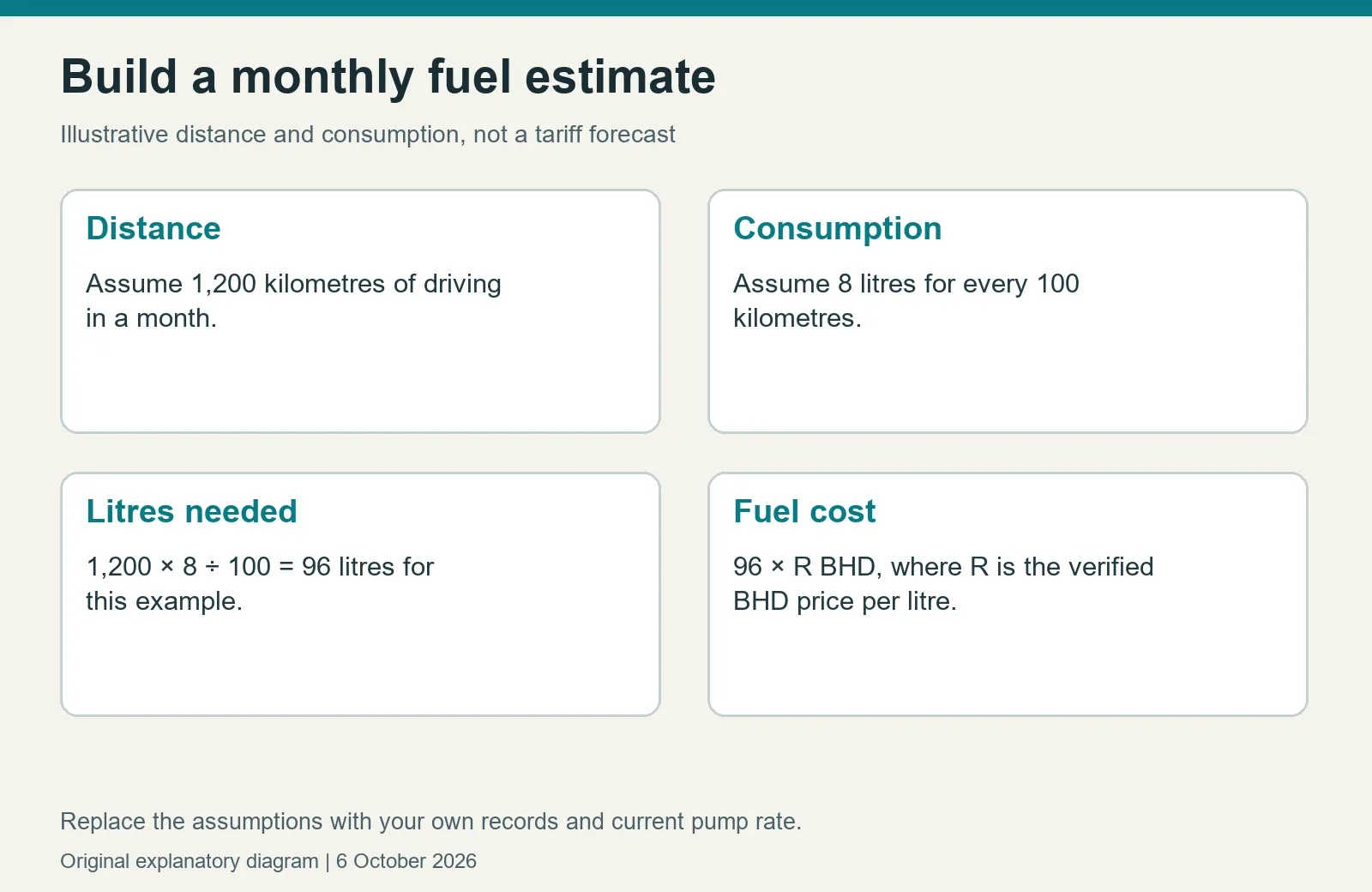
The formula is monthly kilometres multiplied by litres per 100 kilometres, divided by 100, then multiplied by the verified price per litre. For an explicitly illustrative driving pattern of 1,200 kilometres per month at 8 litres per 100 kilometres, consumption is 96 litres. If the verified pump rate is R BHD per litre, the monthly fuel estimate is 96 × R BHD. This example supplies a calculation method, not a claim about the current tariff or a particular model’s consumption.
You can compare a change in price without knowing the full tariff. A rise of 1 fils per litre adds BHD 0.040 to a 40-litre fill. A rise of 10 fils adds BHD 0.400 to the same fill. For the illustrative 96-litre monthly use, a 10-fils change adds BHD 0.960. These are arithmetic sensitivities, not a forecast that a price change will occur.
Find a station and confirm payment before dispensing
The official Bapco Tazweed network page provides a station map. Use the listed station details when planning a fill near home, work or a rental return point. Do not assume every location has every product or facility simply because it appears on a network map. Check the grade and opening information relevant to that station when a late-night stop or a particular fuel is important.
The official BenefitPay service page lists fuel payments at affiliated stations. That wording does not establish universal acceptance at every station or with every foreign payment setup. Ask before dispensing if you depend on a particular card, app or account. Keep a practical alternative available and verify the amount and transaction reference when payment succeeds. An app notification and a fuel receipt answer different record-keeping questions.
Reduce litres used without choosing an unsuitable grade
Begin with the factors you can measure: unnecessary trips, repeated short journeys, abrupt acceleration and avoidable loads. The US Department of Energy and EPA efficient-driving guidance explains that driving behaviour and extra weight can affect consumption. Its dollar examples and test-specific percentage ranges are not Bahrain savings promises. Use the general principle, then compare your own records over similar driving conditions.
The US Department of Energy and EPA hot-weather guidance also explains how air conditioning and open windows can affect consumption. It suggests shade or a sunshade to reduce cabin heat and following the owner’s manual for climate-control use. These general principles help interpret a summer fuel budget, but they do not establish a Bahrain-specific percentage saving. Keep occupants comfortable and safe rather than using an unrealistic assumption that cooling can always be avoided.
Maintain the car according to the manufacturer’s schedule and ask a qualified workshop to investigate a persistent unexplained increase in consumption. Check tyre pressures against the vehicle instructions, not a generic internet number or the tyre’s maximum marking. Keep safety and passenger comfort in view when deciding how to reduce idling or plan trips in hot weather. Do not turn off essential systems merely to produce a smaller fuel figure.
When comparing a more efficient car with your current one, calculate the annual fuel difference and place it beside purchase price, finance, insurance, servicing and resale uncertainty. A small saving per tank may not justify replacing a reliable car. Conversely, high annual mileage can make consumption more significant. Keep the fuel calculation separate from the wider ownership decision so the trade-off remains visible.
Keep a small record that stays useful when rates change
Record date, grade, litres, unit price, amount and odometer reading for each fill. A simple note or spreadsheet is sufficient. If you mix currencies or fuel units when travelling, keep those purchases clearly labelled rather than combining them into an apparent Bahrain average. Compare periods of similar use and note unusual journeys, maintenance or a change in the usual driver.
For a company reimbursement, follow the employer’s evidence requirements and submit the actual receipt. For a rental return, retain the final filling receipt and handover record until the account is settled. The rental company’s refuelling charge may include a service fee, so it should not be used as evidence of the national retail fuel price. More car-planning guidance is available through the Bahrain motoring and travel hub.
Frequently asked questions
What is the petrol price in Bahrain today?
Use the Ministry of Oil and Environment’s current gasoline and diesel notice and check the grade and effective date. On 6 October 2026 the linked official image did not load reliably during this review, so this page does not invent a current figure.
What do Jayyid, Mumtaz and Super mean?
Bapco’s product page lists Jayyid 91, Mumtaz 95 and Super 98. Choose according to the vehicle manufacturer’s requirement, and treat diesel as a different fuel type.
How do I estimate the cost of a full tank?
Multiply the litres you expect to buy by the verified BHD-per-litre rate. Tank capacity is only a rough maximum planning input; the actual bill depends on the litres dispensed.
Will a more expensive grade always save fuel?
No universal saving is established. Follow the manufacturer’s required grade and distinguish a requirement from a recommendation. Compare your own use rather than assuming the higher price guarantees better value.
Sources and checking date
Official authority and operator pages reviewed on 6 October 2026. A checking date records our review, not a promise that a tariff or eligibility rule will stay unchanged. Reopen the linked service before paying or travelling.
- Ministry of Oil and Environment: official price notice link
- Bapco Tazweed: fuel grades
- Bapco Tazweed: station network
- CBB law: currency unit and fils
- US Department of Energy and EPA: hot-weather fuel economy
- BENEFIT: BenefitPay services
- US Department of Energy and EPA: selecting octane
- US Department of Energy and EPA: efficient driving