Independent Bahrain guide
Eviction and Rent Increases in Bahrain: Notice, Evidence and Court Routes
By Gaurav Agarwal · Sources checked 6 October 2026
Classify the event before responding. A rent increase, non-renewal, lease expiry and eviction claim are different. Read the current official law, the registered lease, the notice and the payment record together.
01What the top three results miss
The current results reviewed were a Bahrain law-firm page, Landager and Commoner Law. The mix contains useful summaries and direct contradictions.
| Result | Useful part | Gap to fix |
|---|---|---|
| Bahrain law firm | Lists common disputes and current court | It does not provide a complete tenant response file or distinguish every notice event. |
| Landager | Mentions the two-year interval | Its page also states a 7% residential cap, conflicting with Article 27’s 5% residential text. |
| Commoner Law | Encourages written records | Its summary says there is no government cap and directs readers to RERA mediation, conflicting with the official law and amended forum. |
02Classify the notice
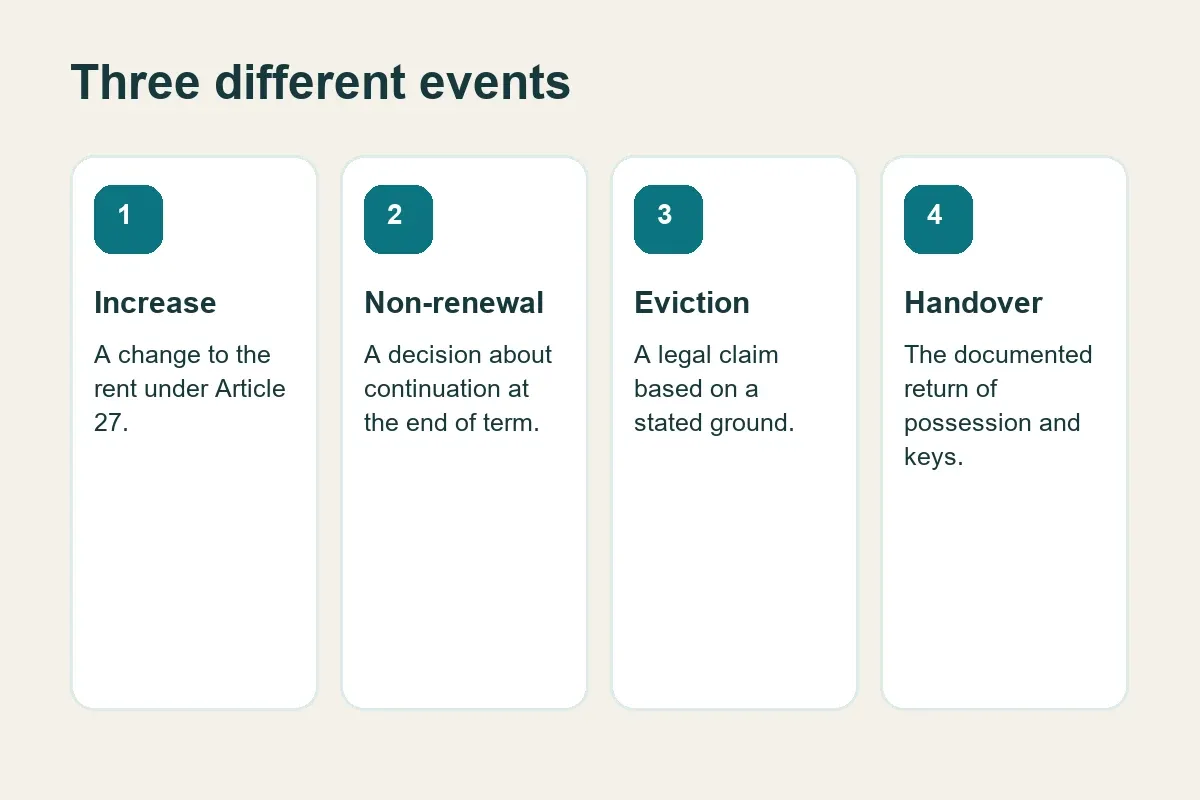
A rent-increase notice proposes a new amount. A non-renewal notice concerns continuation at the end of the term. An eviction claim seeks possession through the legal route. A handover record proves when possession, keys and condition were returned.
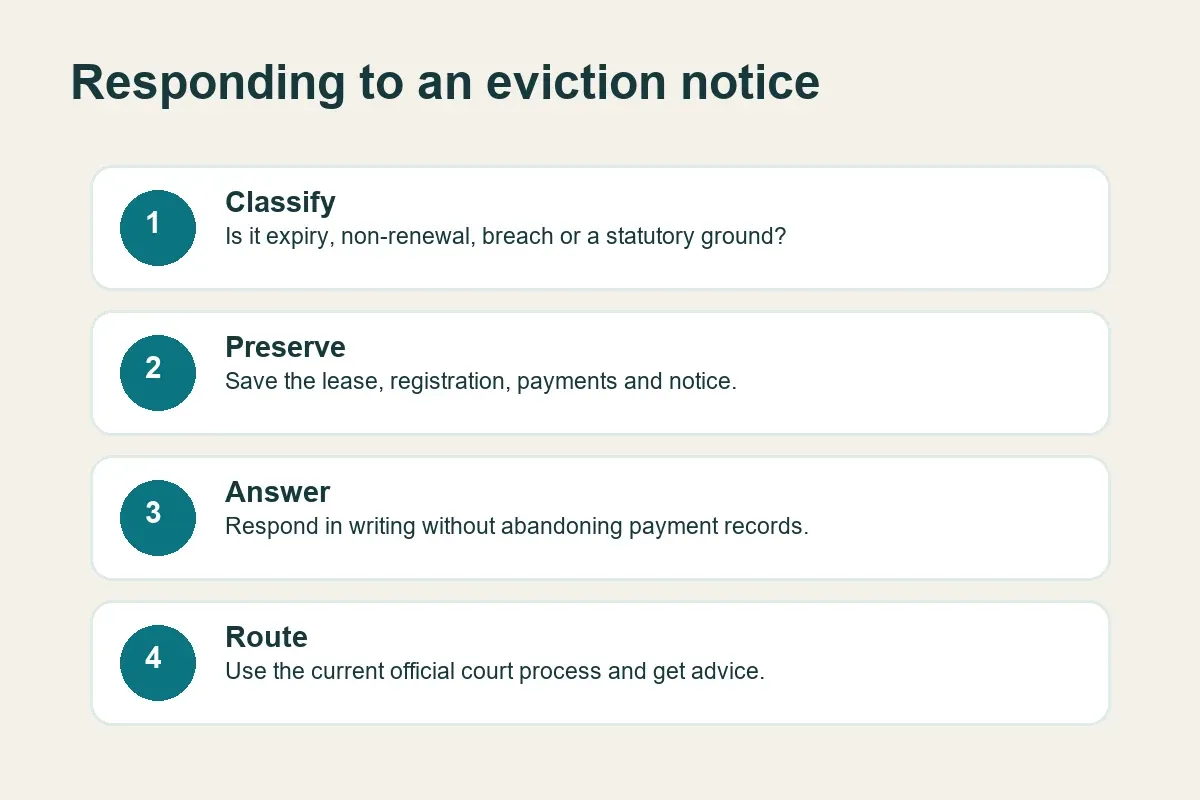
Record who sent the document, their authority, the delivery method, date received, property, registered lease, stated ground, requested date and any amount claimed. Do not assume an agent message is a court order or that contract expiry proves every eviction ground.
03Apply Article 27 to the covered lease
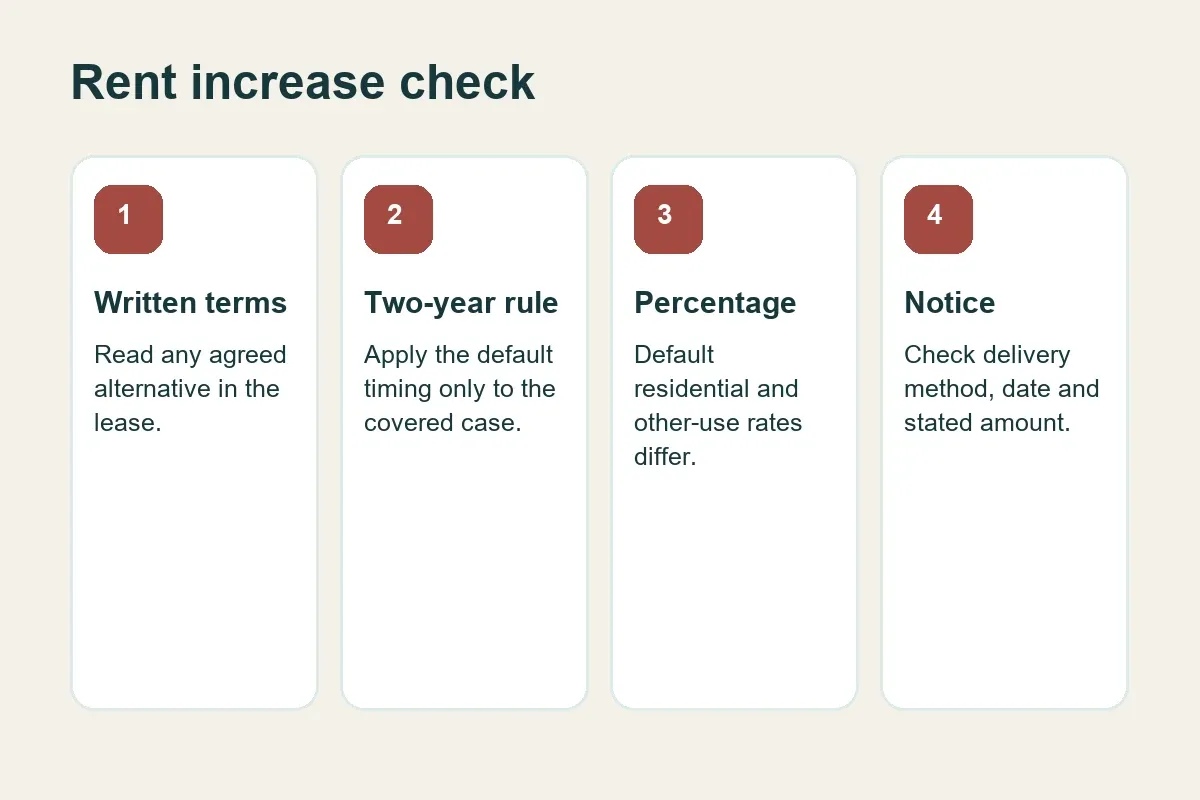
The official consolidated Property Lease Law says that under the default rule rent cannot increase until two years from the lease start or the last increase, whichever is nearer in the official English text. The default percentages are 5% for residential property and 7% for commercial, industrial, professional, craft and other uses.
Article 27 limits increases to five during the contractual relationship and requires registered notice with the new amount at least three months before the end of the second year. It also says a different written agreement can apply. Read the clause, registration and amendment record before calculating.
04Build a date line from documents
Put the lease start, registration, renewal, prior increase, notice delivery and proposed effective date on one line. Keep the registered-letter receipt or other agreed proof. A message screenshot without delivery context may not settle whether the required notice method was used.
Use the official Lease Contract Registration service and Lease Contract Enquiry to identify the recorded lease and amendments. Preserve the rent payment history before and after the notice.
05Read the stated eviction ground
Article 38 of the official English law text lists grounds on which a landlord may request eviction. They include two consecutive months of non-payment, unauthorised assignment or subletting, excessive residential occupancy, prohibited or harmful use, dangerous condition or final demolition decision, redevelopment conditions, landlord residence in the circumstances stated, and abandonment in the circumstances stated.
A landlord request and a court outcome are different. Match the exact ground to the facts and evidence. Do not expand the list from memory or substitute the rule of another Gulf country.
06Handle an arrears allegation with a ledger
Create a month-by-month table of due rent, due date, payment, reference, receipt and any disputed amount. Article 38’s first ground refers to non-payment for two consecutive months and also contains detailed court discretion and repeat-delay provisions. The result depends on the actual record.
Keep paying undisputed amounts through the documented method unless advised otherwise for the case. If the landlord refuses payment, preserve the attempted transfer, rejection and written request for a valid payment route. Do not let an increase dispute erase the payment trail.
07Build the response file
Include the signed and registered lease, amendments, notice and delivery proof, rent ledger, bank records, receipts, repair messages, occupancy records, subletting permission if relevant, photographs and requested handover date. Write a short chronology using only dates supported by documents.
Respond to each stated point. If the dispute concerns an increase, show the written clause, last increase and notice dates. If it concerns arrears, show the ledger. If it concerns condition or use, show the inspection and repair record. Avoid unsupported allegations.
08Use the amended court route
The official Law No. 13 of 2020 record amended the Property Lease Law. The current Article 5 names the High Civil Court for disputes under the law. Older references to a Rent Disputes Committee should not be used as the current filing instruction.
Use Bahrain’s official government services directory to identify current court services. If an agent is involved, the official RERA licence check verifies accreditation. Seek legal advice promptly when a court document, safety risk, lockout threat or substantial claim is involved.
09Questions about eviction and rent increases
What is the default residential rent increase?
Article 27 states 5% for residential use under its default rule, subject to a different written agreement.
Can rent increase every year?
The default rule uses a two-year interval and notice, but the written lease must be checked.
Is a non-renewal message an eviction order?
No. Classify the event and determine whether a legal claim or court document exists.
Can arrears lead to eviction?
Article 38 includes two consecutive months of non-payment and detailed provisions that require the actual record.
Can a landlord evict for subletting?
Article 38 includes assignment or subletting without written permission among its stated grounds.
Where are current lease disputes filed?
The amended Article 5 names the High Civil Court. Confirm the current government service route.