Healthcare Marketing 2026
How AI, GEO and privacy are reshaping patient acquisition
The global healthcare marketing services market is worth about $56.82 billion in 2026 and is on track to reach $79.81 billion by 2031, growing at a 7.03% CAGR (Mordor Intelligence, 2026). But the bigger change is not simply market growth. Healthcare discovery itself is changing, as patients increasingly use search engines, AI assistants, social platforms, reviews and digital scheduling tools to decide where and how to seek care. That is pushing organisations toward Generative Engine Optimization (GEO), stronger first-party data, privacy-safe measurement, structured medical content and more connected patient acquisition — well beyond driving website traffic.
This shift is where I spend most of my time, and it is why I built Xtrusio — an AI-visibility tool that checks how ChatGPT, Google AI Overviews, Gemini and Perplexity actually describe a brand when a patient asks about it, then shows what to change to be surfaced instead of a rival. Throughout this report I will point to where AI answers, privacy-safe measurement and the digital front door — the online journey from discovery to booking — now decide who gets picked.
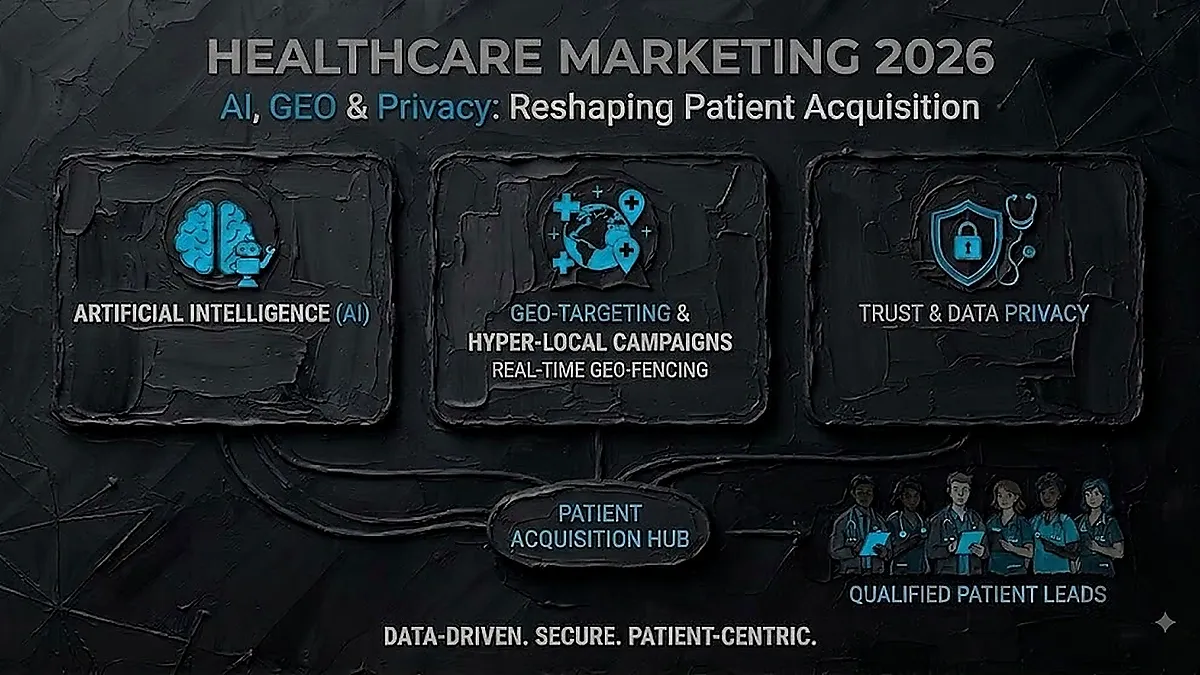
Healthcare discovery in 2026: search, AI answers, reviews and scheduling now share the decision.
Key Takeaways
- Healthcare discovery has stopped being a straight line. A patient may ask an AI assistant, read reviews, watch a video and check insurance before ever booking — so visibility can no longer be measured by rankings and sessions alone.
- GEO is now part of search strategy. You can rank well on Google and still be absent from an AI answer a patient may consult during discovery.
- Privacy has become part of marketing architecture. Tracking that touches health data now carries legal exposure, which is pushing teams toward consent-based measurement using data collected directly by your organisation (first-party measurement).
- In my Gulf audits, Arabic-language coverage has sometimes materially changed which providers surface in Arabic AI answers — treat it as a serious signal, not a guarantee.
The organisations that win the next five years will not be the ones publishing the most content or spending the most on ads. They will be the ones that make their expertise easy to discover, easy to verify, easy to understand and easy to act on — for human patients and for the AI systems those patients increasingly ask first. That is a systems problem, not a campaign problem.
Market figures are directional industry estimates from published reports, not official forecasts or quotes.
Continue to the shiftHealthcare Discovery Is Moving Beyond Traditional Search
For years, healthcare digital marketing followed a familiar line: search, then a website visit, then a form or phone call, then an appointment. That journey is becoming much less predictable.
A patient weighing up their options today might do any of the following, in almost any order: ask ChatGPT or another AI assistant about treatment options; search Google for a nearby specialist; compare hospital reviews; read a medical publisher; check a physician's profile; watch a short educational video; confirm their insurance is accepted; then come back days later to book. Your own website is one voice in that trail, not the whole conversation.
Mordor Intelligence points to online search, social channels, AI tools, digital patient access and measurable patient outcomes as the forces now shaping demand for healthcare marketing services in 2026. Visibility can no longer be judged only through rankings and website sessions — the brand has to stay present across the whole information trail, and how that brand looks matters as much as what it says. The same principle sits behind the Bahrain brand identity shift toward cyber-heritage design, where a consistent visual signature helps both humans and AI systems recognise the entity. Healthcare just feels the discovery shift earlier, because the stakes of a wrong or missing answer are higher.
GEO Is Becoming Part of Healthcare Search Strategy
Generative Engine Optimization, or GEO, focuses on improving how clearly a brand, organisation, service or expert can be understood and surfaced by AI-powered answer engines. It matters especially in healthcare because patients increasingly ask conversational questions such as:
- Which hospitals specialise in this condition?
- What treatment options are available?
- Which clinics provide a specific procedure?
- What should I consider before choosing a provider?
- Which healthcare companies specialise in a particular technology?
AI platforms do not respond like traditional search engines. Instead of returning a list of pages, they synthesise information from several sources into one answer. An organisation may rank well in Google yet remain absent from AI-generated recommendations if its expertise, services, credentials and reputation are not clearly represented across the sources these systems trust.
The behaviour is real and growing. KFF found that US adults using AI tools for health information at least monthly rose sharply from 17% in mid-2024 to 29% in 2026, and the share is higher still among younger adults. Users stay cautious about how reliable those answers are, which is exactly why the goal is not simply to appear in AI answers, but to make accurate, medically reviewed information easier for these systems to understand and retrieve.
What Healthcare GEO Requires
Healthcare GEO extends well beyond adding keywords to articles. Organisations need a stronger information structure around their clinical expertise, and it rests on four things.
1. Clear Medical Entity Information
Search and AI systems should be able to understand your organisation names, physician names and credentials, medical specialties, conditions treated, procedures offered, hospital locations, accreditations, research expertise and clinical affiliations. Consistent information reduces the ambiguity around who the provider is and what it is qualified to offer.
2. Structured Healthcare Content
Important clinical information should not be buried inside vague marketing copy. A strong service page explains what the treatment is, who it is for, how it works, the risks or considerations, the provider's expertise, and the next step — in that order. That structure helps both humans and machines interpret the information.
3. Trusted Third-Party Validation
Healthcare is a high-trust category. Claims are stronger when expertise is supported by credible external sources such as professional associations, medical publications, respected media, institutional partnerships, research databases and authoritative healthcare directories. Credible third-party references can strengthen the signals AI systems use when retrieving and describing a provider — so a brand's AI visibility increasingly depends on its digital authority beyond its own domain, not just the polish of its home page.
4. Content Governance & Medical Review
In healthcare, "who signed off, and when" is a trust signal. Every clinical page should show the reviewing clinician's name and credentials, the review date, the sources it draws on, its next scheduled review, and the approval status of any specific claim. That layer gives patients confidence, gives compliance a clean audit trail, and creates clearer trust and source signals that search and AI systems can interpret when evaluating and retrieving healthcare content — the difference between a generic GEO play and a healthcare-grade one.
What I keep seeing in Gulf healthcare audits
This is a field observation from client audits I have run in Bahrain and the wider Gulf, not a market-wide claim. Private providers here often invest heavily in a polished English website and English service details, then assume Arabic will follow on its own. In the Arabic AI answers I test, it frequently does not. On more than one project a strong, well-known local provider was left out of the Arabic recommendation while a smaller rival with cleaner Arabic entity details was named first. The lesson is not that Arabic coverage guarantees a result — it varies by specialty and city — but that treating Arabic as an afterthought quietly hands Arabic-speaking patients to whoever the AI can describe more clearly. In a bilingual market, that is a patient-acquisition decision disguised as a translation task.
Healthcare Marketing Is Facing a Measurement & Compliance Shift
The second major shift is happening behind the scenes. Traditional attribution — tracking which marketing activity led to an inquiry or appointment — often depended on cookies, advertising identifiers, tracking pixels and third-party analytics. Healthcare organisations face far greater limitations, because the activity being measured can involve highly sensitive information.
HHS guidance specifically addresses the obligations healthcare organisations and their business associates face when using tracking technologies on websites and mobile apps. The FTC has also taken enforcement action over the disclosure of sensitive health information through advertising and tracking technologies. As a result, marketers cannot treat measurement as an afterthought. Privacy architecture has become part of marketing architecture.
From Vanity Metrics to Patient Outcomes
Pageviews, impressions, rankings and clicks remain useful indicators, but leadership ultimately needs to understand whether marketing contributes to meaningful outcomes. A modern framework tries to connect discovery to engagement to patient inquiry to appointment to a completed visit. This is pushing organisations toward stronger first-party measurement — reporting built on consented, appropriately governed data from their own patient-access infrastructure. The important question becomes less "how much traffic did this campaign generate?" and more "did this campaign help the right patients successfully reach the right service?"
Analytics and Compliance Are Becoming Growth Functions
Mordor Intelligence projects analytics, insights and compliance-related healthcare marketing services to grow the fastest of any service category, at a 7.83% CAGR through 2031, as organisations try to connect marketing activity with measurable outcomes while navigating privacy requirements. That changes the role of compliance. Traditionally, it was treated primarily as a final approval stage. In a modern operation, it needs to be considered from the beginning — workflows that support medical review, legal review, claims validation, consent management, data governance, content version control, regional advertising requirements and documented approvals. Organisations that build these into their operating model can move faster without compromising regulatory discipline. The compliance function stops being a brake and starts being a growth enabler.
Pharma, Providers & The Digital Front Door
The healthcare marketing services market is not growing uniformly, and the strategy that works for a pharmaceutical launch is wrong for a hospital's patient-acquisition drive. Pharmaceutical and biotechnology companies remain major buyers of marketing services, while healthcare providers and health systems are among the fastest-growing end-user groups. Mordor projects providers and health systems to expand at a 7.89% CAGR from 2026 to 2031, with their investment focused on patient acquisition, online scheduling, service-line communication, local reputation, digital front doors and AI-search visibility.
| Segment | Main Marketing Priorities |
|---|---|
| Pharma & Biotech | Product launches, physician (HCP) engagement, scientific communication and compliant multi-channel campaigns. |
| Hospitals & Health Systems | Patient acquisition, local discovery, physician visibility, reputation and appointment access. |
| Specialist Clinics | High-intent local search, condition-specific content, reviews and conversion. |
| Medical Technology Companies | Education, evidence, category awareness and B2B demand generation. |
There is therefore no single healthcare marketing strategy that works equally well across the sector, which is why generic "full-service" pitches so often disappoint a clinical buyer.
The Digital Front Door Is Becoming a Competitive Advantage
Generating awareness is only useful when patients can easily act on it. Consider two organisations with similar clinical reputations. One requires the patient to search, find a phone number, call, wait, explain the requirement, get transferred and finally schedule. The other lets them discover, understand, check the provider, select a location and request or book an appointment. The second creates a much shorter path between intent and access — which is why marketing, website experience, provider directories, CRM systems, scheduling technology and patient-access operations can no longer operate as completely separate functions.
A 2026 Healthcare Marketing Roadmap
If you are preparing for this environment, focus on five priorities. Together they improve your ability to be discovered, understood and considered across both search and AI-led patient journeys.
1. Build for Search and AI Discovery
Keep investing in technical SEO, but expand the strategy toward AI discovery. Create content that clearly explains who you are, your specialists, services and medical expertise, and the relationships between medical topics — and start by asking ChatGPT, Gemini, AI Overviews and Perplexity who the best providers are for your main services, in both English and Arabic if you are in the Gulf. Screenshot whether you are named, skipped or described wrongly. That is your honest starting line.
Measure: AI mention rate for your top services (share of prompts where you are named), and brand-description accuracy across ChatGPT, Gemini, AI Overviews and Perplexity.
2. Strengthen First-Party Data
Reduce unnecessary dependence on third-party tracking, and build privacy-conscious systems for measuring the journey from a marketing interaction to a meaningful patient or business outcome. Consent, server-side controls and vendor agreements need to be configured for the rules that apply to you — HIPAA and state law in the US, GDPR where EU rules apply, Bahrain's PDPL and equivalent GCC frameworks in the Gulf. Server-side tracking is a useful pattern, not a compliance guarantee: it is only privacy-safe when it is subject to consent, proper governance and the specific legal requirements of your market.
Measure: consented lead coverage (% of tracked leads with a valid consent record), and share of marketing-attributed inquiries flowing through first-party, privacy-safe measurement.
3. Improve Clinical Content Quality
Generic SEO articles will become less valuable as search and AI systems get better at synthesising information. Healthcare organisations need original, clinically reviewed and genuinely useful content, structured the way patients ask — what it is, who it is for, how it works, the risks, your expertise, the next step.
Measure: percentage of published pages that are clinically reviewed and signed off, and refresh cadence (time since last clinical review) for top-traffic pages.
4. Expand Digital Authority
Visibility should extend beyond your own website. Build legitimate authority through expert contributions, research, partnerships, reputable publications and high-quality industry mentions, because credible third-party references can strengthen the signals AI systems use when retrieving and describing your organisation.
Measure: number of authoritative third-party mentions per quarter (peer-reviewed, professional-association or reputable-media references), and citation share in AI answers to your priority prompts.
5. Remove Friction From Patient Access
Audit what happens after somebody discovers you. If patients cannot easily identify the right provider, location, service or next step, stronger marketing will simply send more people into a broken conversion journey. Then repeat the discovery check every month — AI visibility is earned again and again, not delivered once.
Measure: inquiry-to-appointment conversion rate, and appointment completion rate (booked appointments actually attended), segmented by service line and market.
Published: August 13, 2026 | Last Updated: August 13, 2026
Consultant vs Agency: Which Fits Your Stage?
A question I get constantly from clinic owners and health-system CMOs: do we need a full-service agency for this, or is a senior consultant a better use of the budget right now? Honestly, it depends on the job in front of you. A large agency and a solo senior consultant are not better or worse versions of each other — they are built for different stages. The table reframes the decision around six real trade-offs, with the consultant model (my own practice, imaPRO) in the middle column. The same six checks apply whether you are buying branding or wider marketing work.
| The decision you're actually making | A Senior Consultant (imaPRO) fits when | A Full-Service Agency fits when |
|---|---|---|
| Who owns patient-acquisition numbers | ✓You want one senior person named on the plan and answerable for new-patient volume and CAC. | →You need a coordinated team running paid, creative, web and analytics in parallel. |
| AI visibility and citation work | ✓You want a specialist auditing how ChatGPT, Gemini, AI Overviews and Perplexity describe your practice — and working on that mix directly. | →You are not prioritising AI-answer visibility yet; classic SEO and paid still cover your reporting. |
| Privacy-sensitive tracking | ✓You want senior input on consent, server-side controls and vendor agreements for HIPAA, GDPR or PDPL — not a junior on a template. | →You need in-house compliance sign-off and formal QA across a large hospital group. |
| Arabic-and-English work in the Gulf | ✓You need real bilingual entity and content work — not translated pages — with the senior person personally involved. | →You're running a large multi-country GCC rollout needing several native writers and producers at once. |
| Scope of the immediate job | ✓The near-term job is focused: one service line, one launch, one market, or a strategic audit and reset. | →You need high-volume production across dozens of assets and markets in parallel. |
| Budget shape | ✓You want senior attention at a lower monthly cost than a full retainer or in-house team. | →You have the budget for a full retainer with dedicated people across functions. |
Most healthcare brands eventually need both at different stages. What matters is being clear about which one you need right now, and how quickly that partner can actually convert discovery into a booked appointment — the same speed-to-lead discipline that decides winners in automated trade show lead generation in Bahrain.
The Tier Agencies: Bahrain & The Wider Gulf
imaPRO is my own consultancy, so treat this as a self-description. The model is consultant-led rather than account-managed — I run the engagement personally, not a rotating team. The 2026 focus is exactly what this report describes: working on your chances of being surfaced or cited across ChatGPT, Google AI Overviews, Gemini and Perplexity; running privacy-compliant patient growth; and building the brand in both Arabic and English. Because I built Xtrusio, the whole model is oriented around what happens inside the AI answer, not weekly ranking reports. Score it on the same checks as anyone else, and push hard on evidence.
Rama Group is a Bahrain agency working across paid ads, websites and traditional SEO. Editorially, this feels like a reasonable fit when your near-term priority is classic performance marketing alongside branding work. The honest caveat: AI-answer visibility and privacy-compliant tracking are areas to ask about directly, since they may sit as newer capabilities rather than core deliverables — worth confirming on the first call.
Bahrain-based with a wider GCC footprint, GO-Globe publicly lists Answer Engine Optimization, SEO and AI automation as part of its offering, which is unusual to see spelled out this clearly on a Bahrain agency page. Push them on healthcare-specific compliance and Arabic entity work before assuming the AEO capability runs deep.
Manama-headquartered and working across Bahrain and Saudi Arabia, TSC publicly presents itself as bilingual with an AI-integrated approach and lists healthcare among its sectors. Worth a look if your priority is Arabic-and-English execution across SEO, social and PR — but ask to see real healthcare examples and how patient-data tracking is handled, since public positioning and delivered capability are not the same thing.
Rama Group also fits here because of the range of creative and production work it publicly delivers across sectors. Worth considering if you want a single vendor for brand rollout, print and creative — but for healthcare you will still want someone specifically accountable for AI visibility and privacy-compliant measurement, so plan the split accordingly.
Operating since 2007, Boxon publicly lists healthcare among the sectors it has delivered projects for, alongside government and family-office clients across the Gulf. Worth a shortlist call if your priority is brand-identity work — then bolt on a specialist for the AEO and measurement layer.
Bahrain-headquartered with an additional New Zealand office, GOamplify positions itself as a design-thinking-led digital agency across strategy, design, dev and analytics. Worth considering for a healthcare brand that wants a design-led approach — but add a specialist for privacy-compliant tracking and AI-answer work.
The tiers are operating-model classifications, not audited quality rankings. Names appear based on public positioning and are starting points for your own evaluation, not commercial endorsements. Score every option on the same checks and pick the one that answers with evidence.
FAQ: Healthcare Marketing In 2026
What is the healthcare marketing services market size in 2026?
Mordor Intelligence values the global healthcare marketing services market at about $56.82 billion in 2026, projected to reach $79.81 billion by 2031 at a 7.03% CAGR. The growth is being driven less by media spend and more by AI-led patient discovery, privacy-safe measurement and demand for compliant, clinically reviewed content.
What is healthcare GEO and why does it matter now?
GEO, or Generative Engine Optimization, is the work of making a provider's expertise, services and credentials clear enough that AI answer engines like ChatGPT, Google AI Overviews, Gemini and Perplexity surface them accurately. It matters because US adults using AI tools for health information at least monthly rose sharply from 17% in mid-2024 to 29% in 2026 (KFF Tracking Poll) — so you can rank well on Google yet still be missing from an AI answer a patient may consult during discovery.
How has privacy law changed healthcare marketing measurement?
Tracking pixels and third-party identifiers that once powered attribution now carry real legal exposure when they touch health data. HHS guidance addresses tracking technologies on healthcare sites and apps, and 2026 enforcement over advertising pixels has pushed teams toward consent-based, server-side and first-party measurement instead of cookie-based tracking.
Which end-user group in healthcare marketing is growing fastest?
Healthcare providers and health systems are projected to expand at a 7.89% CAGR from 2026 to 2031 — the fastest end-user rate — as they invest in patient acquisition, online scheduling, service-line communication and AI-search visibility. Pharmaceutical and biotech companies remain the largest buyers overall, at roughly 44.8% of revenue.
What should a Bahrain or GCC healthcare brand prioritise in 2026?
Prioritise real Arabic-and-English work, not translated pages. In my Gulf client audits, stronger Arabic coverage has sometimes materially affected which providers appear in Arabic AI answers — treat it as a serious signal, not a guarantee. Pair it with privacy-compliant tracking under PDPL and equivalent GCC rules, and a senior person accountable for patient-acquisition numbers.
Want To See How AI Describes Your Healthcare Brand Right Now?
Xtrusio shows how your brand appears across ChatGPT, AI Overviews, Gemini and Perplexity, and the steps that can improve your chances of being surfaced instead of a rival.
Explore Xtrusio