Bahrain finance guides
Murabaha in Bahrain: read the price, payment and settlement terms
By Gaurav Agarwal · Sources checked 6 October 2026
Identify the asset, bank cost, agreed profit and final sale price, then check the payment schedule and linked agency or security documents. Request a dated early-settlement calculation showing the treatment of remaining profit and applicable charges.

Jump to a section
A Murabaha contract in Bahrain needs more than a monthly-payment check. Identify the asset being sold, the bank’s purchase cost, the agreed profit and the final sale price. Then read the payment schedule, any agency or security documents, and the terms for missed payments and early settlement together.
This checklist is for reading a proposed personal financing arrangement. It uses named bank documents and the Central Bank of Bahrain’s Islamic-bank rules checked on 6 October 2026. Product examples illustrate particular contracts; they do not establish identical terms across banks. For the broader account and financing background, see the Bahrain Islamic banking guide.
1. Identify what you buy and when you accept it
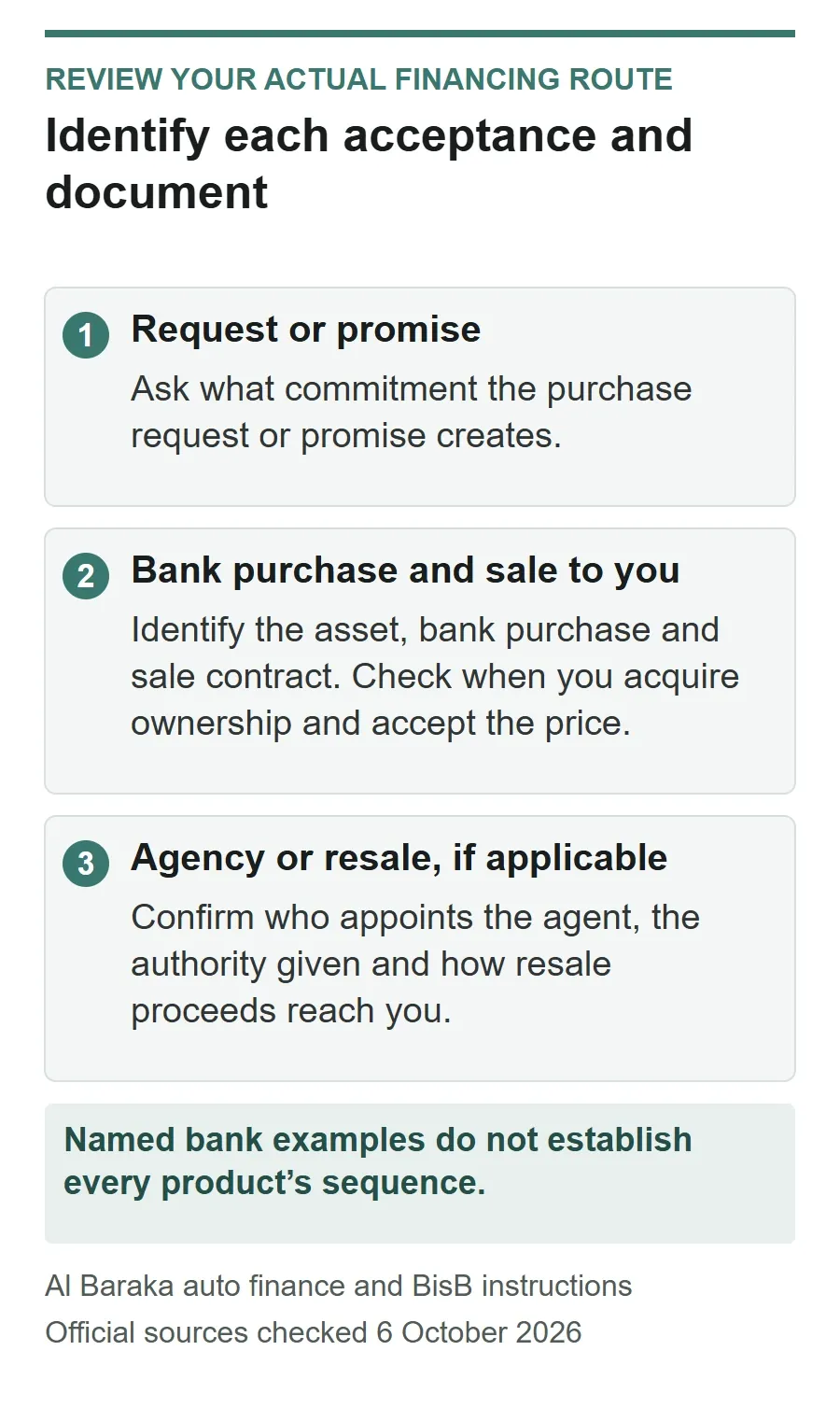
Start with the actual transaction. Al Baraka’s auto-finance description says the bank purchases the car and sells it to the customer at cost plus an agreed profit. That gives you a specific vehicle to identify in the sale paperwork.
A cash-financing journey can contain additional steps. BisB’s published instant-financing instructions distinguish accepting a pledge form, purchasing the commodity, acquiring ownership by accepting the Murabaha contract, and authorising Fajer to sell the commodity on the customer’s behalf. This is a particular financing process against a Tejoori balance, not a description of every personal-finance product.
For your offer, ask the bank to identify the document or screen for each relevant action: a purchase request or promise, the bank’s purchase, the sale to you, and any subsequent sale by an agent. Ask what commitment each acceptance creates. A request to arrange a purchase and acceptance of the completed sale should not be treated as interchangeable labels.
Keep the asset description and available transaction confirmations with the contract. If an agent acts for you, ask who appoints that agent, what the authority permits, and how you receive the resale proceeds. These are practical questions for the bank, not a finding that a particular transaction satisfies religious or legal requirements.
2. Put the price and deductions on one worksheet
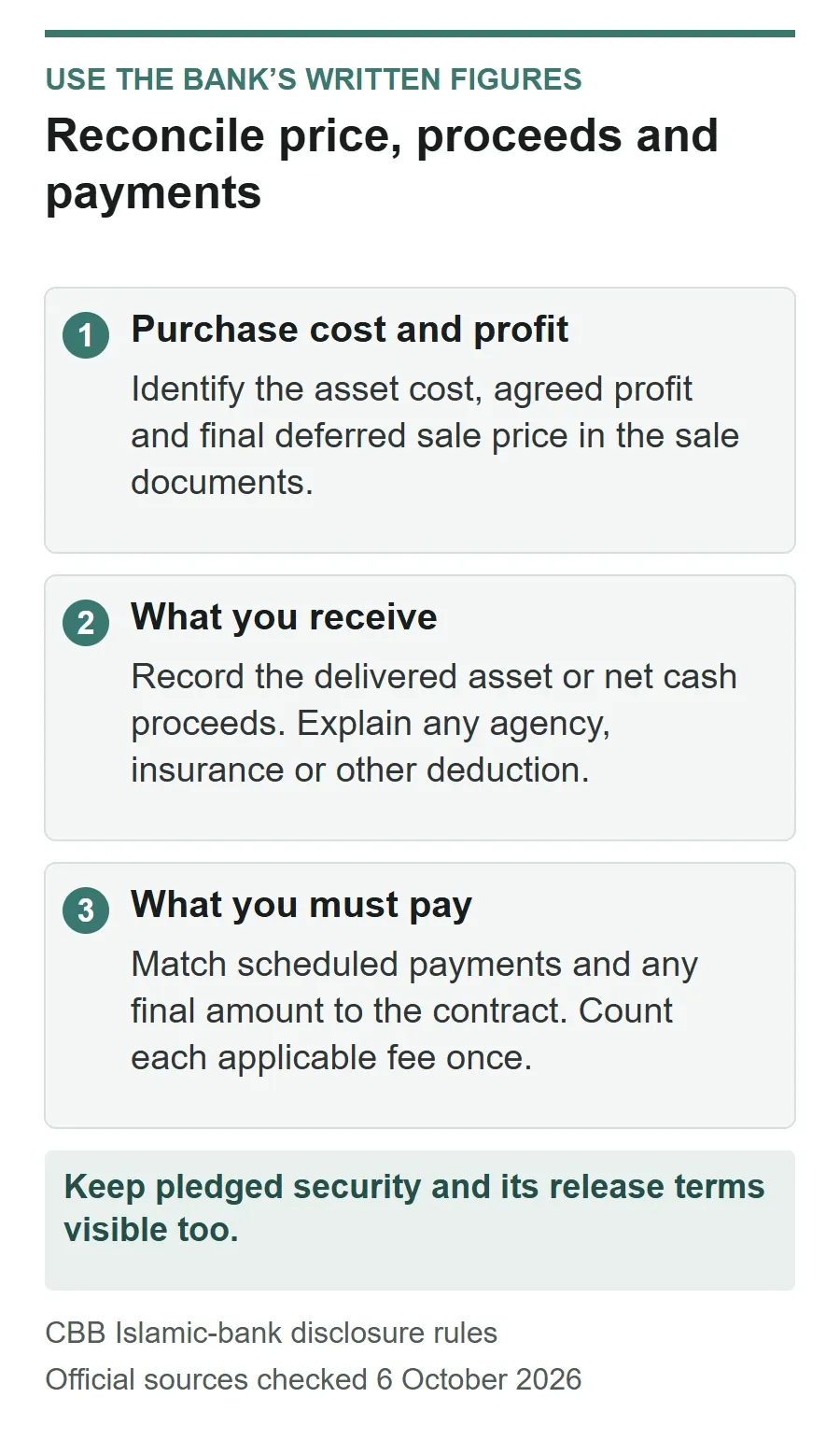
Use the bank’s written amounts to complete this worksheet. Leave an unanswered field open until the bank explains it; a marketing profit rate cannot fill every box.
| Contract field | What to record or ask |
|---|---|
| Asset and purchase cost | The identified asset or commodity and the cost disclosed in the sale documents. |
| Agreed profit and sale price | The profit amount, final deferred sale price and the document connecting them. |
| Money or asset received | The asset delivered, or net cash proceeds after relevant deductions and resale steps. |
| Additional costs | Each administration, agency, asset-purchase, insurance or takaful item that actually applies; whether paid separately, deducted or financed. |
| Repayment obligation | All scheduled payments and any separate amount due at the end. |
| Security | Any pledged balance, account security or other collateral, and its release conditions. |
Check that a fee is not being counted twice when you compare the sale price, financed amount and total cash outlay. Ask for a reconciliation if net proceeds differ from the financing amount. For instalment finance, the CBB requires the key-terms disclosure to identify net funds after charges, total principal and profit, and applicable fees. See BC-4.2.22.
3. Match the payment schedule to the price
Read the first payment date, payment frequency, final payment and maturity against the sale agreement. Ask how the account will be debited and what happens if the expected salary or other funding arrives after the due date. A payment instruction is part of making the schedule work; it does not explain the underlying price.
For instalment offers, compare the annual percentage rate, or APR, alongside total payments and net funds received. The CBB’s disclosure rules distinguish APR for instalment financing from the annual profit-rate disclosure used for other credit, including cards. Do not compare a card’s annual profit rate with an instalment APR as though they are the same measure. BC-4.2.10 to BC-4.2.16 explain that distinction.
Ask for the full monthly breakdown of principal, profit and other charges required at signing by BC-4.2.24. If a deferral or top-up is proposed later, obtain its new figures and ask whether you are accepting a new transaction, changing a payment arrangement, or both.
4. Read missed-payment and security clauses together
Find the trigger, amount or calculation method, and destination of each late-payment charge or donation obligation. Also identify any collection-cost provision and the bank’s rights over security. A charitable destination does not mean that the customer has no payment obligation.
A concrete example appears in KFH Bahrain’s July 2025 credit-card terms. Clause 3.5 describes donation obligations for specified missed-payment events and a charity account supervised by the bank’s Sharia Supervisory Board, after actual collection expenses. Clause 2.6 gives the bank rights to use the secured credit-card account to settle amounts due. These are card-specific terms, not a universal Murabaha tariff.
For your financing, ask separately what late payment means for the instalment, any donation or charge, collection action and release of pledged funds. Request the exact clause if the explanation is only verbal.
5. Get a settlement calculation for a named date
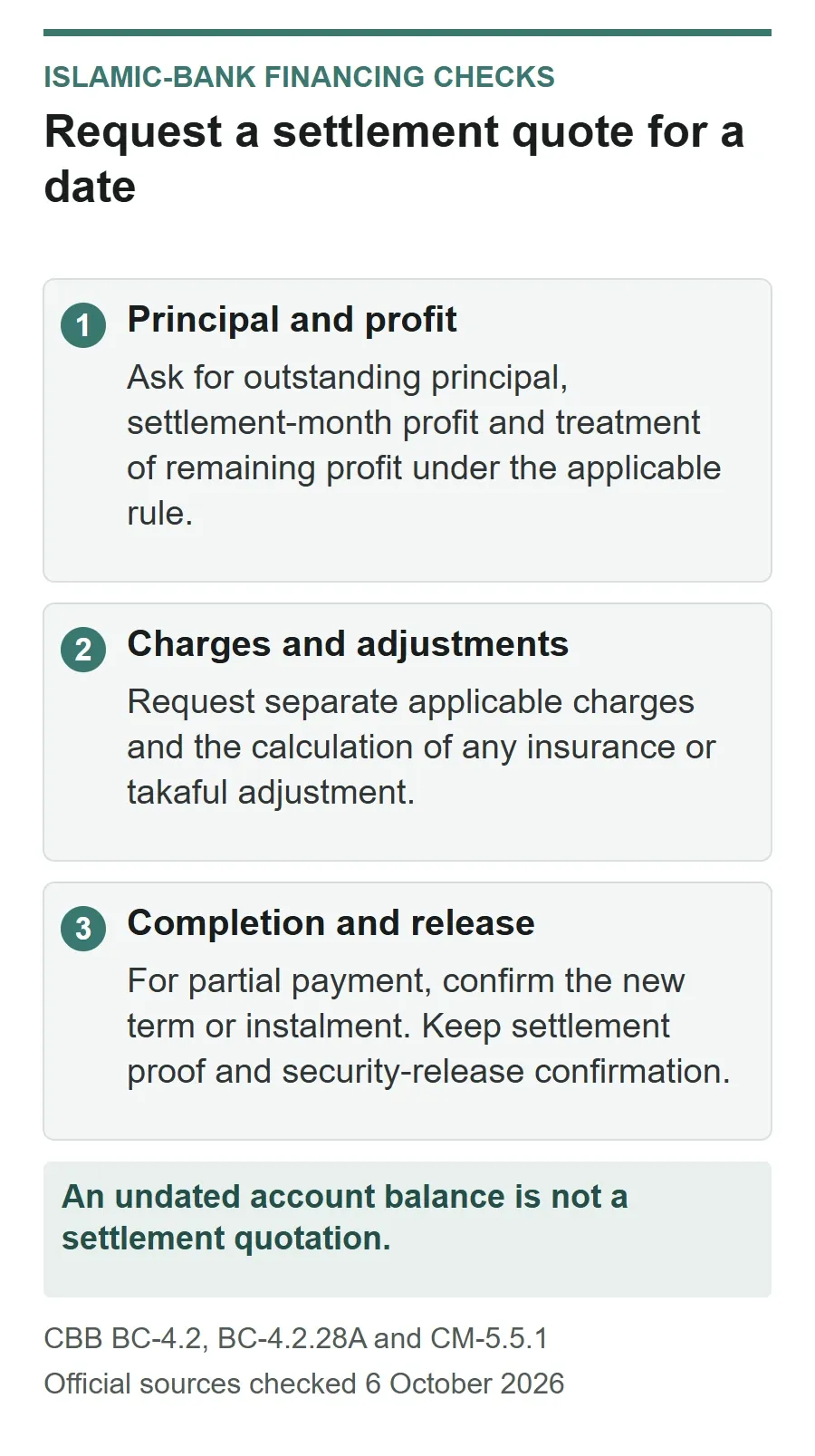
Do not assume that early repayment simply means paying every remaining instalment, or that all remaining profit is always a discretionary rebate. CBB rule BC-4.2.28A requires Islamic banks, on early repayment, to restrict the profit on the transaction to one month’s profit: the month in which actual early repayment takes place.
Ask the bank to show how that rule is applied in a dated quotation. Request separate lines for the outstanding principal, settlement-month profit, treatment of remaining profit, any separately applicable charge, and any insurance or takaful adjustment. Do not use an undated balance screenshot as the settlement amount.
The CBB also requires proportionate refund or adjustment of insurance premiums charged on individual credit facilities when the customer requests a top-up or prepayment, under CM-5.5.1. Ask which premium adjustment applies to your facility and for its calculation. The rule’s prescribed formula is not reproduced here.
For partial repayment, ask whether the instalment, remaining term or both will change. The CBB’s BC-4.2.30 specifically includes requests about partial-prepayment effects and the amount and calculation for full repayment on a specified date. Keep the quotation and evidence that the settlement was processed.
6. Keep the complete set before acknowledging receipt
Retain the sale contract, key terms, payment schedule, current applicable tariff, relevant agency and security documents, and any insurance or takaful certificate. Save the final accepted versions, including digital confirmations, rather than relying on a promotional page that may later change.
Read acknowledgements carefully. KFH’s card terms, clauses 17 and 18, say Arabic prevails if the language versions differ and include acknowledgements about understanding the related documents and receiving final signed copies. Ask which language controls your own agreement and resolve an unexplained difference before accepting it. Read the example on page 13.
If the bank’s calculation or explanation is disputed, use its formal complaints channel and identify the clause, transaction date and amount in question. The CBB consumer-information page explains its complaint role and available routes. Keep the bank’s response and supporting documents for escalation.
For a question about the religious basis, request the bank’s explanation and the relevant product authority. For interpretation of a disputed obligation, obtain qualified advice based on the actual contract. This article provides general information, not a religious ruling, legal opinion or personalised financial recommendation. Browse the Bahrain finance guides for related practical checks.