Bahrain employment and education guides
Sick Leave in Bahrain: Pay, Certificates and Eligibility
By Gaurav Agarwal · Sources checked 6 October 2026
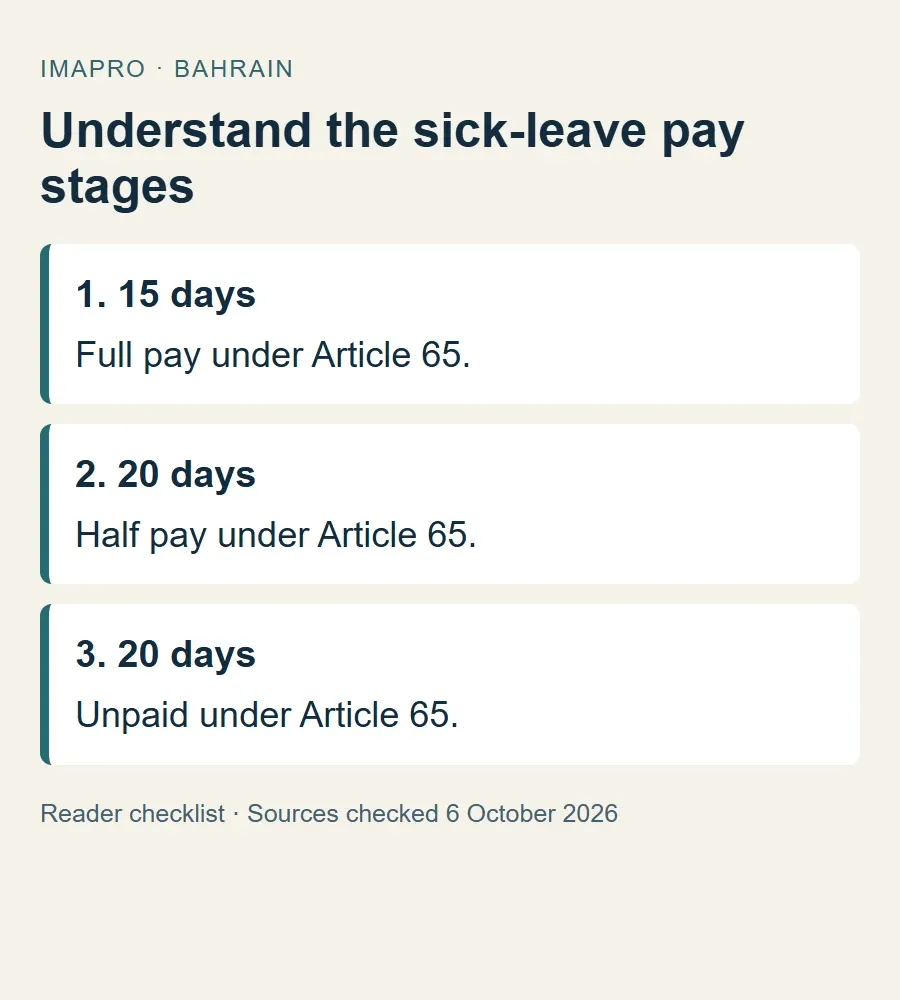
Under Article 65, a covered private-sector employee with three continuous months of service can qualify for 15 days of sick leave on full pay, 20 on half pay and 20 unpaid during the year, with the specified medical certificate. Domestic workers are outside Article 65.

Jump to a section
- Who qualifies for sick leave under Article 65?
- How the 15, 20 and 20-day entitlement works
- Which medical certificate should you provide?
- A practical absence and return-to-work record
- Accumulated sick leave and annual leave are different balances
- What if the employer proposes termination because of illness?
- Sick leave in Bahrain: common questions
Bahrain private-sector employees who complete three continuous months with their employer can qualify for 15 days of sick leave on full pay, 20 days on half pay and 20 days unpaid during the year. The illness and entitlement to leave must be supported by the medical certification specified in Article 65 of Law No. 36 of 2012. Domestic workers and employees governed by public-service rules need a different scope check.
This guide was checked against the official Arabic law and its amendment register on 6 October 2026. It explains the sick-leave record, certificate and payroll questions that determine what happens when you cannot work. It does not assume that a company's leave-system balance is automatically correct.
Who qualifies for sick leave under Article 65?
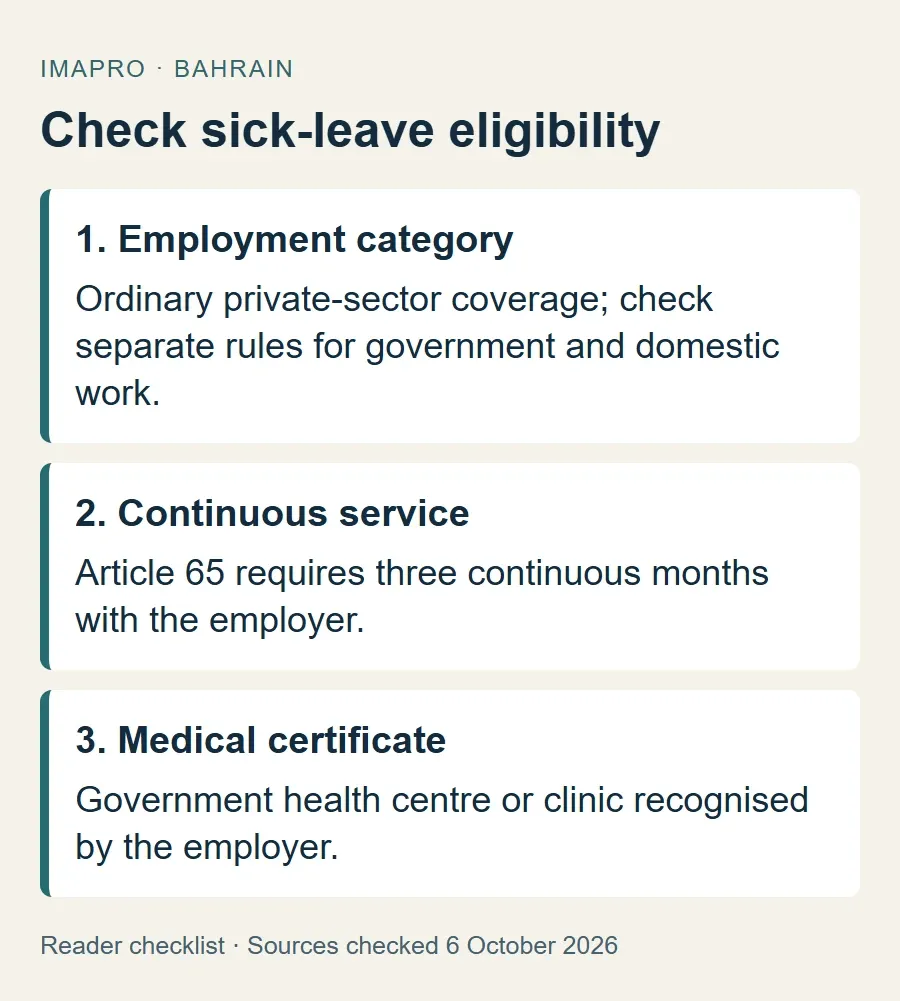
The starting point is your employment category and service history. Article 65 applies to a worker who has completed three continuous months in the employer's service, whose illness and entitlement to sick leave are established by a certificate from a government health centre or a clinic recognised by the employer. The threshold is expressed as continuous service, not successful completion of a company's probation assessment. A contract may contain a probation clause, but that is a separate issue under Article 21.
If you have just joined, check whether your contract or company policy provides paid sickness absence before the statutory threshold. Article 4 preserves better benefits established by contract, company rules or practice. An employer's more generous policy can therefore matter, even when the standard statutory entitlement has not yet become available. Ask HR to identify the policy and the category under which the absence will be recorded rather than assuming the only possibilities are unpaid leave or annual leave.
Government employees subject to civil-service, military-service or special public employment regimes are outside this law under Article 2(a). Article 2(b) applies selected provisions to domestic workers, but Article 65 is not among them. A household worker's contract and applicable protections must be examined separately. A job title such as cleaner does not settle this question: commercial cleaning employment and household domestic work can have different legal treatment. See Law 36/2012, Articles 2, 4, 21 and 65.
How the 15, 20 and 20-day entitlement works
Article 65 provides three pay levels during the year: 15 days paid in full, 20 days at half pay and 20 days without pay. These are distinct stages of the sick-leave entitlement. They are not 55 days on full salary, and the half-pay stage is not an extra payment on top of normal salary. If you have already used sick leave, the balance matters before the next certificate reaches payroll.
For example, suppose an eligible employee has used 12 days from the current full-pay entitlement and then receives a certificate covering five further chargeable sick-leave days. On that simplified record, three days remain in the full-pay stage and two reach the half-pay stage. The example assumes there is no accumulated entitlement, no better employer benefit and no dispute about how the certified absence maps to the leave record. It is a way to check the sequence, not a substitute for the actual payroll calculation.
Ask for the opening balance, earlier days deducted, the dates covered by the new certificate and the resulting full-pay, half-pay and unpaid balances. If payroll has deducted money, request the calculation and the wage components used. Avoid estimating a deduction by dividing a headline salary figure without checking the applicable wage treatment and record. Article 65 itself does not provide a universal worked payroll formula for every allowance, shift pattern or absence scenario.
The statutory wording is an entitlement during the year. If your employer uses a particular leave-year cycle, get that cycle and its application to your service in writing. Do not assume the system resets on your birthday, visa-renewal date or probation-end date. The source for the entitlement and the pay stages is Article 65.
Which medical certificate should you provide?
Article 65 identifies a certificate from a government health centre or a clinic recognised by the employer. The practical question for a private-clinic visit is therefore whether the clinic is recognised for your employer's sick-leave process. Ask for the accepted-clinic policy before you need it, and keep it with your contract and benefits information. A genuine medical appointment receipt may show attendance, but it is not necessarily the same document as a certificate establishing an entitlement to sick leave.
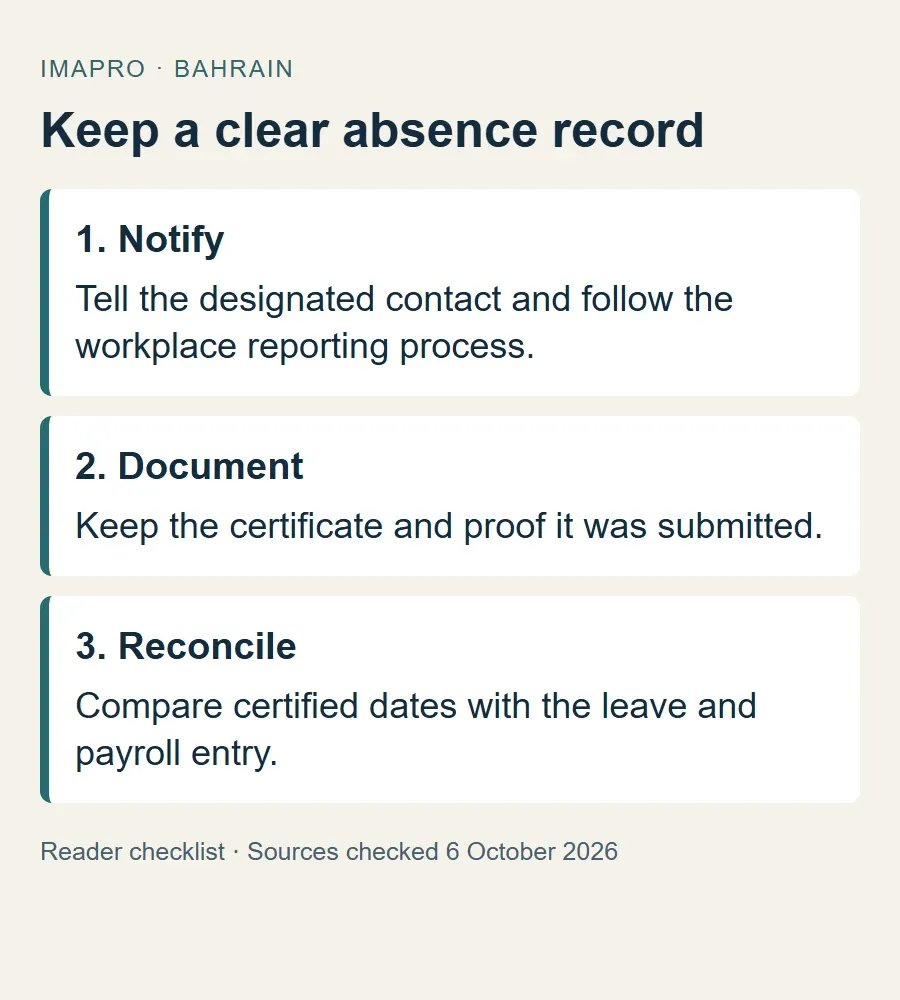
When you receive a certificate, check that your identifying details, issue date and leave dates are legible and consistent. Submit the document through the employer's stated channel and retain evidence of submission. If you are too ill to complete an online process immediately, tell the appropriate contact as soon as practicable and explain when the certificate can follow. This is sensible recordkeeping; Article 65 does not set a single universal hour-by-hour reporting deadline for every company.
If HR rejects the certificate, ask for a written reason. Different problems require different solutions: a missing leave period may need correction from the issuing clinic; an unrecognised clinic may raise an approval question; a disagreement over treatment duration has a specific statutory route. Article 65 refers disputes over the duration of treatment to the medical committee described in Article 89. Do not alter a certificate yourself or treat a manager's disagreement as permission to ignore medical advice. See Articles 65 and 89.
A practical absence and return-to-work record
A useful sick-leave record begins with a short notification: you are medically unable to attend, the expected dates if known, and where the certificate will be supplied. Keep the message factual. You do not need to circulate your health history to colleagues to explain why an urgent task needs reassignment. Use the designated HR or management contact for medical documents and follow the employer's process for confidential records.
Save a personal copy of the certificate, the submission acknowledgement and the leave request. Once the leave is processed, compare the approved dates with the medical document. A request accidentally coded as annual leave or unpaid absence may be easier to correct before payroll closes. If the absence is extended, submit the new certificate and identify the dates it adds, so overlapping or missing periods do not create an avoidable record dispute.
Before returning, clarify your next scheduled shift and any documented temporary restrictions that affect the work. If the treating professional advises modified duties, take that advice through the appropriate workplace process. Do not present an editorial checklist as a medical clearance requirement imposed by Article 65: the relevant requirement depends on your role, health condition and applicable workplace rules. The checklist's purpose is to make dates, documents and responsibilities clear, not to decide whether you are medically fit.
Accumulated sick leave and annual leave are different balances
Article 65 allows accumulation of sick-leave entitlement on full or half pay up to 240 days. The provision refers to those paid and half-paid balances; it should not be paraphrased as an automatic 240-day full-pay entitlement for every worker. Ask HR to show the accumulated record by pay category and explain any deductions. A single number labelled sick leave may conceal an important difference between full pay and half pay.
Article 66 says a sick worker can use the annual-leave balance alongside the sick-leave entitlement. Annual leave therefore becomes relevant when planning a longer medically supported absence. It remains a separate balance with its own history. If you request annual leave in addition to sick leave, make the requested dates and category explicit. Otherwise, you may later disagree over whether leave was voluntarily requested, incorrectly coded or treated as a substitute for an available sick-leave entitlement.
For example, a worker with a continuing certified illness may need an explanation of three records at once: the unused full-pay sick balance, the unused half-pay balance and accrued annual leave. A dated statement of all three is more useful than a verbal assurance that there is plenty of leave remaining. Ask how the unpaid stage is being treated as well. The governing provisions are Articles 65 and 66; an employer may provide better benefits under Article 4.
What if the employer proposes termination because of illness?
Article 117 says an employer cannot end the contract because of the worker's illness until the worker has exhausted sick and annual leave. The employer must notify the worker of the intention to terminate 15 days before the leave is exhausted. If the worker recovers before that period ends, the employer cannot terminate for the illness on that basis. This is more specific than saying an employee can never be dismissed while unwell.
If you receive such a notice, keep the notice and the leave statement on which the proposed date is based. Check whether accumulated sick leave and available annual leave have actually been included. Provide updated medical evidence through the normal channel and request correction of any missing leave. Do not assume the employer's stated exhaustion date is accurate merely because it appears in a formal letter.
Disputes involving termination can have short filing periods. Article 135 addresses termination-compensation claims with a 30-day period and specific settlement-related provisions, while Article 136 contains a general one-year limitation rule. The correct deadline depends on the claim. Seek prompt help rather than treating an ongoing HR exchange as an automatic extension. See Articles 117, 135 and 136. For expatriate workers needing help identifying the appropriate route, the LMRA Expat Protection Centre guide lists worker support at 995.
Sick leave in Bahrain: common questions
Is sick leave available during probation?
Article 65 uses three continuous months of service as its threshold. Article 21 separately regulates probation. Check your actual continuous service and any better contractual benefit; do not assume that a probation label alone determines your sick-leave entitlement.
Are all 55 days fully paid?
No. Article 65 gives 15 days on full pay, 20 on half pay and 20 without pay during the year, subject to its eligibility and certification requirements. Accumulated balances and better employer benefits need separate checking.
Can I use a private-clinic certificate?
The statutory wording includes a clinic recognised by the employer, as well as a government health centre. Confirm the employer's recognition policy and keep the certificate and submission record. A visit receipt alone may not establish the certified sick-leave period.
Does the same 15/20/20 rule cover a housemaid or household driver?
Article 2(b) does not extend Article 65 to domestic workers. Review the domestic contract and applicable protections. The LMRA domestic employer undertaking includes healthcare commitments, but that is not the same as importing Article 65's numerical entitlement.
Can HR convert every illness absence to annual leave?
Ask which entitlement applies and why the absence is being coded that way. Article 65 establishes qualifying sick leave, while Article 66 allows a sick worker to benefit from annual leave alongside it. Keep the request, certificate and balance statement so the issue can be assessed from the record.
Does this guide determine my entitlement in a dispute?
It explains the official provisions checked on 6 October 2026. Your employment category, continuous service, certificates, leave history and any better contractual benefits still determine how those provisions apply. The official amendment register and Arabic text are the legal references used here.