Bahrain finance guides
Bahrain gratuity calculator: a records-based worksheet
By Gaurav Agarwal · Sources checked 6 October 2026
Confirm your eligible service years and final wage basis, then separate service before and from 1 March 2024. This worksheet calculates the service formula for a fixed-pay case and compares recorded contributions without promising a SIO payout.

Jump to a section
- 1. Check whether this worksheet fits your employment
- 2. Enter confirmed records in the gratuity worksheet
- 3. Separate service before and from 1 March 2024
- 4. Understand the wage and service arithmetic
- 5. Keep contributions separate from benefit entitlement
- 6. Use the result to request a written reconciliation
A Bahrain indemnity calculation needs the correct wage basis, confirmed service periods and a separate check of contributions actually paid to SIO. This worksheet calculates the statutory wage-and-service formula for a limited fixed-pay case. It does not determine eligibility or promise the amount SIO will pay.
Rules and public sources checked: 6 October 2026. General information only, not legal or financial advice.
1. Check whether this worksheet fits your employment
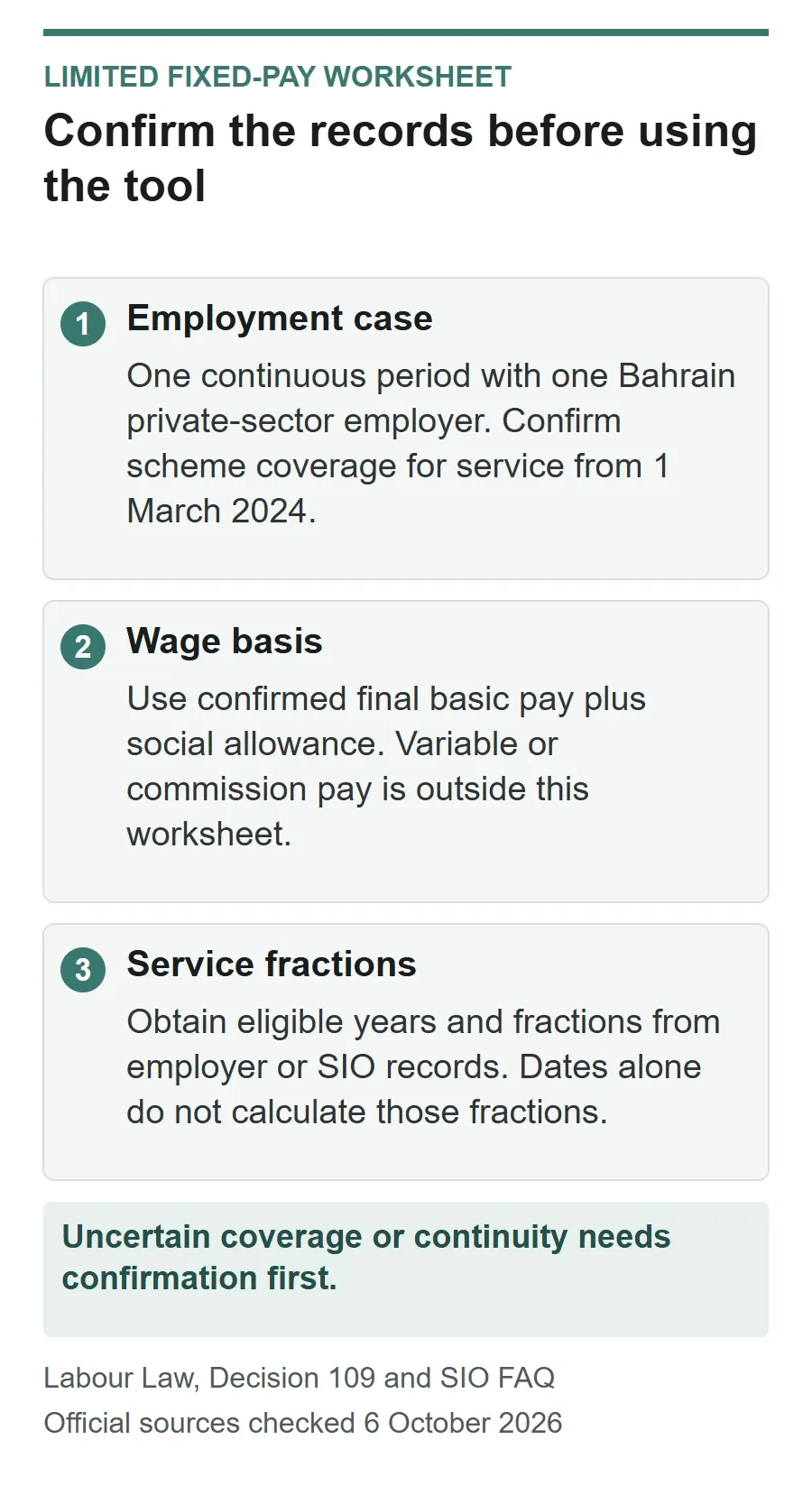
Use it for one continuous period with one Bahrain private-sector employer, on fixed monthly basic pay with any social allowance separately identified. For service from 1 March 2024, first confirm coverage under the non-Bahraini end-of-service scheme. The scheme concerns non-Bahraini workers covered by the employment-injury branch of social insurance. It excludes GCC nationals covered by the GCC insurance-extension system and the categories referred to in Article 3 of the Social Insurance Law. Nationality alone does not establish coverage. See Decision 109 of 2023, Articles 1 to 3.
This is not a citizen pension calculator, a government-service calculator or a universal domestic-worker calculator. Do not use it for a disputed employment category, a break in service, multiple employers, piecework, production pay, commission or percentage-based pay. These restrictions limit this tool; they do not mean that workers outside its scope have no entitlement.
For a variable-pay case, Article 47 of the Labour Law provides a separate basis using the average wage during the last three months for the categories it specifies. A generic “basic salary only” result can therefore be inappropriate. Read the official English Labour Law, Articles 47 and 116, and have the applicable basis confirmed.
2. Enter confirmed records in the gratuity worksheet
Do not guess the service fractions. Obtain the eligible years, including any fraction, for each period from a written employer calculation or SIO record. The dates below check which periods are possible; they do not convert calendar days into years. The official provisions reviewed require proportionate fractions but do not establish a complete day-count convention for this tool. The worksheet accepts up to six decimal places for confirmed years and three for BHD amounts.
Enter zero where a period or social allowance genuinely does not apply. Leave the contribution field blank if you do not have the actual paid record. The worksheet code runs in this page without sending its inputs to a server or saving them. Do not enter a name, CPR number, employer identifier, IBAN or upload documents.
This version accepts employment ending on or before its source review date, 6 October 2026. An empty contribution field means “unknown”, not zero. A displayed result uses your confirmed inputs; date checks cannot validate the accuracy of an employer's service record.
3. Separate service before and from 1 March 2024
| Service period | What to check | Record to request |
|---|---|---|
| Before 1 March 2024 | Employer liability under the Labour Law remains separate from the new scheme. | Employer's itemised pre-scheme gratuity calculation, service length and wage basis. |
| From 1 March 2024 | Scheme service and amounts actually contributed must be reconciled. | SIO contribution record, employment dates and any wage-adjustment entries. |
| Service crossing the boundary | The boundary separates responsibility; it is not a new employment start date. | One employment history showing which part falls in each rate band. |
Decision 109, Article 14 retains the Labour Law treatment for the earlier period. Articles 5 and 13 link the contribution rate to service with the employer, including service before the scheme. The SIO gratuity FAQ also directs workers to the employer for the preceding period.
A branch transfer within the same employer is not automatically an end of service under Article 6. Ownership changes and secondments have their own provisions. If those events complicate your dates, request a confirmed service history before using a worksheet.
4. Understand the wage and service arithmetic
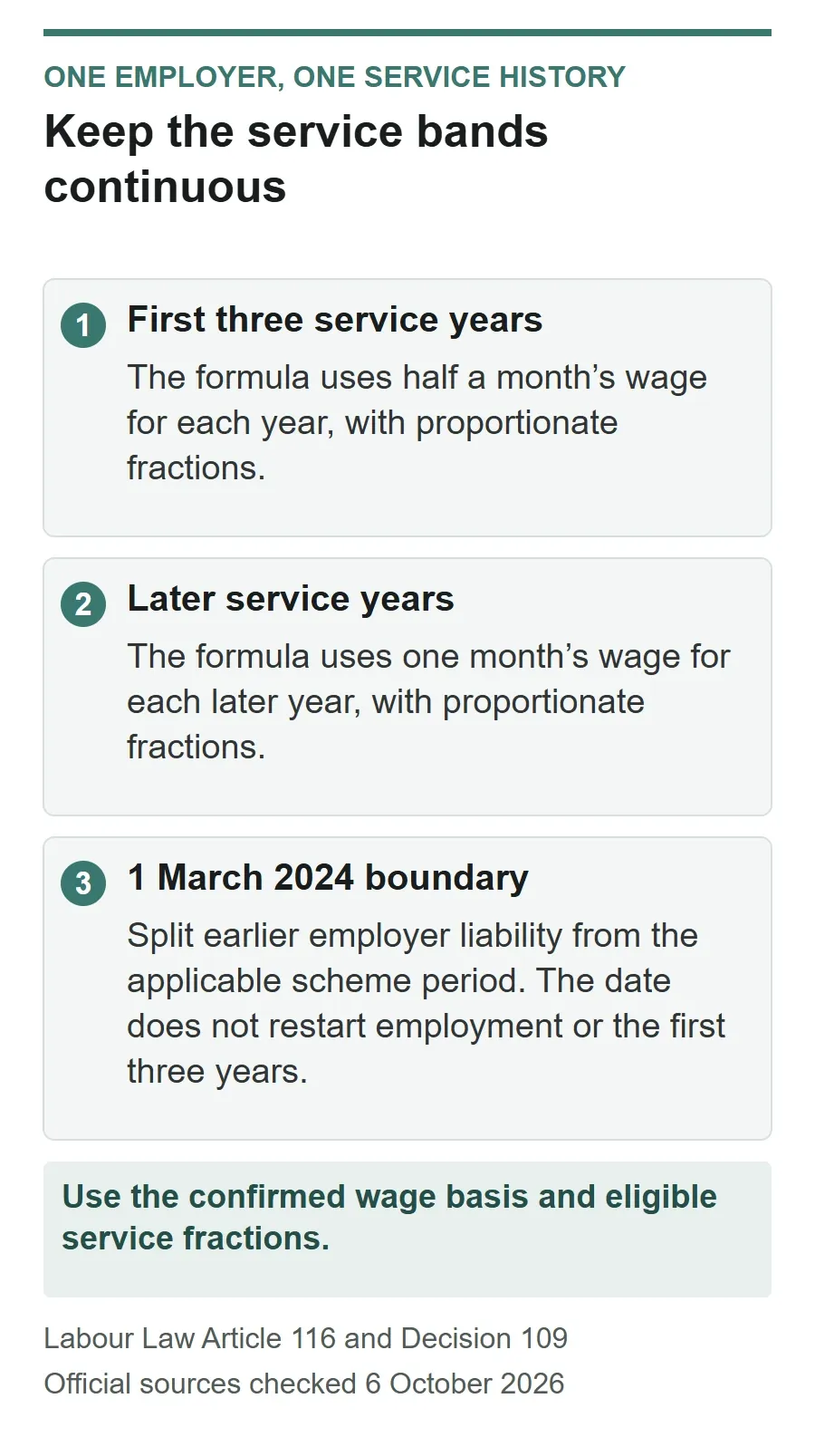
For the fixed-pay case supported here, the monthly wage basis is final basic pay plus any social allowance. SIO's FAQ excludes other allowances and benefits from its stated basis. Housing, transport or a total package figure should not simply replace that input. See the official calculation and final-wage answers.
The service formula uses half a month's wage for each of the first three years and one month's wage for each later year, with fractions proportionate to service. This appears in Labour Law Article 116 and Decision 109, Article 9.
Let W be the confirmed monthly wage basis, A the confirmed pre-scheme service years and B the confirmed post-scheme years. Define F(Y) as half of the first three years of Y, plus all years above three. The worksheet uses:
- Pre-scheme formula amount: W × F(A).
- Post-scheme formula amount: W × [F(A + B) − F(A)].
- Combined formula amount: the two displayed period amounts added together.
This is a stated worksheet implementation of the service bands for the continuous-employment case. It keeps the band continuous across the boundary. Each period is rounded separately to three decimal places for display; the employer or SIO's final settlement may require its own approved rounding and adjustments.
5. Keep contributions separate from benefit entitlement
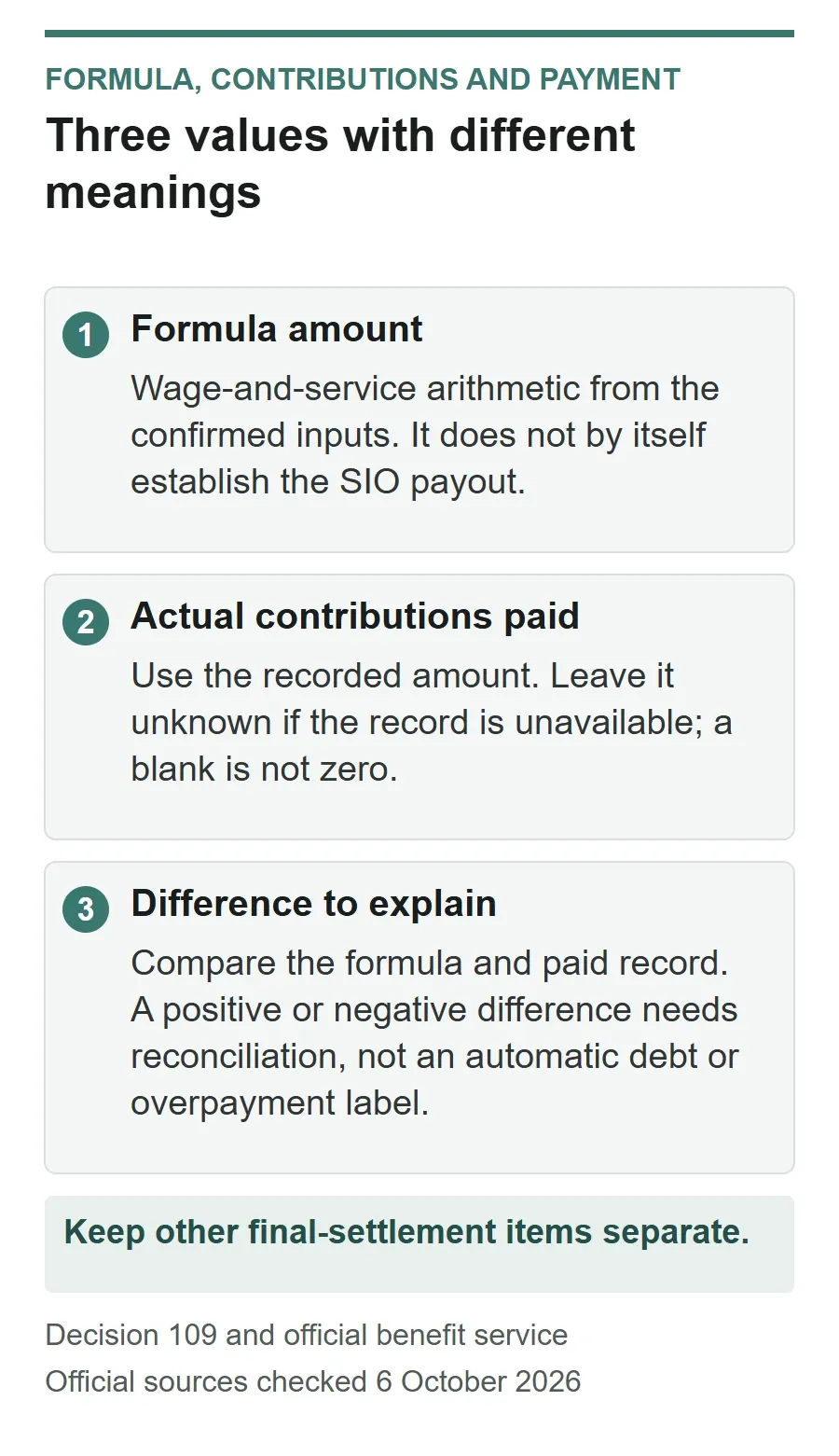
Employers contribute monthly at 4.2% of the relevant wage for the first three service years and 8.4% for later years. Those are contribution rates, not a substitute for the service formula. Decision 109, Articles 5 and 8 to 10 addresses paid contribution service, the final wage and adjustments when wages change.
Article 10 limits the payment to contributions paid and requires the employer to address contribution differences following wage changes. The current official SIO benefit service states that the benefit is calculated on amounts paid by the employer and that an unpaid balance must be claimed directly from the employer.
For that reason, the worksheet does not relabel the post-scheme formula amount as “SIO payout”. Its optional difference is simply formula arithmetic minus the paid contribution figure you entered. A positive difference is a question to reconcile. A negative difference is not proof of an overpayment. Neither establishes a recoverable debt by itself.
6. Use the result to request a written reconciliation
| Check | Ask for a clear answer |
|---|---|
| Wage basis | Which final basic pay and social allowance were used? Does a variable-pay rule apply? |
| Service fraction | What eligible service falls before and from 1 March 2024? How were partial years and the first three years allocated? |
| Contribution history | Were every applicable month's contributions received, and were wage changes reconciled? |
| Different totals | Which difference comes from service, wages, unpaid contributions, rounding or another identified adjustment? |
| Final settlement | Is gratuity separated from unpaid wages, leave, notice compensation and other settlement items? |
Keep the contract, wage records, written employer calculation and SIO contribution statement. Do not assume a single bank credit proves every component was settled. For statement access, use the SIO login and contribution statement guide. For the application itself, use the separate end-of-service benefit claim guide.
If coverage, continuity or the wage basis remains disputed, obtain an official or qualified professional answer before treating a worksheet total as an entitlement. SIO's FAQ points to the LMRA Expatriate Protection Centre when an employer refuses to pay gratuity. Keep any request factual and supported by the records; this page does not submit a claim or complaint.