Bahrain motoring and travel guides
Bahrain Public Transport: Bus Routes, Tickets and Airport Connections
By Gaurav Agarwal · Sources checked 6 October 2026
Plan the route and direction with Bahrain Bus, check the current timetable and live departure, then choose a GO Card or paper ticket. Airport buses use arrivals exit 4, zone 4A. Check the last usable service before a late journey.

Jump to a section
- Plan a bus journey in the order you will actually travel
- Understand the GO Card, paper fares and passes
- Use the airport stop with the correct route direction
- Read a timetable, live departures and alerts differently
- Make the boarding and last-mile parts easier
- Accessible travel and concession checks
- Frequently asked questions
Plan a bus journey in the order you will actually travel
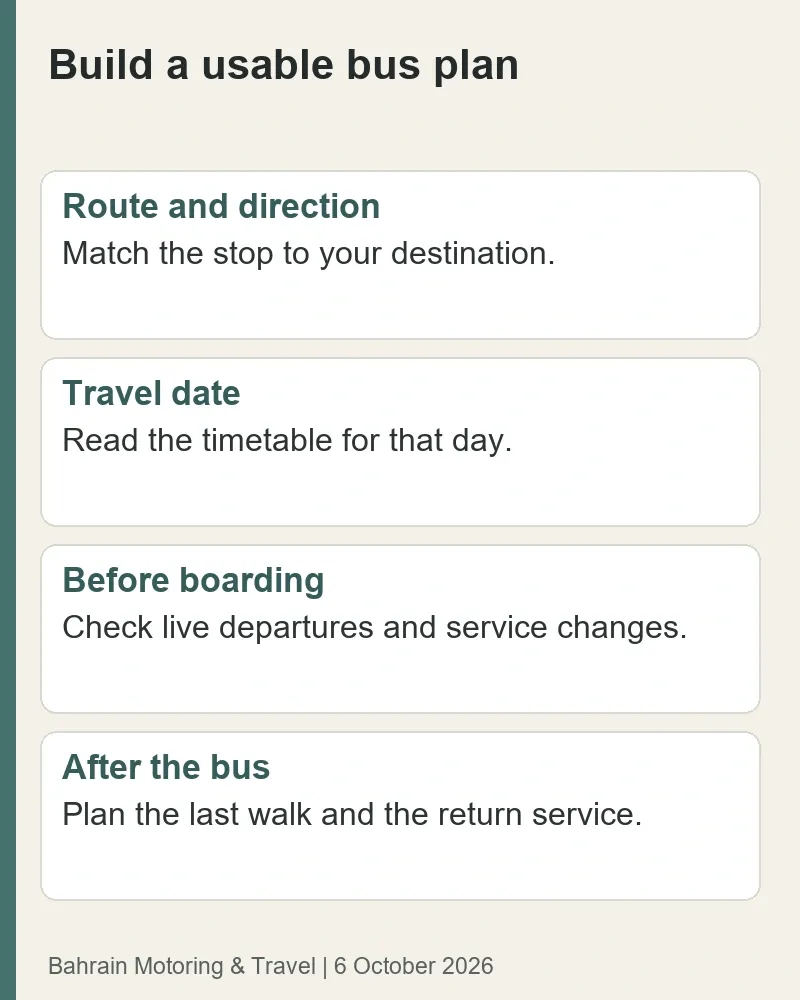
Start with your exact destination, not just the district name. A route that passes through Manama may stop on the wrong side of a large road or leave a long walk to your hotel. Open the operator's Timetables & Maps, find the relevant route and direction, then check the service for your travel day. Finish by looking at the walk from the final stop to the building entrance.
A useful first-trip plan has five parts: the boarding stop, destination displayed on the bus, stop where you leave, any connection and a return option. Save the route information before leaving Wi-Fi. This is particularly helpful on arrival when your phone may not yet have local data. Keep the hotel or venue address available in plain text as well as on a map.
The network connects many destinations, but a route line is not proof of a frequent service at every hour. Timetables can vary by day and direction. The operator's current page includes September 2026 changes and withdrawal notices, so screenshots of an older network should be treated as a starting point only. Check the latest version rather than building an itinerary around a route number remembered from a previous visit.
Understand the GO Card, paper fares and passes
The official fare page listed a GO Card single journey at 275 fils, a daily cap of 700 fils and a paper ticket at 300 fils when checked on 6 October 2026. One Bahrain dinar equals 1,000 fils, so those amounts are BHD 0.275, BHD 0.700 and BHD 0.300. Keep the daily cap separate from a card's purchase cost or the amount you load.
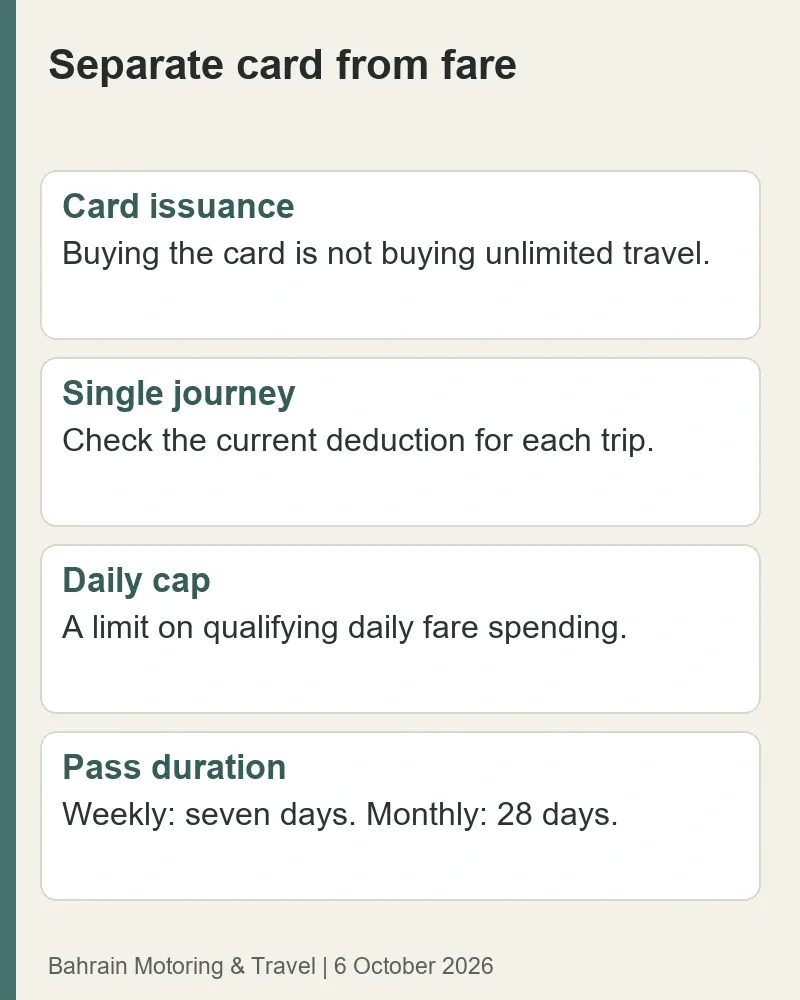
The airport's bus information lists GO Card issuance at 500 fils. That is the card cost, not an unlimited-travel ticket. A new traveler buying a card needs enough available travel credit or the appropriate pass as well. Confirm the current issue and top-up arrangements at the sales point before joining a queue for the bus.
Weekly and monthly products are also available: the published weekly pass is BHD 3 for seven days, while the monthly product is BHD 12 for 28 days. A 28-day period is not the same as every calendar month. The GO Card information describes a refillable contactless card with automatic fare deduction. Ask how a selected pass activates and expires when buying it, especially if you will use it only on some days.
| Published product | Amount checked | What to compare |
|---|---|---|
| GO Card single trip | 275 fils | Individual journey deductions |
| GO Card daily cap | 700 fils | Travel over one applicable fare day |
| Paper ticket | 300 fils | Occasional use without a card |
| Weekly pass | BHD 3 | Seven-day travel pattern |
| Monthly pass | BHD 12 | 28-day travel pattern |
For a short visit, count the days you will realistically use a bus rather than buying a pass by default. A person making one return journey and a commuter taking several buses most days have different needs. Ask the operator how transfers are charged and whether your chosen product covers them. Do not infer that changing buses is free merely because both legs form one journey in a map app.
Use the airport stop with the correct route direction
The airport's bus page places the stop at exit 4 on the arrivals level, zone 4A nearest the terminal. It identifies A1, A2, 10 and 11 as airport services. Follow the current bus signs after completing arrival formalities. A departure traveler arriving by bus must still make their way to check-in; reaching the airport bus stop is not the end of the journey.
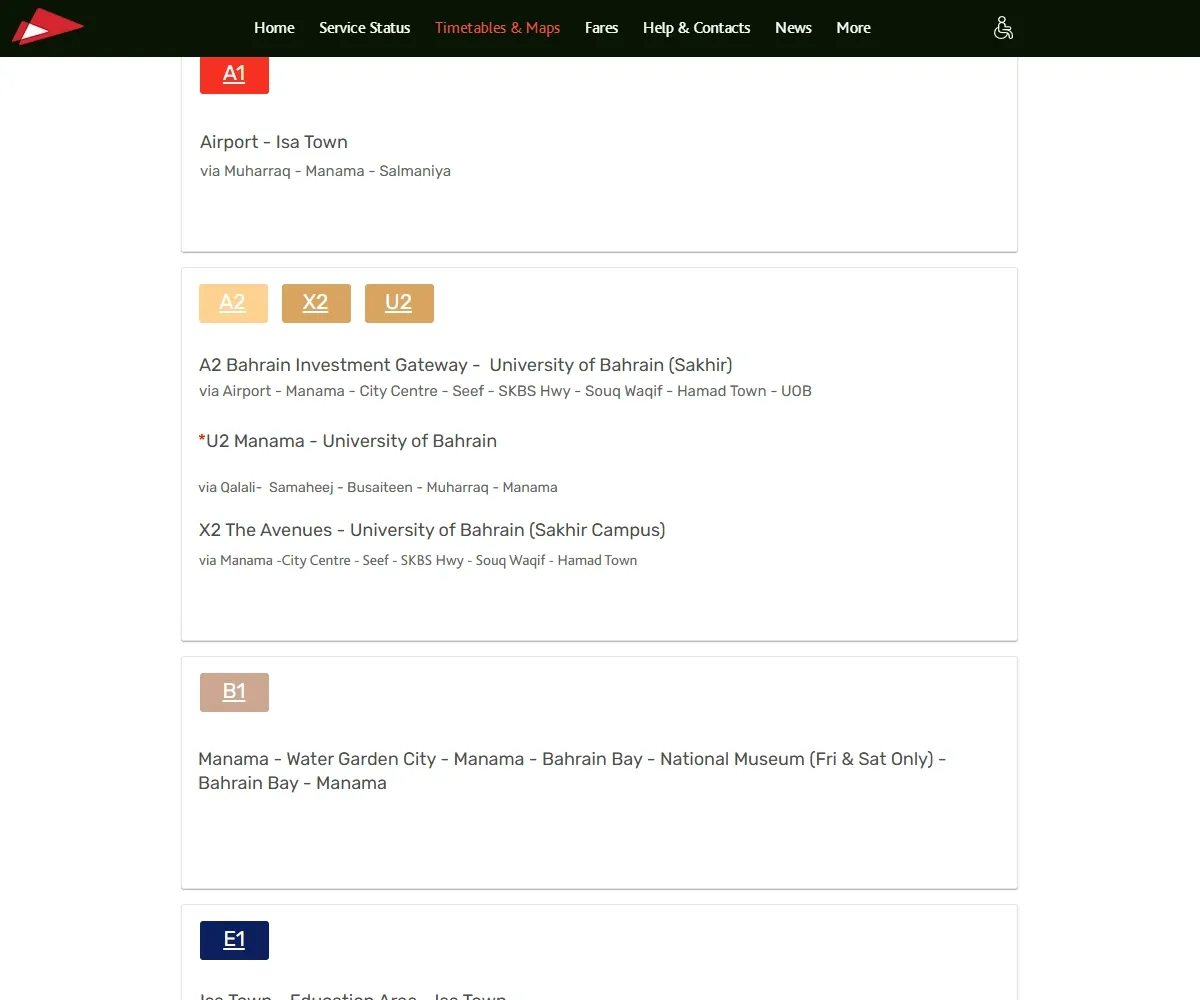
In the operator's route directory, A1 links the airport and Isa Town via Muharraq, Manama and Salmaniya. A2 runs through the airport and Manama toward other destinations, while 10 and 11 are circular services in opposite directions. Read the full route and the destination on the arriving vehicle. Choosing the wrong direction on a circular route can produce a long detour even though the route eventually reaches your area.
The airport describes A2 as its fastest route to Manama, but that description is not a guaranteed arrival time for a specific hotel or connection. Use the timetable and live departure information for the stop and hour you need. Do not assume each airport route runs through the night. If you land late, check a realistic departure after immigration and baggage, plus an alternative if you miss the final usable service.
When traveling to catch a flight, work backward from the airline's required arrival time at the terminal. Include the walk to the boarding stop, the wait, any connection and movement from arrivals level to check-in. A journey planner's vehicle time alone is too narrow a margin. If a missed bus would jeopardize the flight, choose an earlier service or a transport option that gives you more control.
Read a timetable, live departures and alerts differently
A timetable tells you the planned service. The operator's Live Departures page helps locate buses and route information closer to the time of travel. A service alert can explain a diversion, withdrawn stop or temporary route change. Check all three when timing matters. The absence of a live vehicle marker does not automatically prove a service has been cancelled.
At the stop, compare its name or identifier with the one in your plan. A pair of stops across a road can serve opposite directions. Look for a safe crossing rather than assuming the closest visible bus shelter is yours. If you are uncertain, show the destination to the driver before boarding and ask whether that bus serves the stop you need.
For a connection, identify both the arrival point of the first bus and the departure point of the second. A shared terminal name does not mean both use the same bay. Leave room for the walk between bays and for the first bus to run later than planned. Save an alternative route or pickup option if the second service is infrequent.
Make the boarding and last-mile parts easier
Have your fare method ready before the bus arrives. With a GO Card, follow the reader and driver instructions and check that validation succeeds. Do not repeatedly tap a card simply because you are unsure what the display means. Ask for help with an error, and check your balance through the official service without sharing the card number publicly.
For a cash or paper-ticket journey, verify the payment arrangement before relying on change from a large note. Keep a small practical backup amount for unexpected transport needs. A card or pass that works for one passenger should not be assumed to provide simultaneous travel for an entire group. Confirm the rules for children and companions instead of applying a single adult product to everyone.
Pack luggage so that you can move it without blocking doors, aisles or wheelchair spaces. Keep essential travel documents with you and take a moment before leaving the bus to check for a phone, wallet or small bag. If something is left behind, record the route, direction, approximate time and boarding or exit stop before contacting the operator. These details are more useful than the description “the bus from Manama.”
The last walk can determine whether a bus plan is sensible. Check pedestrian access, crossings, heat exposure and the location of the actual entrance. For a day out, planning one bus-friendly area thoroughly can work better than connecting several distant attractions with uncertain return services. If a venue closes late, check the journey home before committing to the outbound trip.
Accessible travel and concession checks
The operator's accessibility page describes low-floor buses, kneeling suspension and driver-operated ramps. It specifies wheelchair limits of 700 mm width, 1,200 mm length and 350 kg combined chair-and-user weight. Check the complete current conditions with the operator when arranging a trip, especially for an unusually sized mobility aid.
Wheelchair users have priority in the designated space. Tell the driver when a ramp is needed and follow their positioning instructions. Accessible vehicle equipment does not establish that every pavement or destination entrance is step-free. Review the route to and from each stop as carefully as the bus itself, and ask about the most practical boarding location.
The fare page lists reduced elderly travel and free travel for eligible special-needs passengers using personalized GO Cards. Those concessions should not be represented as automatic for every visitor or anyone using a wheelchair. Ask what eligibility and application evidence is required. The operator publishes assistance on 66311111 and describes contact hours separately from bus operating hours; an office schedule is not a route timetable.
Frequently asked questions
How much is a bus trip in Bahrain?
The published standard figures checked were 275 fils with a GO Card or 300 fils for a paper ticket. GO Card travel has a listed 700-fils daily cap. Check the operator's fare page for current products and any eligibility conditions.
Can I take a public bus from Bahrain Airport?
Yes. The airport identifies A1, A2, 10 and 11 at arrivals exit 4, zone 4A. Check your destination, travel direction and the actual departure time before boarding.
Is every airport bus available all night?
This guide does not assume that. Reopen the route timetable for your day and expected time after arrival formalities. Keep another transport option if there is no suitable departure.
Is the monthly pass valid for a calendar month?
The operator describes its monthly product as 28 days. Confirm activation and expiry when buying it rather than assuming it ends on the last day of a named month.
Where should I check for route changes?
Use the operator's current timetable directory and service-status information, then consult live departures close to travel. A saved map can be useful offline but may predate a changed route or stop.
Sources checked 6 October 2026. See the motoring and travel hub for related local guides.