Bahrain finance guides
Credit-card balance transfers in Bahrain: promotional cost checks
By Gaurav Agarwal · Sources checked 6 October 2026
Compare the full cost of moving card debt, confirm transfer eligibility and promotion dates, check how payments are allocated, and verify settlement with the old issuer. A transfer changes where debt is owed rather than repaying it.

A credit-card balance transfer in Bahrain moves existing debt to another card; it does not repay the debt for you. Compare the transfer fee, interest during and after any promotion, payment allocation and the amount you can realistically repay. Confirm that the old issuer actually receives the settlement before treating its balance as cleared.
Official sources checked: 6 October 2026. This guide provides a blank cost worksheet and selected contractual examples. It does not promise approval, recommend a card or verify an introductory promotion for every new applicant.
1. Confirm which debt can be transferred
Ask the receiving issuer to confirm the source card, amount and account holder it will accept. Check whether it can transfer the whole balance, whether only one card is allowed, and how much approved credit remains after fees. An approved credit limit is not necessarily the approved transfer amount.
The definition in ila's card terms describes a discretionary transfer of debt owed to another lender outside its group, on agreed terms. It distinguishes balance transfers from cash advances. Do not assume taking cash from one card to pay another receives the same treatment.
Product differences matter. The ila Gulf Air card FAQ says only one card balance can be transferred during application and that the transferred amount does not earn miles. Those conditions should not be copied to every card in the issuer's range.
Provide accurate income and debt information and request the exact eligibility checklist. A low advertised rate does not override credit assessment. The Bahrain credit-report guide explains the separate task of reviewing and correcting the information reported about you.
2. Get the promotion dates and later rate in writing
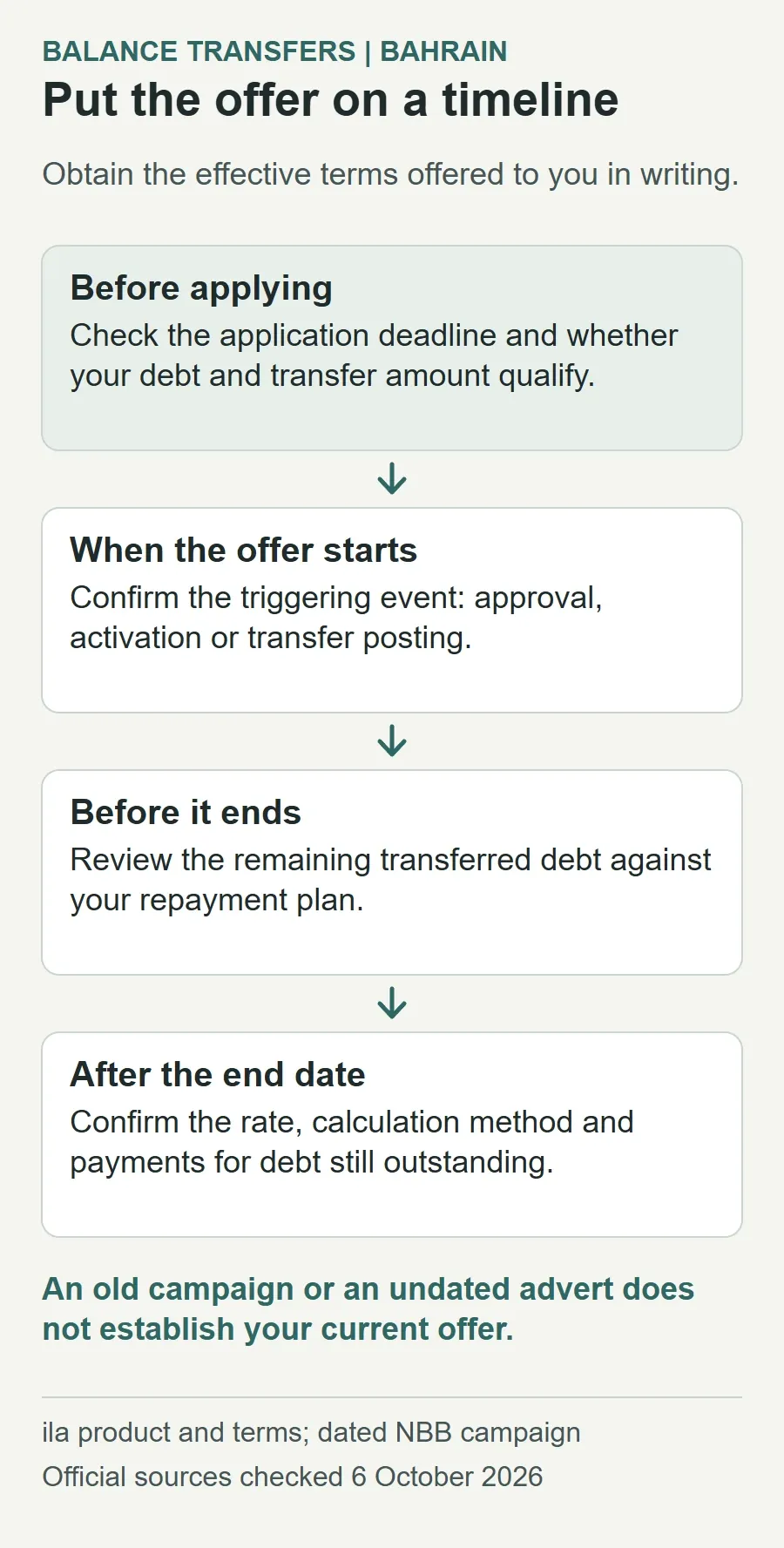
Record the application deadline, the event that starts the introductory period and its exact end date. Ask whether the clock starts on approval, card activation or transfer posting. Confirm the rate on any remaining debt after that date and the consequences of paying late.
A bank's old announcement is not a current offer. NBB's July 2022 balance-transfer campaign identifies application and promotional periods in 2022 and 2023. It is not evidence of an October 2026 promotion.
The ila Switch page displays an introductory offer, but the reviewed page does not provide a dated campaign application window. Obtain the effective terms offered to you before putting an introductory rate into your calculation.
For the standard cost, ila's currently linked card tariff lists Switch balance transfers at 1.25% monthly and purchases at 1.833% monthly. The document states February 2026 effectiveness, with a separate May 2026 instalment-fee update. These are published standard rates, not an individual offer or a guaranteed future reversion rate.
3. Fill in the complete cost worksheet
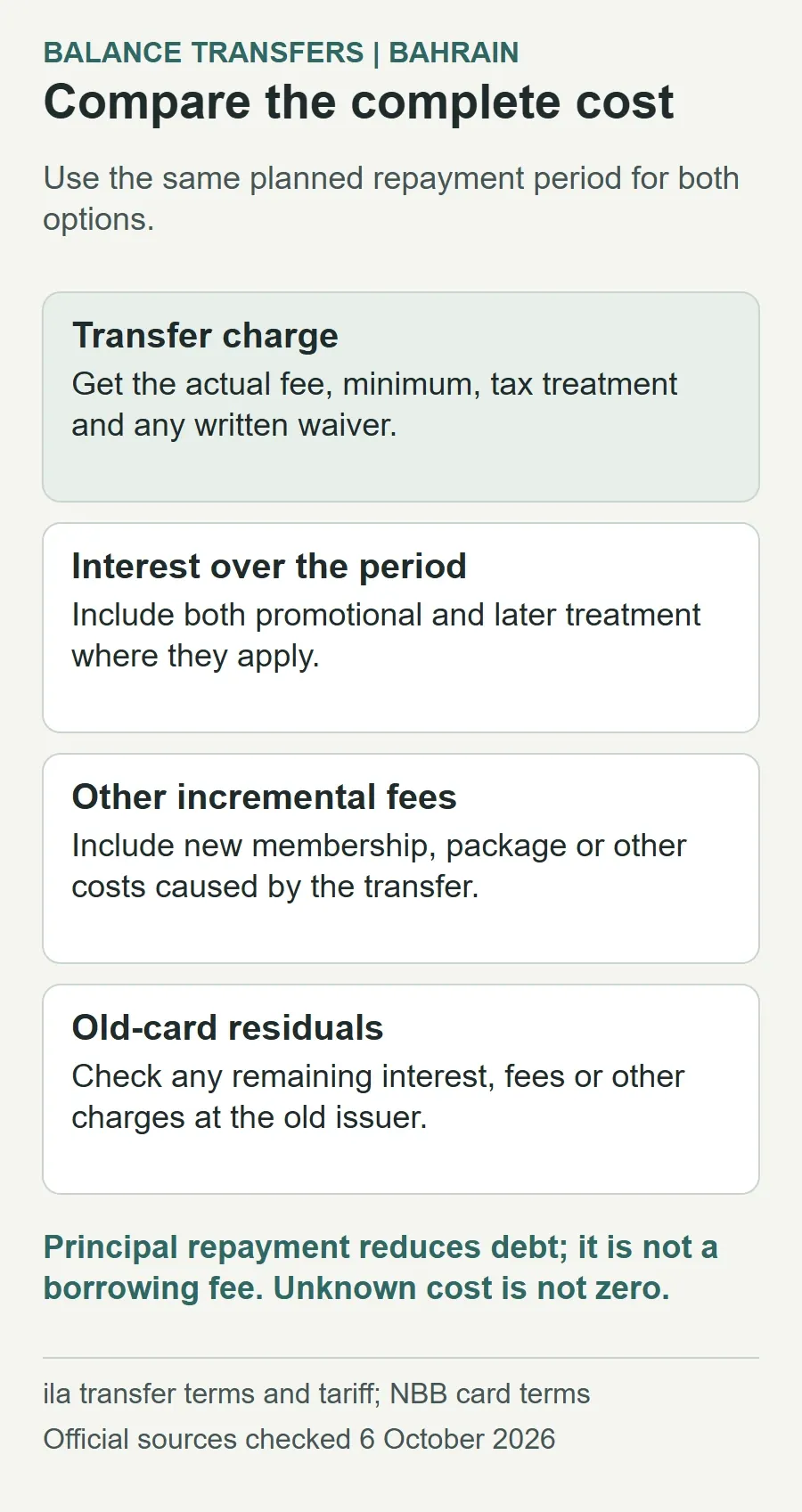
Use the same proposed repayment period for staying with the old card and making the transfer. Populate the fields from written terms or issuer calculations. Keep an unknown field unresolved; do not turn it into zero.
| Field | What to record |
|---|---|
| Debt moved | Confirmed amount paid to the old issuer, settlement date and any amount left behind. |
| Transfer charge | Percentage or fixed fee, minimum, VAT treatment and whether added to the card balance. |
| Introductory terms | Approved rate, start event, expiry date and qualifying conditions, if an offer applies. |
| After the offer | Rate and calculation method for remaining transferred debt, plus the issuer's right to change it. |
| Required and planned payments | Minimum rule, due dates and the amount you intend to pay each month. |
| Allocation | How payments cover fees, interest, transferred principal, purchases and other balances. |
| Other costs | Incremental membership, insurance or package costs, and any residual charges at the old issuer. |
| Exit conditions | Early repayment, cancellation and late-payment consequences. |
Cost over your chosen period = transfer charge + interest charged during that period + other relevant incremental fees + residual old-card charges. Principal repayments reduce debt; they are not a borrowing fee. Avoid counting a charge twice if it is already included in an issuer's total.
Closing balance = opening balance + new debits and charges − credited payments and other credits. For the transferred principal alone, use the issuer's allocation record to establish how much your payments actually reduced it. Ask for a repayment schedule showing the balance at the promotional end date and the later cost of clearing it.
Do not insert an instalment-plan fee as the transfer fee. The ila tariff labels its Easy Payment Plan charge separately. Its card terms refer to possible balance-transfer fees, but the reviewed tariff does not give a separately labelled transfer-fee amount. Get that amount or an explicit waiver in writing.
4. Check what happens if you keep spending
A transfer offer may apply to the moved debt while purchases follow another rate. Ask the issuer to show the result with no new spending, then with any purchases you expect to make. A payment equal to those purchases might still be allocated elsewhere.
For example, ila clause 6.3 places billed fees and interest ahead of billed transferred principal, with billed purchases later in the sequence. It also reserves discretion over the ordering. The product page's shorter statement about paying the transferred balance first should therefore not be read as a promise that every dinar immediately reduces principal.
Check each statement against the agreed allocation and retain the issuer's example. The Bahrain credit-card comparison covers broader card costs and features; a transfer decision needs this additional debt-specific calculation.
5. Plan for missed payments and the promotional end
Ask whether a late or insufficient payment ends the introductory treatment, changes the rate, triggers a fee or makes more debt immediately payable. Request the clause and a worked calculation. Do not assume a single consequence is standard across all issuers.
ila clause 6.11 applies a late charge when the minimum is not paid by the due date. Its ordinary tariff and general terms do not, by themselves, settle every introductory-offer cancellation condition. That needs the specific offer terms.
Set a review date before any promotion expires. Compare the actual remaining principal with the plan, and request an updated payoff amount if you intend to clear it. Making the required minimum is not evidence that the transferred balance will be repaid within the introductory period.
6. Verify the old balance before deciding on closure
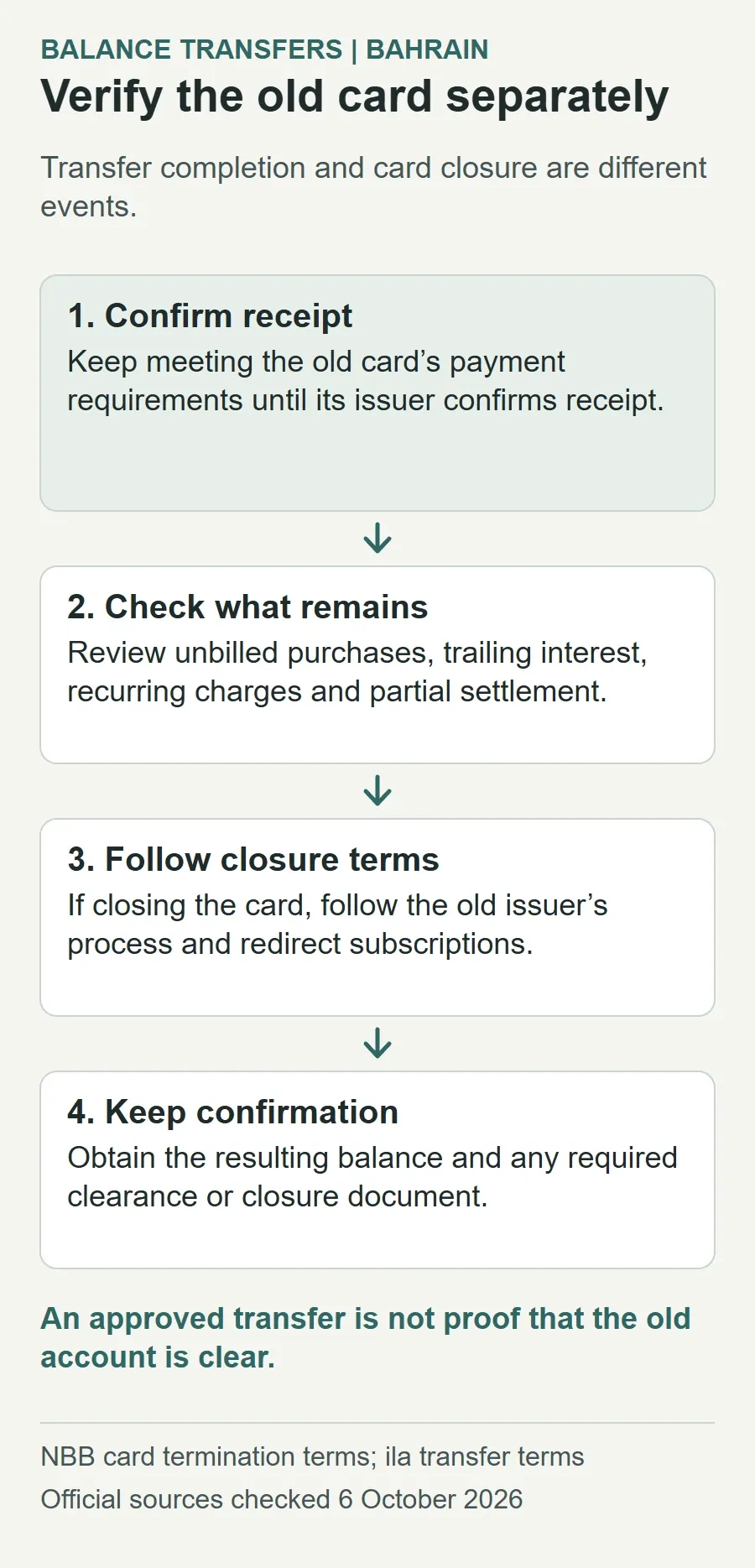
Keep meeting the old card's payment requirements until its issuer confirms receipt and the resulting balance. Save the transfer reference, then check for unbilled purchases, trailing interest, recurring charges or a partial settlement. Ask the receiving issuer for a trace if the payment does not appear.
Transfer completion and old-card cancellation are different events. NBB's card terms, clause 16.1, provide a separate termination process and require amounts due, including unbilled transactions, to be paid. Follow the old issuer's actual process rather than assuming the new issuer closes the card.
Ask whether approval requires the old card to be closed or its limit reduced. If you retain it, record its ongoing charges and avoid treating the released credit as additional income. If you close it, redirect subscriptions and obtain the issuer's confirmation and any required clearance document.
For a disputed transfer or charge, preserve both statements and correspondence, then use the issuer's complaint process. The CBB consumer-information page explains its complaint-review role and links the applicable escalation procedure.
General information only. This is not personal financial or legal advice. A transfer can change the cost and location of a debt without making the repayment affordable. Confirm the complete offer and repayment obligations before accepting it.