Bahrain finance guides
Bank charges in Bahrain: read and compare a fee schedule
By Gaurav Agarwal · Sources checked 6 October 2026
Match each charge to the correct product, tariff version, service channel and calculation basis. Check any waiver and VAT wording, subtract matching reversals, then ask the bank to explain or correct an unsupported difference.

Jump to a section
To check a bank charge in Bahrain, match the statement entry to the tariff for your exact account or card, the transaction channel and the date the service was used. Then check the calculation, VAT wording and any waiver. A fee with a familiar name can still have the wrong amount, frequency or product basis.
Official sources checked: 6 October 2026. This guide provides a fee-audit method, with examples from NBB and BBK. Their figures are product-specific examples, not a Bahrain-wide tariff or a ranking of banks. The CBB provisions cited below come from Volume 1 for conventional banks; Islamic products require their applicable rules and terms.
1. Identify the applicable tariff and its date
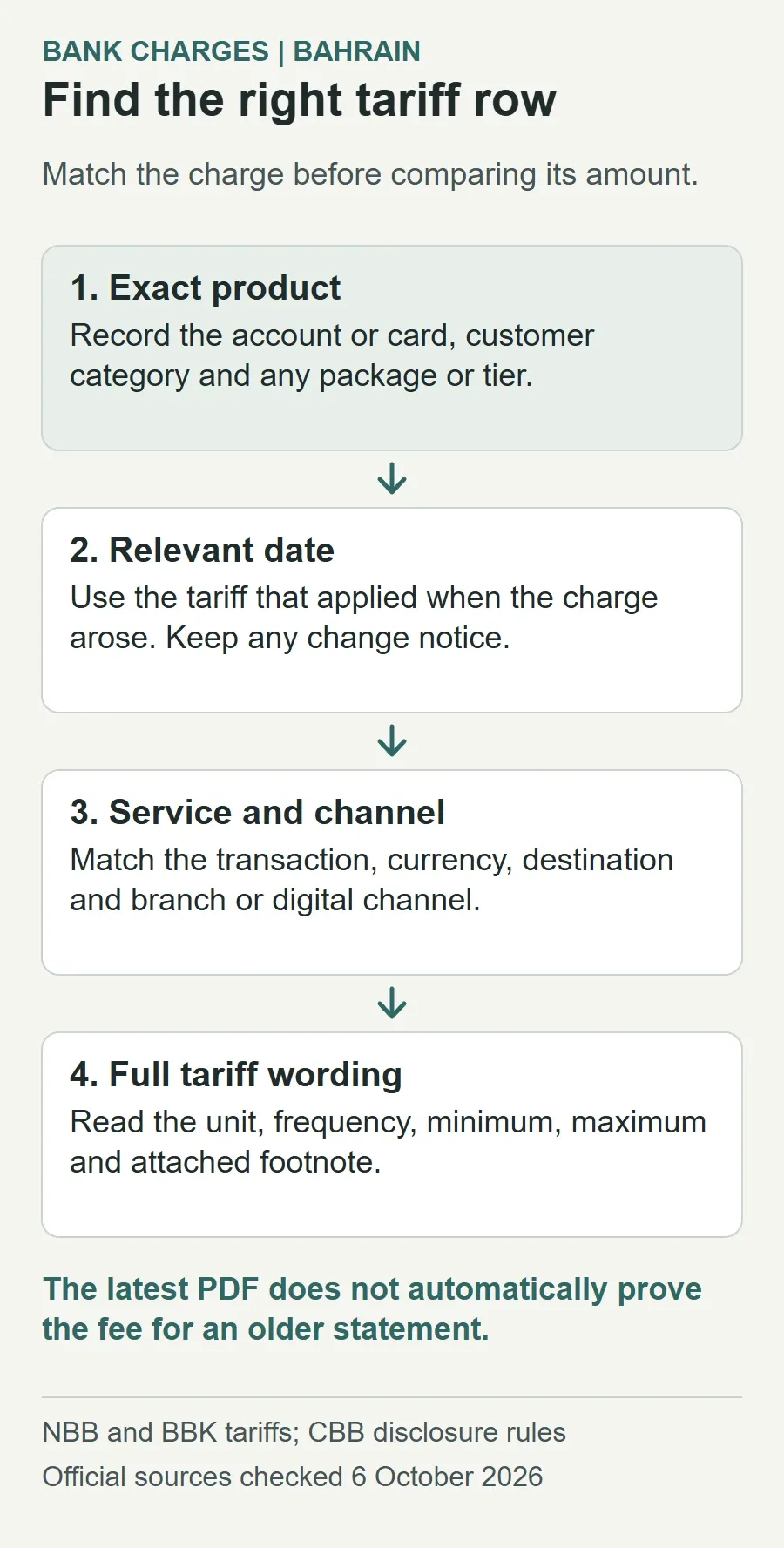
Save the fee schedule alongside the account agreement and statement you are checking. Record the bank, exact product, personal or business status, currency, service channel and tariff version. A premium package, corporate account or credit card can have a separate schedule from the bank's ordinary personal account.
Start from the bank's current website rather than an old search result. NBB's retail fee landing page had an older date in its web address but linked a June 2026 schedule when checked. BBK's fee index separately lists retail, credit-card and relationship-tier schedules. The retail document linked there was effective 7 September 2025. A document's age alone does not establish whether it has been replaced.
For an older statement, ask for the schedule that applied when the charge arose. The latest PDF is a starting point, not automatic proof of a historical fee. Keep the notice of any change as a separate record.
CBB BC-4.3.1 and BC-4.3.2 require relevant retail-bank charge lists to be displayed, including Arabic and English notices in banking halls, and provided with account statements and on websites. BC-4.3.2 also addresses notification when fees change or new fees are introduced.
2. Match each debit to the service actually used
Separate money spent from money charged for providing a service. A transfer's principal, currency conversion, sending fee and intermediary deduction are different items. Likewise, a cash withdrawal and the fee for that withdrawal should not be counted as two service charges.
| Charge category | Evidence to compare |
|---|---|
| Recurring account or plan fee | Product name, charging period, balance calculation and subscription or waiver terms. |
| Transfer fee | Route, destination, currency, branch or digital channel, and any intermediary charges. |
| Cash or debit-card fee | ATM network or counter, transaction method, location and currency. |
| Document or replacement fee | What was requested, request count, pages or items, and any free allowance. |
| Credit-related fee | The separate loan or card agreement, triggering event and applicable schedule. |
Check transaction and posting dates, especially if a fee appears after the underlying service. Ask the bank to identify the transaction behind an unclear description. Two similar entries are a reason to reconcile references, not enough by themselves to establish a duplicate debit.
3. Read the units, channel and additional-charge wording
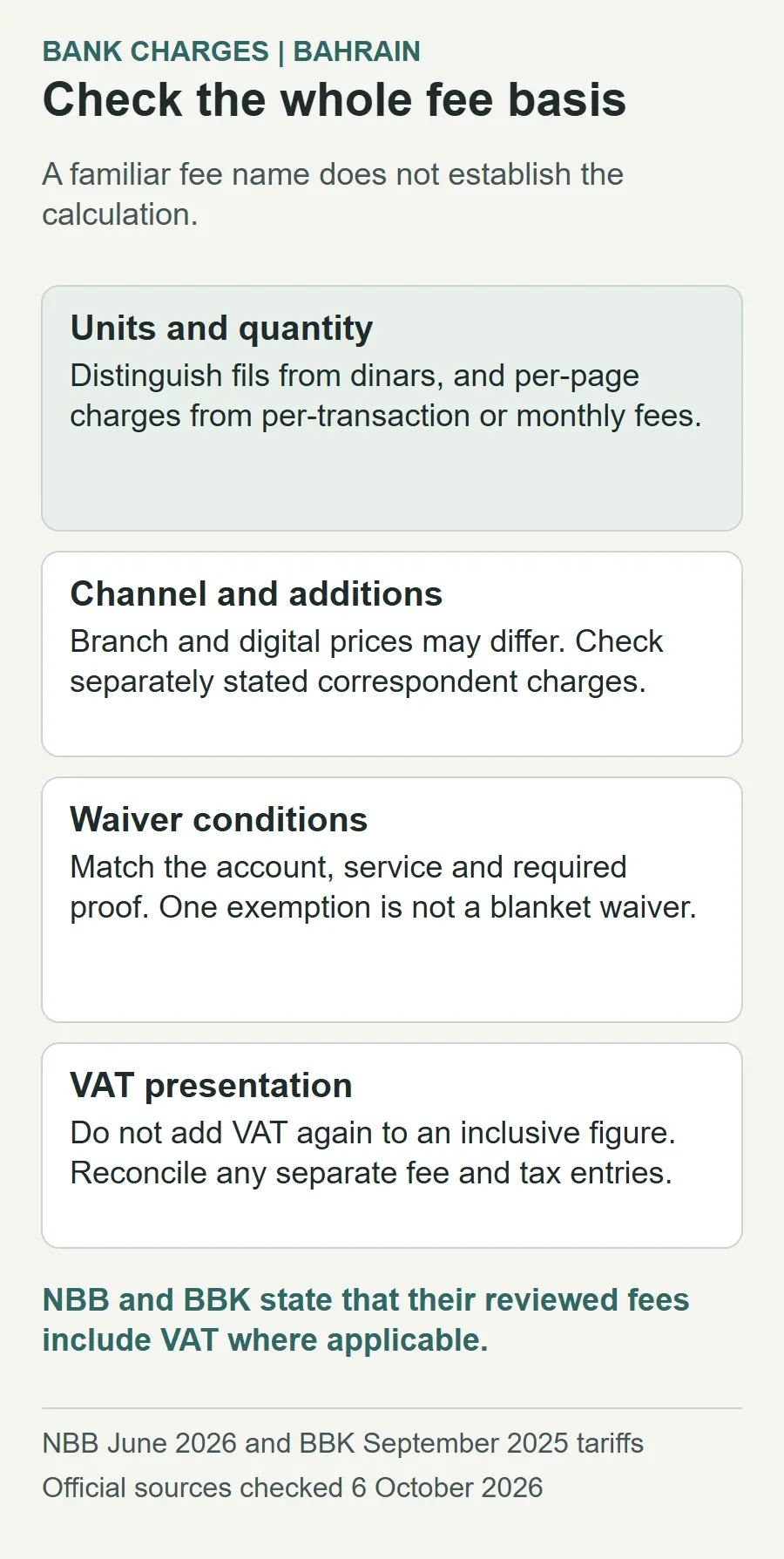
Three published examples show why the full tariff row matters:
- Channel: BBK's retail tariff lists rest-of-world SWIFT transfers at BHD 5.500 through a branch and BHD 4.400 through e-channels. It separately allows applicable foreign or correspondent-bank charges. Compare the channel on the receipt before questioning the bank's fee. BBK wire-transfer table.
- Frequency and unit: NBB's account or loan statement-copy row is free up to twice per year; above that it lists 330 fils per page, capped at BHD 5.500, with footnote 1 applying. The audit needs the request history and page count, not just the number of statements received routinely. NBB June 2026 tariff.
- Additional cost: NBB lists GCC or international SWIFT at BHD 5.500 plus correspondent charges, if any. The listed sending fee therefore does not establish the recipient's final deduction. Ask for the payment's charge breakdown. NBB SWIFT row.
Keep fils and dinars consistent before calculating a difference. Preserve “per page”, “per transaction”, “per month” and any minimum or maximum. Do not apply one published cap to an unrelated service. CBB BC-4.13.1 refers to defined standard-service caps in Appendix BC-7; it does not establish one maximum for every charge. CBB conventional-bank conduct rules.
4. Check the trigger, waiver and VAT treatment
A below-balance fee requires the product's specified balance test. A weighted average monthly balance is different from the balance on payday or the statement's closing balance. Ask for the bank's calculation and the dates included if the threshold appears to have been met.
Read the footnote attached to the actual fee. NBB footnote 1 identifies exempt groups, including Bahraini and non-Bahraini customers with monthly salaries below BHD 250, and asks customers to contact their branch with proof of the relevant status. BBK's minimum-balance exemption note names eligible groups but also restricts the waiver to specified account types. Neither footnote should be treated as an exemption from every bank service charge. NBB footnote 1; BBK deposit-account note.
Both reviewed schedules say their charges include VAT where applicable. Do not add VAT again to an inclusive figure. If a statement presents a fee and tax separately, reconcile their combined amount to the applicable inclusive tariff line. Where the document is unclear, request the tax basis rather than assuming every financial charge receives identical treatment.
5. Use a blank reconciliation worksheet
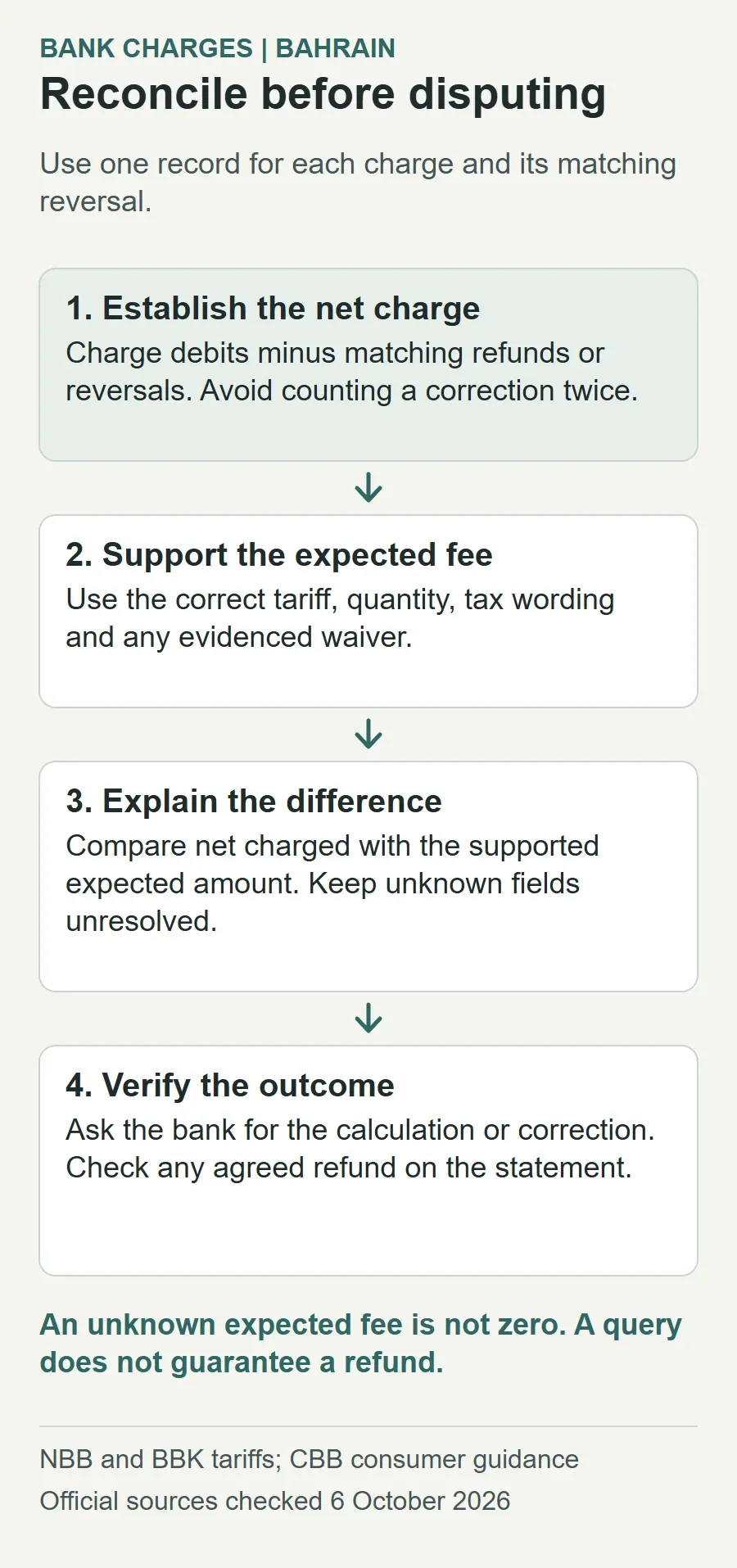
Copy one row for each charge. Leave unresolved fields blank until the bank explains them; an unknown expected amount is not zero.
| Field | Your entry |
|---|---|
| Product, statement period and charge date | ________________ |
| Charge description and private transaction reference | ________________ |
| Amount debited and any matching reversal | ________________ |
| Applicable tariff version, row and channel | ________________ |
| Quantity, charging period or calculation basis | ________________ |
| VAT included or separately stated | ________________ |
| Waiver condition and supporting evidence | ________________ |
| Expected amount, difference and bank explanation | ________________ |
Use net charge = charge debits minus matching refunds or reversals. Then compare that net charge with the supported expected amount. Link a later reversal to the original entry so that a correction is not missed or counted twice. Keep currency conversions separate unless their calculation basis has been established.
To compare old and new schedules, align the same product, channel, unit and waiver conditions. Only then compare the figures. For choosing an account rather than checking a debit, use the separate Bahrain bank-account comparison.
6. Ask for an explanation and record the outcome
Send the bank a concise query through its official secure channel: identify the charge, state the tariff row you used, explain the difference and request the calculation or correction. Attach only the relevant records through the bank's accepted process. Never include passwords, PINs or one-time codes.
If a changed credit-agreement fee is involved, request the variation notice and effective date. CBB BC-4.3.26(b) and BC-4.3.27 contain advance-notice requirements of at least 30 calendar days for the specified unilateral variations and public disclosure of increases under credit agreements. That is a credit-agreement rule, not a blanket statement that every deposit-account charge follows the same notice provision.
Keep the complaint reference, response and promised adjustment date. Verify an agreed refund on the statement. If unresolved, follow the bank's formal complaint procedure and the escalation guidance on the CBB consumer-information page. A disputed fee does not by itself cancel other payment obligations or guarantee reimbursement.
This is general information, not personalised financial, tax or legal advice. Confirm the terms applicable to your account and transaction with the provider.