Bahrain finance guides
Bank complaint in Bahrain: evidence, deadlines and CBB escalation
By Gaurav Agarwal · Sources checked 6 October 2026
Complain to the bank in writing first. Current CBB bank rules require acknowledgement within five working days and a written response within four weeks; an unsatisfactory response can be escalated within 30 calendar days of receipt.

Jump to a section
- 1. Identify the decision or service failure you want reviewed
- 2. Use the bank’s published complaints route
- 3. Build one concise complaint and evidence file
- 4. Track acknowledgement, response and escalation separately
- 5. Prepare the current CBB form and attachments
- 6. Keep the correct complaint route and assess the response
To complain about a bank in Bahrain, send a clear written complaint to the bank’s complaints team first and keep proof of receipt. Current CBB bank rules require written acknowledgement within five working days and a written response within four weeks. If you are dissatisfied with that response, the rules provide for escalation to CBB within 30 calendar days of receiving the letter.
Official sources checked: 6 October 2026. The timings above are in conventional-bank rules BC-9.5 and Islamic-bank rules BC-10.5. They are separate from an urgent fraud report, a card dispute deadline or an insurer’s complaint timetable.
1. Identify the decision or service failure you want reviewed
A useful complaint names the institution, the affected product or transaction, the disputed action and the correction requested. “Please investigate my account” gives the reviewer less to work with than identifying a particular fee, missing transfer, account restriction or settlement calculation.
| Problem | Relevant evidence | Clear request |
|---|---|---|
| An unexplained charge | The statement entry, applicable tariff, product terms and any agreed exemption. | Identify the tariff item and calculation, and correct the charge if applied incorrectly. |
| A missing or delayed transfer | The transfer reference, time, amount, service, debit record and relevant recipient confirmation. | Trace the identified instruction and explain its status and next action. |
| A disputed loan or finance calculation | The signed schedule, dated quote, payments and the precise item disputed. | Explain the calculation and the rule or contract clause used. |
| An unresolved account-service request | The original request, submission date, case reference and bank replies. | Confirm what remains outstanding and provide a written decision or next step. |
This table is a preparation aid, not a list of findings against a bank. Separate facts you can document from assumptions about why something happened. If several issues belong to the same case, number them and ask the bank to answer each one.
For suspected account compromise or fraud, use the bank’s official emergency route immediately. Do not wait for the formal complaint timetable before seeking urgent assistance. For a payment-status problem, the Fawri and Fawri+ guide explains which transfer records to check.
2. Use the bank’s published complaints route
CBB requires conventional and Islamic banks to publish their complaints procedures and the complaints officer’s contact details. A simple guide must be available on request. The process must be accessible and free of charge, and a website cannot be the only route. See BC-9.1 to BC-9.3 and BC-10.1 to BC-10.3.
Open your bank’s own website and find its current complaint page. The CBB procedure starts with an email or formal letter to the institution’s complaints team. Save the sent message, online confirmation or other proof showing when it was received. Keep an ordinary enquiry reference separate from a formal complaint reference if the bank issues both.
As one named example, BBK’s complaint page provides an online form, written and other contact routes. It says its written acknowledgement includes a reference number. It also distinguishes normal cases from complex fraud, legal or third-party cases and describes updates for the latter. That is BBK’s published process, not an exemption that can be assumed for every bank or complaint.
If you cannot use the online route, request an accessible alternative and a copy of the complaints guide. If the complaint concerns a staff member, address it to the complaints officer rather than relying only on that person to review their own conduct.
3. Build one concise complaint and evidence file
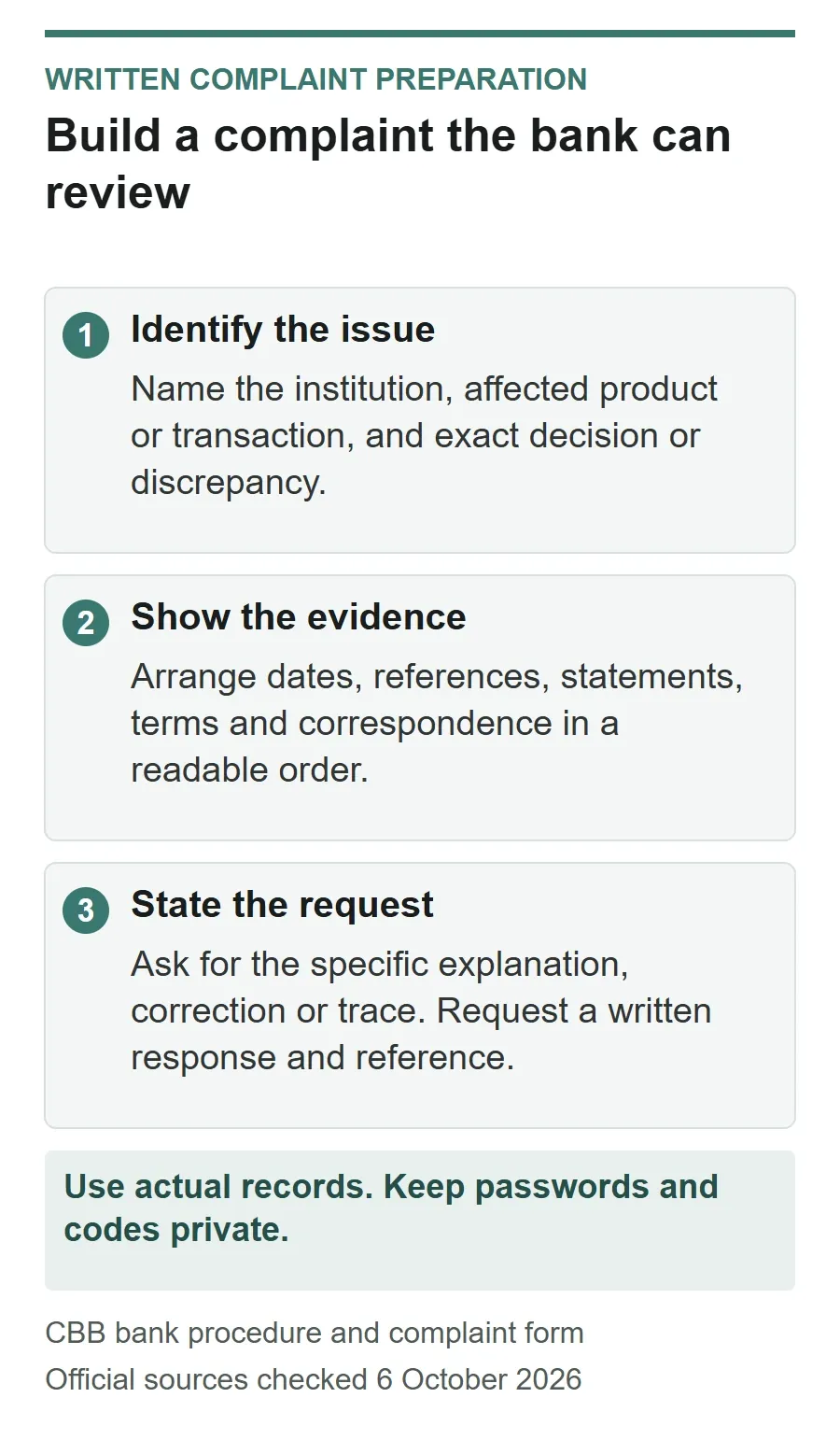
Keep the main explanation short enough to follow, with supporting documents in a clear order. A practical structure is:
- Issue: identify the product, transaction or decision and what is disputed.
- Timeline: record the relevant dates and what happened at each stage.
- Evidence: name the statement, agreement, quote or correspondence that supports each point.
- Requested outcome: ask for the specific explanation, correction, trace or review needed.
- Reply: request a written response and complaint reference.
A neutral opening can be: “I am raising a formal complaint about the transaction or decision identified below. The attached records show the discrepancy. Please explain the basis for the decision, address each numbered point and confirm any correction in writing.” Add your actual facts privately through the official route; do not invent dates or amounts to fit a template.
Keep originals unchanged. Give copies descriptive filenames and attach the relevant pages rather than an unexplained collection of screenshots. Preserve the sender, date and surrounding context of correspondence. Include identity or account information only where the verified bank or regulator process requires it, and never include passwords, PINs or one-time codes.
4. Track acknowledgement, response and escalation separately
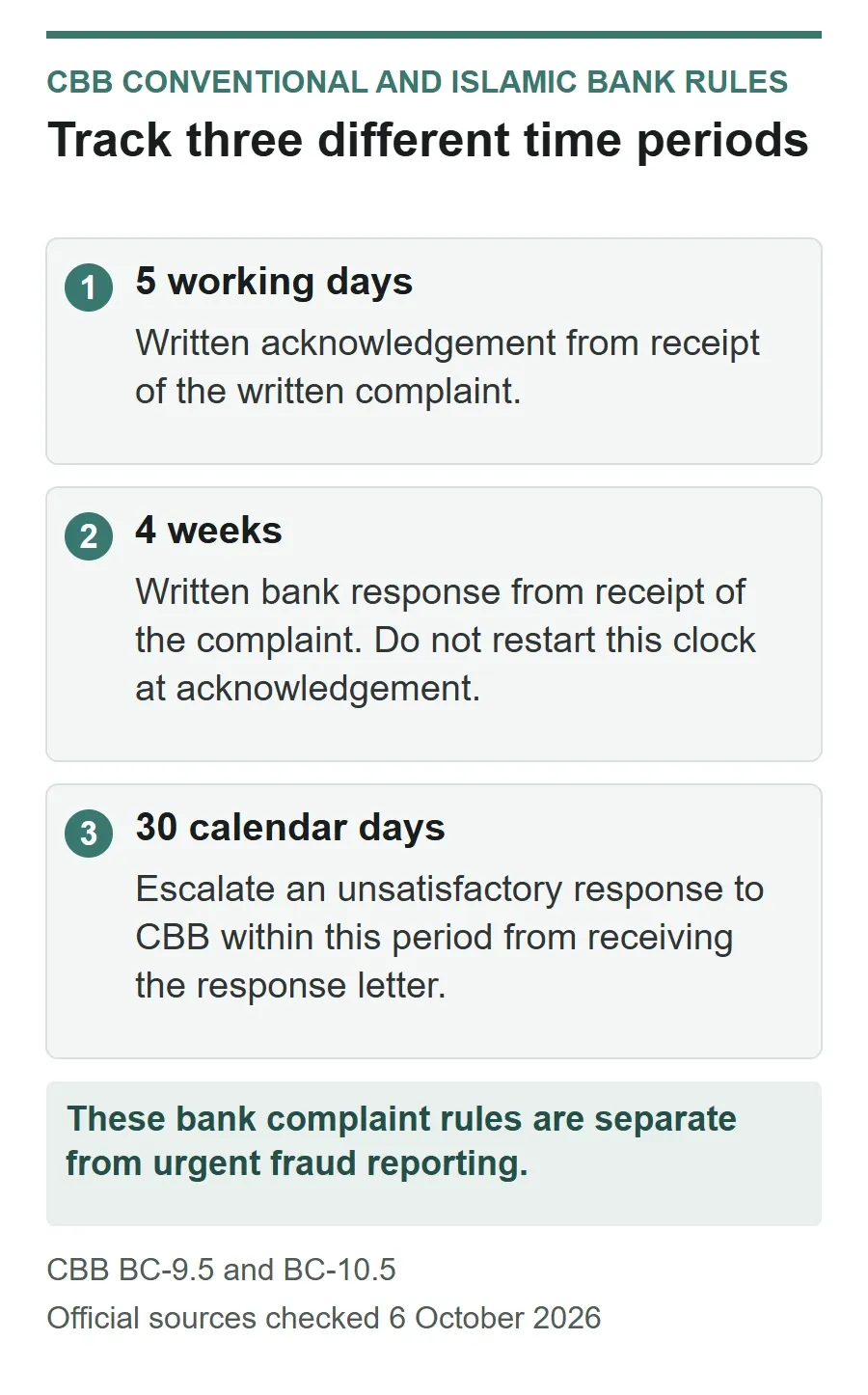
| Stage | Period and starting point | What it establishes |
|---|---|---|
| Written acknowledgement | Within 5 working days of receiving the written complaint. | Receipt of the complaint, not a decision in your favour. |
| Written bank response | Within 4 weeks of receiving the complaint. | The bank’s position and how it proposes to deal with the complaint. |
| CBB escalation after an unsatisfactory response | Within 30 calendar days of receiving the response letter. | A route to regulatory review, not a guarantee of compensation. |
Sources: BC-9.5.1, BC-9.5.2 and BC-9.5.6; BC-10.5.1, BC-10.5.2 and BC-10.5.6. The escalation paragraphs were amended in May 2026 and identify CBB’s Consumer Protection & Enforcement Directorate.
Do not start the four-week period from the acknowledgement date: the rule uses receipt of the complaint. Also keep working days distinct from calendar days. Save the date you actually received the response letter.
If the bank has not provided the required response, retain proof of submission and follow-ups. The public CBB procedure and form request the institution’s written response. Ask the CBB Consumer Protection Office on 17547789 how to present a case where that response is missing. Do not claim to have completed a stage you have not completed.
5. Prepare the current CBB form and attachments
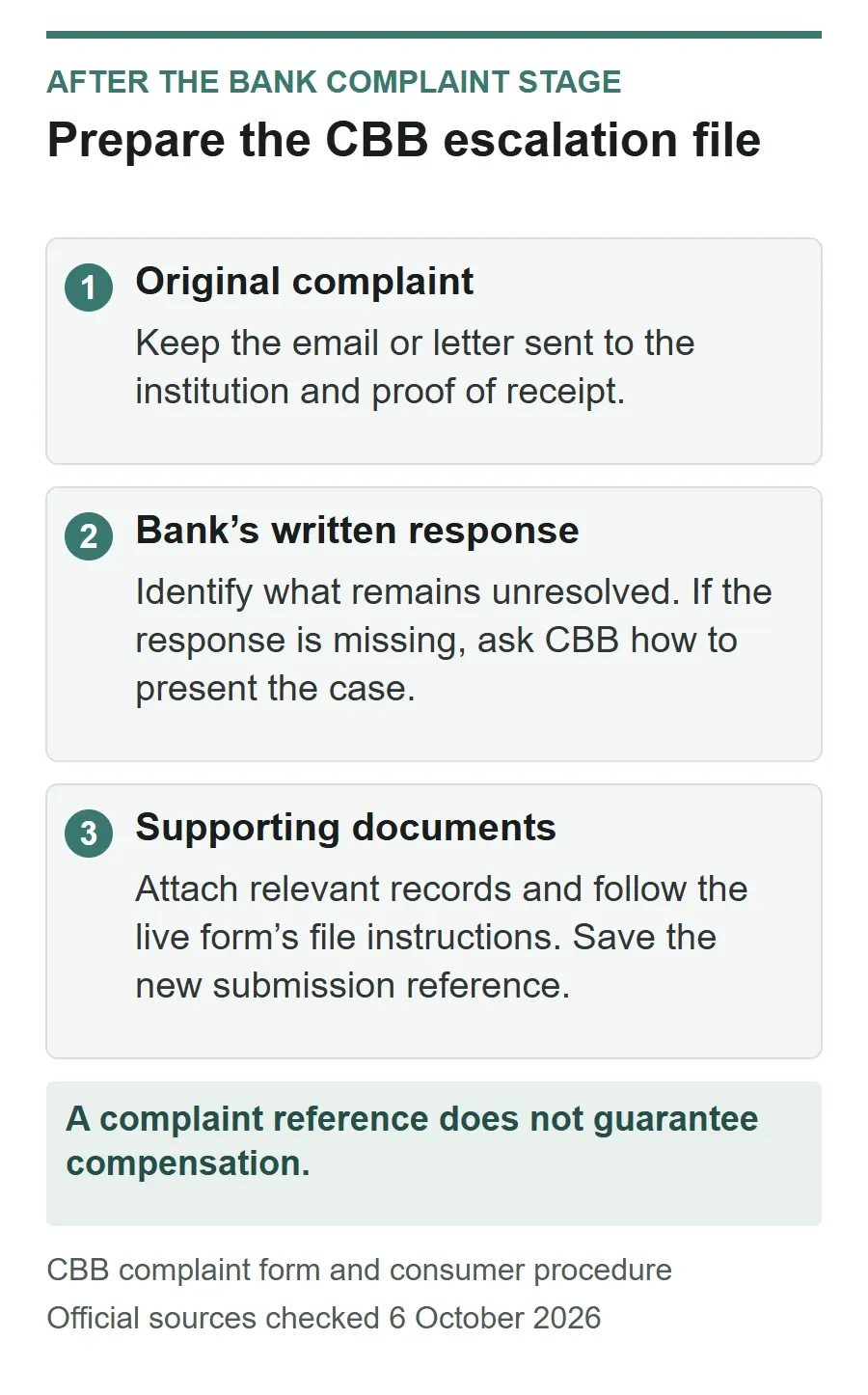
The official CBB complaint form separates Insurance, Bank/Financial, Capital Markets and Other categories. It asks whether the official complaints procedure has been completed. For a banking complaint, use the bank category and identify the actual institution involved.
The bank section requests the complaint subject, further comments and relevant contact or account details. Its attachment instructions ask for the original complaint email or letter, the institution’s written response and supporting documents. When checked, the upload control displayed a 5MB maximum file size and accepted formats including PDF, JPG, PNG and DOCX. Follow the live form’s current instructions if these change.
Prepare a readable, ordered file before uploading. Check that the bank’s response and your remaining disagreement can be found quickly. If a required field does not fit your circumstances, ask CBB how to complete it rather than supplying inaccurate information. This guide does not collect documents or submit a complaint for you.
The published procedure also gives Tawasul and hand delivery as escalation routes. Save the submission acknowledgement and reference, then keep subsequent messages together.
6. Keep the correct complaint route and assess the response
The CBB consumer page says it reviews complaints for possible breaches of its regulatory requirements. A complaint reference is evidence that a case was recorded; it is not proof of wrongdoing or a promise of repayment.
When a response arrives, compare it with your numbered requests. Does it identify the transaction, explain the relevant calculation or term, address the evidence, and state the next action? If compensation or another correction is offered, keep the written terms and check whether the promised action actually occurs.
Use the insurance complaint guide for an insurer dispute. Its published response periods differ from bank rules. A complaint about unpaid wages also needs the relevant employment route; a bank complaint addresses the bank’s account or payment handling. A securities complaint belongs in the applicable capital-markets route, not automatically the bank section because a bank helped arrange the investment.
General information only. This guide is not personal financial or legal advice and does not predict a complaint outcome. Keep any separate contractual or legal deadline under review and share private records only through verified official channels.