Bahrain finance guides
BHD to INR: read the CBB rate and check a transfer quote
By Gaurav Agarwal · Sources checked 6 October 2026
Multiply BHD by an INR-per-BHD rate, or divide by a BHD-per-INR rate. Check the official observation date and distinguish an indicative reference from your provider’s transaction quote. This guide’s calculator uses a rate you enter; it does not show a live feed.

Jump to a section
To convert BHD to INR, multiply the dinar amount by a rate expressed as rupees per dinar. If the source instead gives dinars per rupee, divide by that rate. Check the source date and whether the figure is an indicative reference or a provider's confirmed transfer quote. The same currency pair can appear in either direction.
Sources checked 6 October 2026. This guide and its calculator do not supply a live exchange-rate feed. Open the linked official source for its latest published observation, or enter the rate from your provider's current quote. No payment is made and no account details are requested.
1. Read the CBB reference table with its date
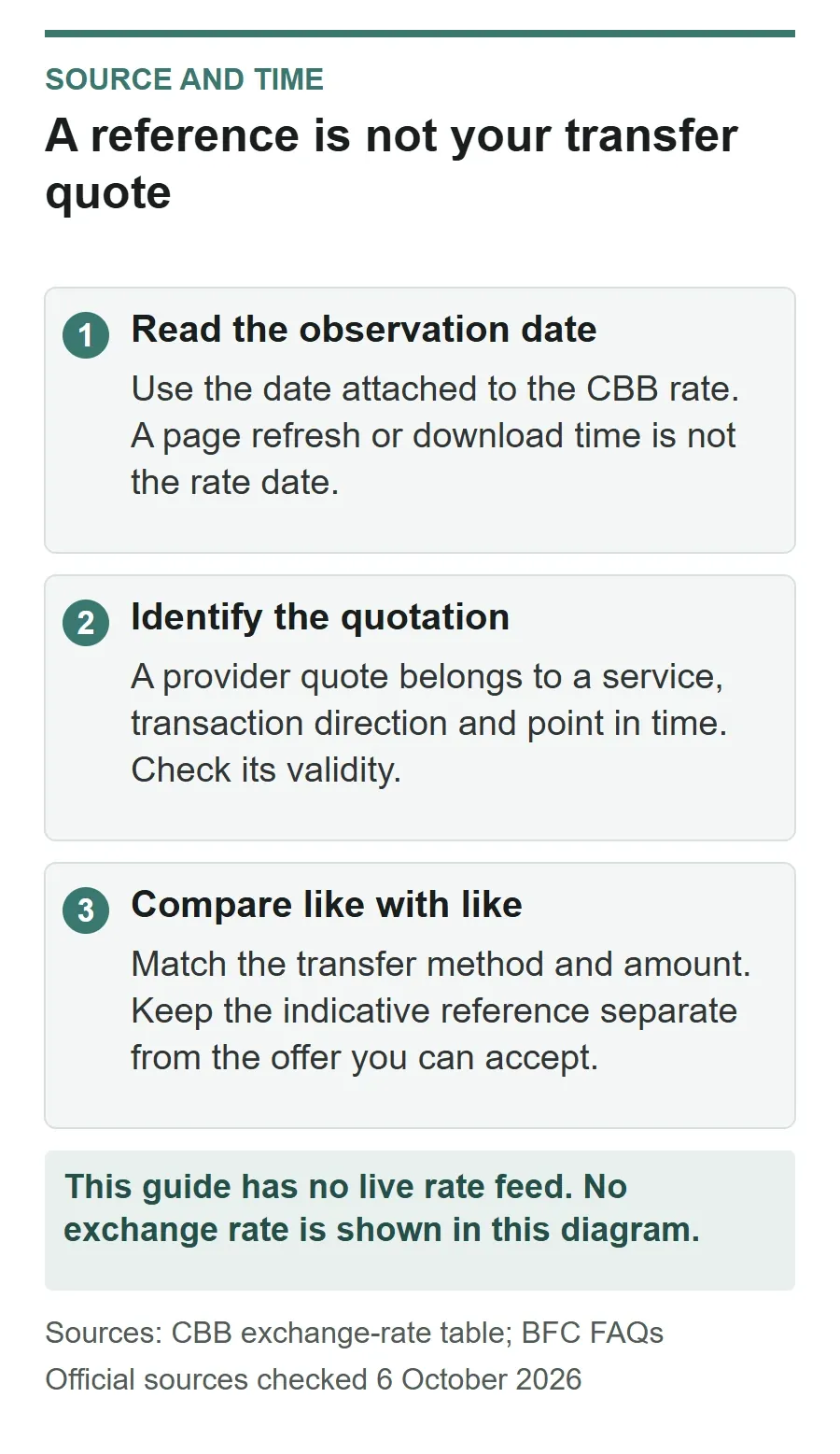
The Central Bank of Bahrain's exchange-rate table lists a currency and its BHD value, and labels the rates indicative. The source table's own date is the relevant observation date. A website footer's update date, your download time and the market observation date can be different.
Find the Indian rupee row and read the column unit before using it. If it expresses BHD for one INR, divide your BHD amount by that figure to calculate INR before fees. Keep the source date beside your private calculation. This guide does not copy a market price into the article, so an old observation cannot be mistaken for a current offer.
The page also links a currency CSV download. When inspected, the file contained currency values but no observation-date column. Keep the displayed table date with a saved CSV; a downloaded file by itself does not establish the date or time of its underlying observation.
For your own comparison, save three separate labels: source observation date, time you checked it and provider quote time. Only the last belongs to the proposed transaction. If the reference table has not advanced to today, retain its published date instead of relabelling it as today's rate.
2. Choose multiplication or division from the units
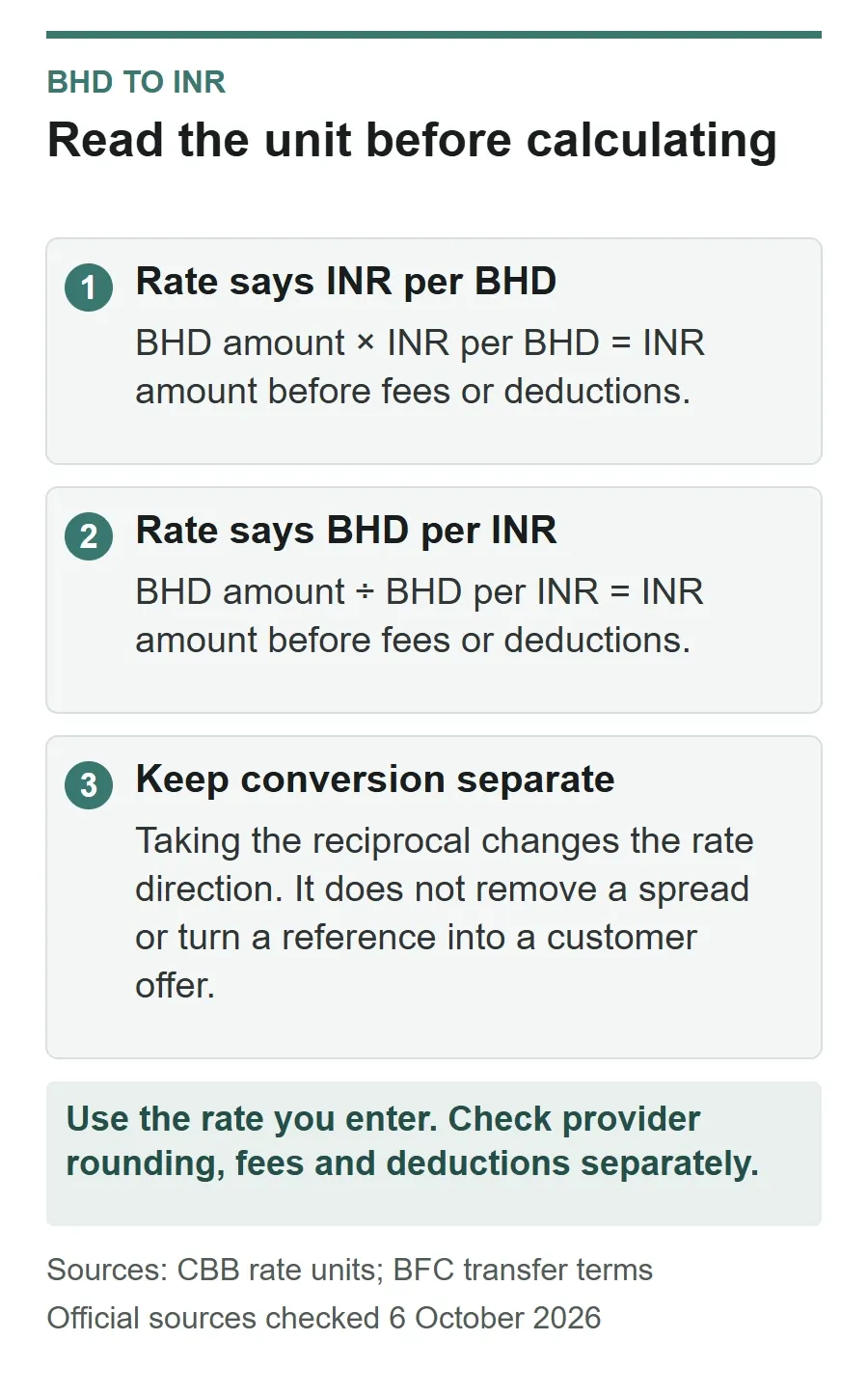
| How the rate is expressed | Calculation | Result |
|---|---|---|
| INR for one BHD | BHD amount × INR-per-BHD rate | INR before any separate deductions |
| BHD for one INR | BHD amount ÷ BHD-per-INR rate | INR before any separate deductions |
Write the unit beside the number before entering it. A reversed rate can produce a plausible-looking decimal with the wrong meaning. Taking a reciprocal changes the quotation direction; it does not remove a provider's exchange margin or transform a reference rate into a customer offer.
Keep the source precision during calculation and round only the displayed result. A provider may use its own precision and transaction-rounding rules. A small difference between your calculation and a receipt should therefore be checked against the exact booked rate and amount rather than attributed immediately to an unexplained fee.
3. Calculate from a rate you supply
Enter only an amount and a rate. The inputs are blank because no current transaction quote has been obtained for you. Select the direction printed by your source. The result excludes fees and other deductions.
Record the source and its observation or quote time privately alongside the result. This tool does not confirm that a provider will honour that rate, that the quote is still valid or that the transfer is eligible. It also does not calculate investment returns or predict the next exchange-rate movement.
4. Separate the dollar peg from the rupee rate
The CBB monetary-policy page describes the dinar's peg to the US dollar at BHD 0.376 per USD. That policy statement does not fix the INR value of one dinar. The rupee side of the currency relationship still matters.
Do not combine a dollar rate from one date with a rupee rate from another and label the result current. A cross-rate calculation also needs matching units, a consistent observation time and an explanation of whether its inputs are reference rates or customer buying and selling prices. For a simple Bahrain-to-India check, a directly quoted BHD-to-INR customer rate is easier to reconcile with the actual receipt.
The peg is not a promise that a retail customer can exchange any amount at the policy parity without a spread or charge. CBB describes its foreign-exchange facility as available to Bahrain retail banks. Your transaction remains subject to the provider's quoted terms.
5. Compare the reference with the right customer quote
Match the service as well as the currencies. Cash notes, a bank-account remittance and a cash-pickup transfer can have different prices. A provider's buying rate is also a different side of the transaction from its selling rate. Ask which one applies when you pay BHD and want INR delivered.
BFC's official FAQ says different transfer types can have different rates, fees and limits, and identifies the executed transaction's displayed rate as the applicable remittance rate. Its terms place the rate and commission on the receipt and warn of possible beneficiary or intermediary bank deductions. These are BFC's terms, not a universal quote for every provider.
| Figure | Purpose |
|---|---|
| Official indicative observation | A dated comparison point, with its direction and precision. |
| Provider exchange rate | The rate offered for the particular service, amount and time. |
| Total BHD debit | The actual budget used, including charges paid on top. |
| Final INR credit | The amount the recipient gets after known deductions. |
A difference from a reference rate is not, by itself, an unauthorised charge. Compare contemporaneous figures and the agreed terms. If a deduction is unknown, keep it unresolved rather than inserting zero. A rate-only calculator cannot decide which quote gives the most rupees for your full budget.
Compare the same service and the same total budget
LuLu Money's Bahrain FAQ distinguishes currency buying, currency selling and remittance rates. Its fee depends on the destination and payout service. A cash-note board therefore does not tell you what an India bank-account transfer will deliver. Select the actual service before comparing its rate.
Western Union's Bahrain-to-India page also describes displayed fees and rates as estimates that depend on payment and payout methods. It tells customers to compare both and states that it earns from currency exchange. Use the Bahrain sending route and your chosen receiving method when requesting a quote.
The World Bank's remittance-price methodology treats the transfer fee and exchange-rate margin as separate cost components. It also records payment method, receiving method and speed. This supports a practical comparison: keep those conditions consistent, then compare how much INR arrives for the same total BHD budget. Its published price surveys are dated snapshots, not a replacement for a provider's current quote.
| Write down | What to check |
|---|---|
| Total BHD you can spend | Does the quoted fee fit inside that budget or get added on top? |
| BHD principal converted | Use this amount in the rate calculator, not a fee-inclusive debit. |
| INR per BHD and quote time | Compare the same direction, service and validity conditions. |
| Recipient amount and deductions | Ask whether the displayed INR amount is guaranteed or may be reduced. |
| Receiving method and expected availability | Compare quotes that meet the recipient's actual need. |
The worksheet is an editorial comparison method, not a provider price list. If a fee is paid separately in BHD, add it to the principal to find the total spend. If a stated INR deduction comes out of the converted amount, subtract it to estimate the recipient amount. Do not count the same fee twice. An unknown deduction means the net comparison is still incomplete.
Use a bank rate sheet with the correct transaction side
HDFC Bank Bahrain’s official overseas-branch forex card-rate sheet includes BHD–INR and separates telegraphic-transfer buying and selling columns. Read the date at the top each time you open it. The sheet describes its rates as indicative and normally applies the card rate prevailing when the customer account is debited or credited. Execution also depends on the branch’s correspondent-banking capability. Ask the bank which column and service apply to your transfer; neither column is a universal Bahrain cash-exchange quote. No figure from the sheet is reproduced here.
Check the provider behind the quote
Use the CBB Licensing Directory to look up the legal entity and review its licence category and permitted activities. Check that the entity matches the app or service's terms. The register cautions that licensees supply its information and that CBB does not guarantee its timeliness. A directory entry helps identify the provider; it does not establish that its rate is cheapest or that a particular transfer is guaranteed.
6. Reconcile the quote with the receipt
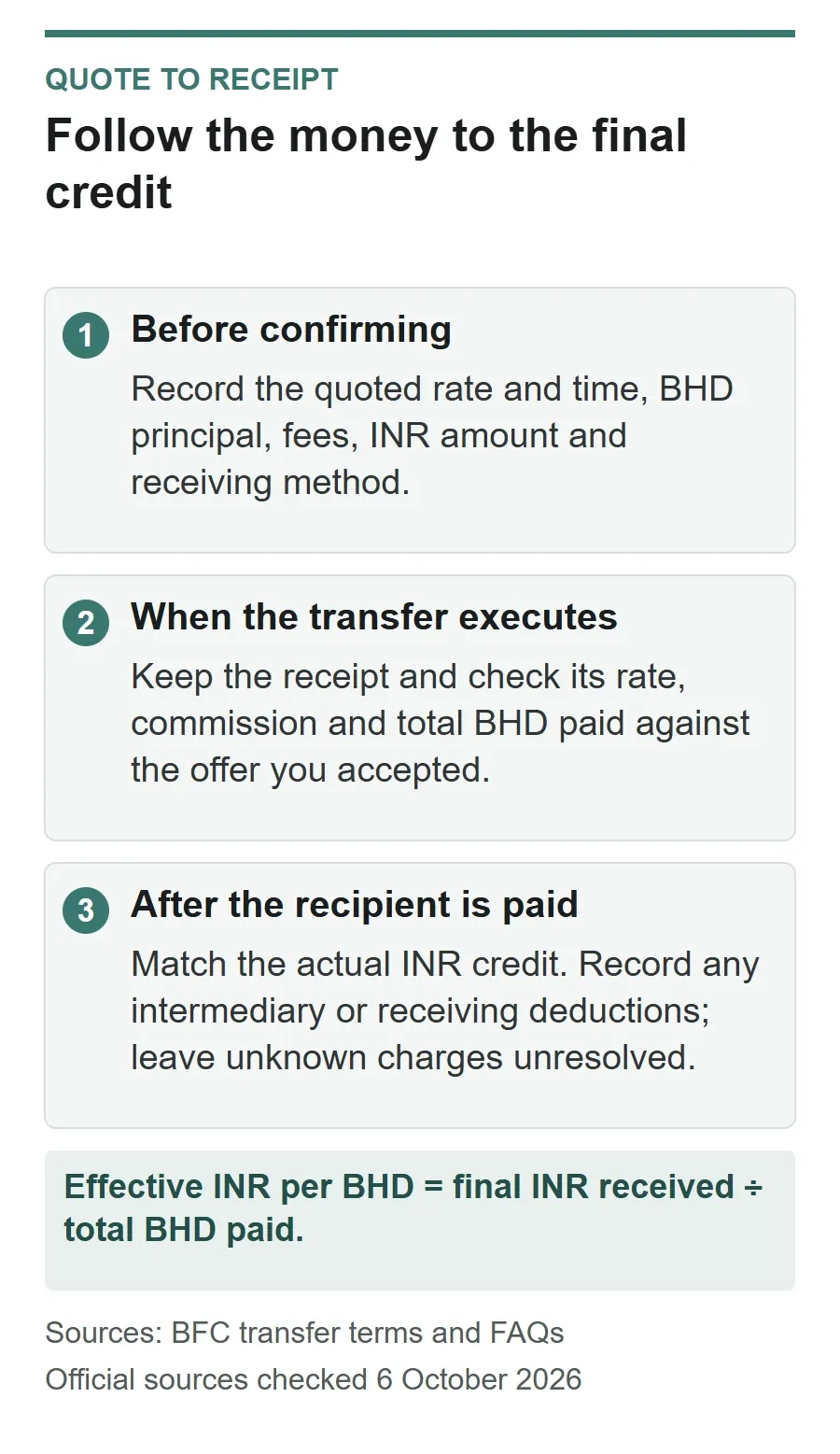
Before confirming, save the quote's time, validity conditions, BHD principal, fees, INR amount and receiving method. After the transaction, match those fields to the receipt and the recipient's actual credit. Ask the provider to explain a difference using the booked rate, rounding, charges and any receiving-bank deduction.
For two comparable completed transfers, final INR received ÷ total BHD paid gives effective rupees per dinar spent. Use the Bahrain-to-India transfer guide for the full quote-comparison worksheet, receiving methods, identity preparation and transfer tracking.
Keep records in your own files and use the provider's official support channel for a dispute. Do not place bank details, IDs, passwords or one-time codes into this calculator or a public comment. This guide provides general information, not personal financial advice, a rate forecast or a recommendation to exchange at a particular time.
If the credited amount does not match
Separate a changed quote from an unexplained deduction. First compare the accepted rate and commission with the transaction receipt. Then ask whether an intermediary or receiving bank reduced the amount. BFC's published terms specifically allow for such deductions, but that does not establish what happened to a different provider's transfer.
If the explanation remains unresolved, retain the quote, receipt, reference number, recipient credit and support response. The CBB consumer-information page explains that it reviews complaints for regulatory breaches and stresses understanding the contract terms. A later market movement alone does not prove that the booked transaction was wrong. Use the linked complaint procedure to check the appropriate next step.
BHD to INR FAQs
What is the BHD to INR rate today?
This page does not provide a live rate. Check the CBB table for its dated indicative observation, or request a current retail quote for the transfer you intend to make. A reference observation and an executable offer answer different questions.
How do I calculate 100 BHD or 1,000 BHD in rupees?
Enter 100 or 1,000 as the BHD amount, without a comma in the calculator, and supply your own rate. For INR per BHD, multiply the amount by that rate. For BHD per INR, divide. The result is arithmetic before fees, not a quoted payout.
Does the dollar peg make the rupee amount fixed?
No. CBB's peg concerns the US dollar. It does not peg the dinar to the rupee. A BHD-to-INR conversion still depends on the rupee exchange relationship, and a retail quote has its own terms.
Does a zero transfer fee mean the cheapest transfer?
No. A fee is only one cost component. The World Bank methodology identifies exchange margin separately. Compare final INR against the full BHD spend under matching conditions, and leave any unknown deductions unresolved.
Which rate should I use: cash buy, cash sell or remittance?
Use the rate for the service you will actually book. LuLu's Bahrain FAQ distinguishes these categories. If you are sending BHD to an Indian bank account, ask for that remittance quote instead of choosing a cash-note rate because it looks more favourable.
When does an estimate become the rate used for my transfer?
Check your provider's execution and quote-validity terms. BFC's FAQ identifies the rate displayed when its transaction is executed. Western Union's corridor page describes its displayed rates as estimates subject to change. Neither statement makes an earlier screenshot a universal rate guarantee.
Why can the recipient get less than the calculator result?
The calculator applies only the rate you enter. It does not deduct fees, establish the booked principal or verify the receiving-bank credit. BFC's terms, for example, warn that beneficiary or intermediary bank charges can reduce a wire transfer's payout. Ask your own provider which deductions apply.
Should I wait for a better rate?
This guide does not forecast rates. Check the current quote and its validity against your payment deadline. A past observation, an indicative calculator result or a rate alert does not establish what a later transfer will cost.