Bahrain finance guides
Bahrain credit-card charges: interest, cash advances and late fees
By Gaurav Agarwal · Sources checked 6 October 2026
Check the billed balance, due date and payment credited before calculating card interest. Confirm the rate period, separate purchases from cash advances, and ask for the daily principal calculation. Paying the minimum can leave both debt and interest due.

Jump to a section
To check a Bahrain credit-card interest charge, start with the statement balance, due date, payment actually credited and the transactions left unpaid. Confirm whether the rate is monthly or annual. Cash advances, fees and purchases can follow different rules, so multiplying the entire statement balance by a headline rate can give the wrong answer.
Checked 6 October 2026. This guide explains statement checking, principally for conventional cards. CBB provisions below are specifically scoped to conventional retail banks; named issuer examples apply to their own products. Islamic-card profit and service-fee arrangements require their own terms. For product selection and rewards, use the separate Bahrain credit-card comparison.
1. Separate the statement’s amounts and dates
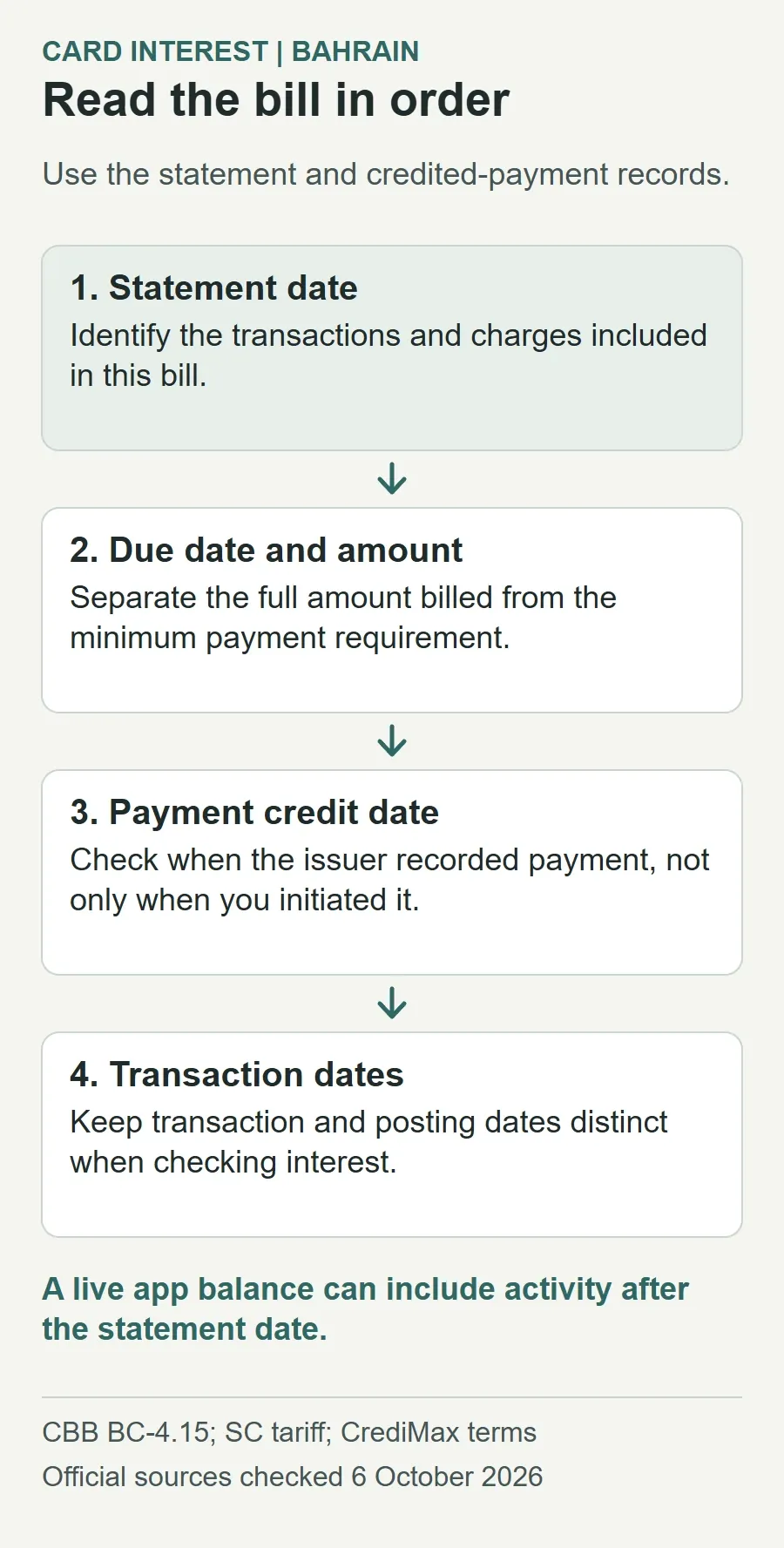
Read the statement in this order before trying to reproduce a finance charge.
| Field | What to establish |
|---|---|
| Statement date and billed balance | Which transactions and charges are included in this bill? |
| Payment due date | By when must the required payment reach the card account? |
| Minimum amount due | What payment satisfies the minimum requirement, including any added instalments or arrears? |
| Full amount billed and due | What amount must be settled for the applicable purchase-interest treatment? |
| Payment credit date | When did the issuer record the payment, rather than when did you initiate it? |
| Transaction and posting dates | When was each purchase or withdrawal made, and when was it entered on the account? |
A live app balance can include activity after the statement was produced. Keep that separate from the amount billed for the current due date. Reconcile the statement against payments and transactions instead of assuming an available-credit figure proves that the bill has been settled.
2. Keep monthly rates, annual rates and APR labels intact
A monthly percentage is not an annual percentage. For example, Standard Chartered Bahrain’s current service guide lists 2.50% per month and a 30% annual interest rate for Journey and Rewards cards. Those are the bank’s published units, checked on 6 October 2026. See page 7 of the guide.
Multiplying 2.50% by 12 gives 30%. That arithmetic does not establish an APR including fees, an effective compounded annual cost, or the charge on your particular bill. Preserve the issuer’s label and ask what costs a quoted annual measure includes.
There is also a distinction between quoting a monthly rate and charging a monthly flat rate on an unchanged original balance. For conventional retail banks, CBB rule BC-4.16.1 requires an effective interest rate based on a reducing balance method rather than a monthly flat-rate method.
3. Check which balance can attract interest
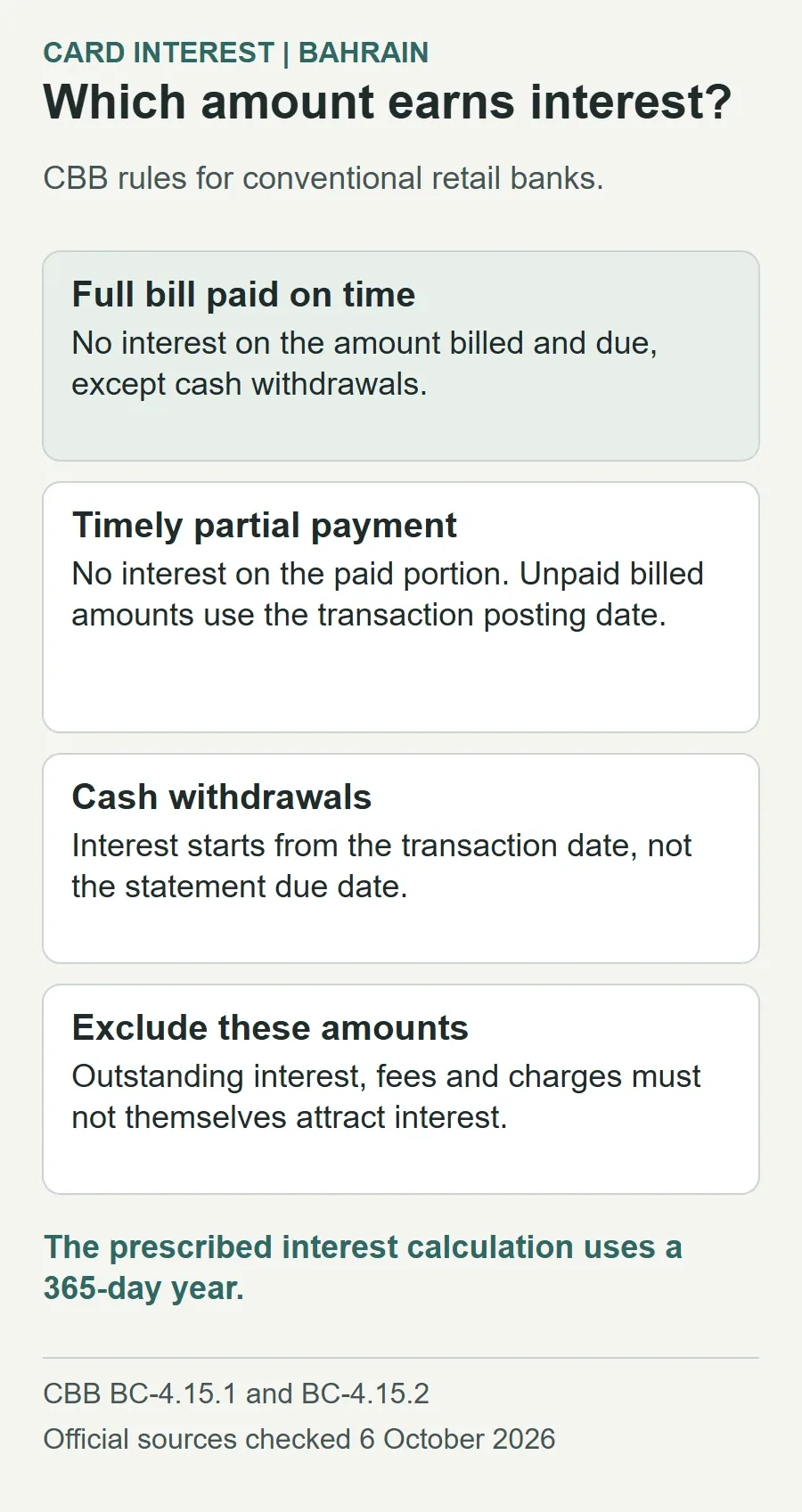
The conventional-bank rules are more specific than the phrase “interest-free period”. CBB BC-4.15.1 and BC-4.15.2 require the following:
- If the customer pays the full amount billed and due by the statement’s due date, interest must not be charged, except for cash withdrawals.
- Interest must not be charged on partial payments made by that due date against the amount billed and due.
- Interest on cash withdrawals is computed from the transaction date.
- Interest on billed amounts still unpaid by the due date is computed from the transaction’s posting date.
- Outstanding interest, fees and charges must not themselves attract interest.
- The interest calculation must use a 365-day year.
This means a timely partial payment matters, even when it does not clear the bill. It also means the payment due date is not necessarily the first date used in calculating interest on what remains unpaid. Ask the issuer to identify the transactions and periods behind the charge.
Do not treat an “up to” interest-free period as a promise that every purchase receives the same number of days. Check its posting date, statement cycle and the full-payment requirement. For new spending after carrying a balance, request the issuer’s applicable calculation and the conditions for restoring purchase-interest relief.
4. Use a daily calculation as a check, with the right inputs
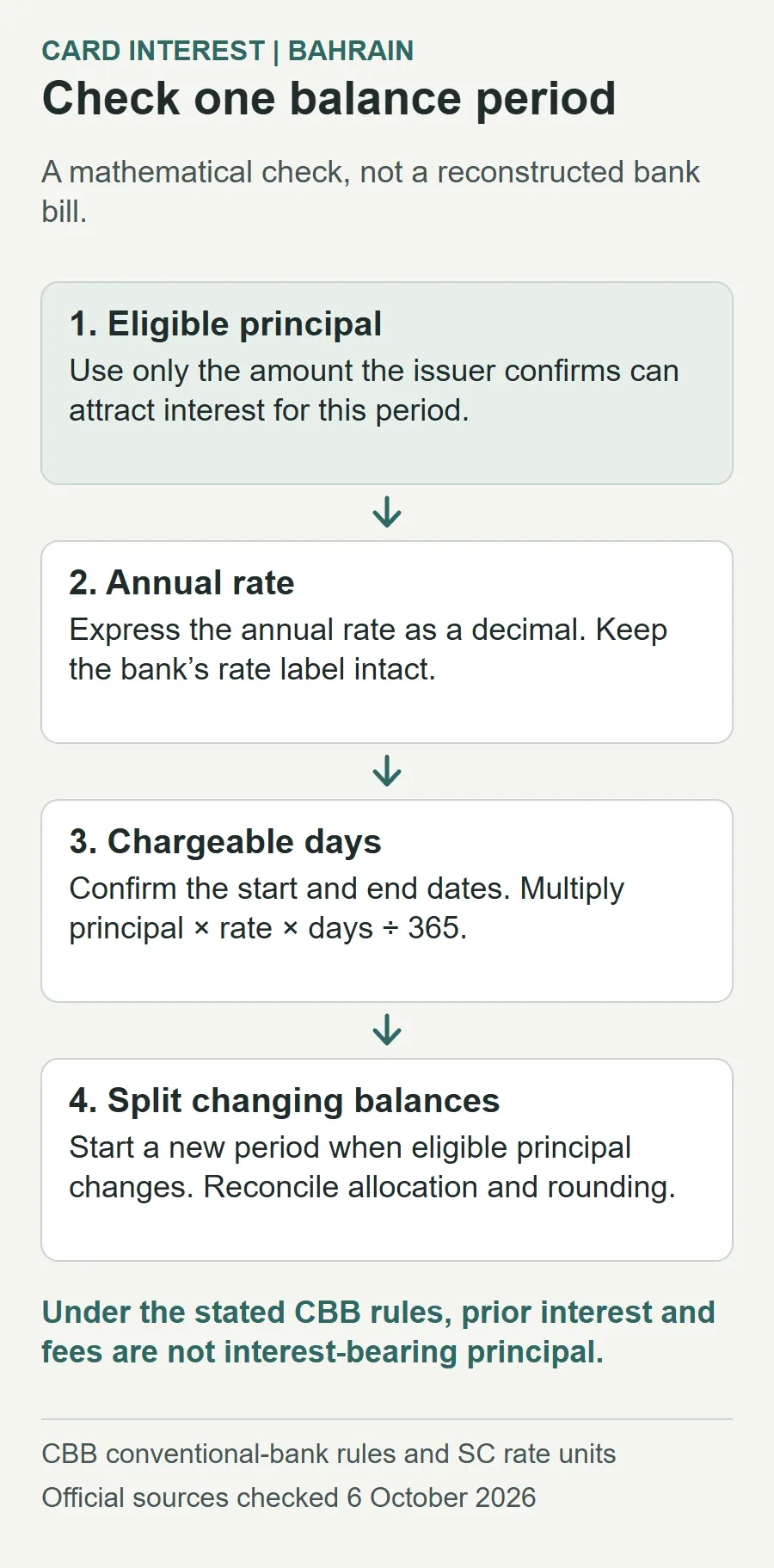
Once the bank confirms the interest-bearing principal and dates, a simple constant-balance arithmetic check is:
Principal × annual interest rate as a decimal × chargeable days ÷ 365.
Using the published 30% annual rate above, an assumed BHD 100 of eligible unpaid principal for an assumed ten chargeable days gives BHD 100 × 0.30 × 10 ÷ 365 = approximately BHD 0.822. The rate is published; the balance and days are hypothetical. This is a mathematical illustration, not a reconstructed Standard Chartered statement or a quote.
An actual calculation needs separate periods whenever eligible principal changes. Payments, posting dates and the issuer’s allocation can change that principal. Do not add fees or prior interest to the interest-bearing amount where the conventional-bank prohibition applies. Ask the issuer to reconcile any difference, including its day-count boundaries and rounding.
A repayment calculator that assumes no new spending also cannot predict a bill containing fresh purchases. To check your own account, request the daily or transaction-level calculation using your actual records; do not send card credentials or a full card number to an unrelated advice service.
5. Check where your payment went
The minimum amount due is a payment requirement, not a promise to clear principal quickly. Standard Chartered’s tariff specifies the greater of BHD 10 or 1% of outstanding principal plus all instalments, fees, charges and interest. Use the amount on your statement and the current applicable terms. Tariff, page 7.
Allocation is a separate issue. In CrediMax’s June 2026 terms, clause 4.1.8 applies payments first to late fees, then billed interest, billed cash advances, billed purchases and finally unbilled advances or purchases. Clause 4.1.9 allows changes with notification. CrediMax is a financing company; this is its contractual example, not a claim that every bank uses that order.
Consequently, the amount paid and the reduction in purchase principal need not match. Ask for a breakdown if you are carrying more than one type of balance. When setting an automatic payment, check whether you selected the minimum or the full balance. CrediMax’s clause 6.1 expressly distinguishes those choices, while clause 4.1.4 treats payment as received when credited to the card account. Read pages 2 and 3.
6. Separate fees from interest, then query unexplained lines
Cash-advance charges can include both a transaction fee and interest. Standard Chartered lists a cash-advance fee of 5.50% or BHD 11, whichever is higher; its late-payment charge is BHD 17.600 if the minimum is not paid by the due date. The listed fees include VAT where applicable. These are named-bank figures, not Bahrain-wide caps. Tariff, pages 7 and 8.
For each fee on your bill, check the relevant line in the current schedule:
- Annual membership: which card and membership year, and whether a confirmed waiver applies.
- Foreign transaction: original currency, converted amount, applicable markup and any separately shown charge.
- Cash advance: the withdrawal amount, percentage fee, minimum fee and interest period.
- Late or returned payment: the triggering event and the payment-credit record.
- Instalment plan: the agreed processing fee, instalment and any separate plan interest.
Save the statement, applicable tariff, agreement and payment confirmation. Ask the issuer for the calculation and clause behind a disputed line, then use its formal complaints route if the explanation remains unresolved. The CBB consumer-information page explains its complaint role and escalation routes. A query does not itself establish that a charge is wrong or that payment obligations have stopped.
This is general information, not personalised financial or legal advice. The source check date is separate from each document’s effective date: the reviewed Standard Chartered guide is version August 2025 with card-fee notes dated June 2024, and the CrediMax terms are the June 2026 version linked from its current download centre.