Bahrain finance guides
Deposit protection in Bahrain: limits, eligible accounts and exclusions
By Gaurav Agarwal · Sources checked 6 October 2026
Bahrain’s scheme caps compensation at BHD 20,000 across an eligible individual’s eligible accounts at the defaulting bank. Qualifying Bahrain retail-bank accounts are subject to product, ownership and exclusion rules, with separate conventional and Islamic treatment.

Jump to a section
- 1. Know what event the scheme covers
- 2. Check the person, legal bank and account location
- 3. Separate deposits from other investment products
- 4. Apply the limit to the right accounts and ownership
- 5. Check the exclusions before relying on a headline cap
- 6. Understand the claim process and confirm coverage now
Bahrain’s deposit protection scheme has a BHD 20,000 ceiling across an eligible individual’s eligible accounts at the defaulting bank. It applies to qualifying accounts at Bahrain offices of CBB-licensed retail banks, with different product definitions for conventional and Islamic banks. Account ownership, exclusions, debt set-off and the claims process still matter. The cap is not a separate allowance for every account.
Official sources checked: 6 October 2026. The current basis is CBB Resolution No. 34 of 2010 and its regulation, read alongside the active compensation modules for conventional and Islamic banks. This guide explains scope and verification, not the financial condition of any particular bank.
1. Know what event the scheme covers
The Deposits and Unrestricted Investment Accounts Protection Board begins the compensation process when a bank is placed under CBB administration or into liquidation. This is the trigger in Article 4 of the regulation. An app outage, delayed transfer or disputed fee does not by itself establish that event.
The scheme has separate conventional and Islamic funds, administered by the same Board. The CBB consumer overview describes the replacement of the earlier protection arrangements. Older documents quoting the lower of 75% of deposits or BHD 15,000 describe the previous scheme. Use the active rules rather than an undated search extract or archived PDF.
The conventional CP module and Islamic CP module were revised in October 2012 to reflect the regulation. Both say the regulation prevails if their summary rules are inconsistent with it. A rule’s age alone therefore does not tell you whether it is superseded; its location in the active rulebook matters.
2. Check the person, legal bank and account location
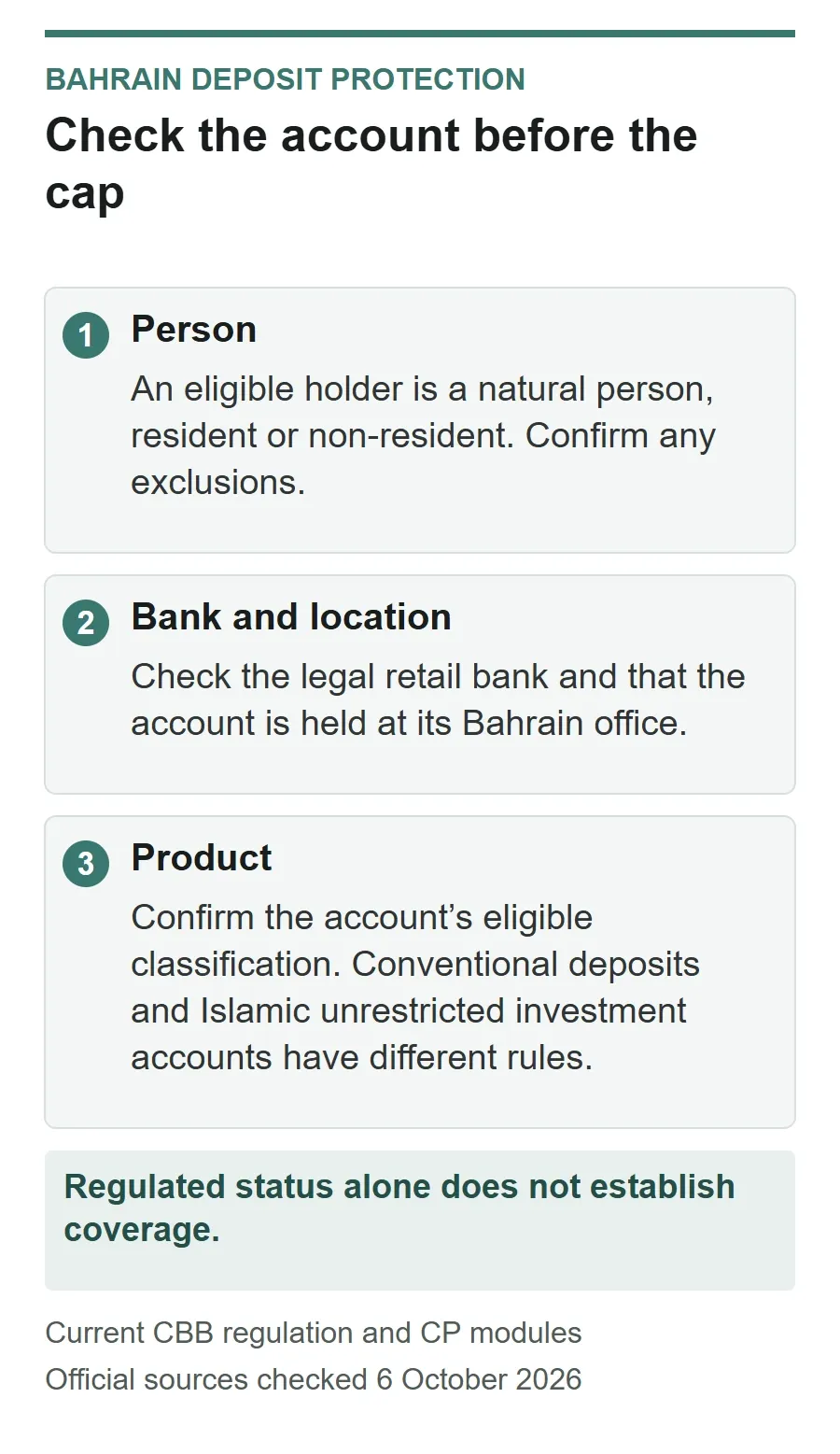
| Question | Published scope | Practical check |
|---|---|---|
| Who holds the account? | An eligible holder is a natural person, whether resident or non-resident. | Do not assume a company account receives the individual protection described here. |
| What kind of institution holds it? | The rules cover qualifying Bahrain operations of licensed conventional or Islamic retail banks. | Confirm the legal bank and licence category, rather than relying on an app or trading name. |
| Where is the account held? | Accounts at the bank’s foreign branches outside Bahrain are excluded from this scope. | Check the booking location in the agreement, even if the bank also operates in Bahrain. |
| Is another country’s scheme relevant? | The Board may exclude compensation wholly or partly where a holder can claim under a similar scheme elsewhere. | Ask how any overseas scheme applies to the Bahrain account; do not add two limits together. |
Sources: regulation Articles 1, 5 and 6; conventional CP-2.1; Islamic CP-2.1. Non-resident status is not itself an exclusion, but it does not remove the other eligibility tests.
3. Separate deposits from other investment products
The protection scheme uses defined account categories. A return, maturity date or banking-app balance is not enough to classify a product.
| Account category | What the active rules say | Boundary to preserve |
|---|---|---|
| Conventional retail bank | Eligible deposit accounts and similar accounts approved by CBB can qualify, regardless of currency. | CP-2.1.1 expressly excludes unrestricted investment accounts held with conventional retail banks. |
| Islamic retail bank | Eligible deposit accounts, unrestricted investment accounts and similar accounts approved by CBB can qualify, regardless of currency. | For unrestricted investment account claims, regulation Article 9 preserves the defaulting bank’s Sharia supervisory board condition. |
| Bearer certificate of deposit | Expressly excluded from the eligible-account definition. | Do not confuse this exclusion with every ordinary fixed-deposit confirmation. |
| Another investment or stored-value product | Its classification must be established under the scheme’s eligible-account definition. | Do not automatically extend coverage to a fund, sukuk, restricted investment account or wallet simply because a bank or regulated provider offers it. |
Sources: conventional CP-2.1.1 to CP-2.1.3, Islamic CP-2.1.1 to CP-2.1.3 and regulation Articles 1 and 9.
The underlying CBB deposit definition, Resolution No. 23 of 2009, distinguishes deposits from profit-sharing placements and Mudaraba money. That does not mean all Islamic investment accounts are outside protection: the protection regulation separately includes eligible unrestricted investment accounts. Ask for the exact classification instead of treating “not a deposit” as the end of the enquiry.
For those Islamic accounts, Article 9 makes the right to claim subject to the decision of the defaulting bank’s Sharia supervisory board. The scheme should not be described as a promise that an investment account will achieve its expected profit. The Islamic banking guide explains the separate contract and return questions.
4. Apply the limit to the right accounts and ownership
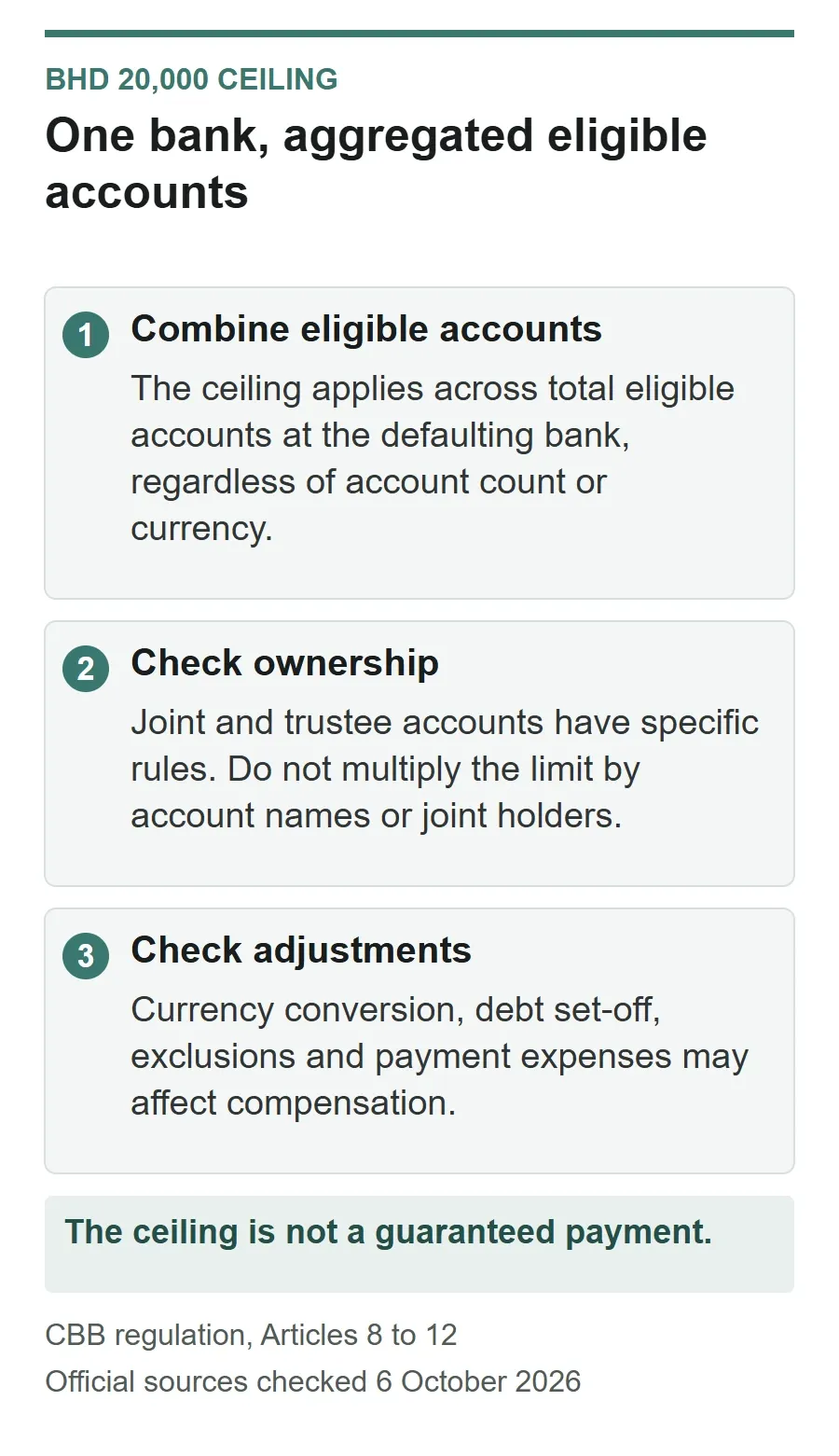
Article 9 sets the maximum at BHD 20,000 from the total eligible accounts held with the defaulting bank, regardless of account count or currency. Several savings accounts, deposits or currency balances at that same bank do not create several individual limits. Identify the legal bank behind each product before drawing conclusions from different brands or account names.
Foreign-currency balances are converted into BHD using the exchange rate on the date CBB determines that the bank is a defaulting bank. The Board may set off the holder’s debts with that bank and deduct expenses incurred in paying the compensation. The cap therefore is not a promise that the account balance, or the full cap, will be paid without adjustment.
- Joint accounts: Article 10 treats a joint eligible account as a single eligible account. Do not multiply BHD 20,000 by the number of names. Obtain confirmation of how the joint holding and any separate accounts would be assessed.
- Trustee accounts: under Article 11, the Board must be satisfied about the beneficial owner. A beneficial owner without other eligible accounts at that bank can be treated separately; where the owner also has other eligible accounts there, the trustee-held and other accounts are treated together under the rule.
- Artificial transfers: Article 12 rejects transfers whose purpose, in the Board’s opinion, is to obtain an advantage not permitted or intended by the regulation.
These ownership provisions require the actual account records. A simple calculator based only on balances and names cannot determine an individual claim.
5. Check the exclusions before relying on a headline cap
Under Article 8, the scheme does not apply to accounts of shareholders holding 10% or more of the defaulting bank, its board members or senior managers. It also excludes accounts where the person’s identity cannot be established, and accounts containing amounts the Board considers illegally obtained or connected with illicit or dubious means.
Read those exclusions alongside the person, location and product conditions above. The rules do not promise coverage merely because an institution is regulated, a customer has completed an application, or a product advertises capital repayment. Keep identity and account records current and ask the bank to explain any unclear classification in writing.
Protection up to the applicable limit is also distinct from a claim for the remaining balance. Article 26 preserves eligible holders’ rights to claim the remaining portion as creditors in liquidation. It does not establish how much that separate claim would recover or when.
6. Understand the claim process and confirm coverage now
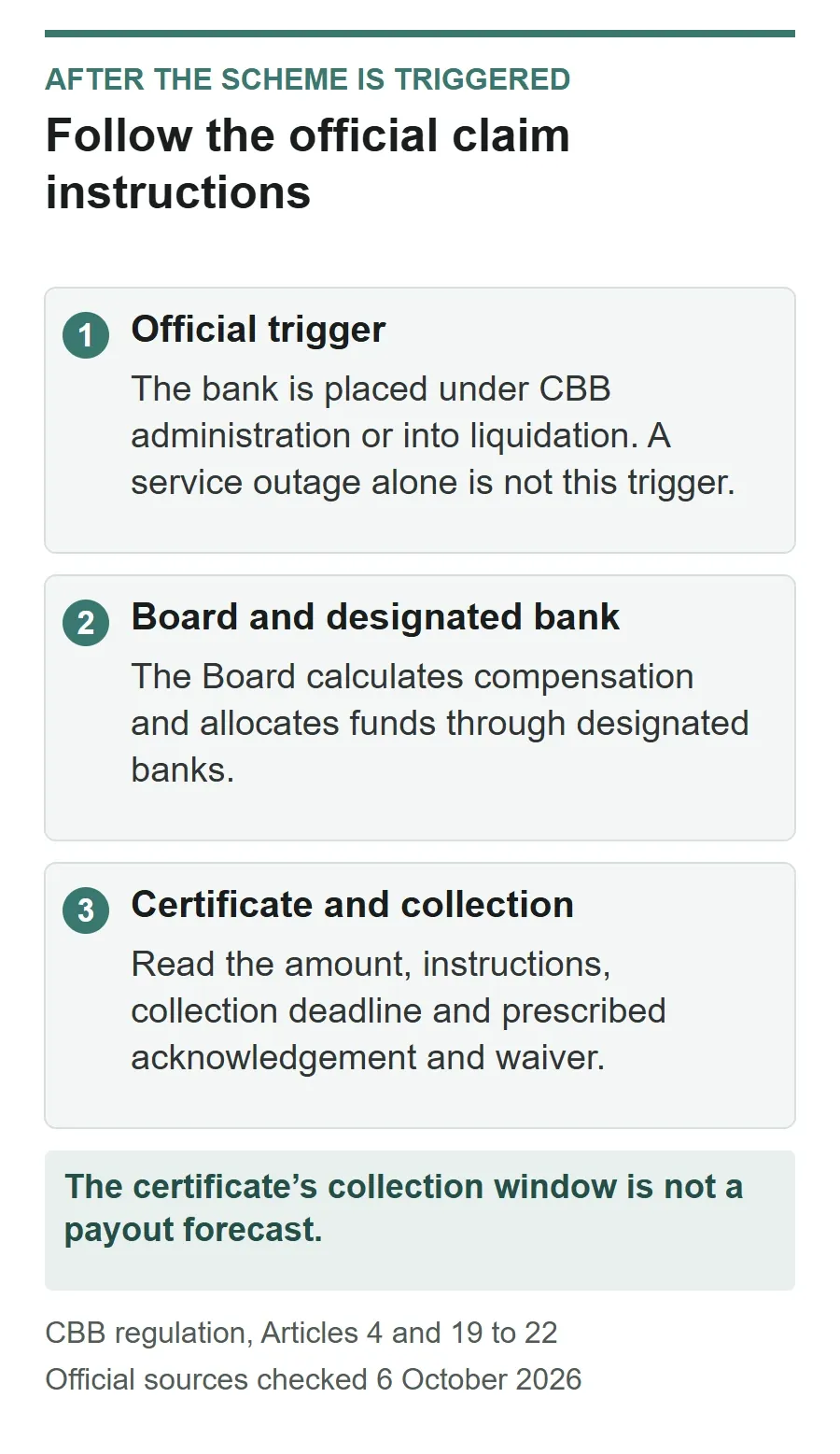
The published process is administered by the Board and designated banks. Under Articles 19 to 22, the Board calculates compensation, designated banks receive the allocated funds, and the holder receives a certificate stating the amount and collection instructions. Payment follows the prescribed acknowledgement and waiver. Read that document carefully, because it transfers the related claim rights for the compensated amount.
Article 21 says the certificate specifies the collection period, which must be no more than 12 months; compensation is not payable under that process after its stated deadline. This is a collection window in the certificate, not a promise to pay every claim within 12 months of a bank failure. Follow the actual official notice rather than an assumed deadline.
Before placing money, request written confirmation of these points:
- The legal bank, its retail licence category and the country where the account is held.
- The exact product’s eligible-account classification and the current protection disclosure.
- How other accounts, currencies, joint holdings and beneficial ownership affect the assessment.
- Whether another jurisdiction’s protection scheme is relevant.
- Any conditions specific to an Islamic unrestricted investment account.
Use the CBB consumer-information page and active rulebook to check the answer. Keep the agreement, dated protection disclosure and statements privately. For product selection, the savings-account guide and fixed-deposit guide cover access, returns and charges separately.
General information only. This guide is not personal financial, investment or legal advice, a bank recommendation or confirmation of an individual entitlement. Official scheme decisions and the applicable account facts determine coverage and compensation.