Bahrain employment and education guides
Employment Contracts in Bahrain: What to Check Before Signing
By Gaurav Agarwal · Sources checked 6 October 2026
Article 19 requires a written Arabic employment contract in two copies, or an Arabic version accompanying another language. Article 20 requires the essential party, work, duration and pay details. Read the complete signed agreement and its annexes before relying on a job offer or permit.

Jump to a section
- The written contract and Arabic version
- What the contract needs to identify
- Separate basic pay, allowances and conditional payments
- Fixed-term, open-ended and task-based contracts
- How to read a probation clause
- Policies, changed duties and better benefits
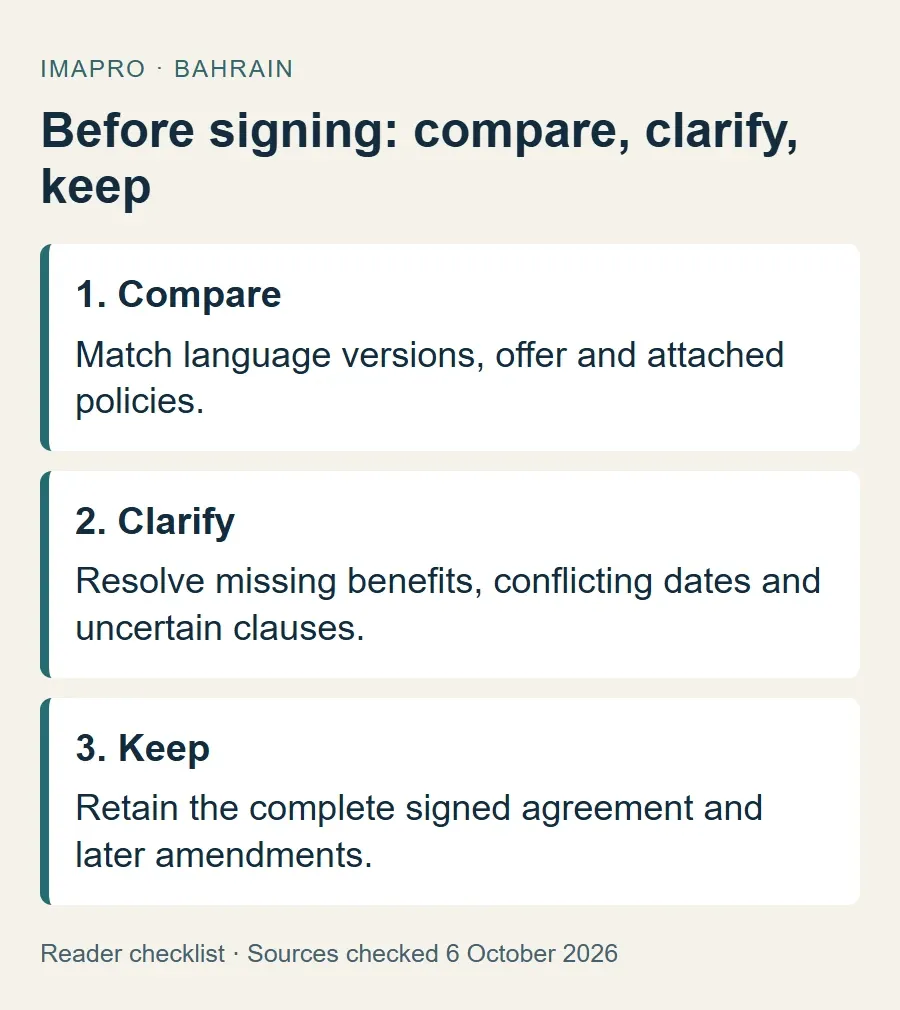
- A practical review before you sign
- Employment contract questions
A Bahrain private-sector employment contract should be written in Arabic in two copies, with one retained by each party. If it is prepared in another language, an Arabic version must accompany it. Article 20 requires the essential employment details, including the parties, nature of work, duration where fixed, and agreed pay and benefits. The practical task before signing is to make those details specific enough to check later.
This guide was checked on 6 October 2026 against the official Arabic consolidation of Law No. 36 of 2012 and its amendments. It focuses on reviewing and keeping the agreement. It does not treat a job offer, an employer policy and an LMRA work permit as interchangeable documents.
The written contract and Arabic version
Article 19 requires a written Arabic contract in duplicate, with a copy for each party. When another language is used, an Arabic version must be attached. If the contract refers to internal regulations, those regulations should also be attached and signed by both parties for evidential use. A clause saying that an unseen handbook forms part of the agreement deserves attention before you sign, because the missing document may contain the practical rules governing your work.
Read the Arabic and other-language versions together. Compare the employer name, role, start date, duration, salary, allowances and probation language. If you cannot assess the Arabic version, obtain help understanding it before agreeing. Where two versions appear inconsistent, request a corrected matching set. A verbal explanation that the difference does not matter leaves a problem for later when the document is needed as evidence.
Keep your complete signed copy, including annexes and the version of any incorporated policy. A photograph of the signature page alone does not show the terms that were agreed. Store a legible copy outside an employer account that may be closed when employment ends. This is practical document management, not an additional legal filing requirement. The source for the language, copies and attached-rule requirements is Article 19 of Law 36/2012.
What the contract needs to identify
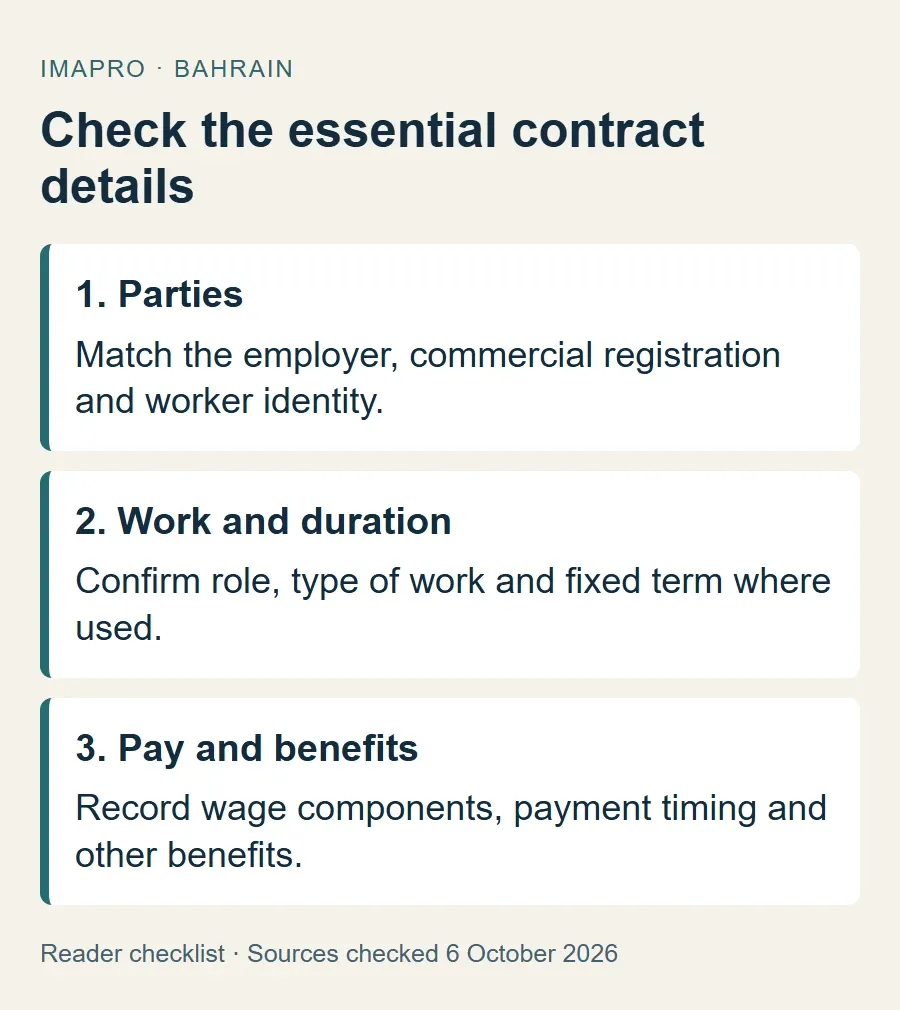
Article 20 lists the employer's name, workplace address and commercial-registration number. It also lists the worker's name, date of birth, qualifications, job or occupation, address, nationality and identification details. The nature and type of work must be stated, as must the duration if the agreement is for a fixed term. The agreed wage, payment method and payment timing belong in the agreement, together with other cash and non-cash benefits.
Start by confirming which legal entity employs you. A familiar brand name may differ from the company that signs the contract. If the offer names one business and the agreement names another, ask for an explanation and correction where needed. The question is particularly useful when a group operates several commercial registrations or when a recruitment intermediary handles paperwork. You want to know who owes the contractual obligations, not merely who conducted the interview.
Then check whether the role description matches the work you accepted. A useful description identifies the occupation and main responsibilities without pretending that every daily task can be listed. If travel, multiple locations or a particular reporting arrangement are material to your decision, ask for those points to be documented. Article 20 is the statutory minimum for material terms; additional clarity can prevent ordinary disagreements even where the extra detail is not itself a named statutory field. See Article 20.
Separate basic pay, allowances and conditional payments
A single advertised monthly figure may combine basic salary, fixed allowances, commission and benefits in kind. Ask the contract to show the components clearly. Article 1 distinguishes basic wage from the broader concept of wage, while Article 20 requires the agreed wage and cash and non-cash benefits. The distinction can matter when a later statutory calculation refers to particular components rather than the headline package.
For a commission arrangement, clarify the event that earns the commission, the calculation period, payment timing and treatment of cancellations or employment ending before payment. For accommodation or transport, identify whether the benefit is cash, employer-provided service or reimbursement. A discretionary bonus should not be confused with a fixed guaranteed allowance. These are questions to settle in the terms rather than assumptions to reconstruct from a recruitment conversation.
Check when salary is due and how it will be paid. Article 40 contains the wage-payment rules, including at least monthly payment for workers paid monthly. Its wording was amended in 2018, and Article 46 addresses the prescribed payment mechanism. A contract's payment clause should be read alongside those provisions. Do not rely on an old English copy stating that wages must simply be paid at the workplace; the current Arabic text has been amended. Use Articles 1, 20, 40 and 46 and the 2018 amendment.
Fixed-term, open-ended and task-based contracts
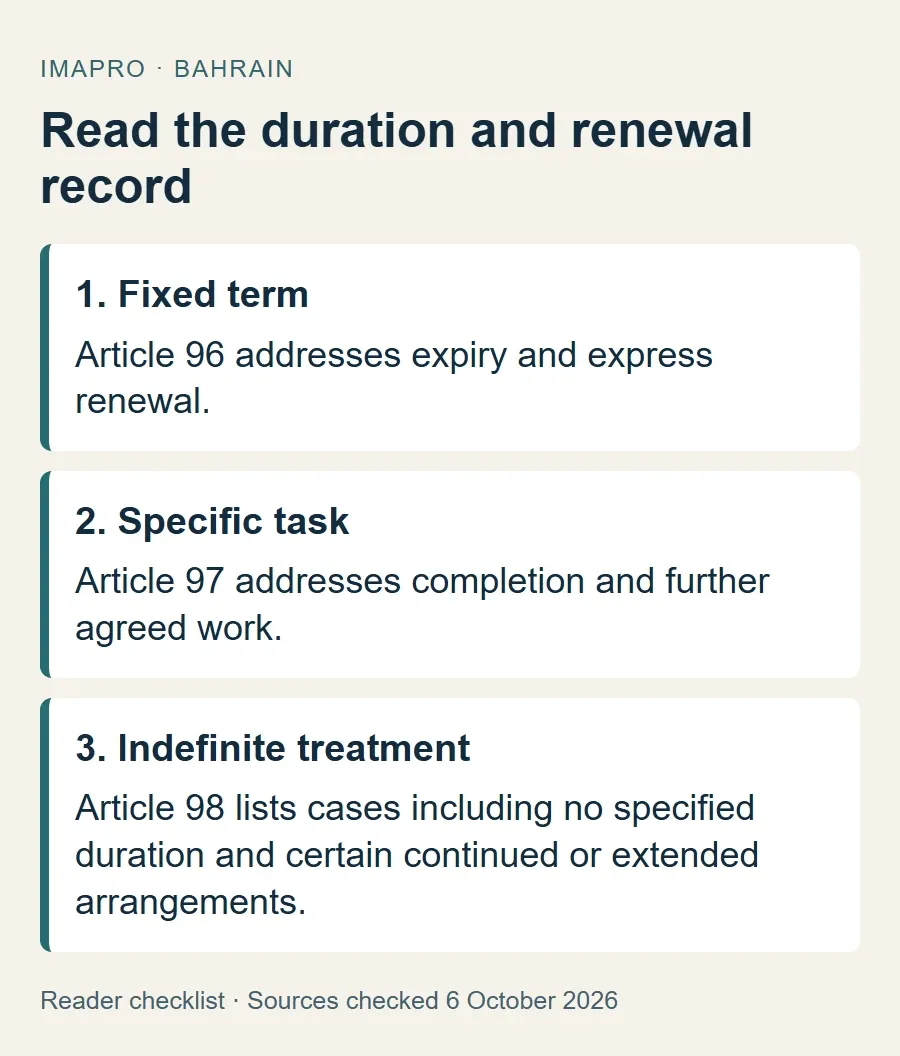
A fixed-term contract specifies a duration. Article 96 says it ends when that duration expires and may be renewed by express agreement. A contract for a particular task ends when that task is completed under Article 97 and may also be expressly renewed for further work. An agreement with no specified duration is one of the situations treated as indefinite under Article 98.
The label on the front page is not the whole analysis. Article 98 also identifies circumstances in which an agreement is treated as indefinite, including an original term longer than five years, original and renewed terms exceeding five years, and continuation after a fixed term expires without an express renewal agreement. Similar rules address work contracted for a specific task. Keep renewal letters and the record of work continuing after the stated end date; these facts may matter more than the original heading.
Before signing, ask how the employer records renewal and whom to contact before expiry. Avoid assuming that the date on a work permit is also the contractual end date. One concerns immigration and work authorisation; the other comes from the employment agreement and applicable law. If either changes, record the change separately. The governing contract provisions are Articles 96, 97 and 98.
How to read a probation clause
Article 21 requires probation to be expressly stated in the contract. The ordinary maximum is three months. A period of up to six months is allowed only for occupations designated by ministerial decision. The law does not give every employer a general choice between three and six months. If the agreement uses six months, ask which occupational rule supports it rather than accepting a standard-template explanation.
During a valid probation period, either party may end the agreement where continuation is unsuitable, with at least one day's notice. The same employer cannot place the worker on probation more than once. Keep the original start date and probation wording, particularly if an internal transfer or replacement contract introduces another probation clause. Whether a changed arrangement is permissible needs assessment against the actual employment relationship.
Probation is also separate from the qualifying period for a particular benefit. For example, Article 65 expresses the ordinary sick-leave threshold as three continuous months of service. Do not use an HR label such as probation pending to decide all other rights. This guide does not name six-month-eligible occupations because the specific occupational decision was not verified for that purpose. The reliable starting point is Article 21.
Policies, changed duties and better benefits
Check which documents the contract incorporates: working schedules, leave policy, expenses rules, confidentiality terms, disciplinary regulations and any benefits schedule. Article 19's attachment rule is relevant where internal regulations are referenced. Ask for the current complete versions and identify which terms are fixed contractual promises and which documents explain administrative procedures.
Article 4 invalidates conditions that reduce the worker's rights contrary to the law and preserves better benefits established by agreements, company rules or practice. A signature does not automatically make a below-minimum condition lawful. Equally, a better contractual benefit should not be dismissed merely because the statute offers less. A clear written entitlement is easier to discuss than a recollection that somebody promised a more generous arrangement.
Article 22 regulates departures from agreed terms and changes of work. It provides qualified exceptions, including temporary necessity to prevent an accident, address its consequences or respond to force majeure. It also permits work that is not materially different where rights are unaffected. This does not support a blanket claim that an employer can rewrite any role at will. If a significant change is proposed, request the revised duties, duration, location and pay treatment in writing and compare them with the original agreement. See Articles 4, 19 and 22.
A practical review before you sign
- Match the employer's legal identity and commercial-registration details across the offer and contract.
- Compare all language versions, dates, role descriptions and salary components.
- Confirm the duration, renewal terms and any expressly written probation clause.
- Read attached policies and benefit schedules rather than accepting missing annexes.
- Ask for material promises from recruitment discussions to be included in the written package.
- Obtain your complete signed copy and keep later amendments with it.
For unresolved points, send a short numbered request identifying the clause and the clarification needed. For example: the offer includes a transport allowance, but clause four lists only basic salary; please confirm the allowance and provide a matching revised agreement. This makes the question answerable without turning the discussion into a general dispute about trust. Keep the response with the agreement, and obtain a properly documented change where the term itself needs correction.
Employment contract questions
Do I lose my rights if I never received a written contract?
No. Article 19 allows the worker, in the absence of a written contract, to establish rights by all methods of evidence. Preserve the offer, salary records, messages, work schedules and other relevant material. This does not make missing paperwork good practice; request the written agreement and your copy.
Can the contract be only in English?
Article 19 requires Arabic and says a contract drawn up in another language must be accompanied by an Arabic version. Request the complete language set before signing and check for inconsistent terms.
Does signing waive the statutory minimum?
Article 4 invalidates conditions that undermine the law's prescribed rights, and Article 5 addresses unlawful settlements or releases during employment and within three months after it ends. A disputed clause or waiver still needs assessment on its actual wording and circumstances.
Do the same contract requirements cover domestic workers?
Article 2(b) expressly applies Articles 19, 20 and 21 to domestic workers, so the written-contract, essential-terms and probation provisions matter. However, many other ordinary private-sector provisions are excluded. Do not copy every company leave or working-hours rule into a domestic agreement as a statutory requirement.
Is an LMRA permit the employment contract?
No. Keep the employment agreement and work-authorisation documents together for reference, but check their separate purposes and dates. The LMRA transfer service illustrates how changing employers also involves a distinct permit procedure.
Which version of the law supports this guide?
The official Arabic consolidation and amendment register, checked on 6 October 2026. The official English reference is helpful for reading, but some wording in it does not reflect all amendments, so it was not treated as the controlling consolidation.