Bahrain finance guides
How to check a Bahrain gold quote: source, date, purity and total
By Gaurav Agarwal · Sources checked 6 October 2026
Identify the price source, observation time, currency, unit, purity and transaction side before comparing it with a Bahrain seller quote. This guide supplies no current rate and is not a live-price service.

Jump to a section
- 1. Identify the kind of price you are viewing
- 2. Read the source time and any publication delay
- 3. Match the unit, currency and purity
- 4. Compare written quotations on the same basis
- 5. Reconcile the retail total, tax and receipt
- 6. Handle missing or unverifiable prices
- Frequently asked questions about Bahrain gold quotations
To check a gold rate in Bahrain, first establish whether it is a market reference, a jeweller's selling rate or the complete price of an item. Then match the date, currency, weight unit and purity. A lower number is not necessarily a cheaper purchase when those details differ.
This guide supplies no current Bahrain retail gold rate. It explains how to check a quotation and reconcile it with a receipt. Sources were reviewed on 6 October 2026. That editorial review date is not a price timestamp.
1. Identify the kind of price you are viewing
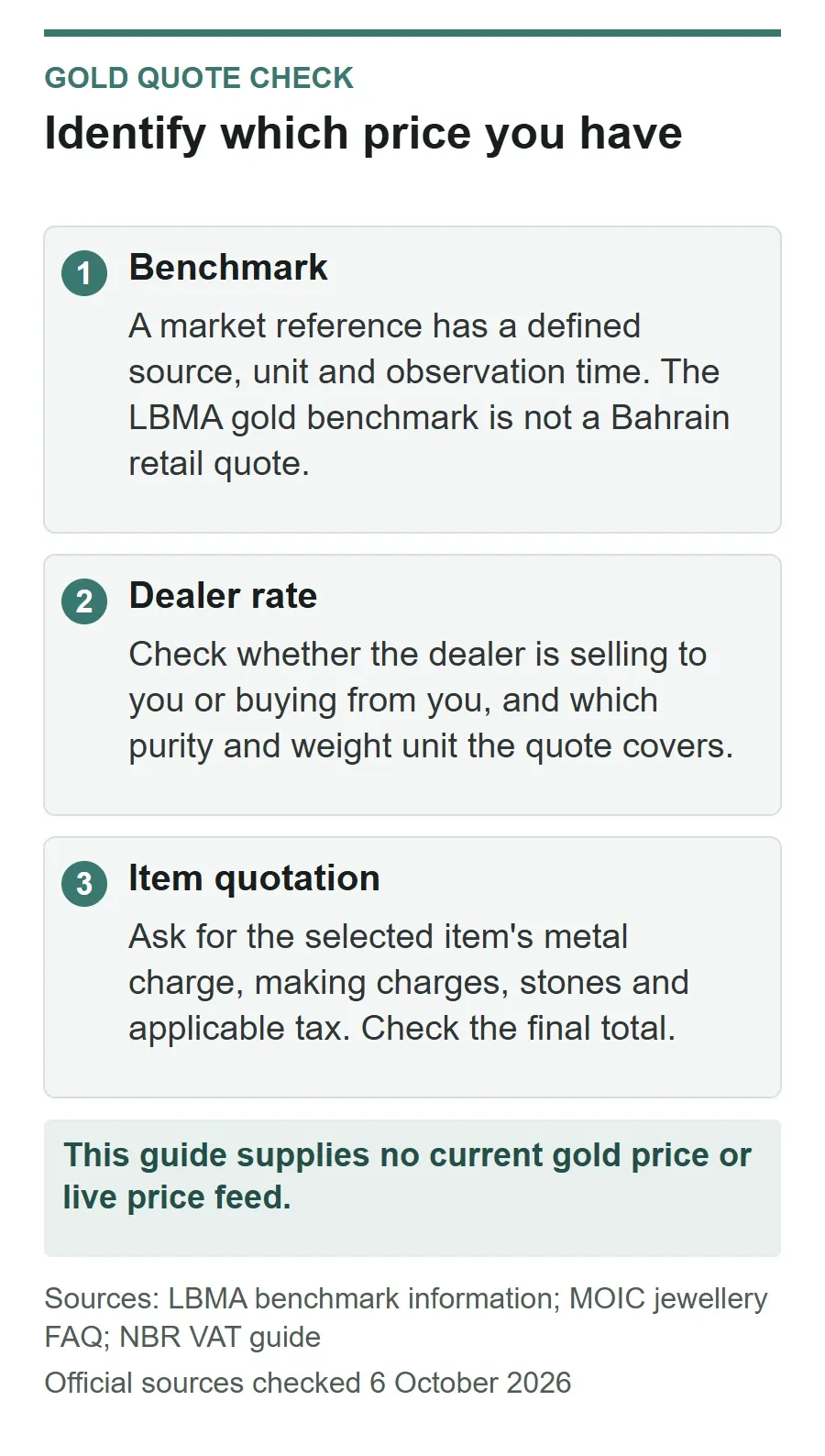
Ask what the provider is pricing before copying its number. These five descriptions answer different questions:
| Price description | What to establish |
|---|---|
| Gold benchmark | The benchmark name, market, currency, unit and observation time. |
| Converted market reference | The original gold source, exchange-rate source and conversion method. |
| Retail selling rate | The named seller, purity, weight basis and charges included. |
| Buyback quotation | The buyer's assessment, accepted weight, deductions and amount payable to you. |
| Finished jewellery price | The specific item, metal, stones, making charge and final tax-inclusive total. |
The LBMA benchmark explanation, checked on 6 October 2026, describes a price for gold delivered in London, expressed in US dollars per troy ounce. Changing its currency to BHD does not turn it into a Bahrain shop quotation.
A seller's own page can establish a narrower scope. For example, Malabar's Bahrain store page, reviewed on 6 October 2026, displays a retail-store rate table with Bahrain entries for 22kt and 24kt per gram and a dated update. It also says prices may vary by city. That is evidence of that seller's published table, not a universal Bahrain rate or a confirmed price for your item. No number from that table is reproduced here.
For an actual purchase, ask the shop to confirm which rate it will apply, when that quote expires and what remains to be added. For a sale, request a separate written buyback offer. Do not use a shop's selling rate as an assumption about what it will pay you.
2. Read the source time and any publication delay
A page reload, a new article date and a new market observation are separate events. Save the price's observation time, its timezone and the time you retrieved it. If the source gives only a calendar date, record that limitation rather than inventing an intraday time.
LBMA's public benchmark explanation says its displayed prices are delayed until midnight London time on the day they are set. Its gold-price FAQ distinguishes the AM and PM benchmarks. A delayed value remains delayed when you open the page again.
ICE Benchmark Administration's publication information, checked on 6 October 2026, gives expected gold auction starts of 10:30 and 15:00 London time. Final publication depends on the auction finishing, so those start times are not promises that a final price exists at that exact minute. ICE also lists non-publication days. Keep the source timezone instead of assuming a fixed difference from Bahrain throughout the year.
- Observation time: when the source says the price was determined.
- Retrieval time: when you obtained the record.
- Valid until: when the seller says its offer expires, if specified.
- Delay or status: live, delayed, historical, unavailable or unverified, using the provider's documented meaning.
If one shop's quote has expired before another arrives, ask for fresh comparable offers. An unchanged number on a page does not establish that the market or the seller's quotation has stayed unchanged.
3. Match the unit, currency and purity
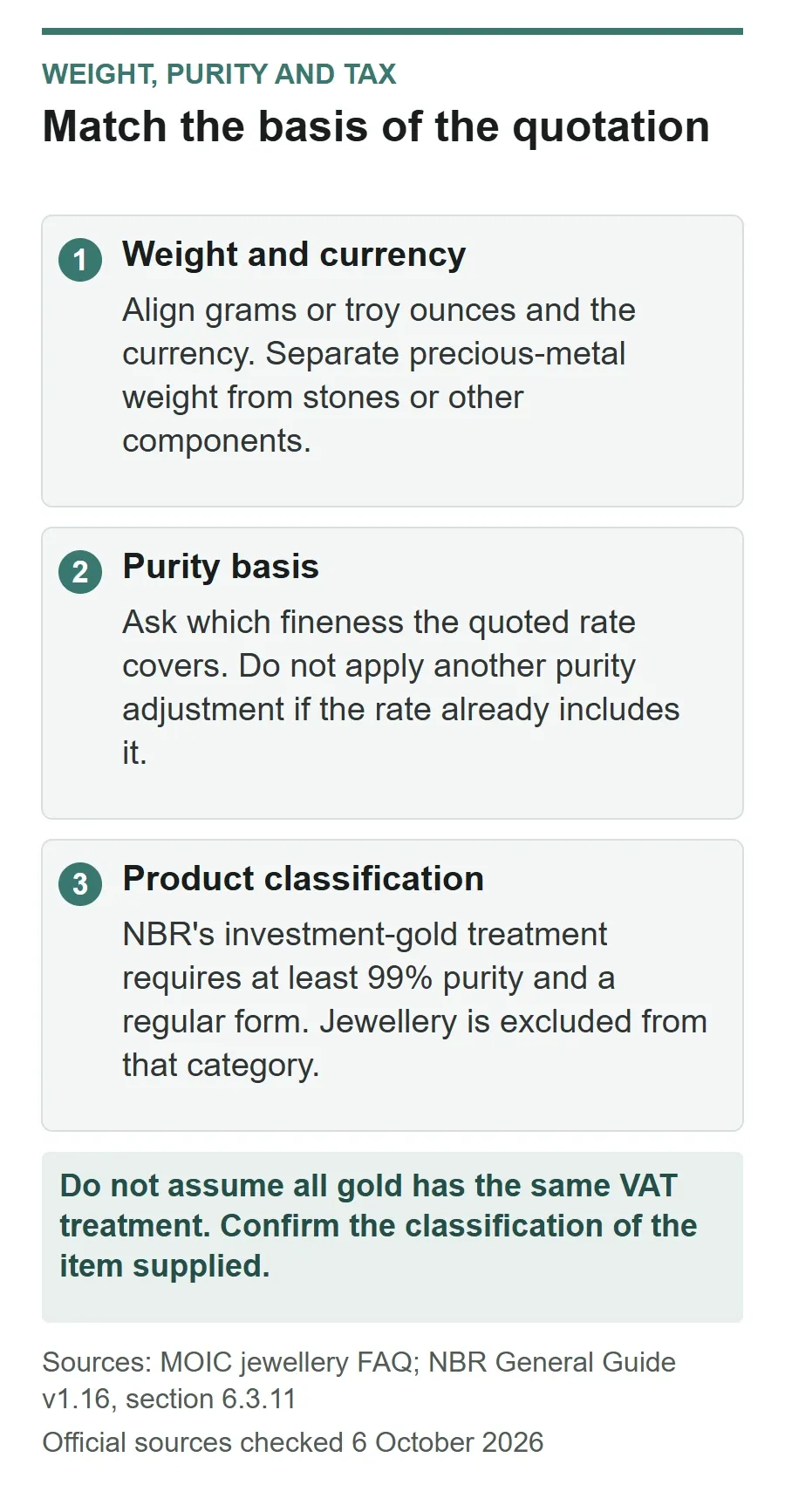
Keep the original quote before converting anything. Record whether the weight is a gram of a specified alloy, a fine-gold weight, a whole item including stones or another stated basis. A label such as “gold price” alone is insufficient for the calculation.
Convert a troy-ounce reference into a per-gram reference
NIST's precious-metals conversion chart, checked on 6 October 2026, gives 1 troy ounce = 31.1034768 grams. Use the troy unit specified by the gold source. NIST is cited for that measurement factor, not for Bahrain retail law.
If P is a verified USD price per troy ounce and X is a verified number of BHD per USD, the converted reference is:
BHD per gram on the source's gold basis = P × X ÷ 31.1034768
When the exchange rate is instead stated as USD per BHD, divide by that exchange rate before dividing by the gram factor. Write the units next to each input to catch an inverted conversion. No current gold price or exchange rate is supplied by this formula.
The Central Bank of Bahrain's exchange-rate table, checked on 6 October 2026, labels its rates indicative. Record the currency direction and source date if using a reference from it. A currency conversion establishes a comparable reference; it does not establish a jeweller's rate, a payment-card conversion cost or an offer to transact.
Do not adjust for purity twice
If a seller already quotes per gram for your item's stated purity, multiplying the price by another purity fraction changes its basis. First ask how the seller calculated the rate. Likewise, do not multiply a metal-only per-gram rate by the gross weight of an item containing stones without confirming the weight being charged.
Keep the item's stated fineness, hallmark and receipt together. This guide deliberately does not provide a Bahrain legal karat conversion table: the official FAQ versions reviewed contain inconsistent purity descriptions. Ask the seller and the Ministry of Industry and Commerce to resolve a discrepancy affecting the item rather than selecting whichever online percentage produces the preferred result.
4. Compare written quotations on the same basis
Use this worksheet for two offers for the same specification. “Not supplied” is a useful answer because it identifies what still needs to be confirmed. Leave a field blank until you have the seller's answer.
| Record for each seller | Quote A | Quote B |
|---|---|---|
| Seller, item reference and written quote | To obtain | To obtain |
| Observation date, time, timezone and expiry | To confirm | To confirm |
| Purity and metal weight used for charging | To confirm | To confirm |
| Rate, currency, unit and price basis | To confirm | To confirm |
| Metal amount, making charge and other charges | To obtain | To obtain |
| Stones or other materials priced separately | To obtain | To obtain |
| VAT treatment and final amount payable | To confirm | To confirm |
| Return, exchange and buyback terms | To obtain | To obtain |
Compare the final payable totals only after resolving the weight, purity and inclusion differences. A lower metal rate can coexist with a higher finished price. A making-charge discount can apply to a component rather than the whole purchase. Ask the seller to show the amount before and after the discount and what the discount covers.
For a buyback offer, record the assessed metal weight, rate applied, each deduction and the net payout. Ask whether stones are returned, valued or excluded. These are questions to establish the contract; this guide supplies no standard deduction, guaranteed resale value or universal making charge.
The World Gold Council's Retail Gold Investment Principles, checked on 6 October 2026, call for transparency about prices, key terms and material product information. They are industry best practices, not Bahrain legislation or proof that a particular seller complies. Their practical use here is a reason to seek clear written terms before comparing offers.
5. Reconcile the retail total, tax and receipt
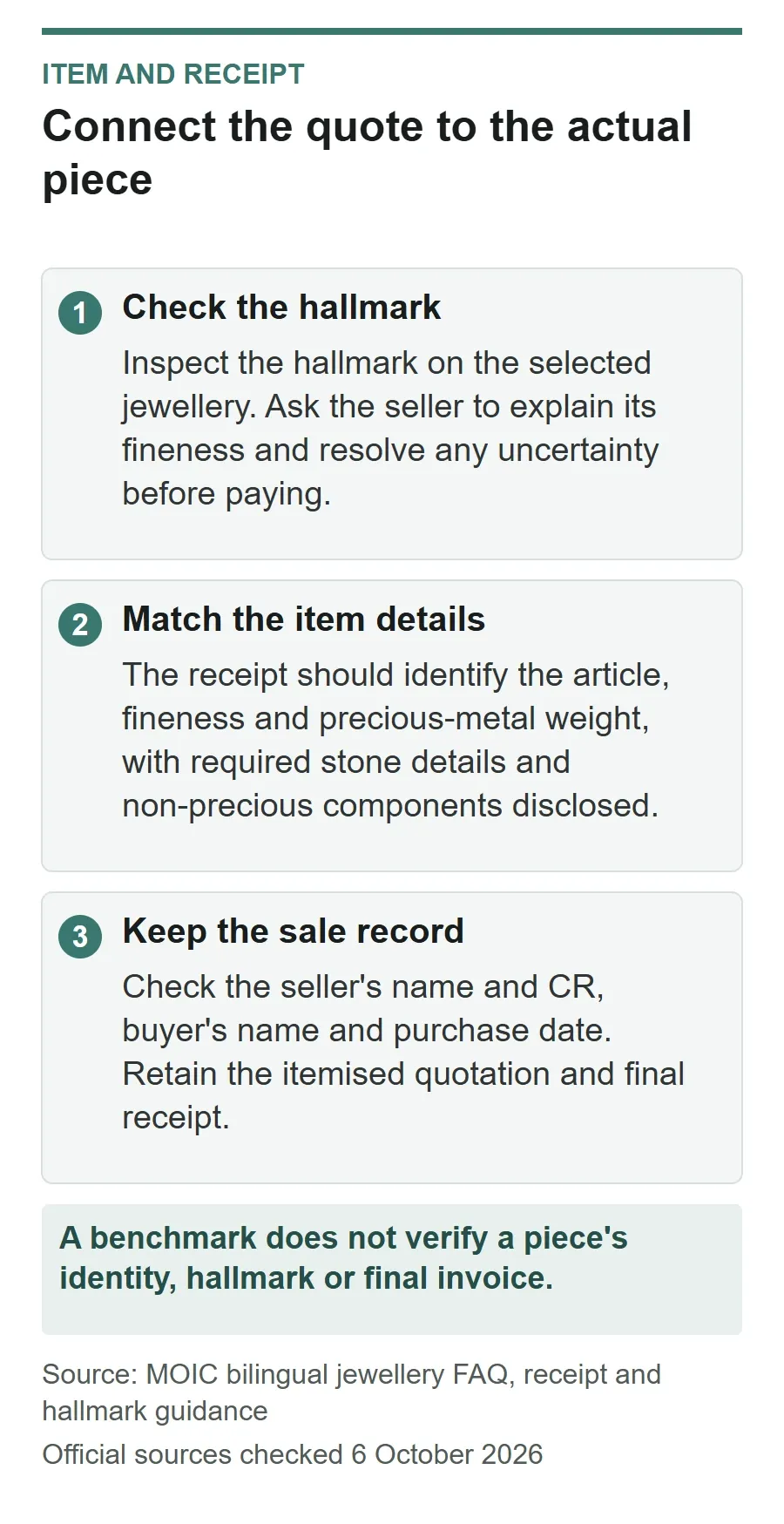
Follow the seller's actual calculation
Start with the metal amount calculated on the agreed weight and rate. Identify the making charge, stones and any other separately quoted costs. Apply the documented discount and confirm the VAT treatment. Then reconcile the final payable total. Do not add a component twice merely because it appears both in a per-gram rate and as an explanatory invoice line.
The NBR Retail and Wholesale Guide, version 1.3, updated 20 September 2026 and checked 6 October 2026, says prices displayed in Bahrain's local retail market must include VAT. Its scope includes shop and online retail displays; it identifies an exception for export prices clearly stated as VAT-exclusive. Ask whether you are looking at an item price or a market reference before treating a displayed number as the amount payable.
Do not assume every gold item has the same VAT treatment
The NBR General Guide, version 1.16, updated 20 September 2026 and checked 6 October 2026, section 6.3.11, describes zero-rated investment-grade gold as at least 99% pure and in a regular form or shape, such as regular bars or metal coins. It excludes irregular forms such as jewellery from that investment-gold category. A high-purity description alone therefore does not settle a jewellery purchase's VAT treatment.
For a supply confirmed to be standard-rated at 10%, NBR's retail guide gives VAT within an inclusive price as total ÷ 11, and the amount before VAT as total ÷ 1.1. These formulae do not decide the classification. Do not apply them automatically to zero-rated items or a mixed invoice. Ask the seller to identify the treatment of the actual supply.
Use the receipt to verify the price basis
The MOIC jewellery FAQ, checked on 6 October 2026, requires fineness and precious-metal weight on the receipt, with diamond weight and purity stated separately from the metal. It also requires disclosure and receipt documentation of non-precious materials included in jewellery. These details let you check whether a quoted metal rate was applied to the correct weight and product.
For the full hallmark, receipt and purchase checklist, use the guide to buying gold in Bahrain. Keep the quotation and receipt together: a rate screenshot alone cannot explain the final item price.
6. Handle missing or unverifiable prices
If a page provides no named price source, unit or observation time, save it as an unverified reference. Ask the provider for the missing information or obtain a current written seller quote. Do not fill a missing day with yesterday's number and relabel it today.
If two sources disagree, first test whether they refer to the same currency, purity, unit, time and transaction side. Next check whether making charges and tax are included. Only after those differences are resolved does the remaining price difference become meaningful.
For a current Bahrain retail quote, open the seller’s official page or contact its branch, then confirm the date, city, purity and charges for your item. For the London benchmark, use the linked LBMA and ICE sources and read their publication-delay information. This guide explains how to interpret those sources; it does not display a current gold price.
Frequently asked questions about Bahrain gold quotations
What is today's gold rate in Bahrain?
This page does not provide a verified current rate. Obtain a timestamped quote from the seller you intend to use, specifying purity, weight unit and whether it is a buying or selling price. A market-reference number cannot confirm the price of a particular item.
Why do two Bahrain gold websites show different prices?
They may use different sources, observation times, purity assumptions or quote types. Check those fields before comparing the values. A currency-converted benchmark and a shop's own selling rate answer different questions.
Does a per-gram rate include making charges?
The label alone cannot tell you. Ask the seller whether the quoted rate includes making charges, stones and any other costs, and obtain the final amount payable for the item. There is no universal making-charge figure supplied by this guide.
Is all 24K gold zero-rated for VAT?
No. The NBR investment-gold test described above includes the form of the gold as well as purity. Jewellery is excluded from that category. Have the seller confirm the classification of the actual supply rather than relying on a karat label alone.
Can I multiply an ounce price by my jewellery's weight?
First match the units. The NIST factor above converts troy ounces to grams. Then establish whether the rate and weight use the same purity and metal basis. A finished item's gross weight can include components outside that gold-price calculation.
Will a shop buy my gold at its advertised selling rate?
Do not assume so. Request the shop's buying quotation, assessed weight and any deductions, then compare the net payout. Keep this separate from the price for buying a replacement item.
Does “updated just now” prove the quote is live?
No. Check what the update refers to. It can describe a page refresh rather than a new market observation. Record the provider's observation time and stated delay, and seek confirmation if either is missing.
What should I keep after buying jewellery?
Keep the itemised receipt, written quotation and product documentation together. The buying guide's receipt checklist covers the detailed purchase checks. For interpreting the rate, retain the source, observation time, purity and weight basis used in the calculation.