Bahrain employment and education guides
Kindergarten in Bahrain: Ages, Admissions, Fees and Visits
By Gaurav Agarwal · Sources checked 6 October 2026
The Ministry of Education describes kindergarten as serving children from age three to under six. Start with its institution finder, then confirm the provider’s class placement, intake cutoff, daily care, admissions requirements and complete cost. School labels such as Nursery, Reception and KG1 are not a universal age conversion.

Jump to a section
- Kindergarten age and school class names
- Find institutions through the Ministry, then confirm the details
- What to look for during a visit
- Discuss settling-in and support before accepting a place
- Admissions and document requirements vary
- Compare fees for the same year and actual class
- Match the timetable to the family's day
- Make the final comparison with written answers
- Kindergarten in Bahrain: common questions
To choose a kindergarten in Bahrain, start with the Ministry of Education's institution finder, confirm the setting's identity and age group, and then compare the actual day your child will experience. The Ministry's early-childhood FAQ describes kindergarten as serving children from age three to under six, while nursery covers birth to under three. Individual international schools may use different class names, so a label such as Nursery, Reception or KG1 does not establish the same placement everywhere.
This guide was checked on 6 October 2026 using Ministry pages and schools' own admissions and 2026/27 fee information. It is a practical selection guide, not a ranking or a promise of an available place. The goal is to leave each visit with comparable answers about age placement, care, learning, hours and the full cost.
Kindergarten age and school class names
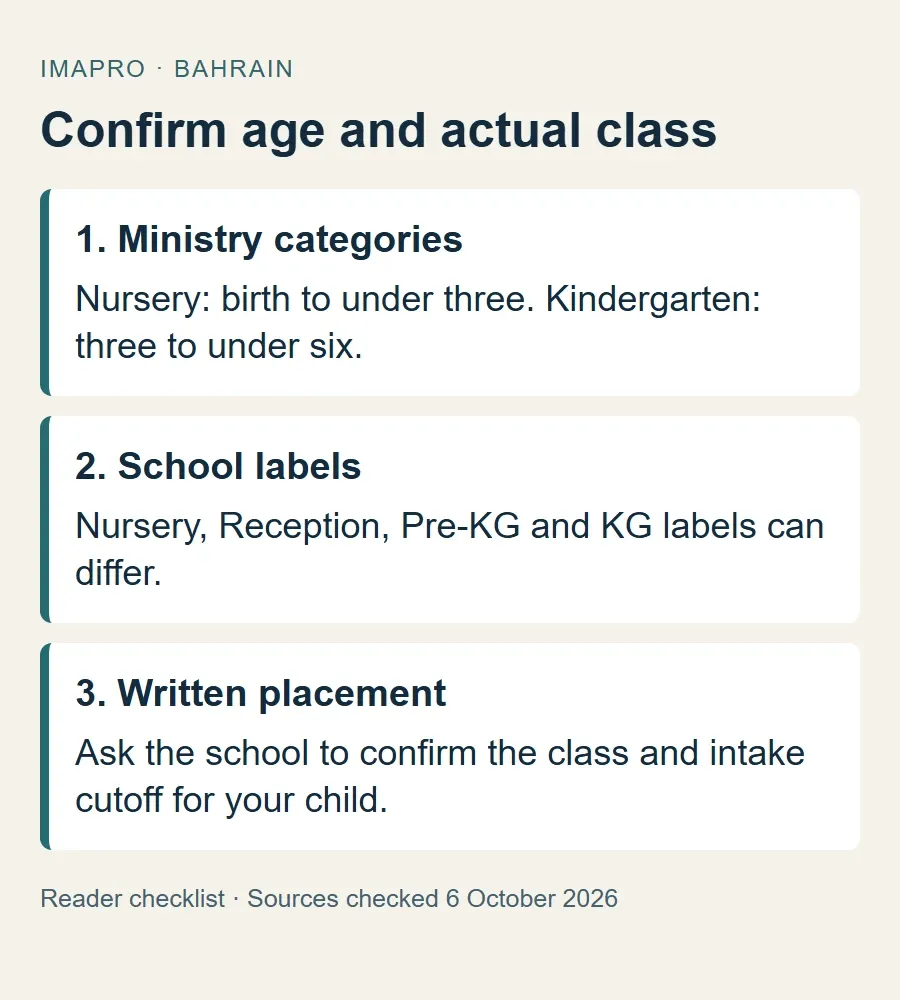
The Ministry of Education's early-childhood FAQ distinguishes nursery, from birth to under three, from kindergarten, from three to under six. It also identifies six as the compulsory education age. This helps you understand the Ministry's categories, but it does not replace the receiving institution's specific class-placement decision.
School terminology can differ. The British School of Bahrain's 2026/27 schedule labels Nursery for ages three to four and Reception for four to five. The American School of Bahrain's placement guide uses Pre-KG, KG1 and KG2, with its own age and equivalency descriptions. These examples show why class names should not be treated as a national conversion chart.
Send the admissions team your child's date of birth, proposed joining date and previous early-years experience. Ask it to confirm the exact class and the date used to calculate age for that intake. If a child is close to a cutoff, request the answer in writing before paying an application fee. Do not move a child into a different label simply because it sounds more advanced. A reliable comparison begins with the class the school will actually offer.
Find institutions through the Ministry, then confirm the details
The Ministry's Educational Institution Finder separates categories including private schools, nurseries and kindergartens, with location and contact information. Use it to build a geographically realistic shortlist and match the institution's name and address to the place you plan to visit. A similarly named branch or a social-media account is not enough to establish that you are dealing with the same setting.
Ask the institution to identify its licensed operation and the age group it is authorised to serve. If a directory record, website and address disagree, resolve the mismatch with the institution or Ministry before committing. The finder is a starting point for discovery, not a guarantee of a current vacancy or a personalised recommendation for your child.
For school-based early years, the Ministry's Private Education page explains its licensing, supervision and related functions. Keep regulatory identity separate from educational fit: a legitimate institution still needs to answer your family's questions about classroom routines, communication, support and costs.
What to look for during a visit
Ask to understand a normal day, not just see the facilities. Request a timetable showing arrival, play, group activities, meals, outdoor time, rest where offered and collection. Then ask how that timetable changes for a child who is settling in, tired or upset. A room full of equipment tells you less than an explanation of how teachers help children use it and how adults respond when a child needs attention.
Observe communication. Ask how staff help children who are new to the teaching language and how parents are told about progress or concerns. If your child uses another language at home, explain that clearly and ask what support is available. Do not assume that a bilingual label tells you how many hours are spent in each language, which language is used for instructions, or how a new child is supported.
Ask practical care questions: who helps with toileting, how allergies are recorded, how medication requests are handled, what happens if a child becomes unwell and who can collect the child. Request the relevant policies rather than relying on a tour conversation alone. These are comparison questions, not a claim that every setting follows an identical method or that this guide has inspected each provider.
Discuss settling-in and support before accepting a place
Explain your child's current routines and any support needs that could affect the school day. Ask how the setting handles separation at drop-off, whether it offers a phased start, and what parents should do if settling takes longer than expected. A useful answer identifies a named contact, the process for reviewing progress and the circumstances in which the arrangement may change.
Where your child already has a professional report or support plan, ask who will review it, what support can actually be provided and whether there are extra charges. Avoid accepting a general statement that all needs are supported without discussing the specific assistance required. Equally, do not assume an admissions assessment is a medical or developmental diagnosis. It is part of the provider's placement process.
For example, American School of Bahrain's admissions checklist asks for relevant learning-support reports where applicable. Sharing relevant information through the school's designated process helps it assess what it can offer. Keep any agreed arrangements with the written offer so the admissions conversation and the classroom plan do not diverge after the child starts.
Admissions and document requirements vary
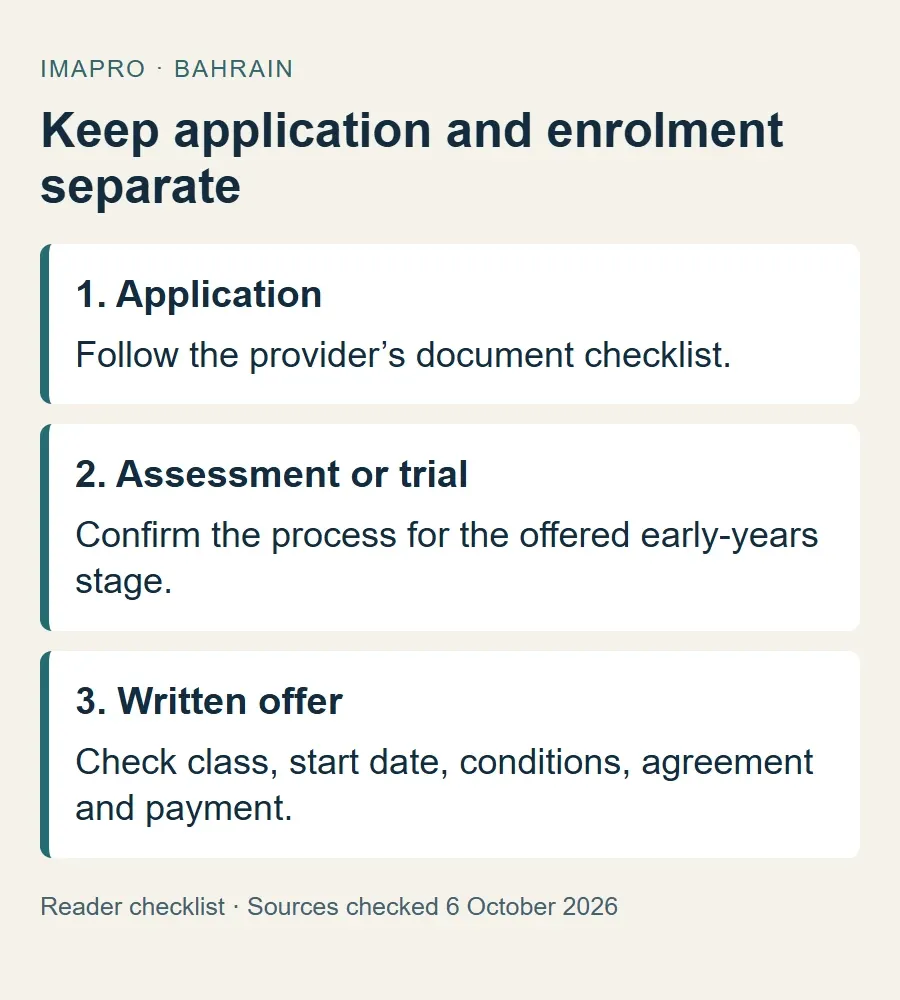
Expect an institution-specific checklist. Identity documents, a birth certificate, immunisation information, photographs and previous reports may be requested, but the timing and relevance differ by child and provider. Ask which documents are needed to submit an application and which must be supplied before enrolment is final. A family moving to Bahrain should be particularly clear about documents still being issued.
The British School of Bahrain admissions page lists child and parent identity documents, immunisation information, a photograph and relevant schooling records. It says CPR cards may be supplied if available at application. Its infant assessment examines readiness for school, including language, social skills and behaviour. Final enrolment requires the stated documentation, agreement and fees.
By comparison, American School of Bahrain describes a trial class for applicants from Pre-KG to Grade 2 and separates the online application checklist from documents needed after assessment. Some unavailable documents can be accompanied by an explanation under its published instructions. Neither example establishes that every Bahrain kindergarten has the same flexibility or assessment format.
Ask how the institution handles a child who has never attended school and therefore has no previous school report. Do not create a document merely to fill an upload field. Explain the situation to admissions and follow its instructions. An application acknowledgement is also different from an offer: confirm the class, start date and any conditions before treating a place as secured.
Compare fees for the same year and actual class
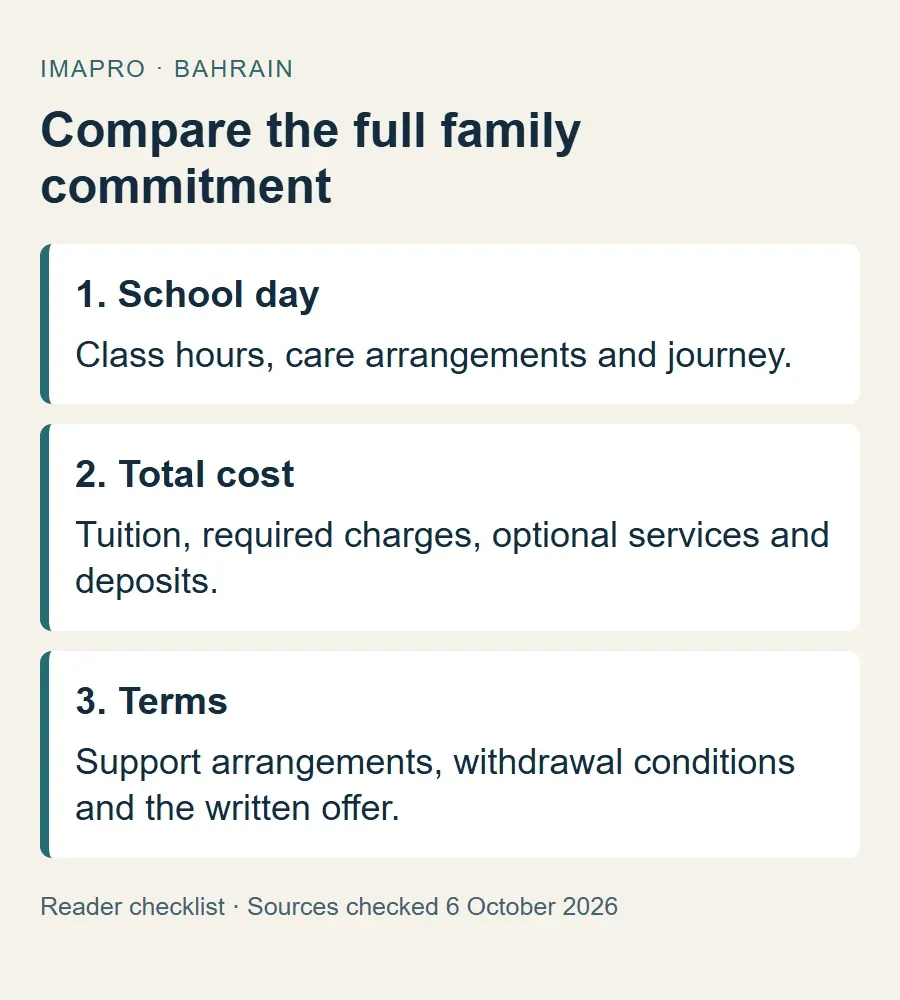
Annual tuition is only one part of the cost. Ask for a written schedule showing application and registration charges, deposits, transport, meals, uniform, materials and any extended-day or support charges relevant to your child. Identify which amounts are refundable and which are credited against later fees. Otherwise, you may count the same deposit twice or mistake a non-refundable application charge for a guaranteed place.
The following are examples from schools' explicitly labelled 2026/27 schedules, checked on 6 October 2026. They are not equivalent-age recommendations or a complete market price range.
| Institution and published class | Annual tuition in BHD | Source year |
|---|---|---|
| British School of Bahrain, Nursery | 3,342 | 2026/27 |
| British School of Bahrain, Reception | 4,419 | 2026/27 |
| American School of Bahrain, KG1 | 4,844 | 2026/27 |
| American School of Bahrain, KG2 | 4,936 | 2026/27 |
Sources: British School of Bahrain fees and American School of Bahrain fees. Confirm the offered class before using a row in your budget.
BSB separately lists an application charge, class-dependent registration and a refundable book deposit. ASB says its BHD 75 application payment is credited against its BHD 300 registration charge, leaving BHD 225 at acceptance, rather than adding BHD 300 again. ASB also lists tuition exclusions such as transport, meals and uniform. Obtain the personalised amount due and payment dates from the school before paying.
Read withdrawal and refund conditions even if you expect to stay. A family relocation, delayed arrival or change of school can affect the amount owed. Ask how notice must be given and what happens if a place is accepted but the child does not start. Do not rely on an old fee screenshot when a current schedule or signed agreement provides the applicable terms.
Match the timetable to the family's day
Check the actual start and collection times for the offered class, not the general school opening hours. Ask whether early drop-off or later collection is available, who supervises it and whether it costs extra. A shorter early-years day may work well for a child but require a separate care arrangement for a working parent. Compare that arrangement before deciding that one tuition figure is cheaper overall.
Try the journey at the relevant time of day. Identify the collection point, authorised-pickup procedure and what happens if you are delayed. If you need transport, confirm that the route serves your address and accepts children in the offered age group. Ask about the actual pickup and return times rather than treating a bus-service logo as evidence that your route is available.
Also request the academic calendar, closure dates and communication process for schedule changes. A programme running during a holiday may be separate from normal tuition and may not be provided by the same team. Keep the regular school day, optional activities and holiday care as separate items in your comparison.
Make the final comparison with written answers
For each shortlisted institution, record the confirmed class, age cutoff, start date, available place or waiting-list position, daily hours, full first-year charges and support arrangements. Add your observations from the visit and any questions that remain unanswered. A side-by-side record helps you compare the same issues instead of remembering only the newest tour.
Before paying, obtain the offer conditions and parent agreement. Check the names, class, dates and amounts, and ask for correction of any mismatch. If an important promise was made during a call, request that it be confirmed in writing. Pay only through the institution's verified payment process and retain the receipt and allocation to your child's application.
The best choice is the setting that can explain and deliver an appropriate day for your child within your family's practical constraints. A larger campus or higher fee does not resolve that question on its own. Your final decision should rest on verified placement, observed routines, clear communication and an affordable complete agreement.
Kindergarten in Bahrain: common questions
At what age does kindergarten start?
The Ministry's early-childhood FAQ describes kindergarten as age three to under six. Confirm the institution's exact class and intake cutoff using your child's date of birth; international-school labels are not a universal age conversion.
Is Nursery always for children under three?
That is the Ministry FAQ's nursery category, but an international school may use Nursery as a class name for an older early-years group. Check the actual published ages and placement decision rather than relying on the label.
Can I apply before receiving the child's CPR?
Some schools' published application instructions allow an explanation or say the CPR may be supplied if available. This is provider-specific. Ask what can be submitted initially and what must be completed before enrolment.
Is an application fee proof that a place is reserved?
No. Read the provider's acceptance and reservation process. Keep the written offer and confirm which payment secures the place, what conditions remain and whether the payment is refundable.
Where should I start a shortlist?
Use the Ministry institution finder, then confirm the institution, visit it and obtain current admissions and fee information. This guide's source check was completed on 6 October 2026; availability must be confirmed directly.