Bahrain employment and education guides
University of Bahrain Fees: Credit Hours, Student Categories and Budgeting
By Gaurav Agarwal · Sources checked 6 October 2026
UOB lists BHD 80 per credit hour for non-Bahraini undergraduates, with category exceptions to check. Bahraini and equivalent students have supported rates tied to study duration. Multiply your registered hours by the applicable rate, then add relevant charges.

Jump to a section
- Identify your fee category before calculating a semester
- Calculate tuition from credit hours, not the number of course names
- Understand how the supported rate changes with study duration
- Use programme totals as a baseline, not your final invoice
- Add admission and relevant service charges without double counting
- Ask about fee exemption through the university's official process
- Check the bill against your admission and registration record
- Frequently asked questions
University of Bahrain tuition is calculated by credit hour, with the rate depending on the programme and student category. For a non-Bahraini undergraduate student outside an applicable supported category, the published rate is BHD 80 per credit hour. The BHD 8 undergraduate rate applies to Bahraini and equivalent students within the supported period; it is not a universal price for everyone studying at UOB.
This guide explains the official UOB studying-fees page checked on 6 October 2026. The page shows a September 2026 update even though its URL includes 2025. Use the published figures to prepare a budget, then confirm your category, registered hours and actual bill with the university.
Identify your fee category before calculating a semester
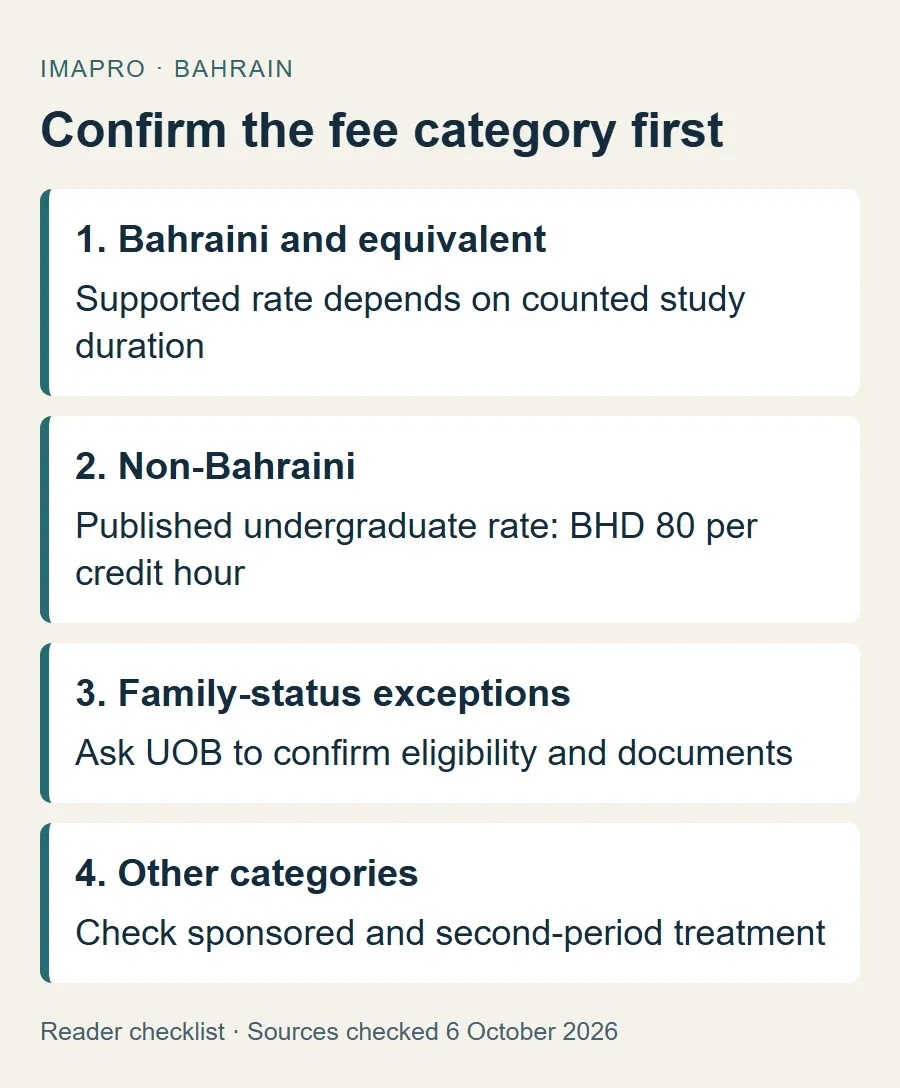
Begin with the category recorded by UOB, not an assumption based on the school you attended or the length of time you have lived in Bahrain. The fee page separates Bahraini and equivalent students from non-Bahraini students and also lists sponsored and second-period categories. Your nationality alone may not settle the classification because the page describes family-status support exceptions.
| Published category | Fee basis | What to confirm |
|---|---|---|
| Bahraini and equivalent undergraduate students | BHD 8 per credit hour during the supported period | Eligibility, programme duration and semesters already counted |
| Non-Bahraini undergraduate students | BHD 80 per credit hour | Whether a stated family-status exception changes the classification |
| Second-period undergraduate study | BHD 80 per credit hour in the published fee-description table | Whether the offered programme is in this category |
| Sponsored undergraduate study | BHD 80 per credit hour in the published fee-description table | What the sponsor pays and which charges remain yours |
The page's support note identifies children of a Bahraini mother and uses the wording Bahraini wife. If your family circumstances may qualify, ask Admissions and Registration to confirm the applicable definition and the supporting evidence required. Do not extend a short website label into a promise that every spouse or child receives a particular rate.
Keep the classification response with your admission documents. If the amount in the student system looks inconsistent with it, raise the difference before relying on your own spreadsheet. A budget built at BHD 8 when the actual category is BHD 80 would understate tuition by a factor of ten.
Calculate tuition from credit hours, not the number of course names
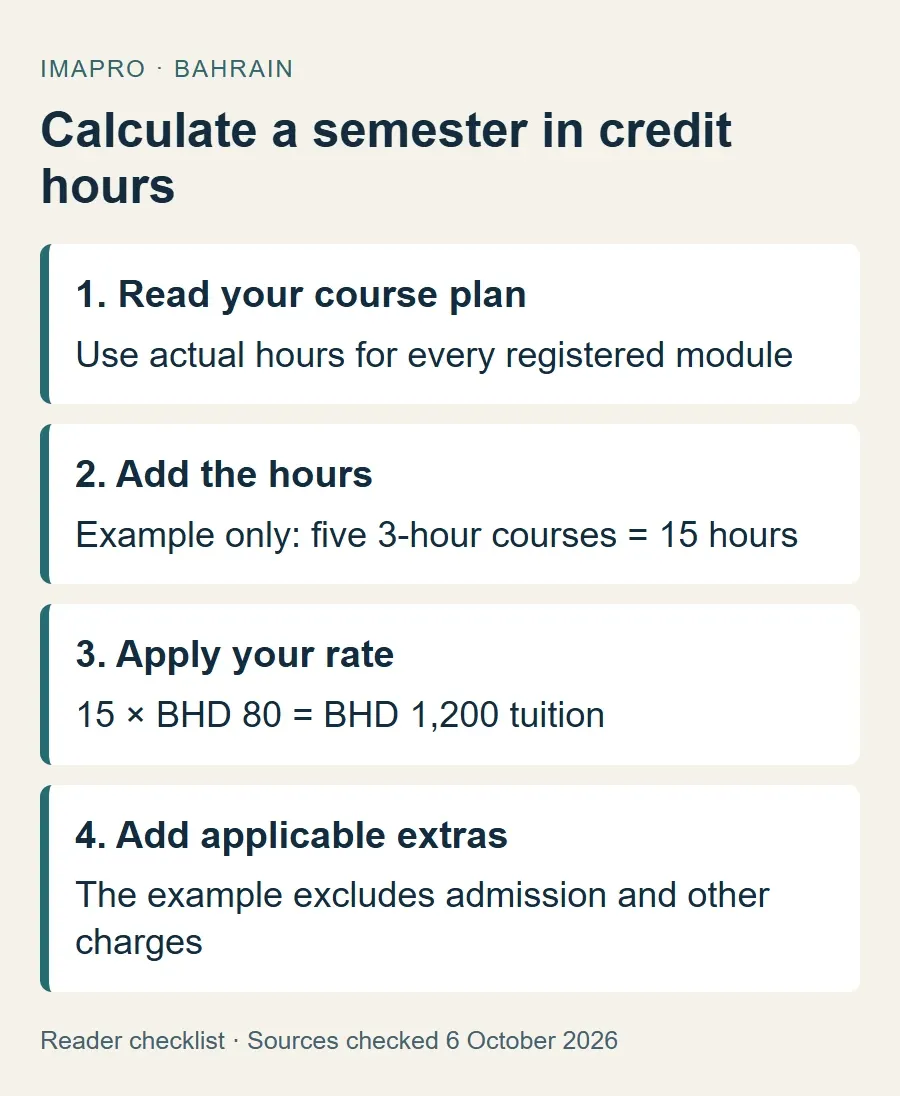
The basic calculation is straightforward: registered credit hours × applicable rate per credit hour. A course title is not itself a fee unit. Read the hours for each module in the approved registration plan, add them and apply the correct rate. UOB explains that many courses carry three hours, but that does not mean every course in your programme does.
| Illustrative registered load | At BHD 8 per hour | At BHD 80 per hour |
|---|---|---|
| One three-hour course | BHD 24 tuition | BHD 240 tuition |
| 12 credit hours | BHD 96 tuition | BHD 960 tuition |
| 15 credit hours | BHD 120 tuition | BHD 1,200 tuition |
| 18 credit hours | BHD 144 tuition | BHD 1,440 tuition |
These are arithmetic illustrations, not a recommendation or approval to register for a particular load. They exclude admission charges and other applicable costs. Your department's progression rules, prerequisites and permitted load determine which registration plan is possible. Choosing an affordable number of hours does not guarantee that the required modules are available in that combination.
For example, if a non-Bahraini undergraduate registers five three-hour modules, the tuition calculation is 5 × 3 × BHD 80 = BHD 1,200. If one module has a different credit value, replace the assumed 15 hours with the actual total. Check the registration record again after any change so that your budget follows what you are enrolled in.
Understand how the supported rate changes with study duration
For Bahraini and equivalent students, the published duration table is important when planning beyond the standard programme period. It shows the following sequence for associate diplomas and bachelor's degrees. Ask UOB which counted semester applies to your record, especially if your study has included a programme change, interruption or other unusual circumstances.
| Associate diploma | Bachelor's degree | Published rate per credit hour |
|---|---|---|
| Up to semester 4 | Up to semester 8 | BHD 8 |
| Semester 5 | Semester 9 | BHD 8, continued support |
| Semester 6 | Semester 10 | BHD 40, partial support |
| Semesters 7 to 8 | Semesters 11 to 14 | BHD 80, without support |
The same page states that summer semesters and the orientation programme are not counted toward the maximum limit. That statement should not be converted into an assumption that every other event pauses the subsidy clock. Ask the university to explain the counted duration for your student record rather than counting calendar years yourself.
A useful planning question is: which compulsory courses remain, in what order can I complete them, and which rate will apply when I take them? This joins the academic plan to the financial plan. Reducing today's load may lower the immediate payment while moving remaining hours into a later, more expensive period.
For illustration, 12 hours at BHD 40 would cost BHD 480 in tuition; 12 hours at BHD 80 would cost BHD 960. These examples show why timing matters, but they do not establish your personal eligibility or duration. Use an adviser-approved course sequence and a university-confirmed fee category before comparing routes.
Use programme totals as a baseline, not your final invoice
UOB's fee page includes programme credit totals and tuition illustrations. For example, it lists 128 hours for several business bachelor's programmes. At the published non-Bahraini rate, 128 × BHD 80 is BHD 10,240 in tuition. A 130-hour programme would produce BHD 10,400 at the same rate. These calculations explain the fee basis; they are not all-inclusive personal quotations.
Start your own completion estimate with the exact programme and the version of the study plan assigned to you. Then identify credits already accepted, courses still required and any study before or outside the degree plan. Ask how a repeated module would be billed and how a change of programme would affect the remaining requirements.
Keep three amounts separate: tuition already paid, tuition for your current registration and estimated tuition still to come. This prevents a common mistake when transferring or changing majors: treating completed study as though it automatically replaces every required module in the new programme.
The fee page says non-Bahraini tuition remains fixed throughout the study period. Retain that statement with the dated schedule and confirm its application to your admission category and offer. It does not turn a tuition illustration into a guarantee about all non-tuition expenses, personal living costs or an unchanged number of modules.
Add admission and relevant service charges without double counting
The reviewed schedule lists an admission fee of BHD 10. Its general-fee table also includes service charges such as a transcript fee and replacement-card fees. These are different from tuition, and many arise only if you request a service or need a replacement. Do not add every item in the schedule to every student's annual budget.
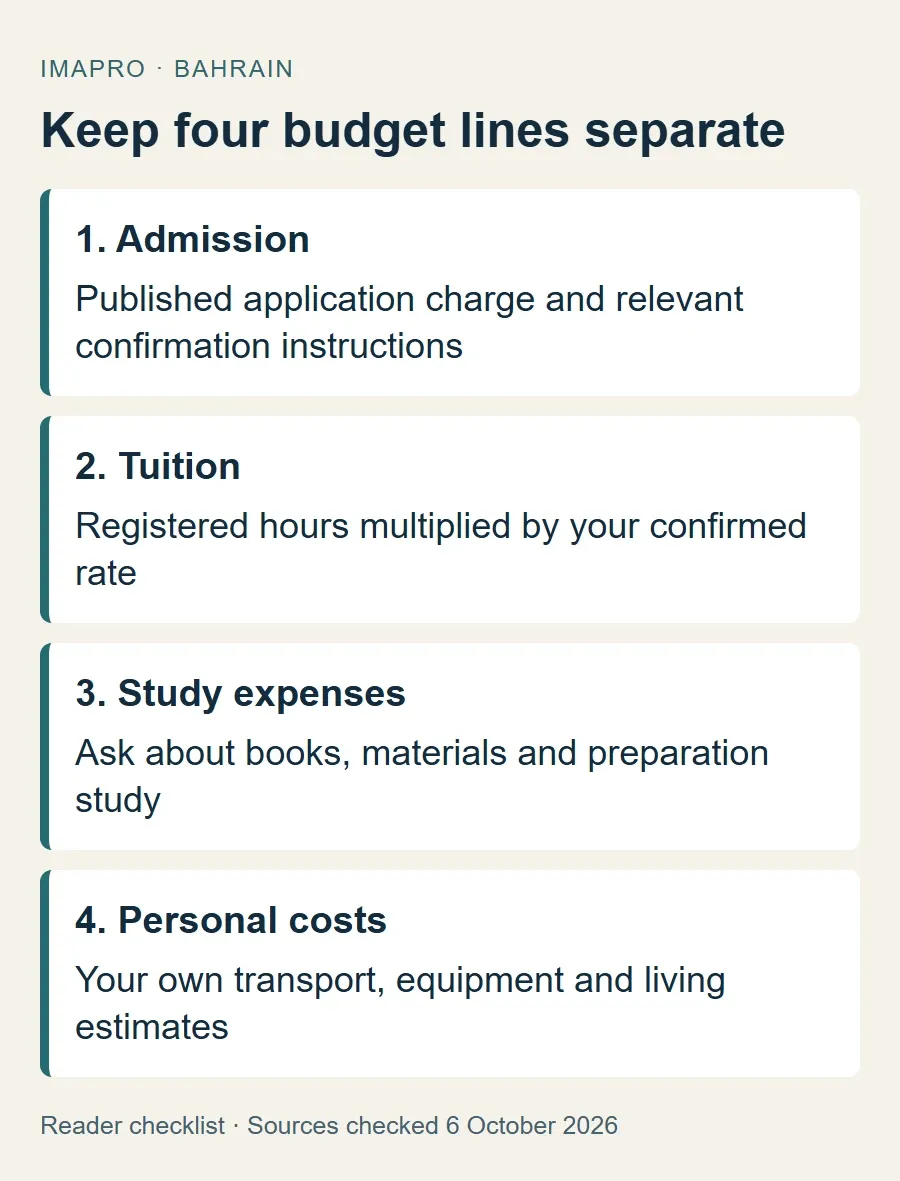
Use a worksheet with four groups: application and admission, registered tuition, confirmed recurring study expenses and conditional costs. For each item, record whether it is included in an existing invoice, charged separately or only payable if the event occurs. Ask about books, course materials and any preparation programme when requesting your own estimate rather than assuming those items are free or already included.
Personal costs need their own realistic budget. Calculate transport from your actual location, the computer or equipment you need and any change in work hours. These are not UOB tuition charges, so label them as your estimates. Keeping them separate lets you compare the university's invoice accurately while still understanding the money you need to study.
Ask about fee exemption through the university's official process
UOB describes a tuition-fee exemption service for students whose circumstances meet its conditions. The Exemptions and Part-Time Employment Division explains that it announces application periods, examines applications and publishes results. An application therefore needs an actual decision; it should not be entered in your budget as an approved waiver.
Check the current announcement for the relevant semester and ask which documents and deadlines apply. The general fee page describes an application period during the first semester, but that is not a substitute for the specific announcement. If an application is under review when a payment falls due, obtain instructions from the university rather than assuming the deadline has automatically moved.
For a sponsored student, obtain the sponsor's written coverage details as well. Ask whether it pays tuition only, whether repeated or additional courses are covered and what happens if the programme changes. The amount charged by UOB and the amount your sponsor agrees to pay are related but distinct records.
Check the bill against your admission and registration record
Before payment, compare the student number, programme, semester, category, registered hours and rate. Save the bill and the registration plan together. If a line differs from the official schedule or your confirmed classification, contact the university with the specific discrepancy and supporting documents rather than sending only a general question about expensive fees.
The undergraduate admissions page is the starting point for current application and confirmation instructions. Its displayed July 2026 application dates were already past on 6 October 2026. A fee schedule remaining online does not mean a new application window is open or that payment alone reserves a place.
For any course withdrawal or registration change, ask what happens to both the academic record and the payment. This guide does not assume a particular refund percentage or automatic credit because that requires the applicable policy and deadline. Keep written confirmation of the outcome and check that the student account reflects it.
Frequently asked questions
How much are UOB fees for non-Bahraini undergraduates?
The reviewed page lists BHD 80 per credit hour. Fifteen hours would therefore be BHD 1,200 in tuition before applicable additional charges. Confirm whether a supported family-status category or another classification applies to you.
Does every Bahraini student pay BHD 8 forever?
No. The published table links the supported rate to study duration and shows later BHD 40 and BHD 80 stages. Sponsored and second-period categories are also listed separately. Ask which row applies to your actual record.
Are summer and orientation counted in the published maximum?
The reviewed fee page says summer semesters and the orientation programme are excluded from that maximum. Ask UOB how it has calculated your counted semesters, particularly when your academic history is not straightforward.
Is a programme total the amount due immediately?
No. A total tuition illustration describes the programme's credit basis. Your current bill depends on your registered courses and applicable charges. Build a semester payment plan as well as a completion estimate.
Are postgraduate fees the same?
No. The schedule has separate postgraduate rows, including diploma, master's and doctoral categories. This guide's BHD 8 and BHD 80 examples explain undergraduate tuition and must not be reused as a postgraduate quotation.
Can I assume a fee exemption before receiving the result?
No. Apply through the announced process, keep the reference and check the decision. Ask the university how to handle any payment deadline while an application is pending.