Bahrain finance guides
Bahrain personal-loan calculator: instalments and total cost
By Gaurav Agarwal · Sources checked 6 October 2026
Enter the fixed annual nominal reducing rate, cash amount, term and costs from your written offer. The calculator estimates monthly instalments, usable cash and total cost, and compares another term. Leave the calculation until the rate basis and fees are known; APR is not a substitute for the nominal rate.

Estimate a monthly personal-loan instalment using the fixed annual nominal reducing rate and costs in your written offer. The calculator shows usable cash, total payments and total cost, and can compare another term. It does not accept an APR as a substitute for the nominal rate or decide whether you qualify.
Sources checked 6 October 2026. No bank rate, fee or loan amount is pre-filled.
1. Estimate the instalment and full cash cost
Use a fixed annual nominal reducing-balance rate from your written offer. An APR, flat rate or variable-rate offer cannot be used directly here. Enter zero only when a cost is confirmed as zero.
The calculator needs JavaScript. If this message remains, use the formula and written-offer checklist below.
Amounts are displayed to three decimal places. Intermediate calculations are unrounded; a bank’s rounding and payment dates may differ. The tool makes no network requests and does not save your entries.
2. Check the rate before using the calculator
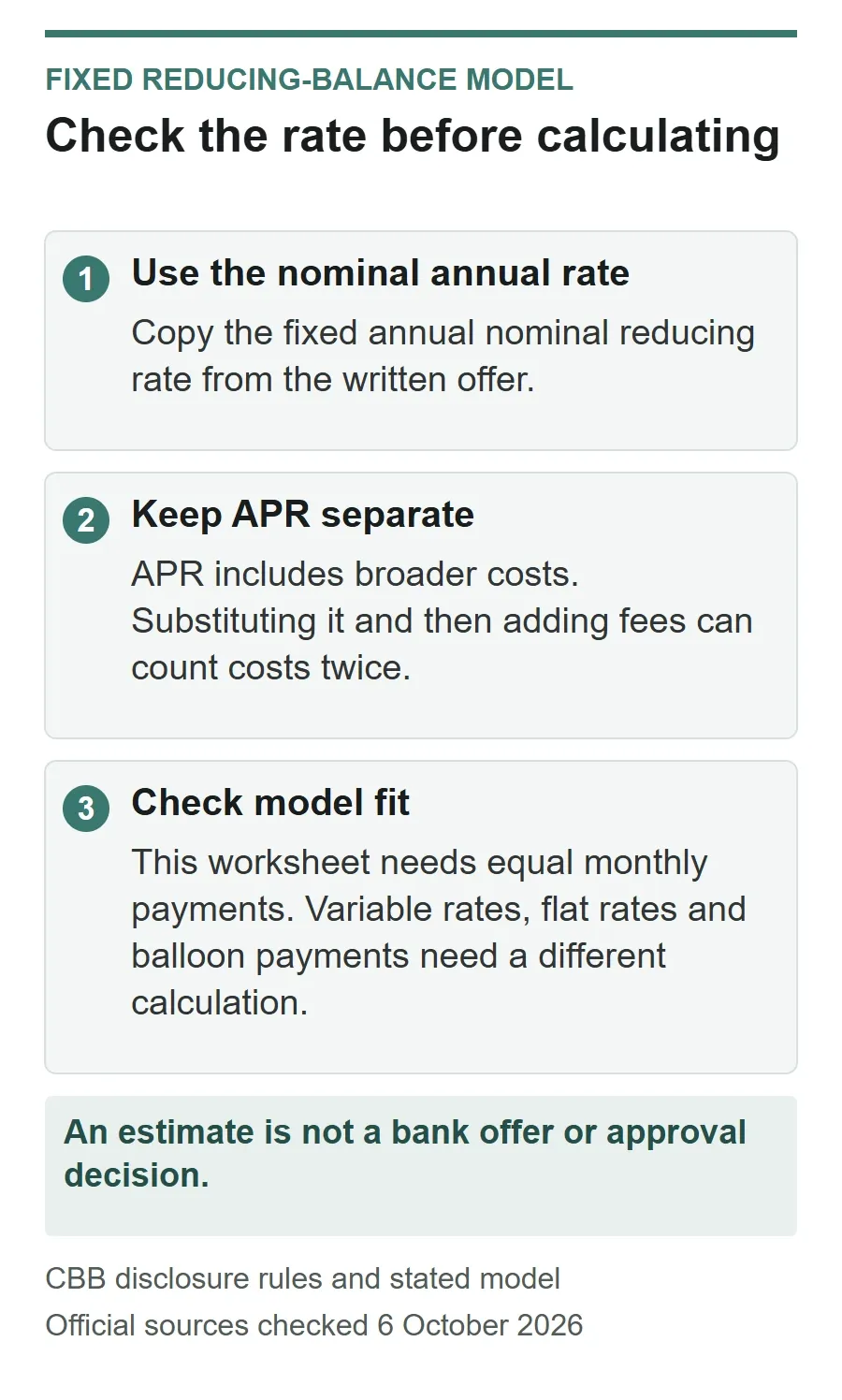
This personal-loan calculator uses a fixed annual nominal rate, divided into equal monthly periods, with interest charged on the reducing balance. It does not turn an advertised APR into a bank quotation. Ask for the nominal rate and the repayment schedule if your offer shows only an APR.
APR is a broader comparison measure. The CBB’s conventional retail-bank rules include administration charges and other mandatory costs in the APR, while excluding contingent costs. Putting that APR into an interest-only formula and then adding the same fees again can count costs twice. The rules require the bank’s key terms to disclose both APR and the nominal annual rate, with the calculation basis and an illustration. CBB BC-4.3.10, BC-4.3.11 and BC-4.3.22.
For example, BBK’s product page publishes an indicative APR of 4.92% for BHD 10,000 over seven years. That is an APR example with stated assumptions, not the nominal rate for this tool or a guaranteed rate for you. No rate is pre-filled here.
A flat-rate calculation uses the original principal throughout, whereas a reducing calculation uses the balance still unpaid. Fixed describes whether a rate changes; flat describes its calculation base. CBB rule BC-4.16.1 prohibits conventional retail banks from charging interest using a monthly flat rate and requires a reducing-balance basis. This tool therefore provides a reducing-balance estimate only. It does not calculate an Islamic sale contract’s profit or certify any contract structure. CBB BC-4.16.1.
3. Put each cost in one place
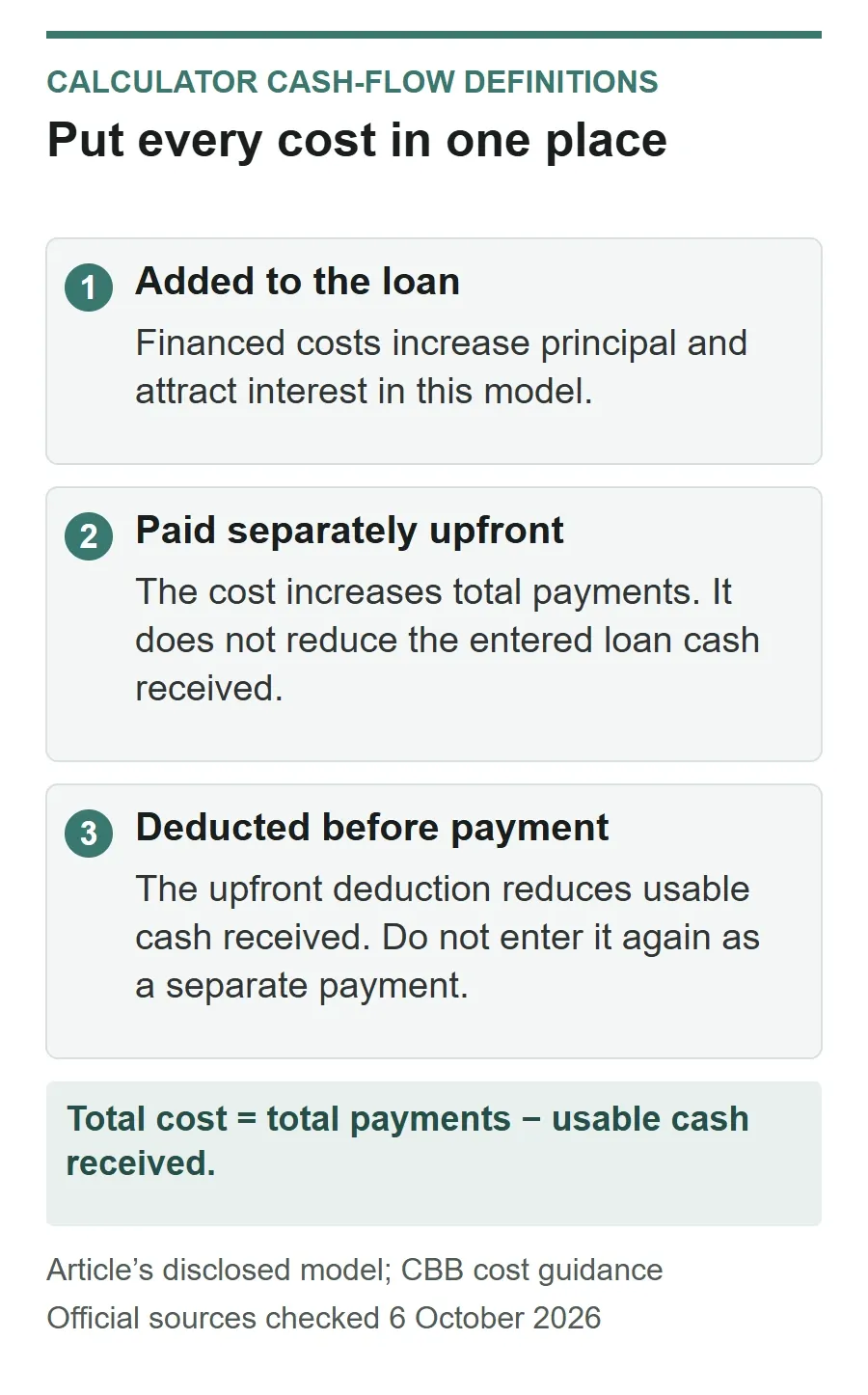
Separate the cash portion you borrow from the costs financed alongside it. If a fee or insurance premium is added to the balance and repaid through instalments, enter it under costs added to the loan. Do not include it again in upfront costs. The model charges interest on the total financed principal, so confirm that this matches your offer.
For a cost paid at the start, select whether it comes from your own cash or is deducted before disbursement. A separate payment increases total payments. A deduction reduces the usable cash received. Both increase the cost above the cash you receive, but the calculator records their cash flows differently.
- Financed principal: cash amount before deductions plus costs added to the loan.
- Cash received: cash amount before deductions, less an upfront deduction when selected.
- Total payments: all scheduled instalments plus upfront costs paid separately.
- Total cost above cash received: total payments less the usable cash received.
Use the actual VAT-inclusive cost where applicable; this tool does not decide which charges are taxable. It does not model recurring account fees, mixed upfront payment methods, missed-payment costs, early settlement or refunds. If your offer has those cash flows, compare the full bank schedule separately. A missing charge is not a confirmed zero.
4. Understand the formula and term comparison
For financed principal P, monthly rate r and payment count n, the equal monthly instalment is P × r ÷ [1 − (1 + r)−n]. The monthly rate is the annual nominal percentage divided by 1,200. At zero interest, the instalment is P ÷ n.
The estimate assumes one disbursement, a first payment one month later, the same rate throughout, equal monthly periods and no balloon payment. It keeps full precision in the calculation and rounds the displayed BHD amounts to three decimal places. A lender may use daily accrual, calendar dates, a different first period and a final rounding adjustment; those differences can change the actual schedule.
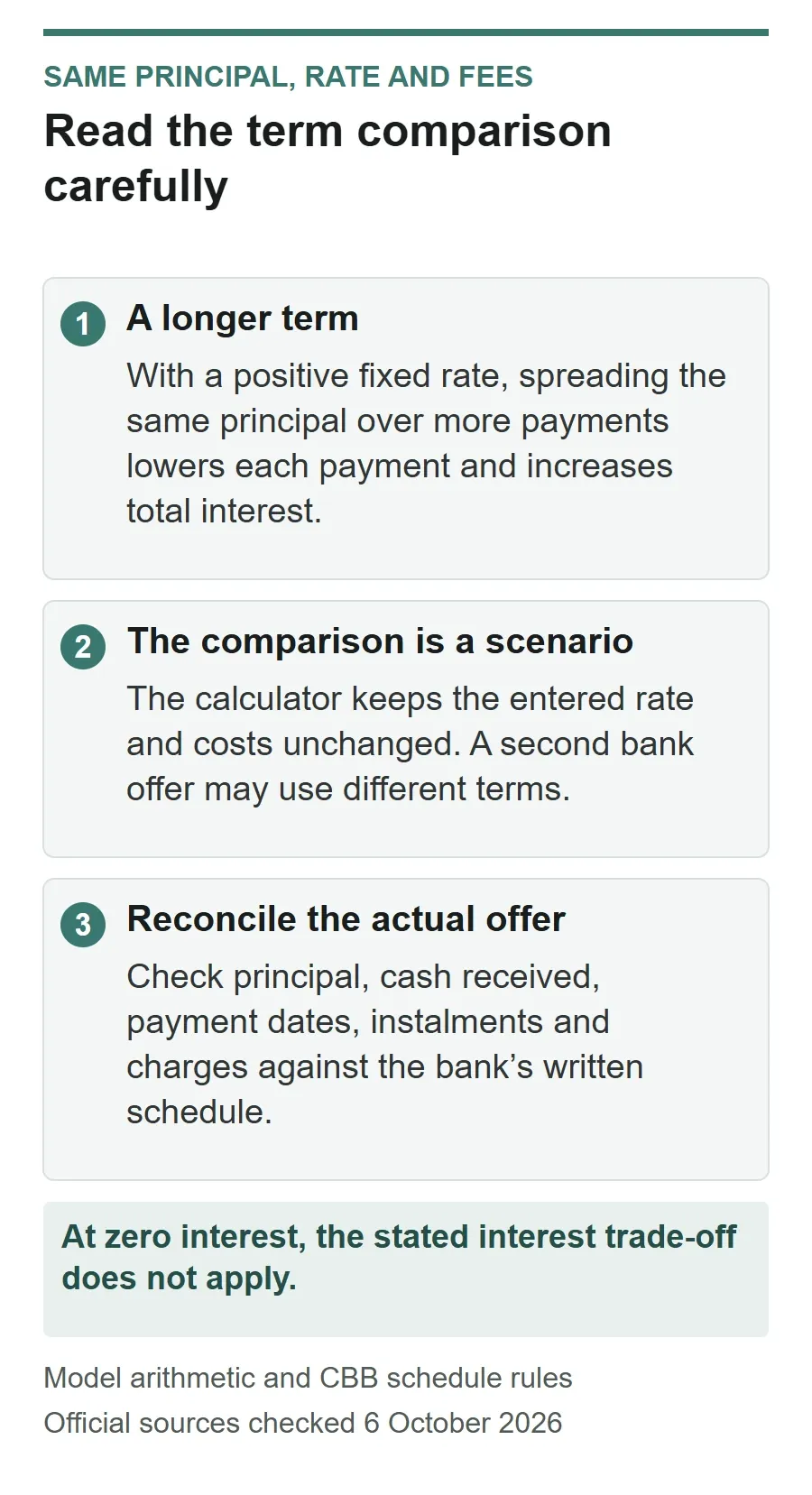
The optional comparison term holds the entered rate and fees constant. With a positive rate, stretching the same financed principal across more payments reduces each payment but increases total interest. Use the comparison to understand that trade-off. Then ask the bank for a written offer for each term, because its actual rate, insurance or other charges may change.
The tool’s permitted input range is a technical calculation boundary, not a statement of loan eligibility or the maximum term a bank may offer.
5. Reconcile the result with the written offer
Match the calculator’s financed principal and cash received to the bank’s disbursement statement first. Next check the number of instalments, the first payment date, the nominal rate and any separate charges. If those agree but the monthly amount differs, ask about day-count rules, rounding and payment timing before assuming either figure is correct.
Conventional retail-bank rule BC-4.3.24 requires a schedule showing monthly principal, interest and other charges over the life of the facility at signing. That schedule is the useful reconciliation document. Keep it with the dated key terms and the bank’s APR. CBB BC-4.3.24.
Standard Chartered Bahrain’s own calculator disclaimer also describes its output as illustrative and says other charges may apply. An independent model should be treated with the same care. For lender-specific published terms and a written-offer worksheet, use our Bahrain personal-loan guide.
6. Keep approval and contract questions separate
A calculated payment does not establish whether a bank will lend, whether the borrowing is manageable for your household, or whether an employer or residency category is accepted. This tool intentionally asks for no salary, CPR, employer details or account information.
Do not use a fixed-rate estimate as a prediction of future payments on a variable-rate loan. It also does not price an overdraft, revolving card balance, payment holiday, top-up that repays another debt, or early-settlement quote. Obtain the relevant dated schedule and charges for those arrangements.
General information: This is a mathematical illustration from the figures you enter, not personal financial advice, a lender offer, a calculated regulatory APR or an approval decision. Sources checked 6 October 2026.